ProfileSCAPE: Belowground microbial landscapes at the profile scale (TERRA Cluster of Excellence)

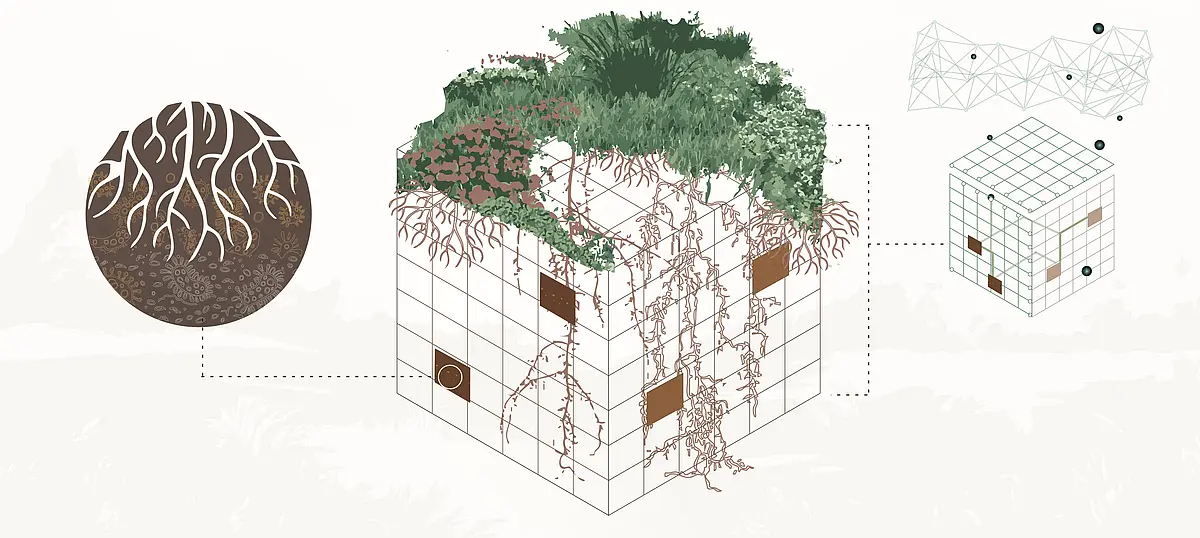
We aim to develop a workflow for multi-parameter analysis of individual sub-gram soil samples, combining µCT imaging, soil chemistry, mineralogy, root identification, and microbial sequencing. We will integrate these measurements to map the soil as a 3D microbial landscape and investigate how soil structure, roots, hydrology, geochemistry, and mineralogy shape microbial community assembly through environmental filtering and dispersal limitation at fine spatial scales.

Project page: https://uni-tuebingen.de/forschung/forschungsschwerpunkte/exzellenzcluster-terra/terra/


TERRA GAP Project: Greenhouse Gas Emissions from Alpine Peatlands

The GAP project is one of the five focus units (FUNs) of the TERRA Cluster of Excellence.

We investigate the spatial and temporal heterogeneity of methane and CO2 emissions from alpine peatlands. In an interdisciplenary approach we combine geochemistry, microbiology, plant science, and hydrology to improve our understanding of this fascinating ecosystem and its implications for the global carbon cycle.

We will use a mix of fieldwork in the Austrian Alps in Vorarlberg, lab experiments based in Tübingen and modelling.
The devil in the details: Phage microhabitats as drivers of soil biogeochemistry (Emmy Noether grant from the DFG)

Although phages are abundant in soil, to date they have been neglected in soil biogeochemistry. In this Emmy Noether research group we will for the first time study how abiotic soil microhabitats govern phage infection and thus bacterial death and quantify the effects on plant nutrient and CO2 release as well as the stabilization of microbial residues. We will go beyond phenomenological descriptions to reveal the mechanisms of these processes, including direct dispersal limitations (e.g. phage sorption to mineral surfaces) and indirect effects (shaping traits of the phage community, with potential feedback to dispersal). The project will couple isotopic tracing techniques with phage isolation and culture-independent molecular methods to comprehensively characterize the interactions between the soil habitat, its bacterial inhabitants, and their viruses.

MetaRhizoPhage: Elucidation of bacteriophage dynamics in soil and rhizosphere plant-phage interactions (Stemmler-Stiftung)

Only in recent years have metagenomic methods enabled characterization of soil phage communities. However, more than their presence in the soil, it is the rate of phage turnover (new phage production through infection) that is related to their ecological function. These dynamics are almost entirely unknown. By combining recent advances in diffusive isotopic labelling with metagenomic sequencing through 18O and 13C DNA stable isotope probing, this project will for the first time open a view on phage dynamics in undisturbed soil. We will measure phage turnover in natural soil and determine whether plant roots accelerate this, which could enhance plant nutrient availability. Further, the project will reveal the dynamics of phage populations along growing roots and how they respond to root carbon inputs under current and future concentrations of atmospheric CO2. These results will show how viruses contribute to plant-soil interactions and provide new insight into ecological mechanisms of plant nutrition under global change.

EcoEnergetics II: Economic and bioenergetic implications of microbial cooperation in soil systems (DFG grant under SPP 2302 SoilSystems phase 2)

This project examines microbial cooperation, competition and cheating in soils, to reveal the implications for carbon and energy use efficiency.

This is a collaboration with the Geosphere-Biosphere Interactions group.

Project page: https://soilsystems.net/projects-partners/2-p9-ecoenergetics-ii/

SoilProS: Soil biodiversity analysis for sustainable production systems

Participating in this large project to map soil biodiversity, soil chemical, and soil physical characteristics with respect to current and desired soil functions in agricultural fields across the Netherlands.

Project page: https://soilpros.nioo.knaw.nl/en