German
Folk Dance and Songs (08-01-04)
One
can never say that one has truly experienced another country’s
culture or history unless one has taken part in the traditional
dances. South Africans are known for their spirit and life and
that was not lost, although being far away from home, as we eagerly
learnt the German folk dances.
We
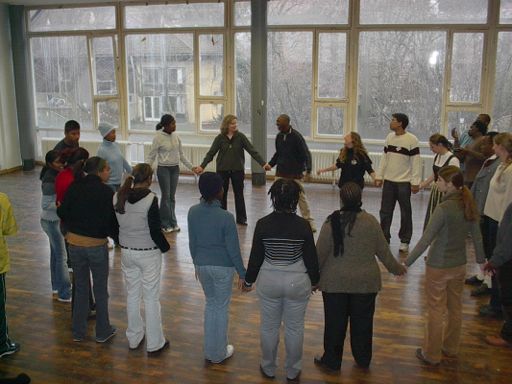
were slowly introduced to the German folk dances, beginning with
the easy ‘Fröhliches Kreis’ and then progressing
to the derivatives of the ‘Polka’, and finally to
the ‘Walzer’ and ‘Jägermarsch’.
Initially
it was not easy, but as true South Africans we quickly learnt
to adapt and soon we were dancing like true Baden-Württemberg
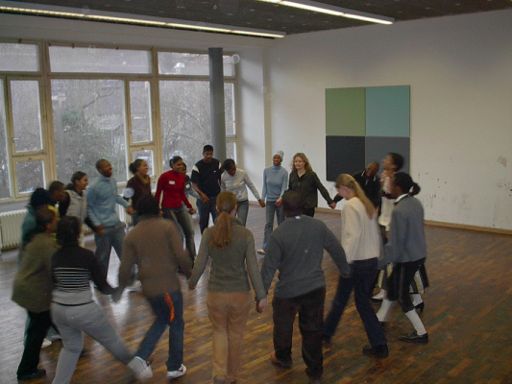
locals, despite the fact that our circles were not always quite
so circular, and steps not so smooth and elegant.
The
traditional position of the man leading had to be forgone, as
the girls took the lead in order to save our feet. And because
the boys were also out-numbered, some of the girls had to declare
manlihood and polka with one another, and very proudly indeed.
But
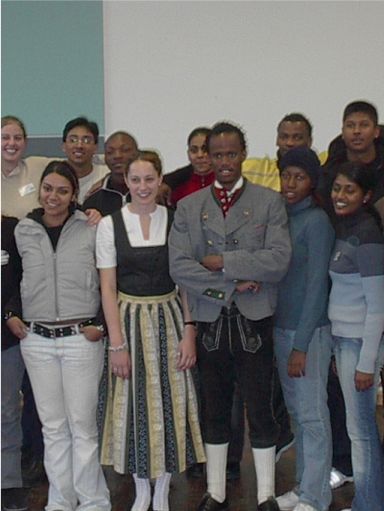
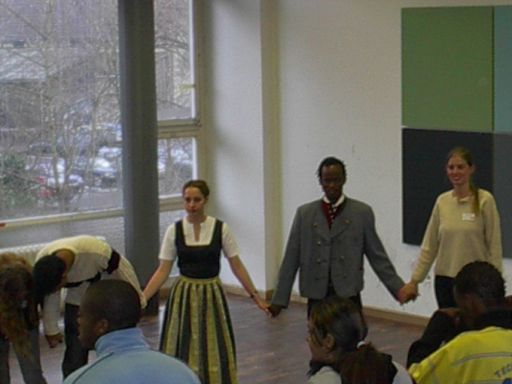
nothing was enjoyed as much when Kgosi and I had to dress up in
the traditional German dress; Kgosi in Lederhose and jacket, and
I in white knitted socks, white frills, apron and plaited hair.
This
German folk dance seminar did not lack the true South African
enthusiasm to enjoy every moment of our German experience as we
danced into each other, took two steps instead of three, and stood
on each others toes. Thank you to Elisabeth and all those concerned
for making this experience possible.
(Report
by Inge-Lisa Rohlwink, University of Cape Town)