It
was, probably the coldest day to-date that we have experienced
in Germany as we went about to yet another excursion. This time
around, we were heading for the Würth factory tour as well
as a visit to the historical town of Schwäbisch Hall. I guess
we all thought it was going to be boring, being taught about how
screws are made in such a cold weather. I think we will look back
and say this was an experience comparable to that of the visit
to Daimler-Chrysler. I leave it up to you to judge.
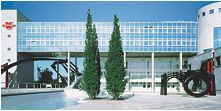
.
The major
challenge for most people on the day was to show up at the WHO
bus station @7h15 am of which I believe everyone negotiated that
with easy with me and Prof T.C. Selala leading by example. The
journey to Würth was long and almost everyone was asleep.
I was even surprised to see Themba sitting down for the first
time. I thought that was inspiring. On arrival to Würth Company
we were introduced to Dr Ute Roth who gave us a presentation about
the status of this big company. We gathered that the company annual
generates a turnover of about 6.89 billion euros a year and has
about 351 Würth line and allied companies operating in 81
countries. The core business of the Würth group is the worldwide
sale of more than 100000 different articles which includes fixing
and assembly materials, screws, screw accessories, dowels and
plugs and other small articles to a customer population of about
2.8 million. We had a privilege of having a company walk-through
after the presentation to observe the production processes. This
company receives various articles or items from various supplies,
most of which belong to the Würth group. Its task therefore
is to distribute these articles to various customers. This is
achieved through a number of logistical process steps which includes,
picking step, sorting step and despatching. In the picking step
the articles from supplies are picked from storage aisles by both
electronic and manual means. At this stage the articles placed
in yellow bins manually are sent to the sorting step where they
are distributed to various packaging positioned by means of barcode
detection methods. The packing is done manually and I must say
it demands a lot of concentration. The articles packed in cardboard
boxes are sent to the despatch department where they are sealed
and prepared for despatch to various customers. It is also interesting
to mention that the Würth group is over 60 years old.
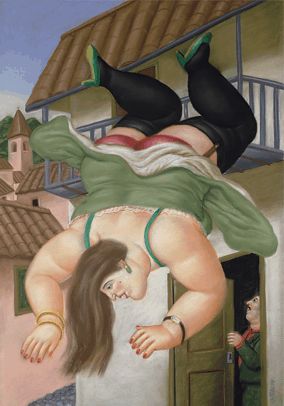
After
a wonderful visit to the Würth Company, we went to the small
town of Schwäbisch Hall located in the valley of the river
Kocher in the north-eastern part Baden-Wurttemberg with a population
of about 36000 people. In this town lies the Kunsthalle Würth
art gallery, which is the result of cultural commitment of the
Würth Group boss Reinhold Würth. We were led to believe
has been collecting art for over forty years. This art gallery
exhibits modern art and contemporary art. We were also privileged
to see artwork by Fernando Botero. Botero was an artist born in
1932 in Meddelin, Columbia. His artwork reflects his personal
experience with the real world. Criticised for not conforming
to rules of modern art, this paradigm pioneer in the making has
established his own style of art which I believe only he can master.
His way of unpacking the harsh realities of life in a harmonic
and harmless way is difficult to describe. However with the US-Iraq
war pictures, he felt it was proper to expose the truth in a way
closest to reality.
We also managed to squeeze enough time to explore various shops
in the town. I could also sense that most items in the shops were
reasonable cheap judging by how impressed Themba was about the
prices. That was a surprise as well.