"Staatsgalerie"
visit 2008
On
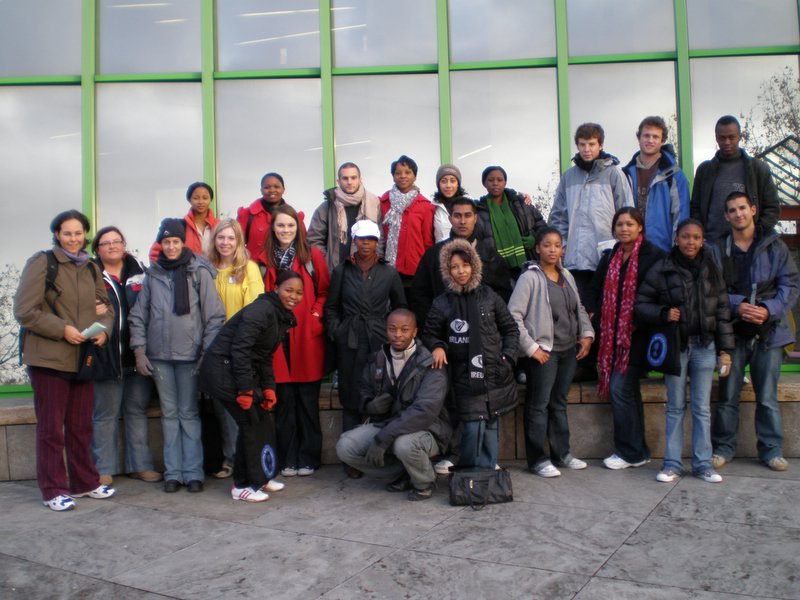
Wednesday 9 January we, the participants of the 2008 Tübingen-South
Africa program, visited the Stuttgart Staatsgalerie accompanied
by our group leader, Lidia du Plessis, and our knowledgeable guide,
Marion Schmidt. The old Staatsgalerie was rebuilt after the Second
World War, and was joined in 1984 by the new Staatsgalerie, designed
by the British architect, James Stirling. At first glance, Stirling’s
striking post-modern building, with its curved green-framed windows,
and pink and blue balustrades, seem to clash horribly with the
surrounding architecture, but on closer inspection (and explanation
by Marion) we soon noticed that the building was not only designed
to fit in with the surrounding architecture, but also functions
as a link between upper and lower Stuttgart, as well as between
itself and its neighbour, the old Staatsgalerie. The building
is therefore (like post-modern art) a playful mixture of old and
new, reflecting the era in which it was designed.
The impressive architecture of the new Staatsgalerie sets the
tone for what one is to find inside. We travelled to Stuttgart
to look at some of the modern and post-modern art the gallery
houses, but seeing as the old Staatsgalerie next door was closed
for restoration, we were lucky enough to see some art by the ‘old
masters’ side by side with the newer pieces. This provided
for an interesting contrast between very different styles and
periods, and of particular interest were pieces by the great impressionist
Monet, the father of Cubism, Picasso, and the great Pop artist,
Andy Warhol.
A few hours prior to our visit to the gallery we were split into
pairs, each pair being assigned a different piece of art that
was on display in the gallery. We had to prepare an analysis of
the piece, and on seeing it in the gallery, present our analysis
to the rest of the group. After initially struggling to keep our
distance from the paintings, so as not to damage them, insightful
interpretations of the chosen pieces were given.
For some this was a first time visit to an art gallery, especially
one housing modern art, and as a result, some pre-conceived notions
of what ‘art’ is, had to be set aside in order to
appreciate and enjoy what the gallery had to offer. As with all
things, modern art does not always fall within everybody’s
taste, and this was also true for our group. Despite this everyone
was able to learn more about modern art and the movements within
it, and perhaps come to a greater appreciation of it.
For those members of the group, myself included, who love art
and are familiar with modern art, this trip was a truly amazing
experience. It is one thing to see a piece of art in a book, but
it is a completely different experience to stand in front of an
original work. If it is a painting one is looking at, you get
to see the brush strokes of the artist, the colours and textures
of the paints, and in a way become a part of the painting. This
is particularly true in the case of modern art, as one is often
confronted with something abstract and challenging, and your interpretation
of the work, and your relationship to it, can be greatly influenced
by the environment you are viewing the art in. Not only was the
gallery itself visually stunning, but the art, some quirky, some
traditional, allowed us to open our minds and experience what
it is to think outside the box. All in all I think it was an amazing
and insightful experience.
by
Lizelle Franken
Last
Update (15/01/08)