Ethnologie

Kolloquium des Wintersemesters 2025/2026

Details

Wintersemester 2025/26

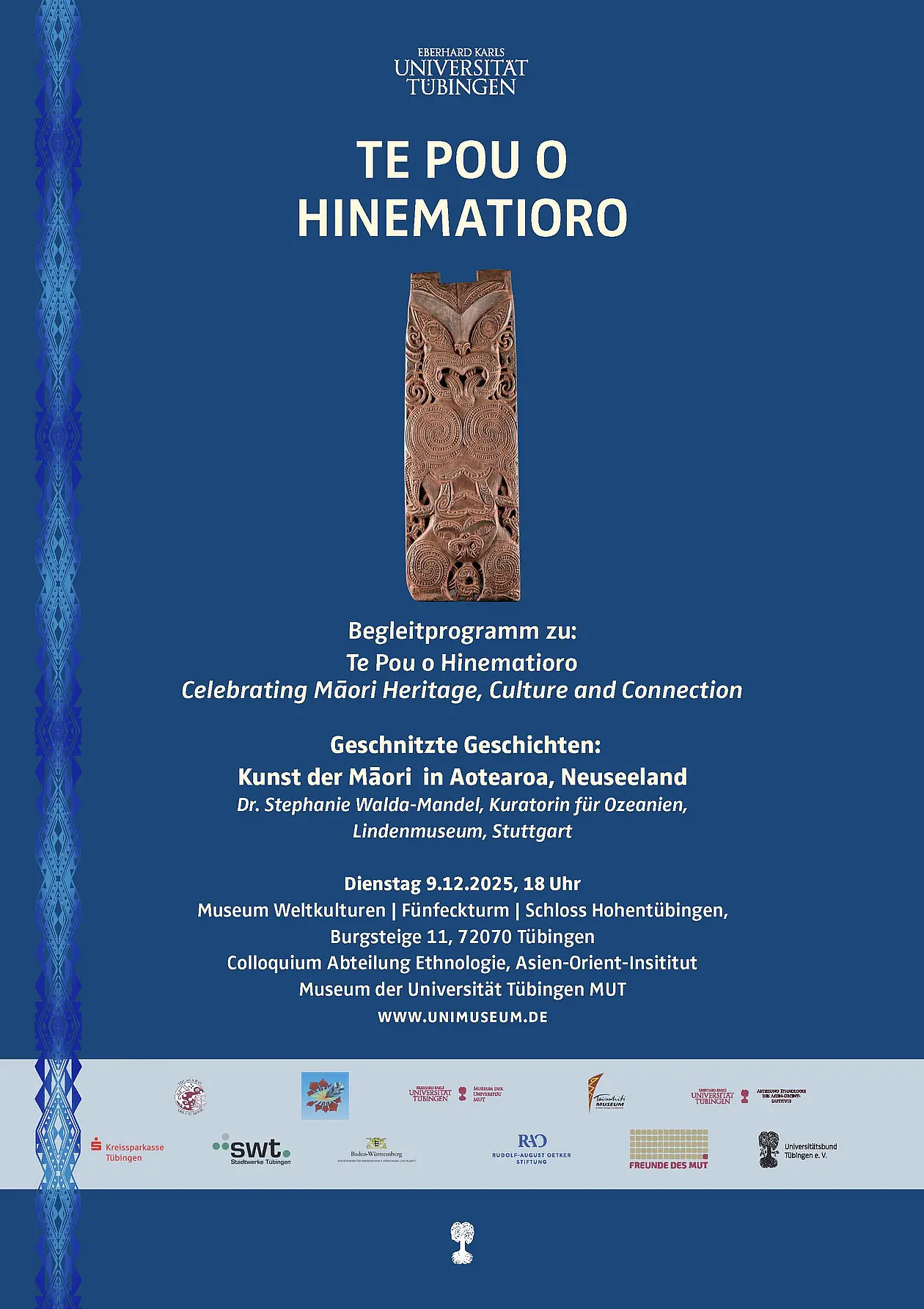
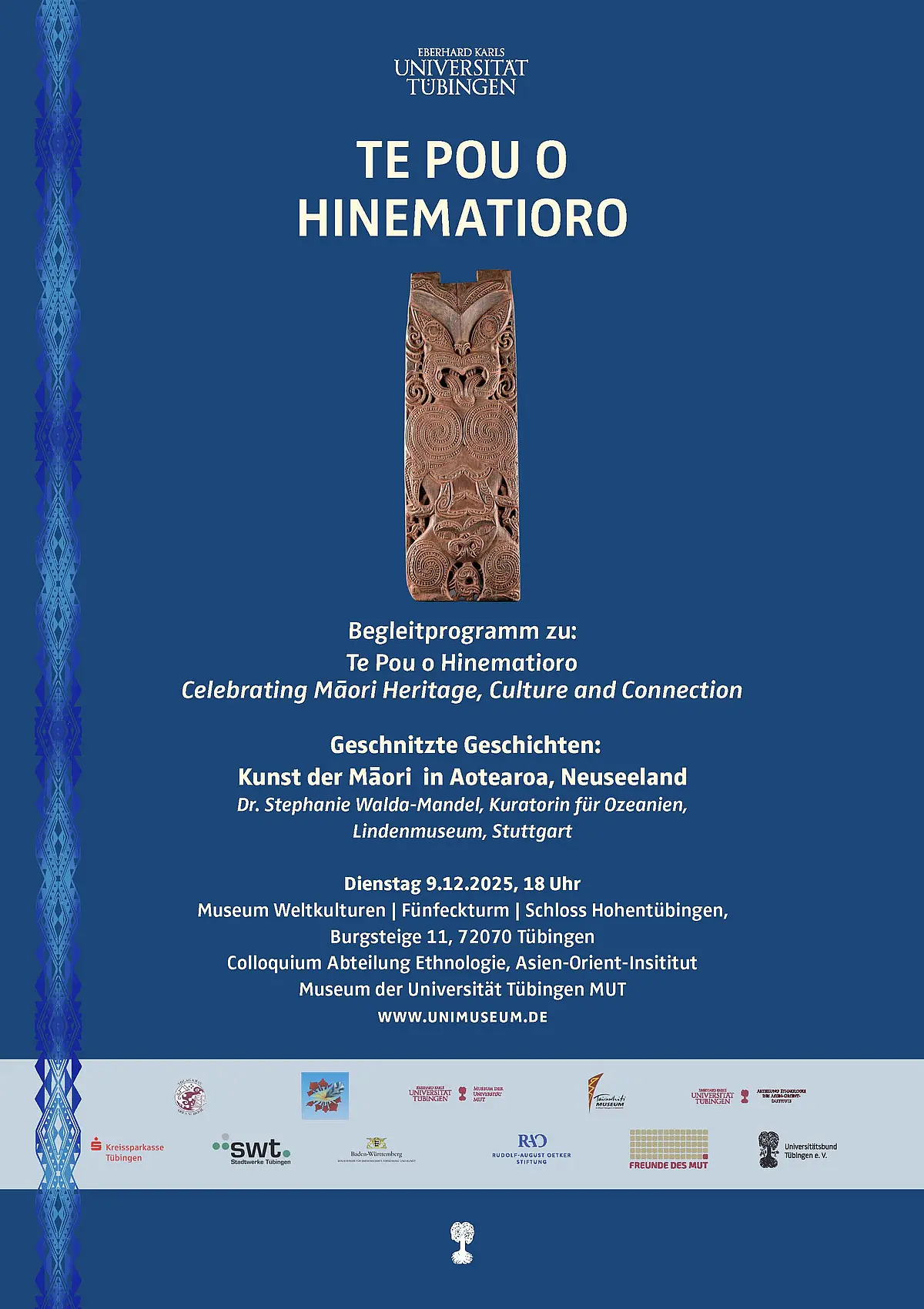
09.12.2025: Geschnitzte Geschichten: Kunst der Māori in Aotearoa Neuseeland Dr. Stephanie Walda-Mandel

Geschnitzte Geschichten: Kunst der Māori in Aotearoa Neuseeland

Die Kunst der Māori ist eng mit ihrer kulturellen Identität, Geschichte und Spiritualität verwoben. Dieser Vortrag bietet einen Einblick in die traditionellen künstlerischen Praktiken, die zu den Taonga („Schätzen“) führten, und zeigt, wie heutige Māori-Künstler:innen diese traditionellen Elemente mit zeitgenössischen Ausdrucksformen verbinden, um auf aktuelle gesellschaftliche Fragen zu reagieren.

Donnerstag 09.12.2025 18-20 Uhr

Schloss Hohentübingen, Museum Weltkulturen, Fünfeckturm

Dr. Stephanie Walda-Mandel - Kuratorin im Linden-Museum Stuttgart


Die Vortragsreihe wird zusammen mit dem Museum der Universität Tübingen (MUT) und als Begleitprogramm zur Ausstellung Te Pou o Hinematioro – Celebrating Māori Heritage, Culture and Connection  (hier auch weitere Informationen zur Eröffnung am 24.10) organisiert.


Archiv

Sommersemester 2025

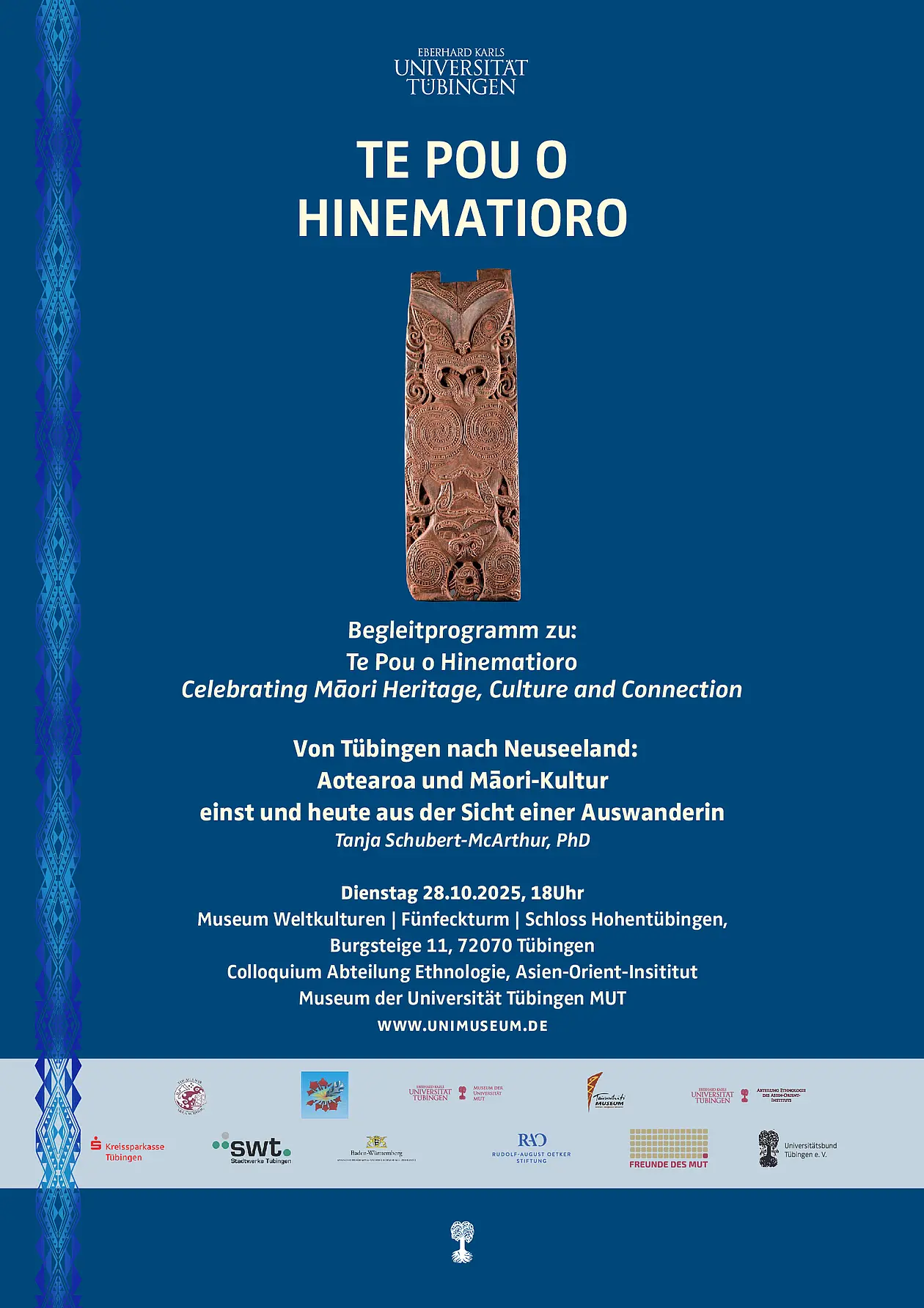
28.10.2025: "Von Tübingen nach Neuseeland: Aotearoa und Māori-Kultur einst und heute aus Sicht einer Auswanderin" von Tanja Schubert-McArthur

Von Tübingen nach Neuseeland: Aotearoa und Māori-Kultur einst und heute aus Sicht einer Auswanderin, Tanja Schubert-McArthur

Neuseeland war einer der letzten Zipfel der Welt, der von Europäern ‚entdeckt‘ und von den Briten kolonialisiert wurden. Māori, die seit Jahrhunderten in Neuseeland lebten, hatten jedoch mit ihrer Unabhängigkeitserklärung (1835) und dem Vertrag von Waitangi (1840) eine bessere Ausgangsposition als indigene Völker in anderen Ländern. In diesem Vortrag wird Tanja Schubert-McArthur näher auf die Geschichte Neuseelands eingehen, und die Entwicklungen im Bereich der Museumspraxis, Bildung, Kultur und Politik der letzten Jahrzehnte kommentieren. Als Auswanderin und Mutter zweier Kinder beobachtet sie die Veränderungen im öffentlichen Dienst, in der Schule und im Alltag, und versucht als ‚Kulturvermittlerin‘ zu einem besser informierten Aotearoa Neuseeland beizutragen. Gerade Museumausstellungen und Führungen können eine ‚contact zone‘ darstellen, in dem Menschen unterschiedlicher Herkunft – z.B. Māori und Pākehā (Neuseeländer europäischer Herkunft) und Einwanderer miteinander in Kontakt kommen und voreinander lernen. Erleben sie einen Vortrag der sie ins Land der großen weißen Wolke entführt, aber mit manchem touristischen Klischee aufräumt. Warum machten Mitglieder der Māori-Partei einen Haka im Parliament? Und warum war die Reaktion nicht so begeistert wie beim Rugby Team All Blacks?


Dienstag, 28.Oktober 2025

Weltkulturen Museum, Schloss Hohentübingen

Tanja Schubert-McArthur (PhD) wuchs in Grossbottwar (Baden-Württemberg) auf, und studierte in Tübingen Empirische Kulturwissenschaft, Rhetorik und Neuere Deutsche Literatur auf Magister. 2003 ging sie fuer ein Auslandsjahr an die Victoria University of New Zealand, verliebte sich in das Land und einen Neuseeländer, mit dem sie 2006 nach Wellington auswanderte. Tanja hat für ihre Doktorarbeit über Bikulturalismus im Te Papa Museum geforscht. Sie ist die Autorin zweier Bücher Mit Sack und Pack nach Neuseeland: Zum Gepäck deutscher Auswanderer heute (Mana 2007) undBiculturalism at New Zealand’s National Museum: An Ethnography of Te Papa (Routledge 2019). Ihre Karriere in Museen und Bibliotheken, sowie dem Waitangi Tribunal hat ihr tiefe Einblicke in die Māorikultur gegeben. Seit sechs Jahren arbeitet sie als Museumspädagogin in der National Library of New Zealand. Tanja lebt mit ihrem Mann Ryan und ihren Kindern Max und Soča in Featherton, in der Wairarapa Region.

Wintersemester 2024/2025

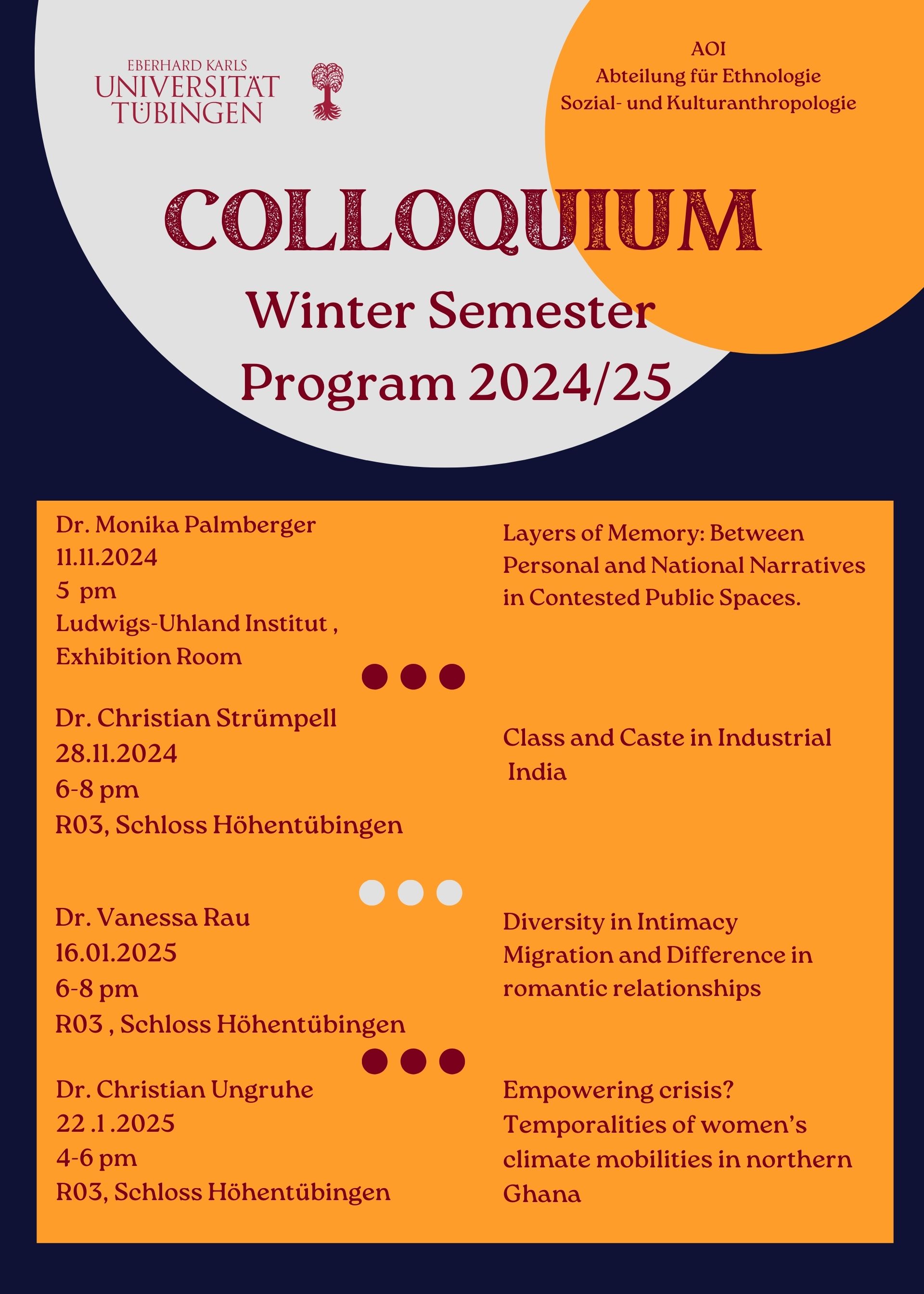
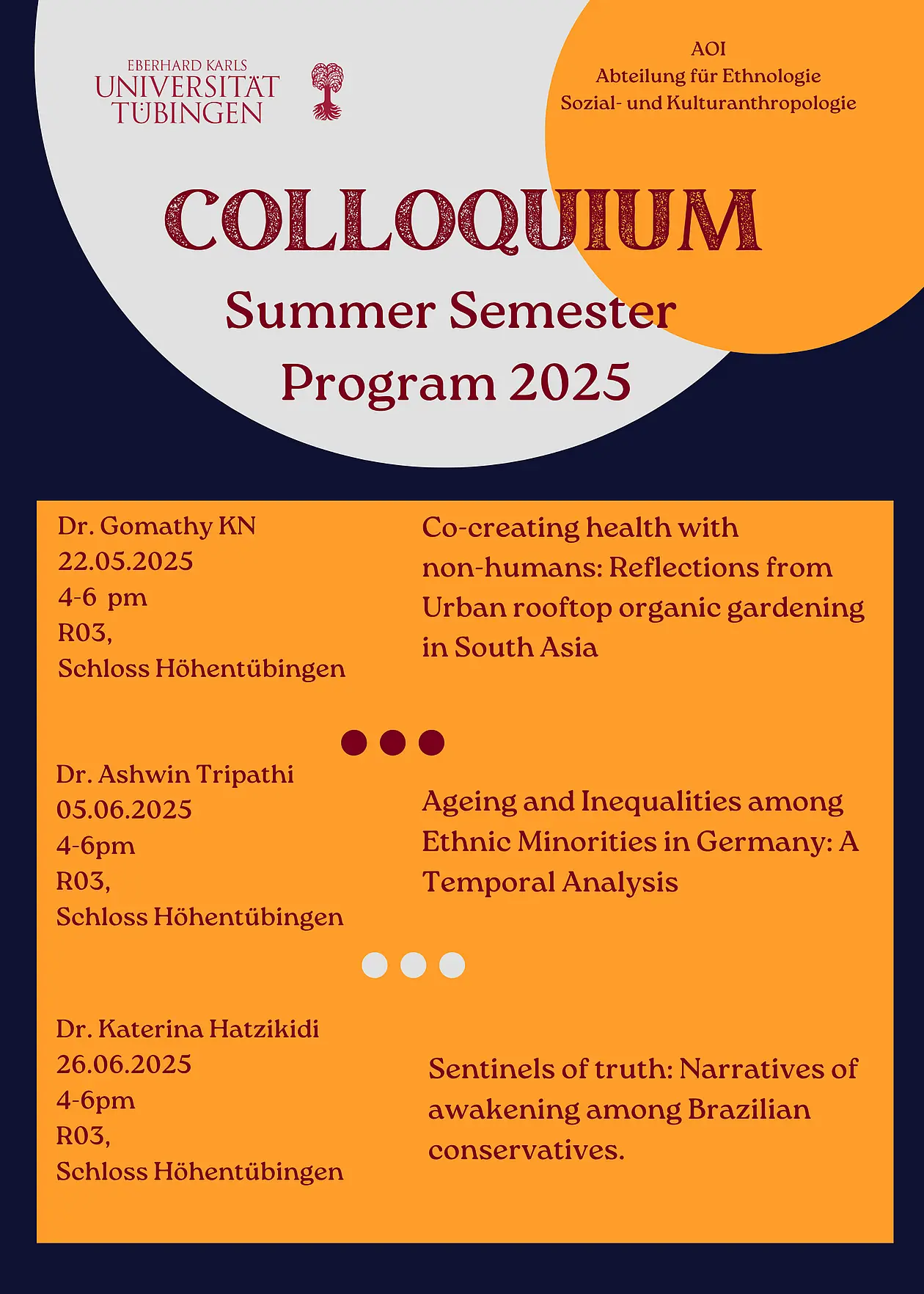
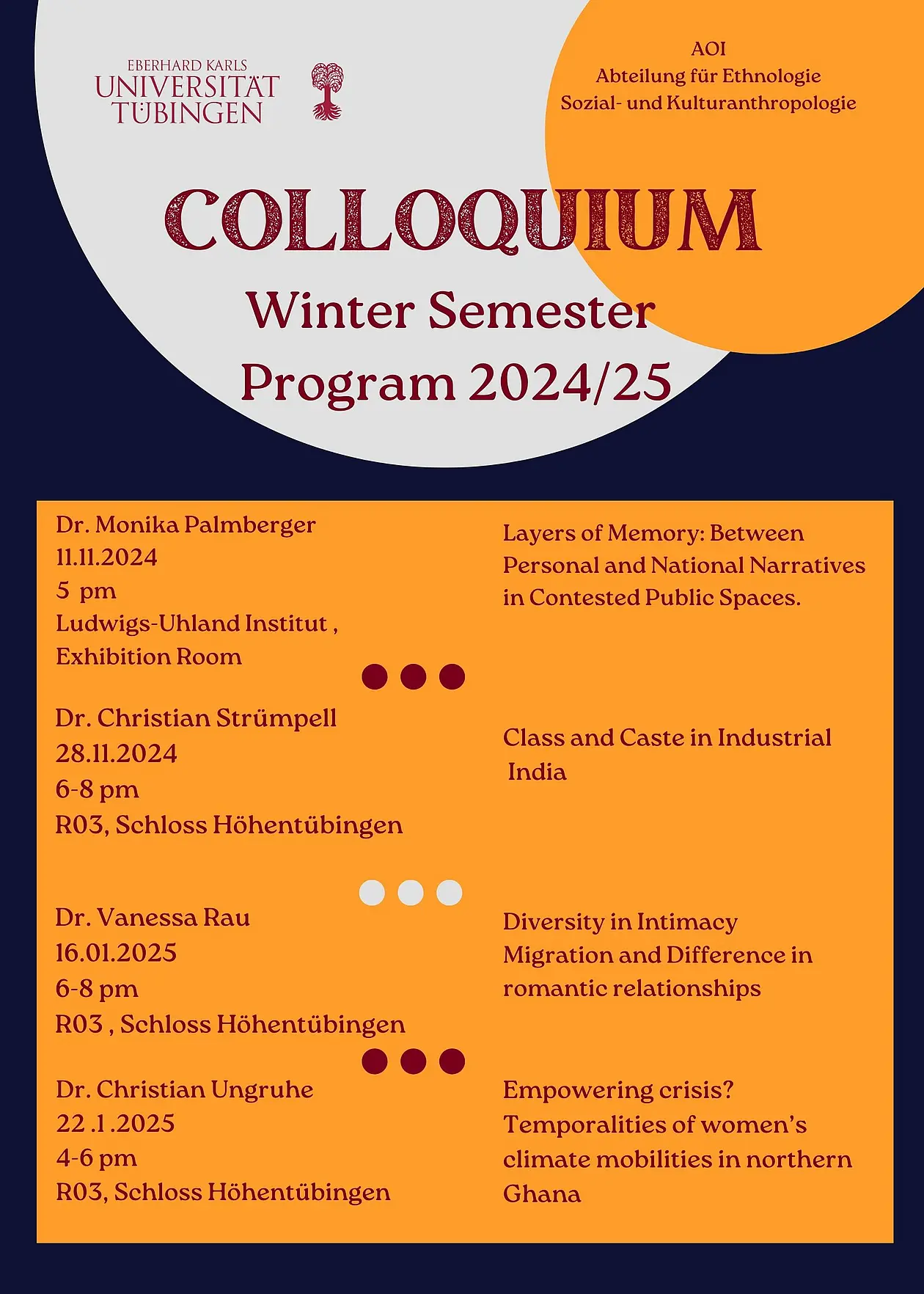
11.11.2024: Layers of Memory: Between Personal and National Narratives in Contested Public Spaces - Dr. Monika Palmberger

Layers of Memory: Between Personal and National Narratives in Contested Public Spaces - Dr. Monika Palmberger

This lecture examines the complex processes of remembering, placemaking and silencing in the city of Mostar Bosnia and Herzegovina. In the aftermath of the 1992-1995 war, Mostar’s urban landscape has become an arena for competing national narratives, each seeking to impose its version of history through monuments, memorials, and public symbols. These official representations obscure alternative histories and interpretations, including the memories of individuals whose lived experiences do not align with the dominant public national discourses. The lecture critically examines how individuals of different "generational positioning" navigate and position themselves within this newly prescribed memorial landscape, where personal memories and dominant national narratives do not always coincide. It explores the tension between public and personal, often marginalized, memories, highlighting the non-linear and sometimes ambivalent ways in which people engage with the past.


Montag, 11.11.2024 17:00 Uhr s.t.         

Ludwig-Uhland-Institut für Empirische Kulturwissenschaft, Ausstellungsraum

Dr. Monika Palmberger - Visiting Professor at the Department of Gender Studies, Central European University (CEU) and Senior Research Fellow at the Department of Social and Cultural Anthropology, University of Vienna

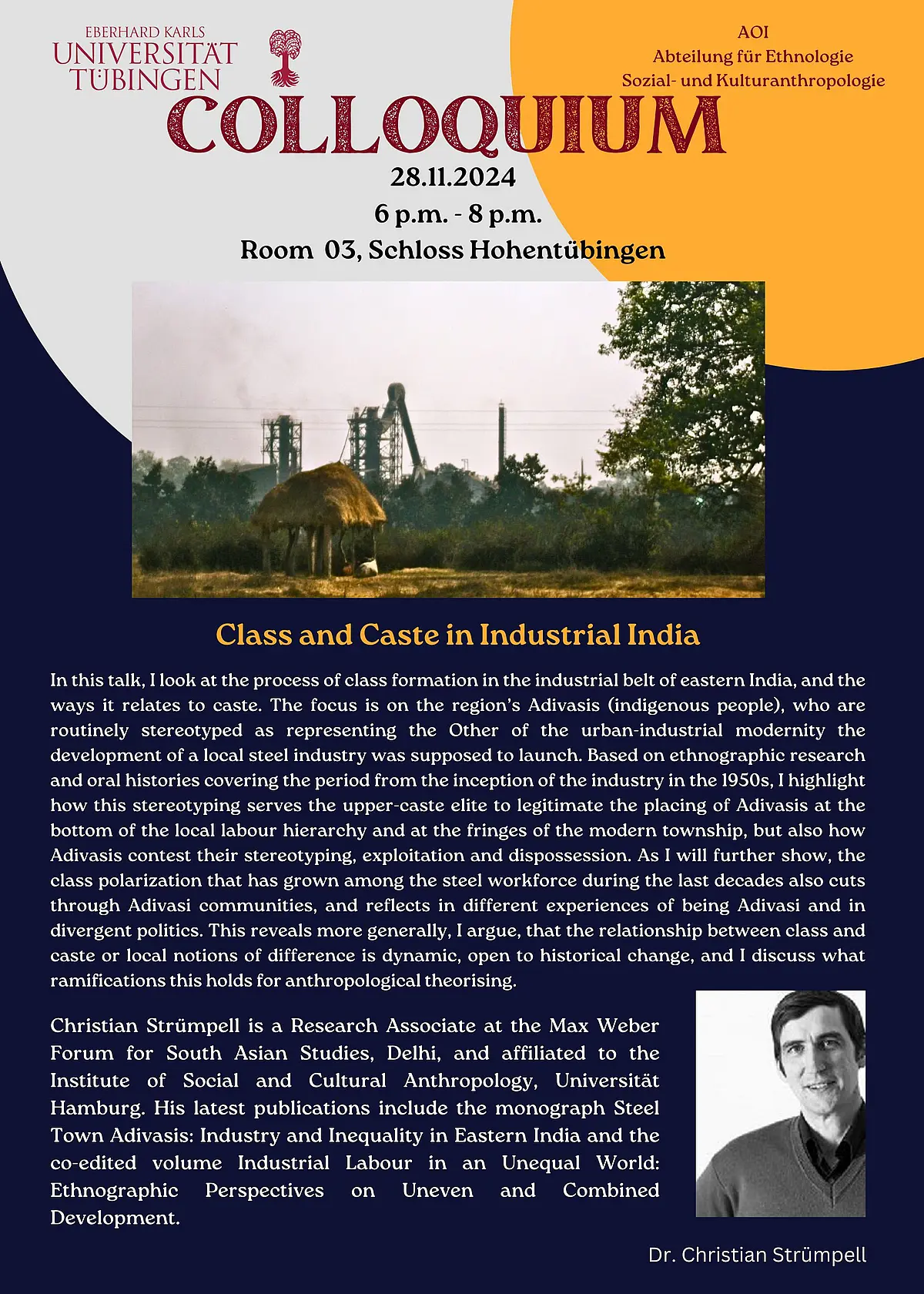
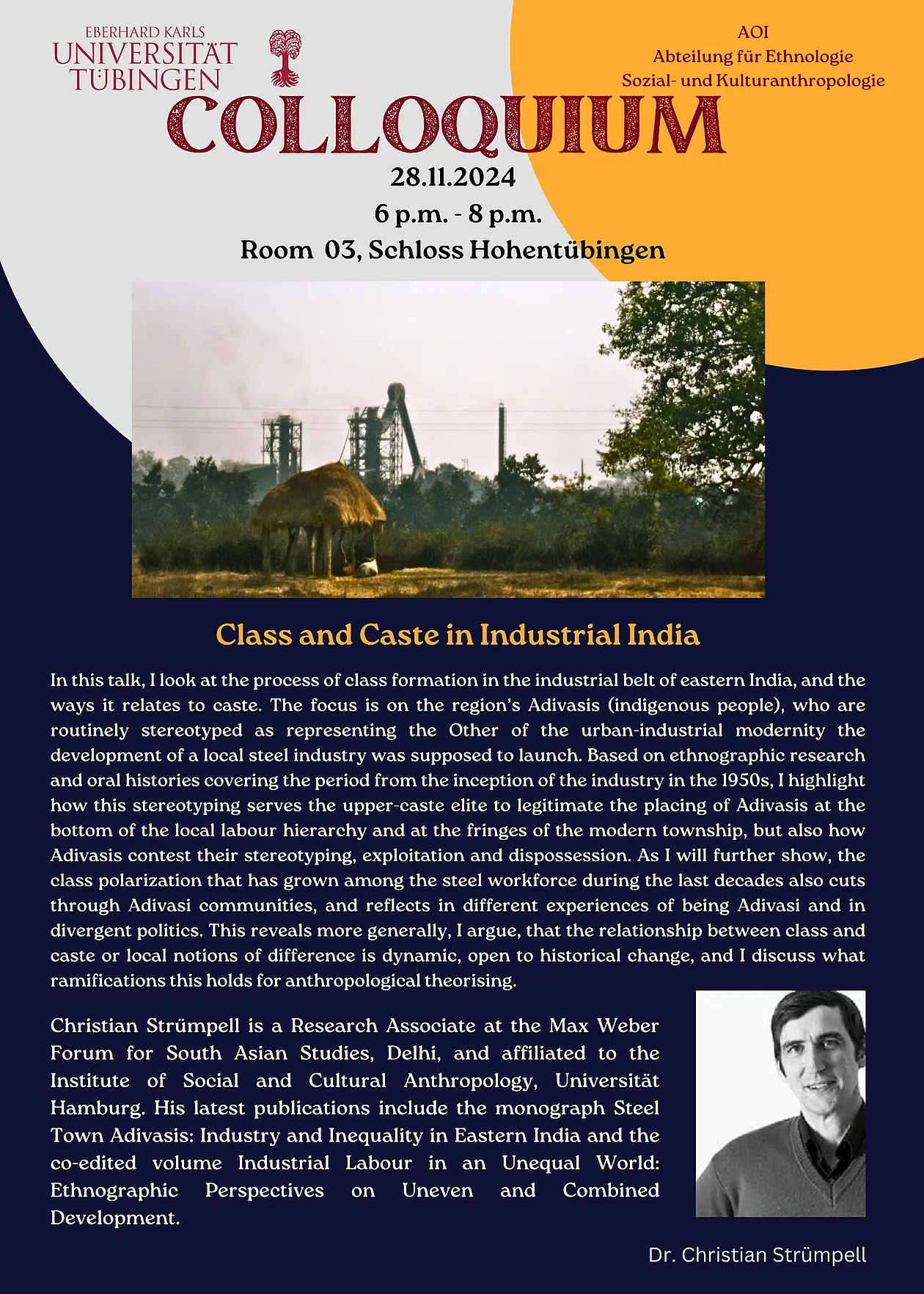
28.11.2024: Class and Caste in Industrial India - Dr. Christian Struempell

Class and Caste in Industrial India - Dr. Christian Struempell

In this talk, I look at the process of class formation in the industrial belt of eastern India, and the ways it relates to caste. The focus is on the regions Adivasis (indigenous people), who are routinely stereotyped as representing the Other of the urban-industrial modernity the development of a local steel industry was supposed to launch. Based on ethnographic research and oral histories covering period from the inception of the industry in the 1950s, I highlight how this stereotyping serves the upper-caste elite to legitimate the placing of Adivasi at the bottom of the local labour hierarchy and at the fringes of the modern township, but also how Adivasis contest their stereotyping, exploitation and dispossession. As I will further show, the class polarization that has grown among the steel workforce during the last decades also cuts through Adivasi communities, and reflects in different experiences of being Adivasi and in divergent politics. This reveals more generally, I argue, that the relationship between class and caste or local notions of difference is dynamic, open to historical change, and I discuss what ramifications this holds for anthropological theorising.


Donnerstag, 28.11.2024 18-20 Uhr c.t.

Schloss Hohentübingen, Seminarraum 03

Dr. Christian Strümpell - is a Research Associate at the Max Weber Forum of South Asian Studies, Delhi, and affiliated to the Institute of Social and Cultural Anthropology, Universität Hamburg. His latest publications include the monograph Steel Town Adivasis: Industry and Inequality in Eastern India and the co-edited volume Industrial Labour in an Unequal World: Ethnographic Perspectives on Uneven and Combined Development.

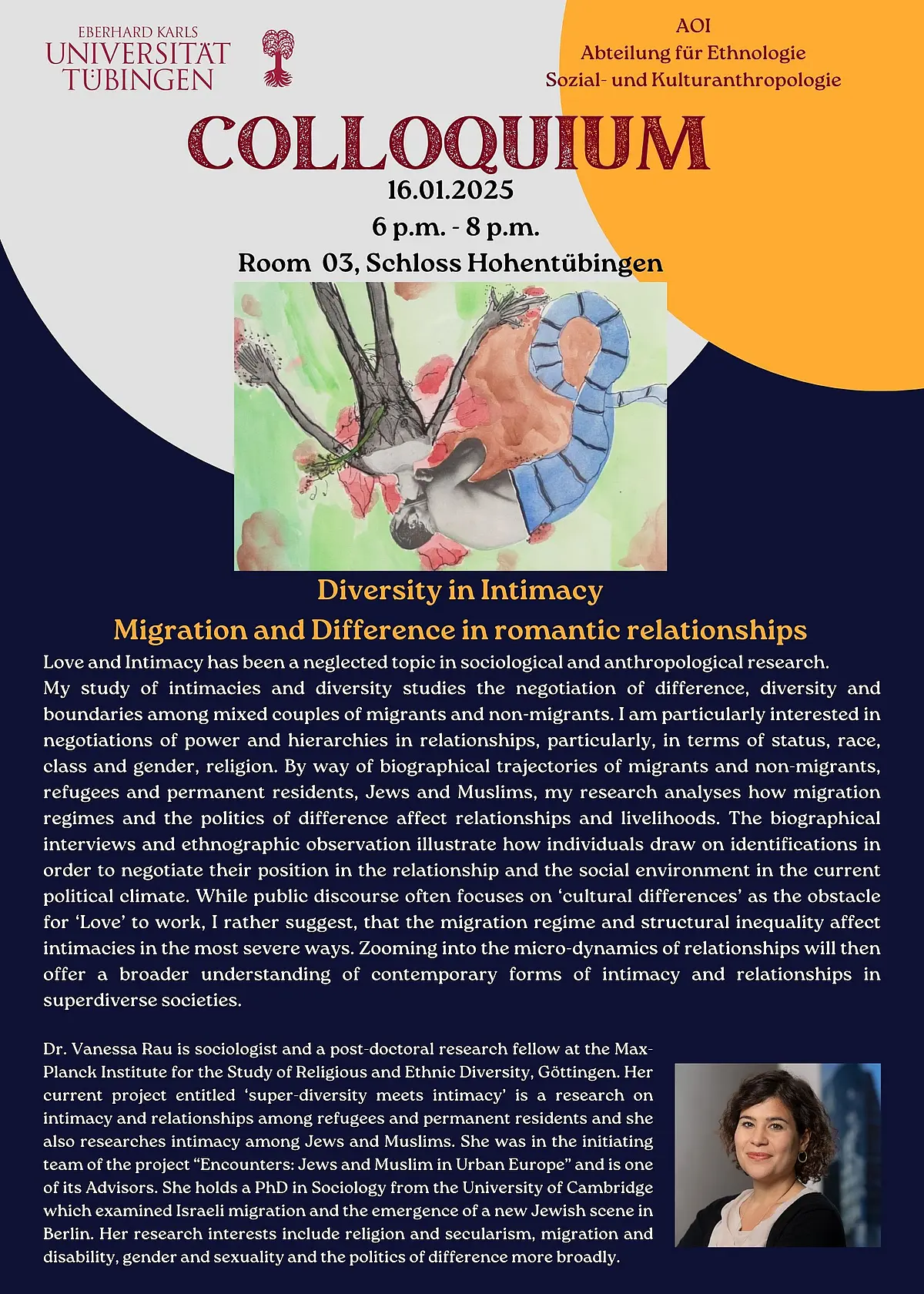
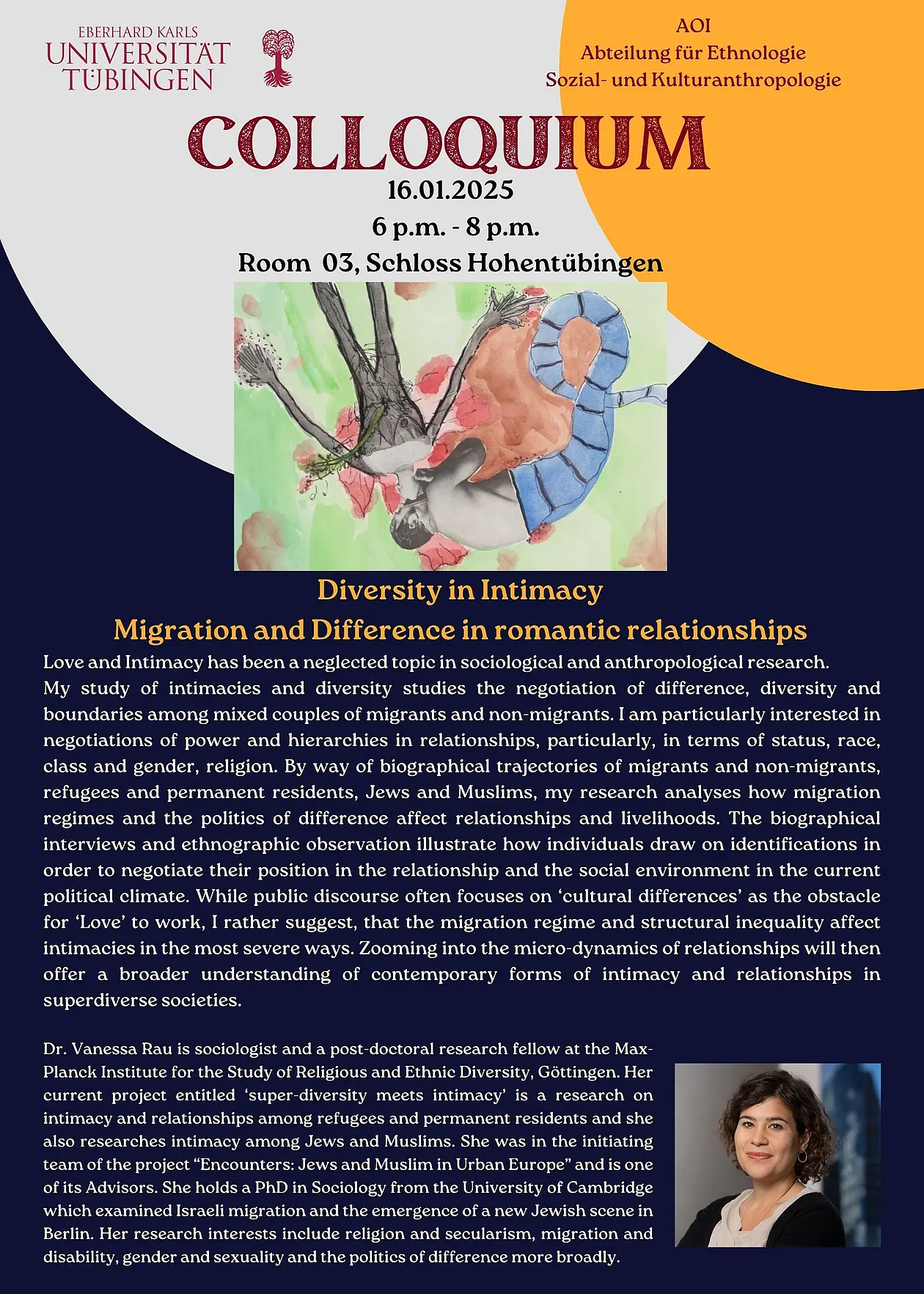
16.01.2025: Diversity in Intimacy: Migration and Difference in romantic relationships - Dr. Vanessa Rau

Diversity in Intimacy: Migration and Difference in romantic relationships

Love and Intimacy has been a neglected topic in sociological and anthropological research. My study of intimacies and diversity studies the negotiation of difference, diversity and boundaries among mixed couples of migrants and non-migrants. I am particularly interested in negotiations of power and hierarchies in relationships, particularly, in terms of status, race, class and gender, religion. By way of biographical trajectories of migrants and non-migrants, refugees and permanent residents, Jews and Muslims, my research analyses how migrants and non-migrants, refugees and permanent residents, Jews and Muslims, my research analyses how migration regimes and the politics of difference affect relationships and livelihoods. The biographical interviews and ethnographic observation illustrate how individuals draw on identifications in order to negotiate their position in the relationship and the social environment in the current political climate. While public discourse often focuses on ‘cultural differences’ as the obstacle for ‘Love’ to work, I rather suggest, that the migration regime and structural inequality affect intimacies in the most severe ways. Zooming into the micro-dynamics of relationships will then offer a broader understanding of contemporary forms of intimacy and relationships in superdiverse societies.

Donnerstag, 16.01.2025 18-20 Uhr c.t.    

Schloss Hohentübingen, Seminarraum 03

Dr. Vanessa Rau - is a sociologist and a post-doctoral research fellow at the Max-Planck Institute for the Study of Religious and Ethnic Diversity, Göttingen. Her current project entitled ‘super-diversity meets intimacy’ is a research on intimacy and relationships among refugees and permanent residents and she also researches intimacy among Jews and Muslims. She was in the initiating team project “Encounters: Jews and Muslim in Urban Europe” and is one of its Advisors. She holds a PhD in Sociology from the University of Cambridge which examined Israeli migration and the emergence of a new Jewish scene in Berlin. Her research interests include religion and secularism, migration and disability, gender and sexuality and the politics of difference more broadly.

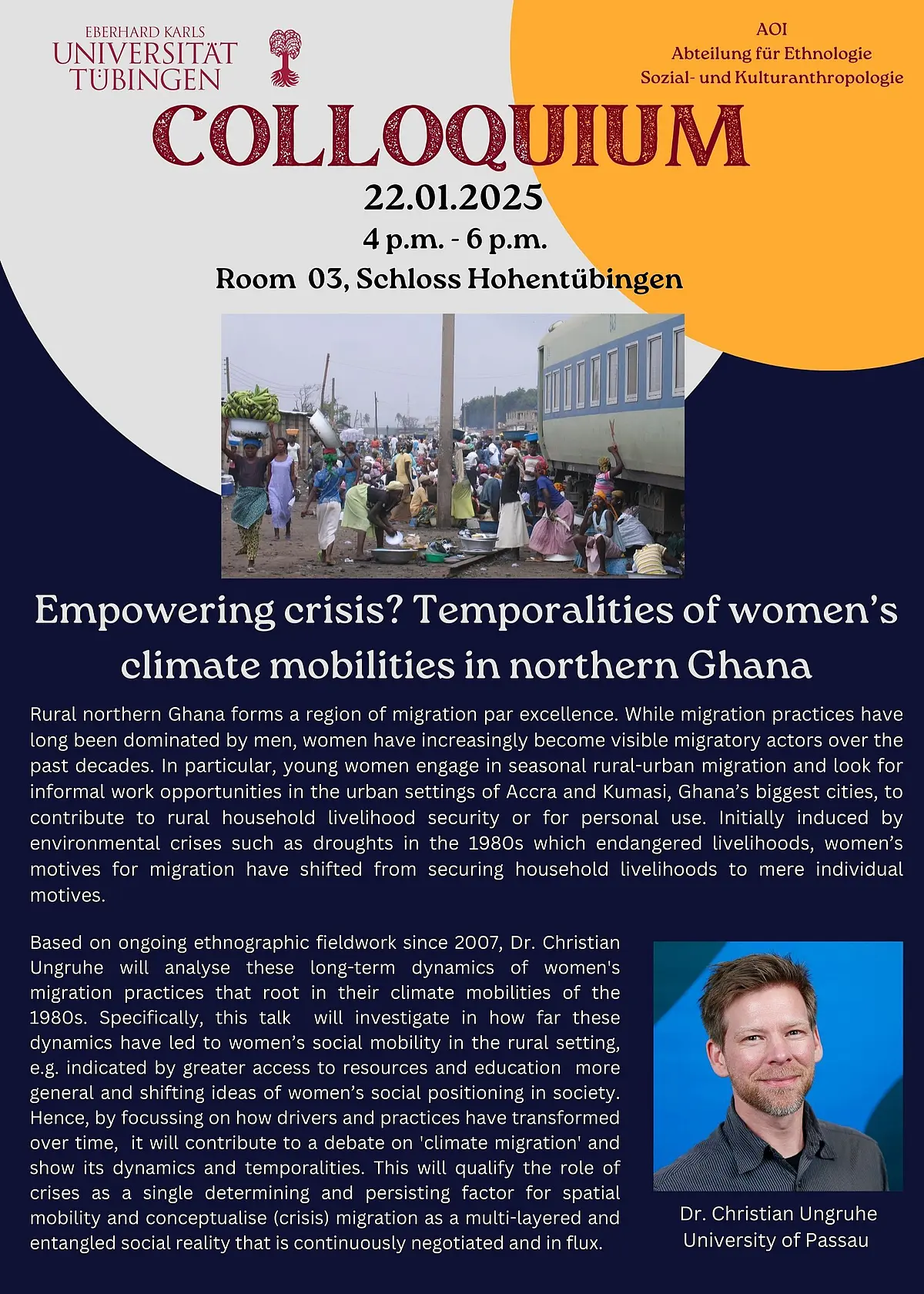
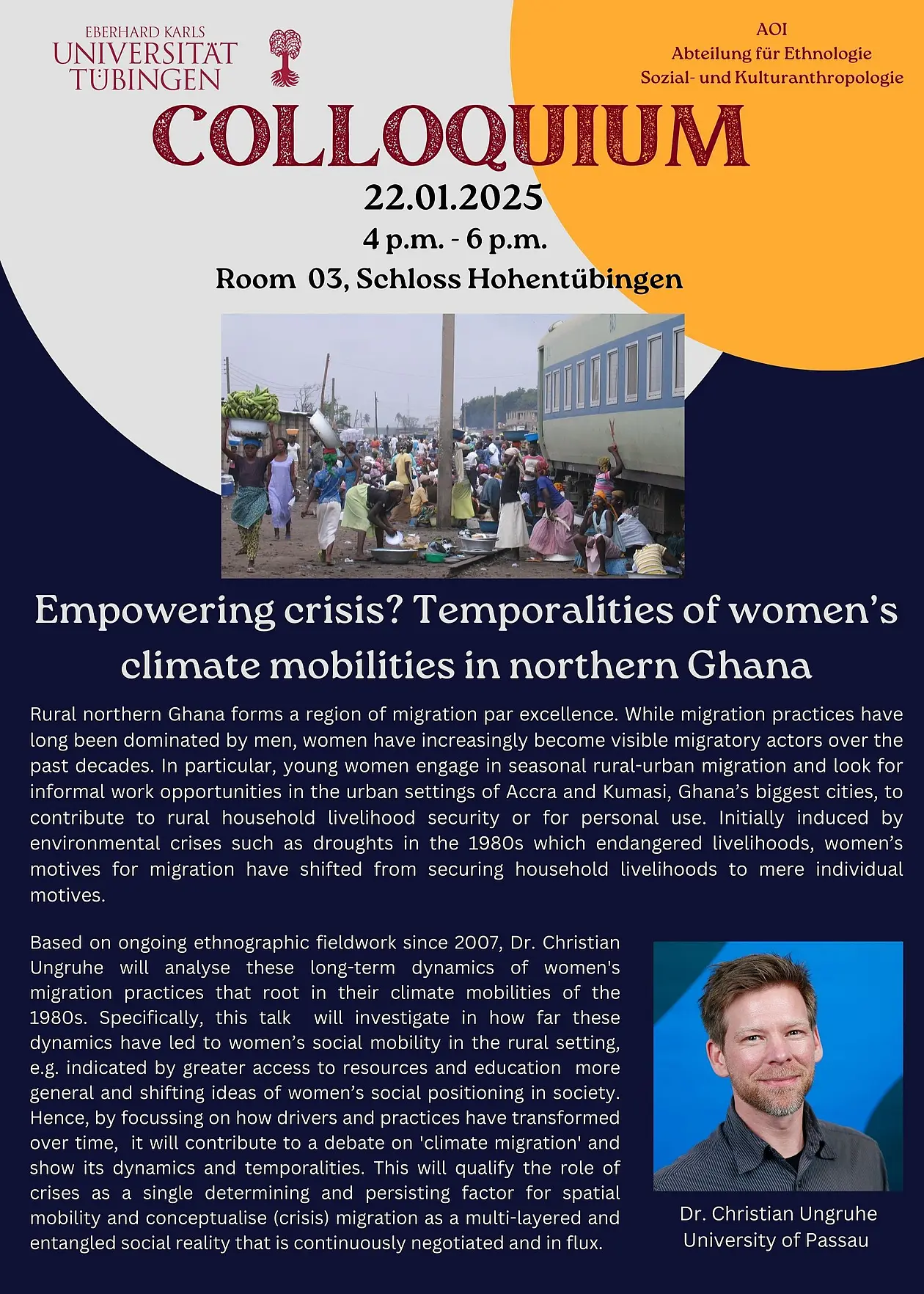
22.01.2025: Empowering crisis? Temporalities of women's climate mobilities in northern Ghana - Dr. Christian Ungruhe

Empowering crisis? Temporalities of women's climate mobilities in northern Ghana

Rural northern Ghana forms a region of migration par excellence. While migration practices have long been dominated by men, women have increasingly become visible migratory actors over the past decades. In particular, yong women engage in seasonal rural-urban migration and look for informal work opportunities in the urban settings of Accra and Kumasi, Ghana's biggest cities, to contribute to rural household livellihood security or dor personal use. Initially included by environmental crises such as droughts in the 1980s which endangered livelihoods, women's motives for migration have shifted from securing household livelihoods to mere individual motives.

Based on ongoing ethnographic fieldwork since 2007, Dr. Christian Ungruhe will analyse these long-term dynamics of women's migration practices that root in their climate mobilities of the 1980s. Specifically, this talk will investigate in how far these dynamics have led to women's social mobility in the rural setting, e.g. indicated by greater access to resources and education more general and shifting ideas of women's social positioning in society. Hence, by focussing on how drivers and practices have transformed over time, it will contribute to a debate on ‘climate migration’ and show its dynamics and temporalities. This will qualify the role of crises as a single determining and persisting factor for spatial mobility and conceptualise (crisis) migration as a multi-layered and entangled social reality that is continuously negotiated and in flux.


Mittwoch, 22.01.2025 16-18 Uhr c.t.

Schloss Hohentübingen, Seminarraum 03

Dr. Christian Ungruhe - Universität Passau