Methodenzentrum

Program

Aims

The Master’s program QDS encourages a focus on research and on the development of methods. It expands and deepens methodological and technical knowledge, enables graduates to carry out academic research, provides the basis for advancing the field, and prepares graduates for subsequent PhD studies. The QDS program is specifically targeted to enable graduates to take up responsible leading roles and emphasizes a scientific, research-oriented mindset based on independent thought, judgement and decision-making. The Master’s program QDS is a methodological program which covers a wide range of topics. Graduates are not only able to apply methods, but to evaluate and to develop methods in the three areas of interest. Through optional specializations further expertise in relevant areas can be gained. 
The Master’s program QDS explicitly aims to cover the full breadth of the field, ranging from fundamental skills in statistics and data handling to advanced methods of modern data analysis using a variety of methods. In particular, we will train students to be able to quickly take up new research developments in the three areas. 

Structure

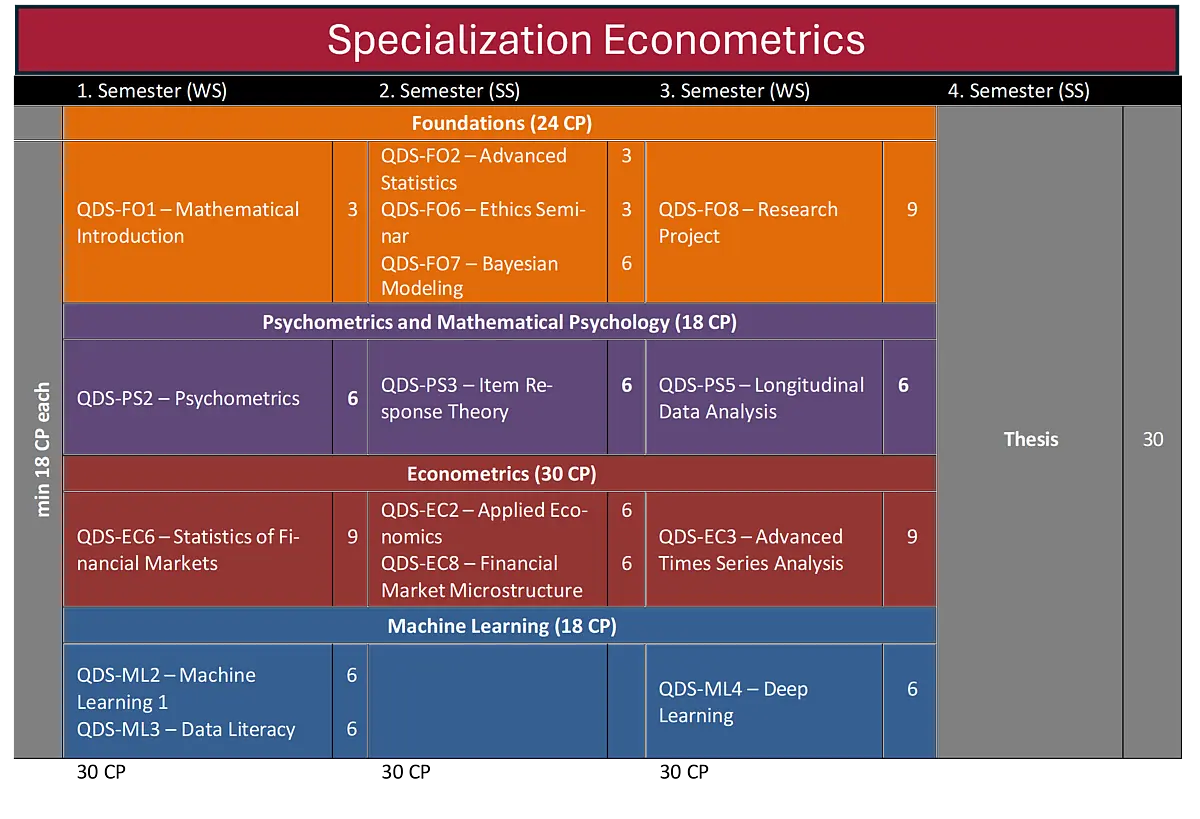
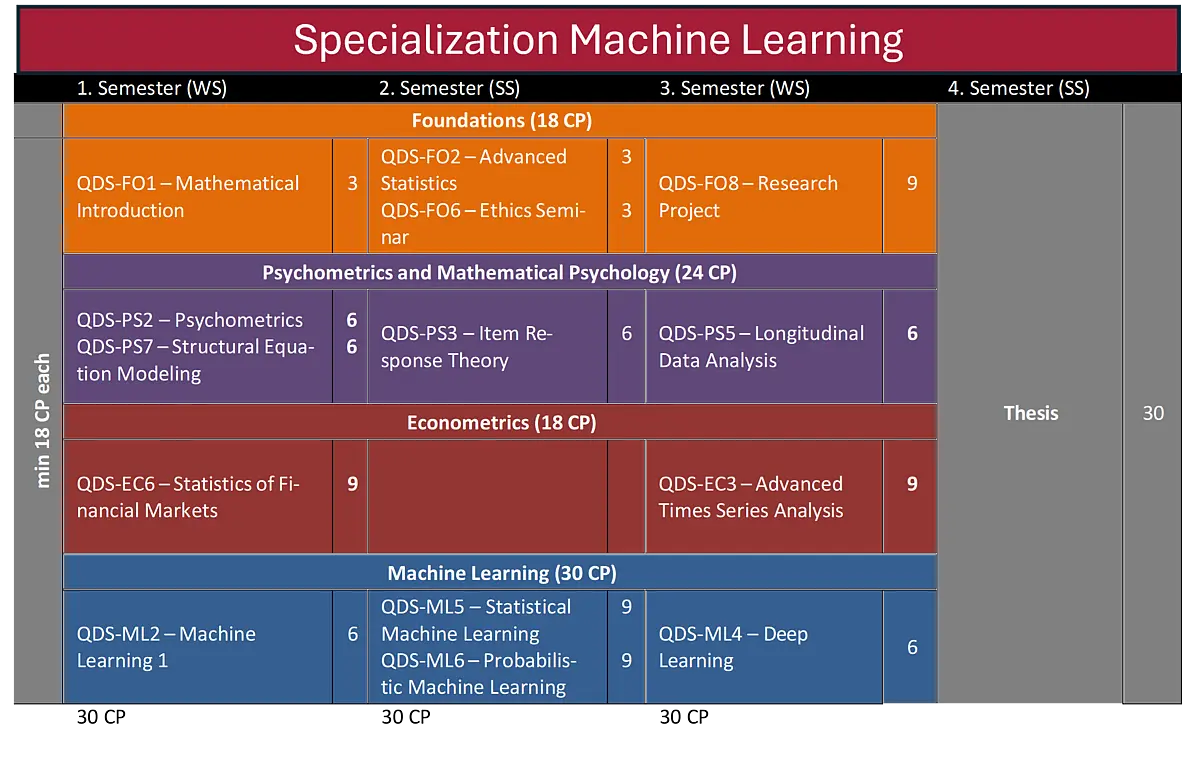
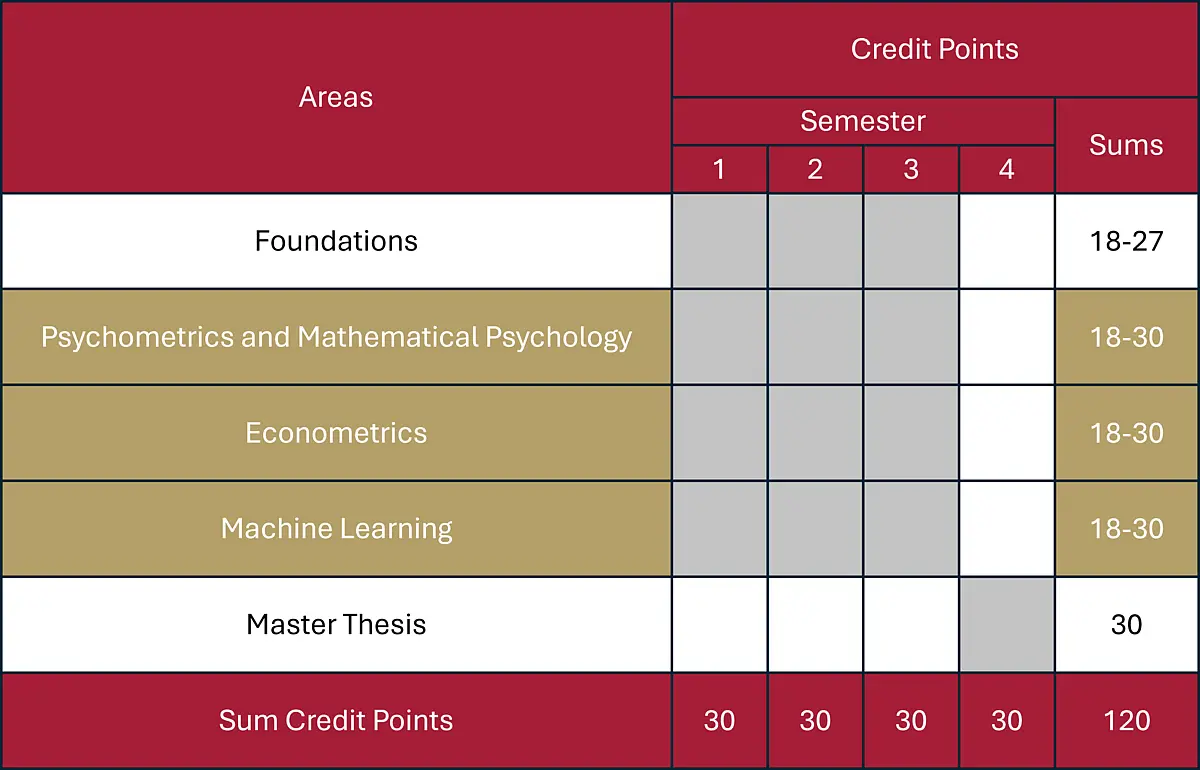
The four-semester Master’s program QDS is split into four areas. These are interdisciplinary Foundations (QDS-FO) and the three core areas of Psychometrics and Mathematical Psychology (QDS-PS), Econometrics (QDS-EC), and Machine Learning (QDS-ML).

To ensure the interdisciplinary character of the program a minimum of 18 ECTS points have to be earned in each of the areas (QDS-FO, QDS-PS, QDS-EC, QDS-ML), distributed across three semesters.

The program suggests that students specialize in one of the three core areas. This specialization can be achieved in three stages.

  • Modules: The area of specialization can cover a total of 30 ECTS points.
  • Research Project: The topic of the Research Project can build on the area of specialization.
  • Master thesis: The master thesis allows for further specialization in one area.

A specialization is not mandatory. The master’s program offers a wider path with e.g. 21-24 CPs in each area and interdisciplinary topics in the Research Project and thesis as well.

Preparatory Course

The module covers key concepts in linear algebra and mathematical statistics. In particular, it will cover matrix algebra (including linear independence and eigenvalue theory), quadratic forms, matrix differentiation, differential equations, basic probability theory and statistical inference.
The aim is to provide students with the mathematical tools and the fundamentals of probability theory and statistics which are particularly important for successful completion of the Master’s program QDS. The module is designed to review some basic concepts which are covered in standard bachelor courses and will then move on to more advanced methods. After completing the module, students will have acquired the basic mathematical and statistical knowledge that is needed to start the Master’s program QDS.

Foundations

The area Foundations covers general statistical and technical modules. Depending on the individual’s prerequisites from the qualification degree, this area can serve to compensate for heterogeneity. For this purpose, personalized module combinations can be offered, focusing for example on statistics and probability theory or techniques such as programming. The Foundations area also offers the participation in one elective seminar on ethics in, e.g., technology, Data Science and AI.

Psychometrics

In Psychometrics and Mathematical Psychology, students learn typical methods used in these fields, such as (semiparametric) latent variable modeling, item response modeling, dynamic longitudinal modeling, Bayesian statistics, knowledge space theory, models for decision-making etc. Students are qualified to reflect the critical assumptions of the methods and to know their limitations.

Econometrics

In this area, quantitative methods used in econometrics are introduced. The modules on Core Topics in Econometrics I/II (QDS-EC10 / QDS-EC11) are intended to cover changing lectures.

Machine Learning

The area of Machine Learning introduces key concepts of the field. Obligatory courses are defined by the individual curriculum.

Data Ethics

The increasing use of data and data driven applications, for example in decision-making processes, affects our daily lives. Thus, ethical discussion on the responsible usage of data are of growing importance.
Through appropriate supplementary events and a varied program of seminars, graduates will be able to reflect the ethical and moral handling of current topics of data science.
 

Research Project

The Research Project requires students to undertake an independent research project. It is designed to deepen both theoretical and practical knowledge within a specific field and may be conducted in any of the core disciplines or optional areas of specialization. The project may be completed individually or in groups and can be carried out within university research groups or in collaboration with external companies.