Abstract
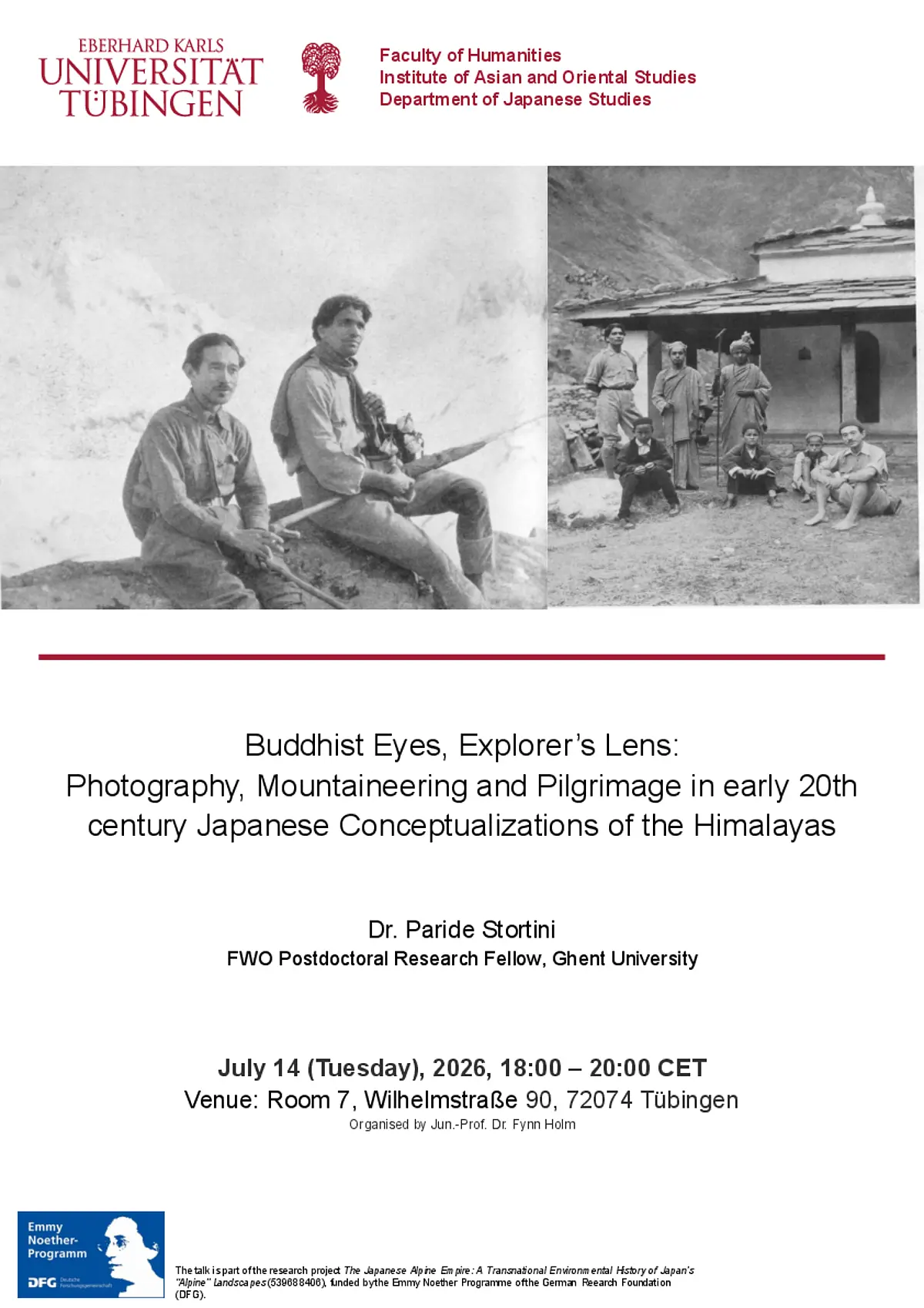
This presentation will show a compresence, rather than a progressive replacement, of pilgrim and modern mountaineer identities in the earliest Japanese exploration of Central Asian mountain ranges. I will particularly focus on two photographic collections of the Himalayas and Tian Shan ranges that were produced through Buddhist pilgrimage to India and exploration of Buddhist sites in Central Asia (1910s-1930s). Using an interdisciplinary approach that combines religious studies, history, and media theory on photography, I will argue that the combination of photography and embodied experience of mountain climbing did not simply equate to a disenchanting gaze onto the peaks. It could also be deployed within Buddhist discourse that linked together civilization, religion, and the environment.
About the Presenter
Dr. Paride Stortini is an FWO research fellow at Ghent University, which he joined after a JSPS fellowship at Tokyo University. He holds a PhD in history of religions from the University of Chicago. In his dissertation titled "Reimagining India between Science and Religion: Indology and Modernity in Japanese Buddhism", he shows the active role of Japanese Buddhists in redeploying ideas and images on India in scholarship, literature, and visual culture to inform the role of religion in modern Japan. At Ghent University, he is currently developing a second project titled "Building Buddhist Heritage in Postwar Japan: The Silk Road between History and Memory at Yakushiji Temple", in which he explores the concept of “Silk Road” in twentieth century Japan, at the intersection between cultural heritage, religious practices of memorialization and pilgrimage, and media representation of travel and “Buddhist cosmopolitanism,” centering on the case study of the temple and Buddhist community of Yakushiji, Nara Prefecture.