Diversity and palaeoecology of the latest Cretaceous vertebrates from Transylvania
Drill a little bit deeper
Monitoring of Vertebrate Use of Caves
Exzellenzcluster TERRA
Exzellenzcluster HUMAN ORIGINS
Powerful Plants
Ökologische Entwicklung des ehemaligen Gipsbruchs Entringen/Breitenholz
From Ornaments to Ecosystems
Isotopenökologie des Wolfs in der Lausitz
Stable Isotope Analysis of Prehistoric Aquatic Resource Use at Hohle Fels
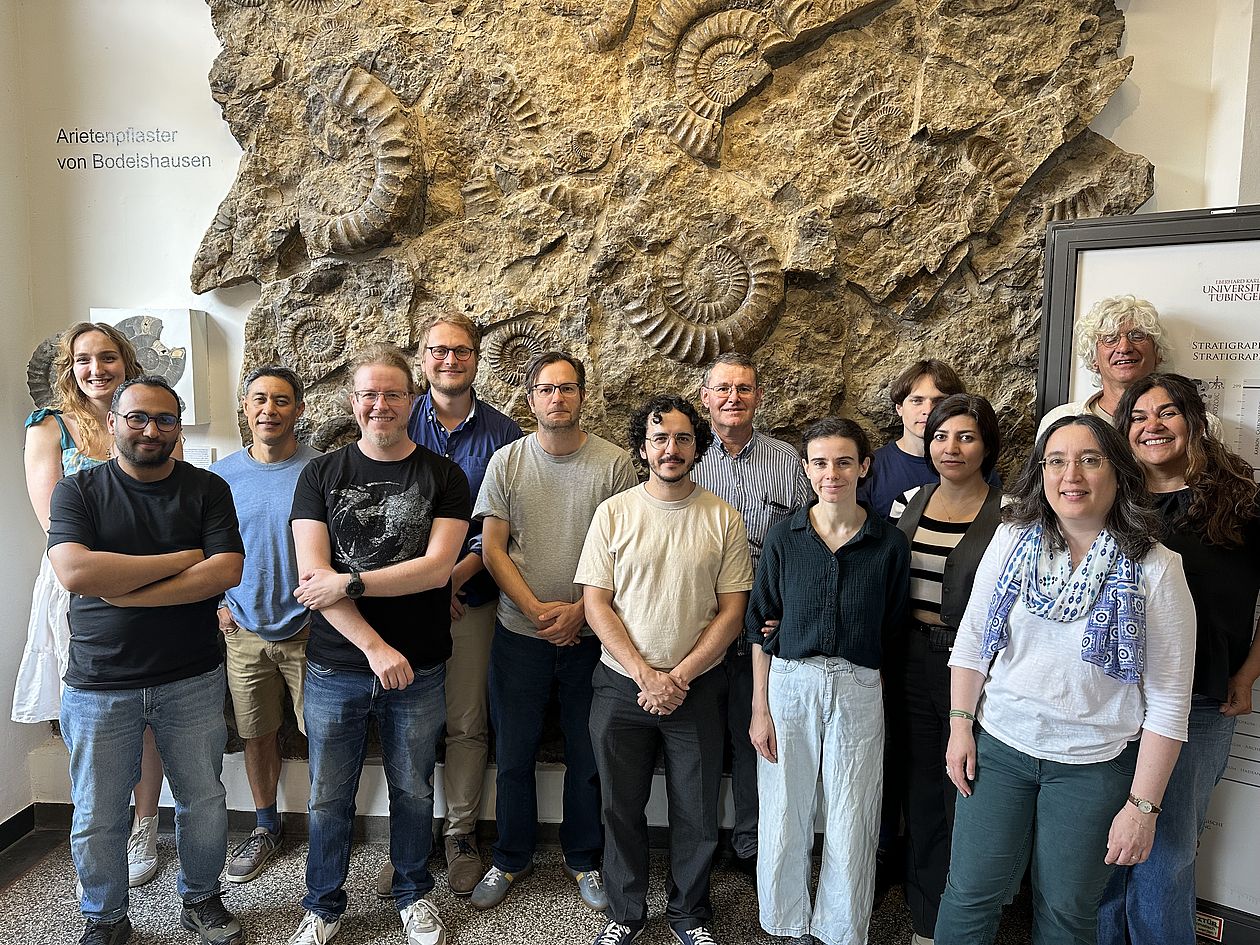
We are the Biogeology Research Group
Our group explores how organisms have adapted to and influenced their environments over time, with a particular focus on hominid-related periods in Earth’s history. We investigate the ecological roles of both extinct and extant species, using isotopic analyses of ancient remains to reconstruct diets, habitats, and ecological niches. Our research spans a wide temporal and taxonomic range, from the woolly mammoths of the Siberian steppes to the great dinosaurs of deep time.
By reconstructing past ecosystems and analyzing long-term ecological dynamics, we contribute to a deeper understanding of biodiversity and environmental change. Our guiding principle:
We are happy to welcome our new team members Dr. Tigan Foister who will work on ecological models in the HUMAN ORIGINS Cluster framework, and Dr. Ivan Krivokorin who will teach this semester paleoecology in the teach@Tübingen framework
Baumann, C., Streif, S., Akarsu, A.S., Nowak, C., Drucker, D.G., 2026. Retrospective isotope monitoring reveals spatial and temporal effects of anthropogenic pressures on the trophic ecology of European wildcats (Felis silvestris) in Germany. PLOS ONE 21(2): e0343705. https://doi.org/10.1371/journal.pone.0343705
Bergstrom, A., Furtwängler, A., Johnston, S., Rosengren, E., Breidenstrein, A., Booth, T., McCabe, J.B., Peto, J., Williams, M., Kelly, M., Tait, F., Baumann, C., Radzeviciute, R., Barrington, C., Anastasidou, K., Gilardet, A., Glocke, I., Sherman, M., Brativnyk, A., Herbig, A., Prüfer, K., Pfrengle, S., Gretzinger, J., Feu-erborn, T.R., Reiter, E., Linderholm, A., Carlton, S., Racimo, F., Mikkola, L., Anderson-Whymark, H., Baird, D., Gotfredsen, B., Bocherens, H., Bridault, A., Brocke, R., Drucker, D.G., Fairbairn, A.S., Frantz, L., Gasparyan, B., Giemsch, L., Germonpré, M., Janssens, L, Kande, A.W., Kjaer, K., Laznickova-Galetova, M., Loponte, D., Magnell, O., Martin, L., Münzel, S.C., Mustafaoglu, G., Mage, B., Perri, A., Pfenninger, F., Robilckova, M., Roman-Binois, A., Saritas, Ö, Schäppi, K., Sheridan, J.A., Sjögren, K.G., Stora, J,, Sørensen, L.V., Tafelmaier, Y., Ter-Nedden, F., Thalmann, O., Larson, G., Schuenemann, V.J., Krause, J., Skoglund, P., 2026. Genomic history of early dogs in Europe. Nature 651: 986-994. https://doi.org/10.1038/s41586-026-10112-7
Boerman, S.A.C.M., Vellekoop, J., Jouve, S., Rabi, M., Vallée-Gillette, N., Oudoire, T., Smith, T., 2026. Revision of the longirostrine crocodylian Thoracosaurus isorhynchus from the Maastrichtian-Danian of northwestern Europe. Journal of Vertebrate Paleontology e2604600. https://doi.org/10.1080/02724634.2025.2604600
Bongers, J.L., Milton, E.B.P., Osborn, J., Drucker, D.G., Robinson, J.R., Scafaldi, B.K., 2026. Seabirds shaped the expansion of pre-Inca society in Peru. PLOS One 21(2): E0341263. https://doi.org/10.1371/journal.pone.0341263
Fotiadou, C.M., Pedersen, J.B., Rougier, H., Roksandic, M., Spyrou, M.A., Nägele, K., Reiter, E., Bocherens, H., Kandel, A.W., Haidle, M.N., Streicher, T., Conard, N.J., Schilt, F., Godinho, R.M., Uthmei-er, T., Doyon, L., Semal, P., Krause, J., Barbieri, A., Mihailovic, D., Crevecoeur, I., Posth, C., 2026. Archeogenetic insights into the demographic history of Late Neanderthals. PNAS 123(13): e2520565123. https://doi.org/10.1073/pnas.2520565123
Maidment, S., Butler, R.J., Brusatte, S.L., Meade, L.E., Augustin, F.J., Csiki-Sava, Z. Ösi, A., 2026. A hidden diversity of ceratopsian dinosaurs in Late Cretaceous Europe. Nature 651: 397-403. https://doi.org/10.1038/s41586-025-09897-w