
19.10.2026
How far-right parties mobilize against cultured meat. Protecting the prosciutto, saving the schnitzel
New publication by Prof. Dr. Manès Weisskircher and Prof. Dr. Léonie De Jonge in "Environmental Sociology"
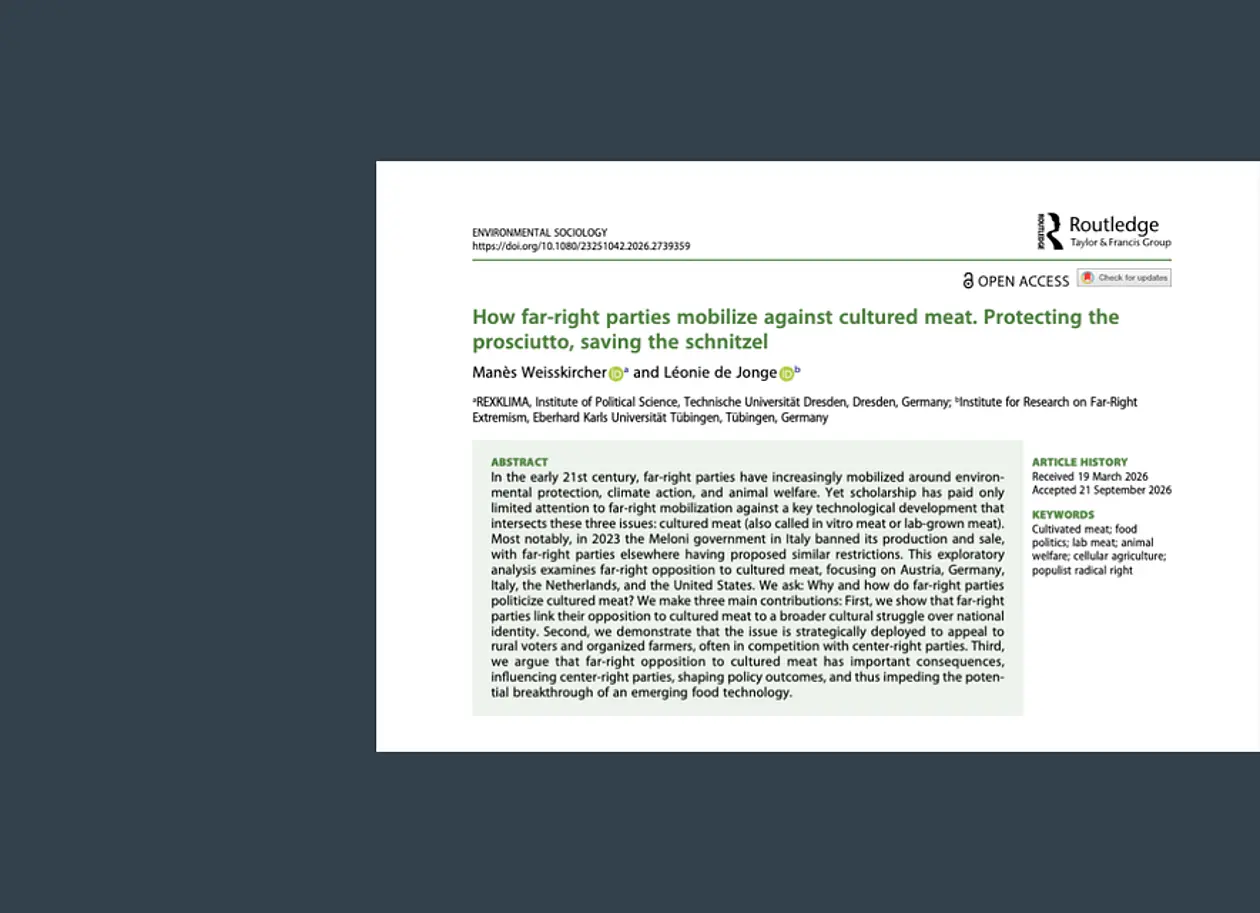
Authors: Prof. Dr. Manès Weisskircher and Prof. Dr. Léonie De Jonge
In the early 21st century, far-right parties have increasingly mobilized around environ- mental protection, climate action, and animal welfare. Yet scholarship has paid only limited attention to far-right mobilization against a key technological development that intersects these three issues: cultured meat (also called in vitro meat or lab-grown meat). Most notably, in 2023 the Meloni government in Italy banned its production and sale, with far-right parties elsewhere having proposed similar restrictions. This exploratory analysis examines far-right opposition to cultured meat, focusing on Austria, Germany, Italy, the Netherlands, and the United States. We ask: Why and how do far-right parties politicize cultured meat? We make three main contributions: First, we show that far-right parties link their opposition to cultured meat to a broader cultural struggle over national identity. Second, we demonstrate that the issue is strategically deployed to appeal to rural voters and organized farmers, often in competition with center-right parties. Third, we argue that far-right opposition to cultured meat has important consequences, influencing center-right parties, shaping policy outcomes, and thus impeding the potential breakthrough of an emerging food technology.
The article was published online on 12 October 2026 in Environmental Sociology.