
20.11.2026
How the populist right profits from online misogyny: The global backlash against women demands urgent action
Essay by Prof Dr Cynthia Miller-Idriss published on November 11, 2026 in the British magazine Prospect
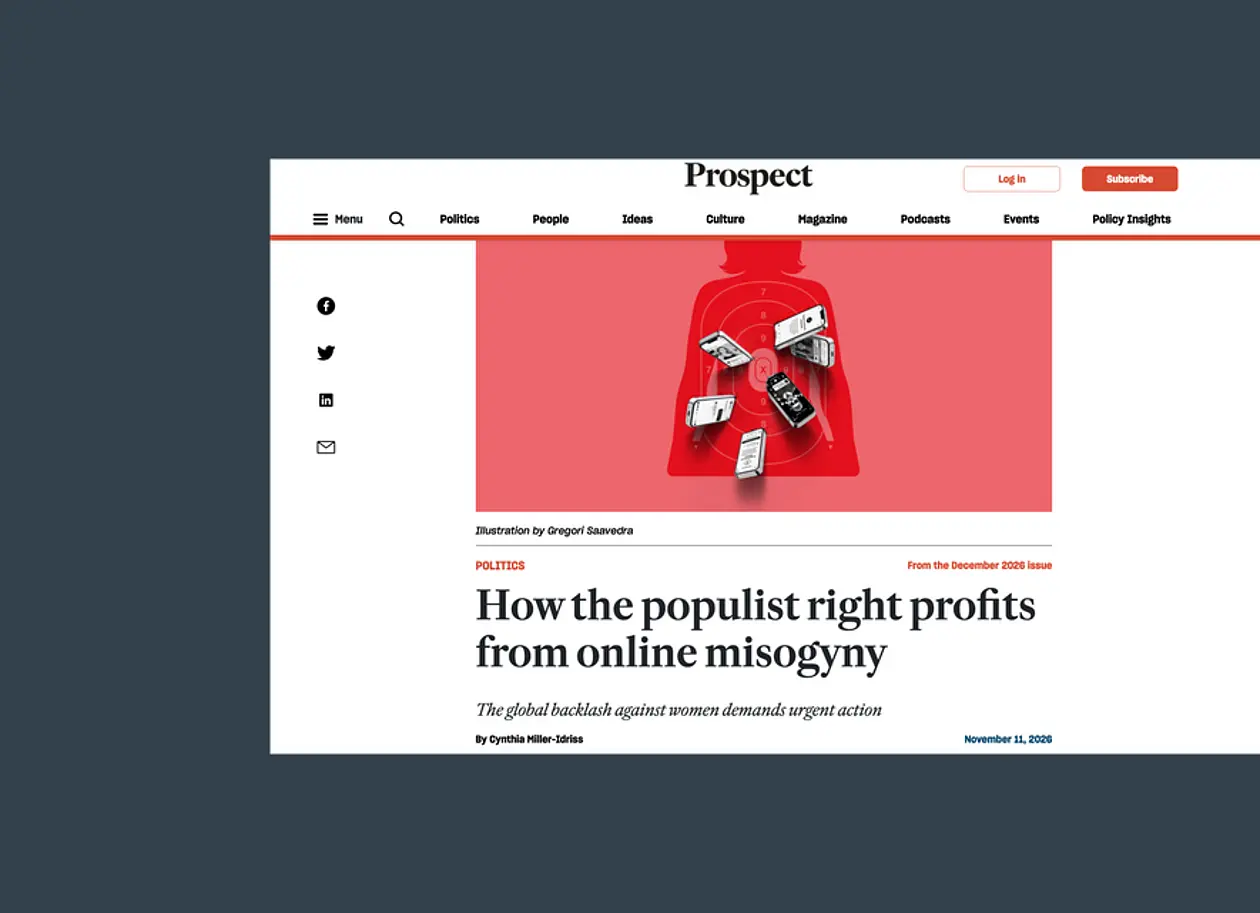
Misogyny as a bridge to extremism: Cynthia Miller-Idriss on gender as a mobilising factor for the far right
In her latest essay, Cynthia Miller-Idriss, Founding Director of the Polarisation & Extremism Research & Innovation Lab (PERIL) at American University and author of Man Up: The New Misogyny & the Rise of Violent Extremism, demonstrates how closely misogyny, digital discourses on masculinity and far-right mobilisation are intertwined.
Empirical basis
The article is based on an analysis of more than 100 million social media posts containing gender-related grievance narratives, as well as around 300 interviews with young women and men in the US, Canada, Kenya and Jordan.
Key findings
Survey data from several countries suggests that young men of Generation Z are becoming increasingly sceptical of gender equality and feminism. Miller-Idriss demonstrates how algorithmically amplified content, gaming communities and violent pornography foster these attitudes. Personal grievances are reinterpreted as collective narratives of marginalisation, humiliation and retaliation. Political actors on the far right are seizing upon these narratives and deliberately using gender as a mobilisation issue to win over voters and donors. Anti-feminism thus appears not as a by-product, but as part of a strategic project to restore patriarchal hierarchies.
Misogyny functions both as a risk factor and as a gateway to various forms of extremism. Many far-right and incel attacks exhibit a gender-related dimension, such as a history of violence against women or explicitly misogynistic motives. An Australian study cited here identifies misogyny as the strongest predictor of extremist attitudes across ideological divides.
Prevention strategies
The author advocates measures at three levels:
- System: effective regulation of platforms, online games and pornography that goes beyond mere age restrictions, as well as health and policy approaches targeting men and boys
- Individual: evidence-based media literacy such as ‘prebunking’, peer interventions and facilitated discussion spaces for young people
- Culture: educational and campaign work against patriarchal norms, as well as clear public stances from political leaders
Appreciation
Miller-Idriss succeeds in establishing gender as a core analytical category in research into right-wing extremism, rather than treating it as a peripheral issue. Particularly compelling is the way she combines large-scale data analyses with the voices of young people themselves, who often describe their digital lives with surprising insight. The essay remains nuanced throughout: it takes the lived realities of young men seriously, identifies the limitations of blanket bans and highlights countervailing trends. In doing so, it provides an important impetus for research, prevention and political practice, and the author makes a lasting contribution to making these interconnections visible and open to discussion.