
21.09.2026
Aspects of femonationalism on the European far right: Alice Weidel compared with Marine Le Pen and Giorgia Meloni
Dr. Sabine Volk publication examines the phenomenon of ‘femonationalism’ from a critical perspective
Author: Dr. Sabine Volk
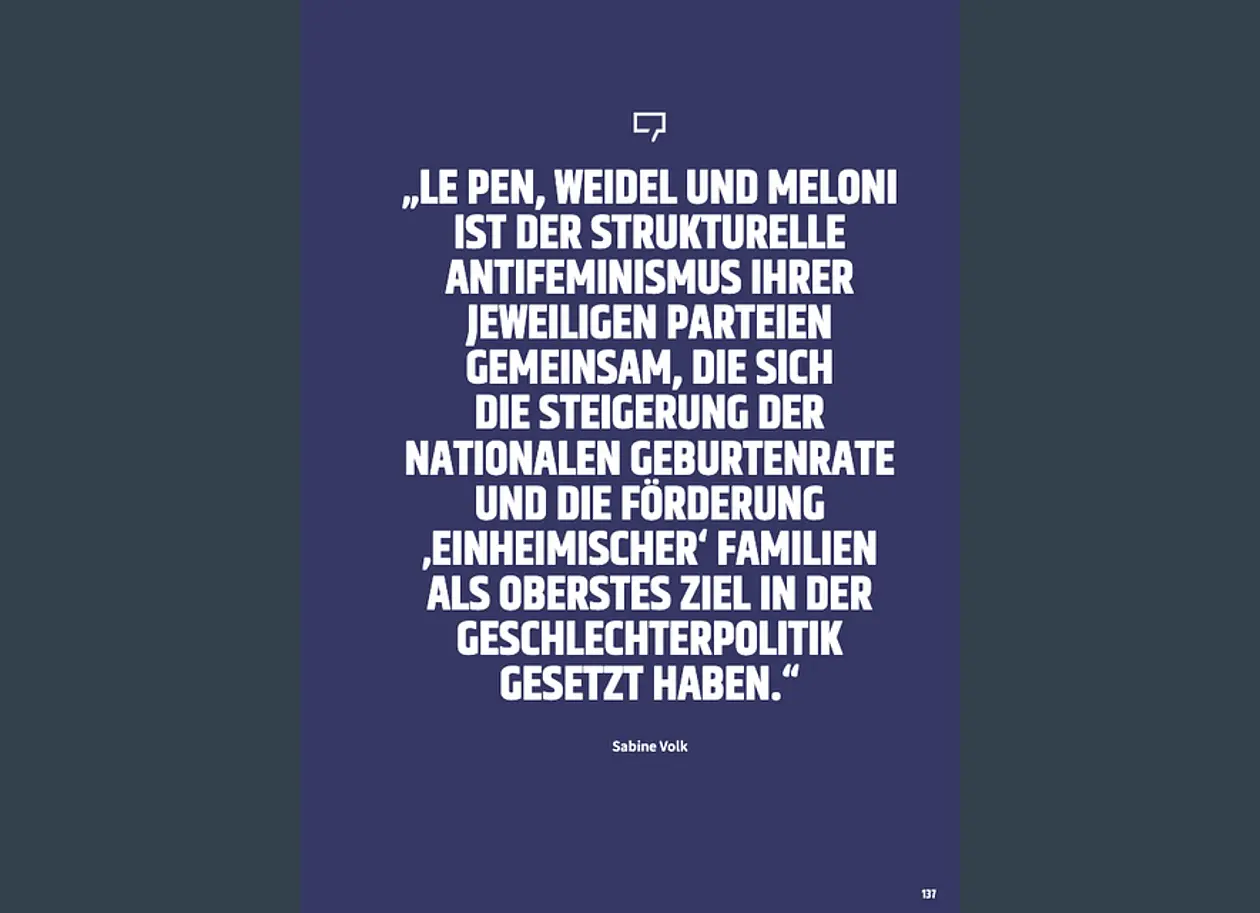
Abstract: The far right is regarded as patriarchal and anti-feminist. At the same time, not only in Germany but also internationally, an increasing number of women are at the helm of powerful far-right and right-wing populist parties. Against this backdrop, the question arises as to whether, and to what extent, female leaders are committed to strengthening women’s rights and combating anti-feminism within their parties. This article examines this question from a critical perspective, focusing in particular on the phenomenon of ‘femonationalism’ (the co-opting of feminist issues as part of a racist agenda). To this end, it compares and contrasts the discursive strategies of three female leaders within European far-right party politics: Alice Weidel, Giorgia Meloni and Marine Le Pen.
The article has been published in the Institute for Democracy and Civil Society’s series Wissen schafft Demokratie (Volume 19/2026), which focuses on democracy and gender.
Citation: Volk, Sabine (2026). Facetten des Femonationalismus in der europäischen extremen Rechten: Alice Weidel im Vergleich mit Marine Le Pen und Giorgia Meloni. In: Institut für Demokratie und Zivilgesellschaft (Hg.). Wissen schafft Demokratie. Schwerpunkt Demokratie und Geschlecht, Band 19. Jena, 136–147.