Institute for the Study of Religions

Isis Mrugalla Kalmbacher, M.A.

2025
PhD: "Wirklichkeitstechniken und Infrastrukturen"

English translation: “Reality Techniques and Infrastructures. Developing a Systemic-Praxeological Research Approach for the Study of Religions using the Case Example of Chaos Magic.”

Grade: summa cum laude

Doctoral Thesis Award 2026, Tübingen University

Publication: January 2027, Vandenhoeck & Ruprecht, CSRRW Series)

Since 2023
Representative of the Mittelbau, Senate Equal Opportunities Commission.

University of Tübingen

2022 - 2025
Researcher and Doctoral Candidate, Institute for the Study of Religion

University of Tübingen

2017 - 2022
Kultur & Gestalt

Founder

Social educational enterprise for Diversity, Change, and Conflict Management

See online

2014 - 2016
M.A. degree: Study of Religions, Antropology, Migration Studies

University of Heidelberg, University of Basel, University of Lucerne

2010 - 2014
B.A. degree: Study of Religions, Linguistics, Cultural Journalism

Universtity of Heidelberg, Universidad de Sevilla

Since 2025
Postdoctoral Researcher, Institute for the Study of Religions

Tübingen University

Research Focus

  • Magic and Esoteric Scene
  • Human-Plant-Relations, Religion and Plants
  • European History of Religion
  • Anthropology of Lived Religions
  • Empirical Social Research, Practice Theory
  • Systemic Study of Religions
  • Science Communication
  • University Didactics and Adult Education


Current Projects

Reality techniques and infrastructures

Systemic research on group practice

In this project, I have developed a new research approach for the ethnographic study of practice in groups and organizations. I integrated the systemic paradigm (Systemik) into the discipline Religionswissenschaft (Study of Religions), developing an epistemic framework, methodological guidelines, quality standards for research, and two major theoretical tools: reality techniques and infrastructures.

In my PhD thesis, I propose a new research approach for the Study of Religions (Religionswissenschaft) focusing on practice in groups and organizations. Adapting the systemic paradigm (Systemik), I developed an epistemic framework, methodological guidelines, quality standards for research, and two major theoretical tools: reality techniques and infrastructures.  

The epistemic framework is based on methodological agnosticism regarding ontological questions (Religionswissenschaft) and inspired by clinical systemic theory including constructivism, cybernetics and the study of group dynamics (Palo Alto Institute, Heidelberger Gruppe), practice theory (Bourdieu, Goffman, Butler, Reckwitz) and sociological perspectives conceptualizing the diverse experiences of reality as social facts (Durkheim, Thomas, Luckmann and Berger). I understand “the social” as a performative network of human and non-human actors (Gibson, Latour, Harvey, Laack).

The concept of reality techniques analyzes cognitive, psychological, embodied, social, and material techniques used by practitioners to (co-)create, validate, and share an anticipated and thus perpetuated perception, interpretation, and experience of reality. In my research, I worked with the case example of contemporary Chaos Magicians and their practice of occultism in organized group settings, focusing particularly on the aspects of how magic and the identity of being a magician is experienced, and occult secretive organizations are formed. As a result, I was able to identify a multitude of reality techniques used by the Chaos Magicians and the ways these techniques are learned in continual processes. As such, reality techniques is conceptualized as a systemic theoretical approach analyzing how reality in its experienced form is learned, constructed in, and fundamentally based on social systems.

The concept of infrastructures examines resources necessary for the process that people are actually able to experience and participate in a specific reality. In my thesis, I analyze the narrational, emotional, and performative infrastructures used by the Chaos Magicians I worked with, adapting and extending similar conceptual tools such as codes (Hall), access (Foucault), body techniques (Mauss), performances (Fischer-Lichte), and emotions (Scheer). These infrastructures are not invented and used by individuals alone, nor are they freely available for everyone. Instead, they are exclusive, mostly implicit knowledge that is available only to initiated members of a social system.

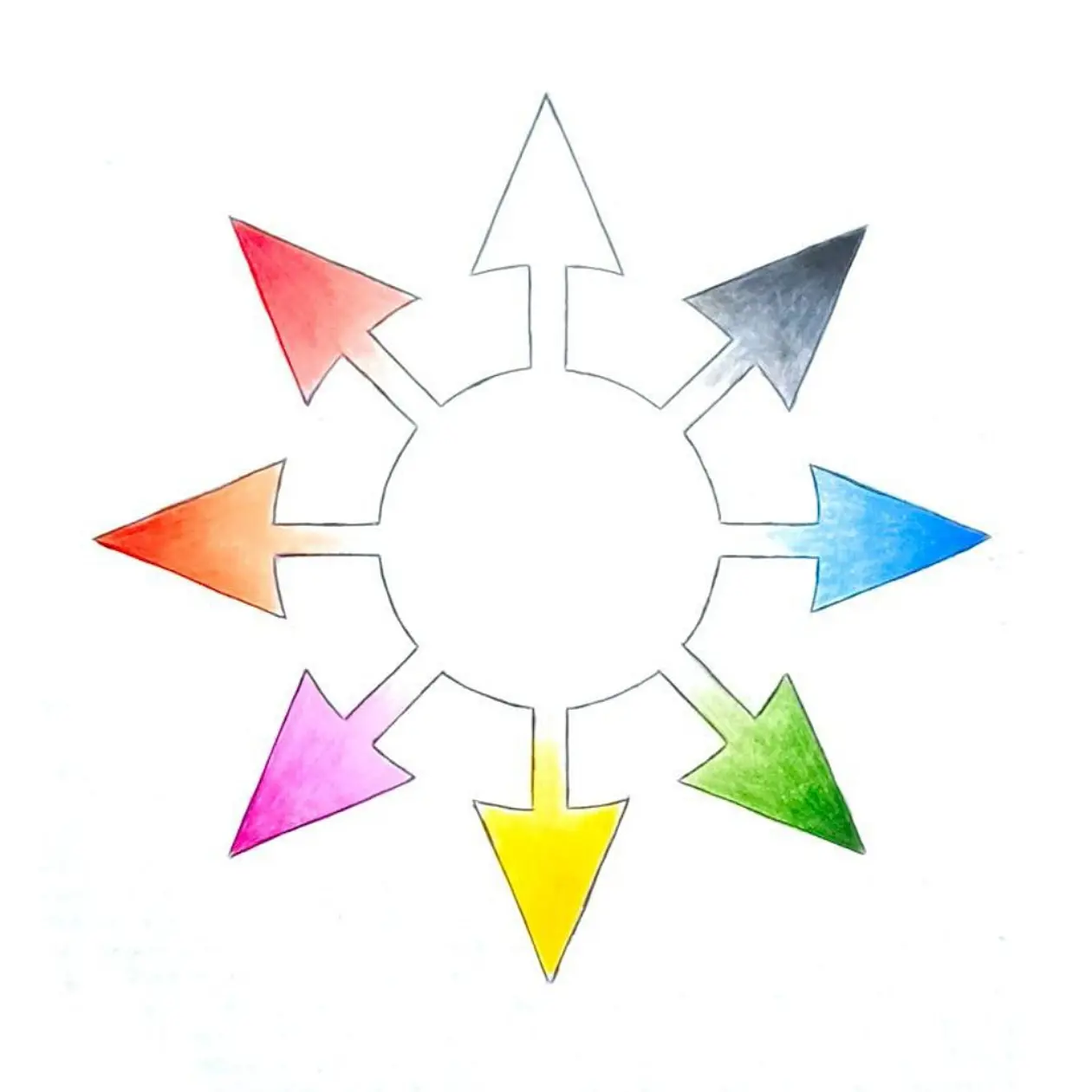
Chaos Star. By courtesy of Frater Fuchs Lächelt Viel 12.3 II°, priest of chaos.

History and Practice of Chaos Magic

Contemporary Esotericism

Chaos Magic is a style of contemporary magic performed globally by self-referential Chaos Magicians that has only been marginally researched thus far. For scholars of religions and contemporary cultures, this case example highlights historical and current trends within spiritual practices, believes, and world views. In my research I developed new categories for studying esotericism inspired by a systemic and practice theory approach. These categories reflect and identify the ways esotericism is experienced and practiced in everyday life, which is in many cases different to ideas expressed in written publications by Chaos Magicians.

Chaos Magic is mostly practiced by solo practitioners, who use digital or written sources to train themselves in this style of Magic, but also in organized online and offline communities. These communities act as powerhouses for distributing new tools, techniques, and lore about Chaos Magic, making Chaos Magic an ongoing, open-source project of contemporary esotericism. Chaos Magic reflects late modern (some practitioners say postmodern) political, technological, and scientific developments, making it an echo chamber of today's society. 

In my thesis, I describe and analyze this lore and emic and etic historical narratives, contemporary practices of Chaos Magic as well as their historical development in several phases. This work is based on the multi-modus research I conducted over the past seven years including the study of literature, online and print archives, digital and analogue ethnographic field work, and expert interviews. The results of this research are documented in my thesis.

RelWissKomm

Science Communication in the Study of Religions

I am experimenting with different science communication formats to promote the Study of Religions and extend the impact of research insights. My activities include the Spring School RelWissKomm (March – April 2025) funded by the DVRW (the German Association for the Study of Religions) and the Institute for the Study of Religions at Tübingen University, and my work with REMID e.V., where I am currently part of the management board and host a podcast. Further, I am giving talks and workshops for civil organizations like the Rauschzeit project about altered states of mind without using substances (drug prevention of the city of Darmstadt, Germany) or the Deep Dive Religion project for education on religious diversity for employees of the city of Bremen, Germany.

I am interested in understanding the specific fields, needs, and languages of political and civil lobbies to develop matching communication strategies and didactical concepts. This project is based on the conviction that the Study of Religions (Religionswissenschaft) has much to offer for well-informed and fact-oriented public debates and can generate benefits for democratic political processes. 

This project and its considerations are closely linked to the work of Prof. Dr. Isabel Laack and the newly founded Institute for the Study of Religions at Tübingen University.


Publications

Chapters and articles

(2024): “What is Chaos Magic?”, in: Suzanne Owen und Angela Puca (Eds.): Pagan Religions in 5 Minutes, Sheffield, Bristol: Equinox, 138-141.

(2019): „Die Ekstase der Spielplätze. Über die Kulturschöpfung in körperlichen und kognitiven Gegenwelten.“ In: Soziologiemagazin, 1-2019. Stuttgart: Budrich Journals, S. 45-72.


Reviews

(2026): “THE ESOTERIC IN RELIGIOUS AND SPIRITUAL TRADITIONS: A COMPARATIVE STUDY. By Patrick Laude. Springer, 2025. Pp. xii + 309. Hardback, €142.99.”, in Religious Studies Review, v52 n2 (202606): 676.

(2025): “INTENTIONAL TRANSFORMATIVE EXPERIENCES: THEORIZING SELF-CULTIVATION IN RELIGION AND ESOTERICISM. Edited by Sarah Perez, Bastiaan van Rijn, and Jens Schlieter. Religion and Reason, 67. De Gruyter, 2024. Pp. viii + 330. Hardback, €89.95; E-Book, open-access.”, in Religious Studies Review, v51 n4 (December 2025): 1051.

(2019): „Stefano Micali, Thomas Fuchs (Eds.): Angst. Philosophische, psychopathologische und psychoanalytische Zugänge.“ In: Familiendynamik. Systemische Praxis und Forschung., 2019 (4). Heidelberg: Klett-Cotta, S. 354-355.

Outreach and science communication

Krug, Lea 2023: "Astrologie-Trend: Was verraten die Sterne wirklich?", interviewee, Stuttgarter Zeitung

since 2016: www.kultur-wissen.de, journalistic blog for the communication of cultural theory, psychology, and field research beyond the boundaries of the academic audience.

With Sophie Stolberg, Clara Wenz and Philipp Wehage (2019): "Wir sind richtig gut darin, Komplexität zu begreifen. Das ist quasi unsere Superkraft. Interview zu Religionswissenschaft im Beruf (RiB) 2.0", in: Christoph Wagenseil: REMID Blog, Marbug.

Podcast Kultur Wissen

Podcast Kultur & Gestalt

Conferences and Lectures

2026 “Theorizing Heterodox Knowledge: Collaboration, Relationality, and the Enchanted Epistemes Approach”, 22nd EASR Conference, Religion 360°, Open Panel: Steps in Theorizing Religion in Bucharest (20.-26.09.2026).

2026 “Which Turn Next? Toward a Relational Study of Worlds in the Study of Religions", 22nd EASR Conference, Religion 360° in Bucharest (20.-26.09.2026).

2026 “Periscoping Religion and Ontology.”, IAHR Workshop: Study of Religion Without an Object? Global Perspectives in Tartu (19.-21.08.2026).

2025 Chaos Magic in practice: Researching contemporary esotericism.”, invited talk at the Monday Lectures, Study of Religions, Erfurt University (10.11.2025)

2025 “Intime Praxis beforschen. Ansätze einer systemisch-praxeologischen Religionsethnographie.”, Religionsethnographie. Perspektiven und Praktiken in Rostock (13.-15.03.2025).

2023 "Chaosmagie als ritualisiertes Experiment. Feldanalyse mit systemischem Ansatz", lecture in the panel "Gegenwärtige Spiritualitäten. Ästhetiken, Praktiken und Temporalitäten", XXXV. annual conference of the DVRW in Bayreuth (25.-28.09.23). 

2023 "Gegenwärtige Spiritualitäten. Ästhetiken, Praktiken und Temporalitäten", Panel Chair, with Anna Matter, XXXV. annual conference of the DVRW in Bayreuth (25.-28.09.23). 

2023 "Eight-rayed meeting point: The Chaos Star as emotional-cognitive tool, map, and anchor in chaos magical rituals", lecture at ESSWE 9 conference in Malmö (26-28.06.23).

2022 „15 Jahre Religionsästhetik“, co-organization and execution of the conference. des AK Religionsästhetik (DVRW), with Prof. Dr. Isabel Laack, Tübingen (6.-8.10.22).

2022 „Erfolgreiche Exoten“, lecture at the conference „Religionswissenschaft im Beruf 2022“, Hamburg (29.07.22).

2020 "Magic Realities. Über die alltägliche und außeralltägliche Produktion variabler Realitäten.“, lecture at the University of Arts and Design, Karlsruhe (16.02.20).

2019 “Religionswissenschaft im Beruf“, organization, execution and hosting of the conference, with REMID und the RiB Team Heidelberg, Mannheim (20/21.07.19).

2019 "Vom Elfenbeinturm in den Beruf. Ein Kompetenz-Workshop.", Workshop at the conference „Religionswissenschaft im Beruf 2019“, with Silke R. G. Hasper, Mannheim (20.07.19).

Teaching and academic services

Teaching

WS 26/27 Tübingen University, Institute for the Study of Religions, Seminar: “Fachspezifisches Ressourcenmanagement”, Practice Module

WS 26/27 Tübingen University, Institute for the Study of Religions, Seminar: “Freimaurerei und okkulte Orden”, Module: History of Religions, Module: Systematics

WS 26/27 Vienna University, Institute for the Study of Religions, Seminar: „Religion und Pflanzen“, Module: Systematics and Comparison

SS 26 Tübingen University, Institute for the Study of Religions, Seminar: “Komparatistik: Methoden und Fragestellungen der Religionswissenschaft“, Basic Module

SS 26 Tübingen University, Institute for the Study of Religions, Seminar: “Disziplingeschichte der Religionswissenschaft“, Basic Module

SS 26 Vienna University, Institute for the Study of Religions, Seminar: „Ontologische Geschlechterordnungen? Sex und Gender in westlicher Wissenschaft, europäischer Esoterik und chinesischem Daoismus“, Module: Systematics and Comparison 

WS 25/26 Tübingen University, Institute for the Study of Religions, Seminar: “Einführung in die Theorien der Religionswissenschaft“, Basic Module

WS 25/26 Tübingen University, Institute for the Study of Religions, Seminar: “Einführung in das wissenschaftliche Schreiben“, Basic Module

SS 25 Tübingen University, Institute for the Study of Religions, Seminar: “Fachspezifisches Ressourcenmanagement”, Practice Moduel

SS 24 Tübingen University, Transdiciplinary Course Program, PS "Voodoo and Santería. Introduction to Afro-American religions in Central America"

WS 23/24 Tübingen University, Transdiciplinary Course Program, PS "Contemporary Ritual Magic: Theories and Practices in Occultism"

SS 23  Tübingen University, Transdiciplinary Course Program, PS "The wicked and unholy? Understanding contemporary transgression and taboo-breaking"

WS 22/23 Tübingen University, Transdiciplinary Course Program, PS „Western Contemporary Magic: Introduction to Occultism and Paganism in our Society and Culture“

SS 22 Tübingen University, Seminar of Philosophy, HS „Variable Wirklichkeiten als Werkzeug der Contemporary Western Magic“

SS 22 Heidelberg University, Institut for the Study of Religions, PS "Nothing is true, everything is permitted" - "Immersion" anhand von Techniken der außeralltäglichen Wirklichkeit im Vergleich von Virtual Reality, Rollenspielen und "magischen" Ritualen“, with Florian Diller, M.Sc. (FH Worms)

WS 21/22 Heidelberg University, Institut for the Study of Religions, PS „Among all forms of Contemporary Western Occultism, Chaos Magic is the most punk rock.”

SS 20 Heidelberg University, Institut for the Study of Religions, PS with Silke R. G. Hasper, Benedikt J. Kastner and Christian Koch: "Die Glücksdoktrin des 21. Jahrhunderts Neoliberalismus, Spiritualität und Branding"

SS 19 Heidelberg University, Institut for the Study of Religions, PS with Silke R. G. Hasper: "Außerhalb des Hörsaals. Ein Praxis-Seminar zur Kommunikation kulturwissenschaftlicher Erkenntnisse"

Academic services

Since 2024: Mentor in the Athene Mentoring Program, Eberhart-Karls University Tübingen, Faculty of Philosophy.

Since 2022: Representative of the Mittelbau in the Senate Equal Opportunities Commission (elected member), Eberhart-Karls University Tübingen.

2015-2017: Mentor for students, Institute of Religious Studies, Ruprecht-Karls University Heidelberg.

Peer-Reviewer for

Religion

Crosscultural Studies in Religion and Theology