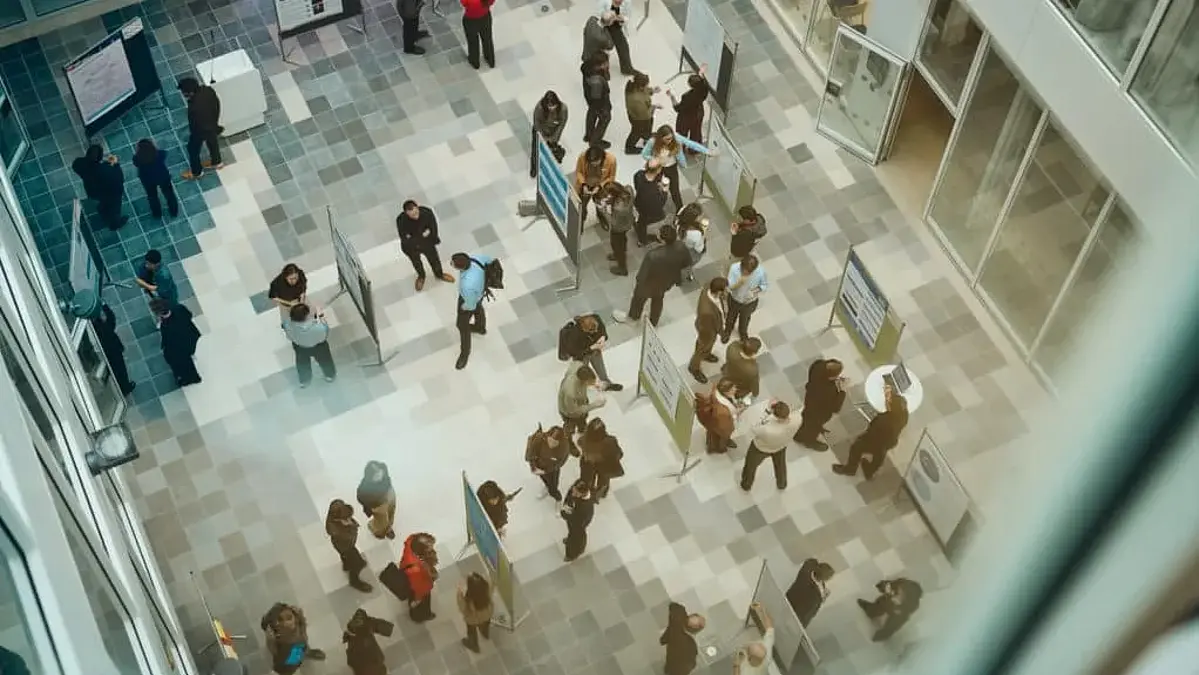
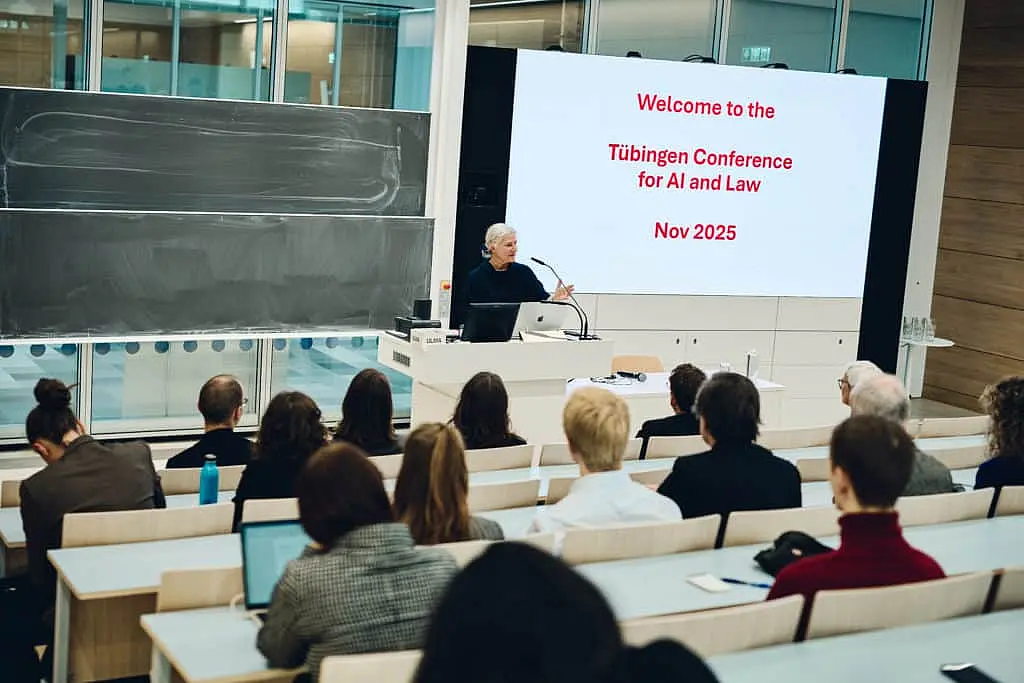
The Tübingen Conference for AI and Law (November 5-6, 2025, Cyber Valley Research Building) brought together international researchers from computer science and legal scholarship for two days of interdisciplinary exchange. It was funded by the Carl Zeiss Foundation and the Cluster of Excellence “Machine Learning: New Perspectives for Science”.
Keynote speakers included Sylvie Delacroix (King’s College London) on LLM interfaces and democratic renewal; Solon Barocas (Microsoft Research/Cornell) on generative AI in decision-making; Lilian Edwards (Newcastle University) on ChatGPT and transparency; Christoph Sorge (Saarland University) on machine learning and data protection; Michal Gal (University of Haifa) on regulating algorithmic competition; Christoph Kern (LMU Munich) on the human factor in AI pipelines; Christoph Engel (Max Planck Institute for Research on Collective Goods) on LLMs and legal commentary; Rediet Abebe (Harvard/ELLIS/Tübingen) on evaluating AI-evidence in courts; and Philipp Hacker (European New School of Digital Studies) on AI liability along the value chain.
Key topics included algorithmic fairness and explainability under the EU AI Act, AI liability and product safety, data protection and machine learning, competition law and algorithmic pricing, copyright in AI-generated content, and the use of LLMs in legal practice and adjudication. In addition to the keynotes, the program featured short talks and an extensive poster session, which included contributions from the institute’s own researchers (Stefan Thomas on algorithmic pricing, Kristof Meding on the Computational Law Lab, and Alina Wernick on the Law, AI and Society Group and on Biological Computing).
The conference was organized by the institute’s directors and group leaders (Michèle Finck, Ulrike von Luxburg, Stefan Thomas, Kristof Meding, and Alina Wernick) together with the Faculty of Law and the Department of Computer Science at the University of Tübingen..