Interfakultäres Institut für Mikrobiologie und Infektionsmedizin

Curriculum of the MSc Microbiology and Infection Biology

The Master of Science Microbiology and Infection Biology is a two years program with a total 120 ECTS credits. All modules except for the Elective Modules and the courses of the Interdisciplinary Module are graded and will contributed to the overall grade of the Master´s degree.

The first year will euqip you with broad foundation in microbiology and you will learn state-of-the-art molecular biology and biochemistry methods and bioinformatics. In addition, you can sharpen your profile by freely choosing modules from different research areas.

In the second year, experimental work in our laboratories is planned, as well as training in scientific communication.

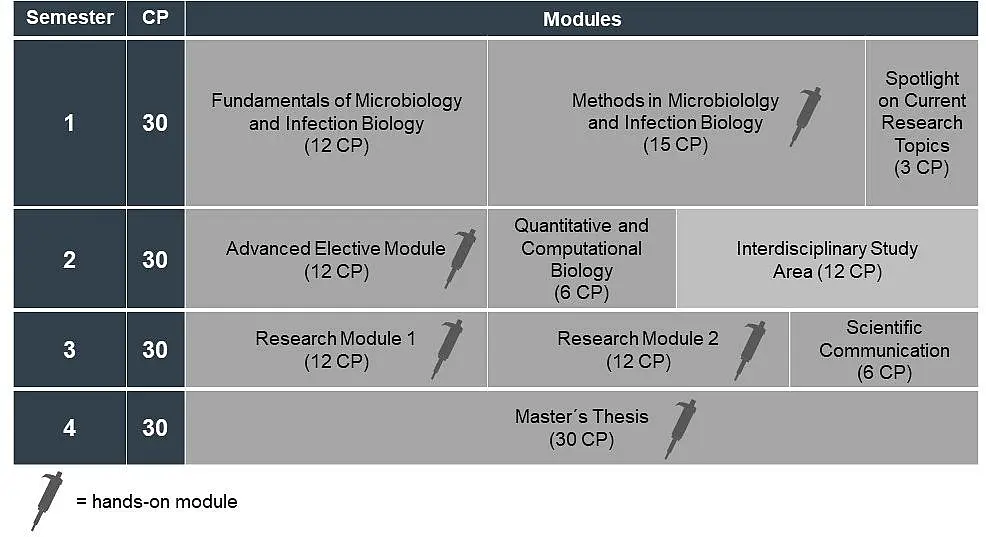
The table below shows a typical course of study. Depending on the selected courses, it may look different. The module handbook (module handbook) specifies content, teaching methods, prerequisites, and examination procedures for each module. The examination rules contain detailed information about the calculation of the final grade of the Master´s degree.

Fundamentals of Microbiology and Infection Biology

The module provides a comprehensive introduction to the fundamental principles of microbiology and infection biology. Through lectures and accompanying tutorials, students acquire a broad understanding of the biology, diversity, and interactions of microorganisms in environmental and host-associated systems. Topics covered include bacterial growth and physiology, microbial control, genome organization and gene expression, protein structure and function, metabolism, and the molecular mechanisms underlying microbial adaptation, signaling, evolution, and diversity. The module also addresses bacterial ecology, host–microbe interactions, and the composition and function of the human microbiota, with particular emphasis on mucosal microbiota and its role in immune homeostasis. In the field of infection biology, students gain insight into pathogen–host interactions, microbial virulence mechanisms, immune responses to infection, and current approaches to antimicrobial therapy, including the development and spread of antimicrobial resistance.

Following a flipped-classroom approach, students independently explore selected topics based on the lecture content and present and discuss their findings in seminars. This format promotes self directed learning, scientific communication skills, and the ability to engage with current research questions.
The module thereby provides a solid foundation for advanced studies in microbiology, infection biology, and related life science disciplines.

Methods in Microbiology and Infection Biology

In the lecture, students are introduced to fundamental methods in microbiology, molecular biology, biochemistry, and infection biology. Topics include classical microbiological techniques, genetic engineering methods, sequencing technologies, RNA-based methods, cell culture techniques, infection models, basic diagnostic procedures, and approaches for the detection of antibiotic activity. In addition, students gain an understanding of modern biochemical and biophysical methods for the analysis of protein–protein and protein–DNA interactions, protein purification and characterization, as well as advanced imaging techniques. 

The accompanying exercises consolidate the theoretical knowledge by focusing on experimental design, data interpretation, troubleshooting, and the identification of potential sources of error. During the laboratory practical, students independently perform selected microbiological, molecular biological, and biochemical methods in accordance with principles of good laboratory practice. 

Furthermore, students can choose from a range of advanced state-of-the-art methodologies and explore them in small-groups in the respective specialized research groups

Spotlight on current research topics

In the lecture, students gain insight into current research activities and emerging topics in microbiology by learning about the projects and research focus areas of the different microbiology research groups at the University of Tübingen. The accompanying seminar includes either presentations by representatives of start-ups or biotechnology companies or an excursions to research institutions or companies. In addition, students participate in the poster session of the previous students cohort, providing them with an opportunity to engage with ongoing research projects, discuss scientific results, and gain experience in scientific communication. The poster session also fosters interaction and networking between different student cohorts, encouraging the exchange of experiences, ideas, and research interests within the programme.

Advanced Elective Module

Students can select from different specialized courses in the areas of Microbiology and Infection Biology.

The following 6 CP-courses are offered by our labs:

  • Advanced Infection Biology
  • Antibiotics - Modes of Action and Resistance
  • Applied Biotechnology
  • Genome Mining and Natural Product Biosynthesis
  • Microbe-Host-Interactions
  • Microbial Glycobiology
  • Microbial Pathogenicity
  • Microbiome Study - Hands on experience
  • Molecular Structures and Interactions

Additionally the following courses can be credited (with the designated CP) in the Advanced Elective Module:

  • Environmental Microbiology and Geomicrobiology
  • Lab Course Geomicrobiology
  • thematically suitable courses that are completed during your study abroad

Quantitative and Computational Biology

Courses offered within this module will teach and deepen selected topics from and relevant to the computational life sciences. Individual courses focus on sequence bioinformatics, structural bioinformatics, integrative bioinformatics, systems biology, data handling and analysis, statistics, or other relevant topics in the area of computational biology and bioinformatics. The focus of accompanying tutorials is to learn to implement algorithms of theoretical models and to analyze large life science data sets.

Interdisciplinary Study Area

In this Module students can choose any course offered by the University of Tübingen to extend their studies in the direction of other disciplines. Of course, it is also possible to choose the microbiology and infection biology courses from the Advanced Elective Module as they are also part of the courses offered by the University of Tübingen.

Research Modules

In these Modules students will be given the opportunity to work in the labs of their choice to develop their preferences. Students learn how to work independently on a scientific project in a research group and to design, implement and evaluate experiments in preparation for their Master´s thesis. In one of the Research Modules students present the progress and background of their experimental work in a scientific poster and in the other one they will prepare a protocol and report on their experimental work in an oral presentation.
One of the Research Modules can also be completed in a lab outside the University of Tübingen. We offer two places at the University of Aix-Marseille every year (More infomation can be found in the Studying abroad section).

Scientific Communication

The course aims to strengthen scientific communication skills, with a particular focus on writing skills in preparation for the master’s thesis. The structure, content, and style of scientific manuscripts are addressed. Core concepts are taught through a combination of lectures, small-group exercises, and written essays, for which students receive extensive personalized feedback. In the journal club, primary scientific articles are discussed. 

Another part of the course focuses on the structure and content of scientific posters.

Master´s Thesis

In the thesis, the students work independently on a research project.
They acquire new data, exploit and interpret their results, design clear and informative figures and write a clear and concise thesis. The results should contribute to the gain of knowledge of the scientific community.
Participation in lab meeting/progress report.
