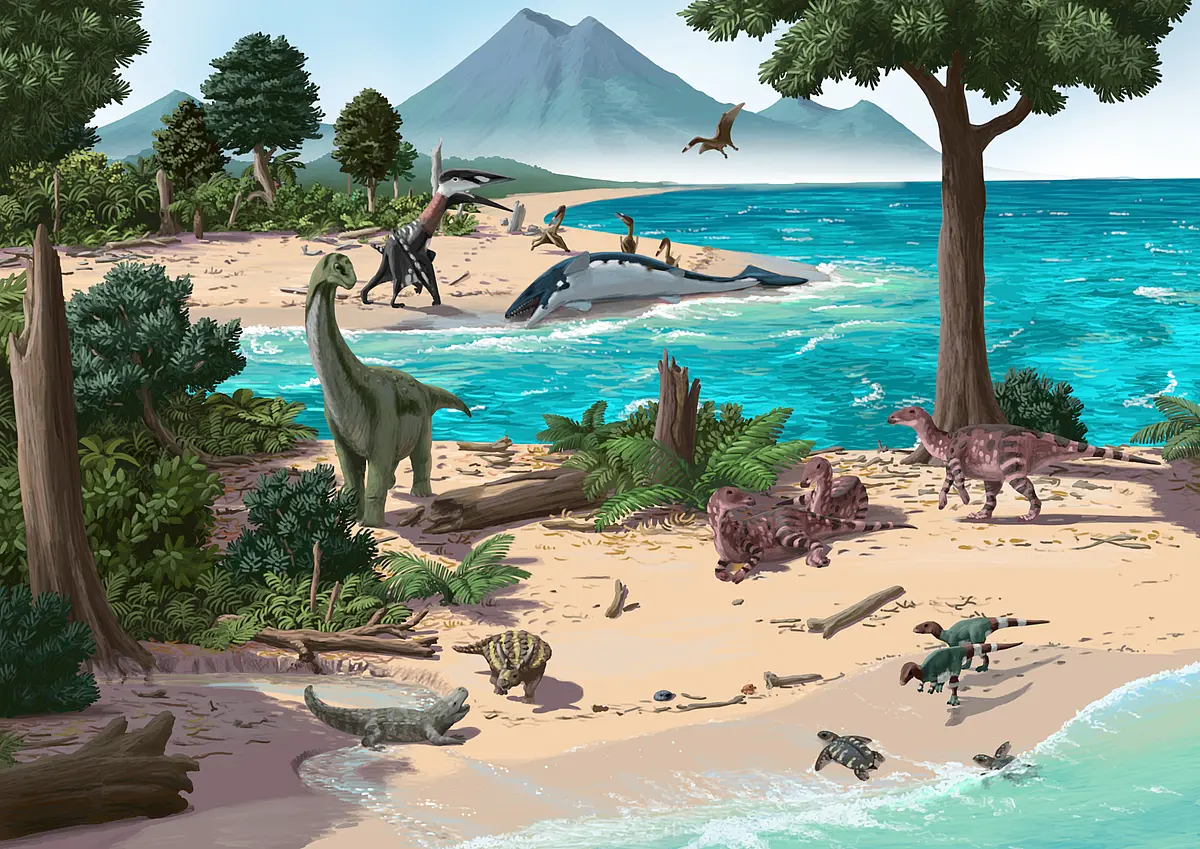
* Augustin, F.J., Csiki-Sava, Z., Matzke, A.T., Botfalvai, G., Rabi, M. 2021. A new latest Cretaceous pleurodiran turtle (Testudinata: Dortokidae) from the Hateg Basin (Romania) documents end-Cretaceous faunal provinciality and selective survival during the K-Pg extinction. Journal of Systematic Palaeontology 19: 1059-1081.https://doi.org/10.1080/14772019.2021.2009583
* Augustin, F.J., Matzke, A.T., Maisch, M.W., Pfretzschner, H.-U. 2021. New information on Lonchognathosaurus (Pterosauria: Dsungaripteridae) from the Lower Cretaceous of the southern Junggar Basin (NW China). Cretaceous Research 124: 104808. https://doi.org/10.1016/j.cretres.2021.104808
* Augustin, F.J., Matzke, A.T., Maisch, M.W., Pfretzschner, H.-U. 2021. Dinosaur taphonomy of the Jurassic Shishugou Formation (Northern Junggar Basin, NW China) – insights from bioerosional trace fossils on bone. Ichnos, 28(2): 87-96. https://doi.org/10.1080/10420940.2021.1890590
* Augustin, F.J., Bastiaans, D., Dumbravă, M.D., Csiki-Sava, Z., 2022. A new ornithopod dinosaur, Transylvanosaurus platycephalus gen. et sp. nov. (Dinosauria:Ornithischia), from the Upper Cretaceous of the Haţeg Basin, Romania, Journal of Vertebrate Paleontology, 42:2 e2133610 https://doi.org/10.1080/02724634.2022.2133610 , Press release
* Augustin, F.J., Dumbravă, M.D., Bastiaans, D., Csiki-Sava, Z. 2022. Reappraisal of the braincase anatomy of the ornithopod dinosaurs Telmatosaurus and Zalmoxes from the Upper Cretaceous of the Haţeg Basin (Romania) and the taxonomic reassessment of some previously referred specimens. PalZ, 1–17. https://doi.org/10.1007/s12542-022-00621-x
* Augustin, F.J., Kampouridis, P., Hartung, J., Abersdörfer, R., Matzke, A.T., 2022. The geologically oldest specimen of Pterodactylus: a new exquisitely preserved skeleton from the Upper Jurassic (Kimmeridgian) Plattenkalk deposits of Peinten (Bavaria, Germany). Fossil Record 25(2): 331-343. https://zoobank.org/E342050A-E2C2-47F4-A315-09B507E6D267
* Augustin, F.J., Matzke, A.T., Maisch, M.W., Csiki-Sava, Z. 2022. Pterosaur remains from the Lower Cretaceous Lianmuxin Formation (upper Tugulu Group) of the southern Junggar Basin (NW China). Historical Biology 34: 312-321. https://doi.org/10.1080/08912963.2021.1910819
* Augustin, F.J., Matzke, A.T., Maisch, M.W., Kampouridis, P., Csiki-Sava, Z. 2022. The first record of pterosaurs from the Lower Cretaceous Hutubei Formation (lower Tugulu Group) of the southern Junggar Basin (NW China) – A glimpse into an unusual ecosystem. Cretaceous Research 130: 105066. https://doi.org/10.1016/j.cretres.2021.105066
* Augustin, F.J., Ösi, A., Csiki-Sava, Z., 2023. The Rhabdodontidae (Dinosauria, Ornithischia), an enigmatic group endemic to the Late Cretaceous European Archipelago. Fossil Record 26(2): 171-189. https://zoobank.org/3168FE10-A551-4F73-8D99-0FE627D642C0 Media report
* Augustin, F.J., Rabi, M., Spindler, F., Kampouridis, P., Hartung, J., Albersdörfer, R, Matzke, A.T. 2023. A new specimen of Solnhofia parsonsi from the Upper Jurassic (Kimmeridgian) Plattenkalk deposits of Painten (Bavaria, Germany) and comments on the relationship between limb taphonomy and habitat ecology in fossil turtles. PLoS ONE 18(7): e0287936. https://doi.org/10.1371/journal.pone.0287936 press release (German) press release (English)
* Ebner, A.J., Csiki-Sava, Z., Treiber, T., Totoianu, R., Augustin, F.J., 2025. First hadrosauroid record from Petreşti-Arini (Transylvanian Basin, Romania; Upper Cretaceous) and its implications for the evolution of the Hațeg Island vertebrate faunas. Palaeoworld 34(5): 200937. https://doi.org/10.1016/j.palwor.2025.200937
* Li, L., Zhou, C.F., Rabi, M., 2022. The skeletal anatomy of Manchurochelys manchoukuoensis (Pan-Cryptodira: Sinemydidae) from the Lower Cretaceous Yixian Formation. Historical Biology 34: 538-554. https://doi.org/10.1080/08912963.2021.1934834
* Magyar, J., Csiki-Sava, Z., Osi, A., Augustin, F.J., Botfalvai, G., 2024. Rhabdodontid (Dinosauria, Ornithopoda) diversity suggested by the first documented occurrence of associated cranial and postcranial material at Valioara (uppermost Cretaceous Densus-Ciula Formation, Hateg Basin, Romania). Cretaceous Research 156: 105810. https://doi.org/10.1016/j.cretres.2023.105810
* Maidment, S., Butler, R.J., Brusatte, S.L., Meade, L.E., Augustin, F.J., Csiki-Sava, Z. Ösi, A., in press. A hidden diversity of ceratopsian dinosaurs in Late Cretaceous Europe. Nature https://doi.org/10.1038/s41586-025-09897-w
* Owocki, K., Kremer, B., Cotte, M., Bocherens, H., 2020. Diet preferences and climate inferred from Oxygen and Carbon isotopes of tooth enamel of Tarbosaurus bataar (Nemegt Formation, Mongolia). Palaeogeography, Palaeoclimatology, Palaeoecology 537: 109190. https://doi.org/10.1016/j.palaeo.2019.05.012 media report
* Szegszárdi, M., Ösi, A., Rabi, M., 2026. Cretaceous crocodyliform reconciles conflicting evidence on the Mesozoic paleogeography of Europe during the Gondwana-Laurasia split. Scientific Reports 16: 2842. https://doi.org/10.1038/s41598-025-28504-6
* Treiber, T., Csiki-Sava, Z., Ebner, A.J., Augustin, F., 2025. New report of Late Cretaceous struthiosaurids from the Hateg Basin, with an overview of the Transylvanian ankylosaur fossil record. Palaeobiodiversity and Palaeoenvironments 105: 517-543. https://doi.org/10.1007/s12549-025-00661-6
*Tschopp, E., Araújo, R., Brusatte, S.L., Hendrickx, C., Macaluso, L., Maidment, S.C.R., Rabi, M., Rashid, D., Romano, C., Williamson, T., 2020. Dinosaurs, but not only: Vertebrate evolution in the Mesozoic. In: E. Martinetto et al. (eds), Nature through time. Springer textbooks in Earth Sciences, Geography and Environment. https://doi.org/10.1007.978-3-030-35058-1_7
Uhl, D., Bocherens, H., El Atfy, H., Havlik, P., Methner, K., Mulch, A., Solórzano Kraemer, M.M., 2020. Die Umwelt zu Edmonds Lebzeiten. Senckenberg / Natur-Forschung-Museum 150: 56-65.
* Walter, J., Massonne, T., Paiva, A.L.S., Martin, J.E., Delino, M., Rabi, M., 2025. Expanded phylogeny elucidates Deinosuchus relationships, crocodilian osmoregulation and body-size evolution. Communications Biology 8, 611. https://doi.org/10.1038/s42003-025-07653-4 media report 1