Institut für Physikalische und Theoretische Chemie

Recent research highlights

Selected research highlights. Research efforts were mainly devoted to interface properties of small pi-conjugated molecules.

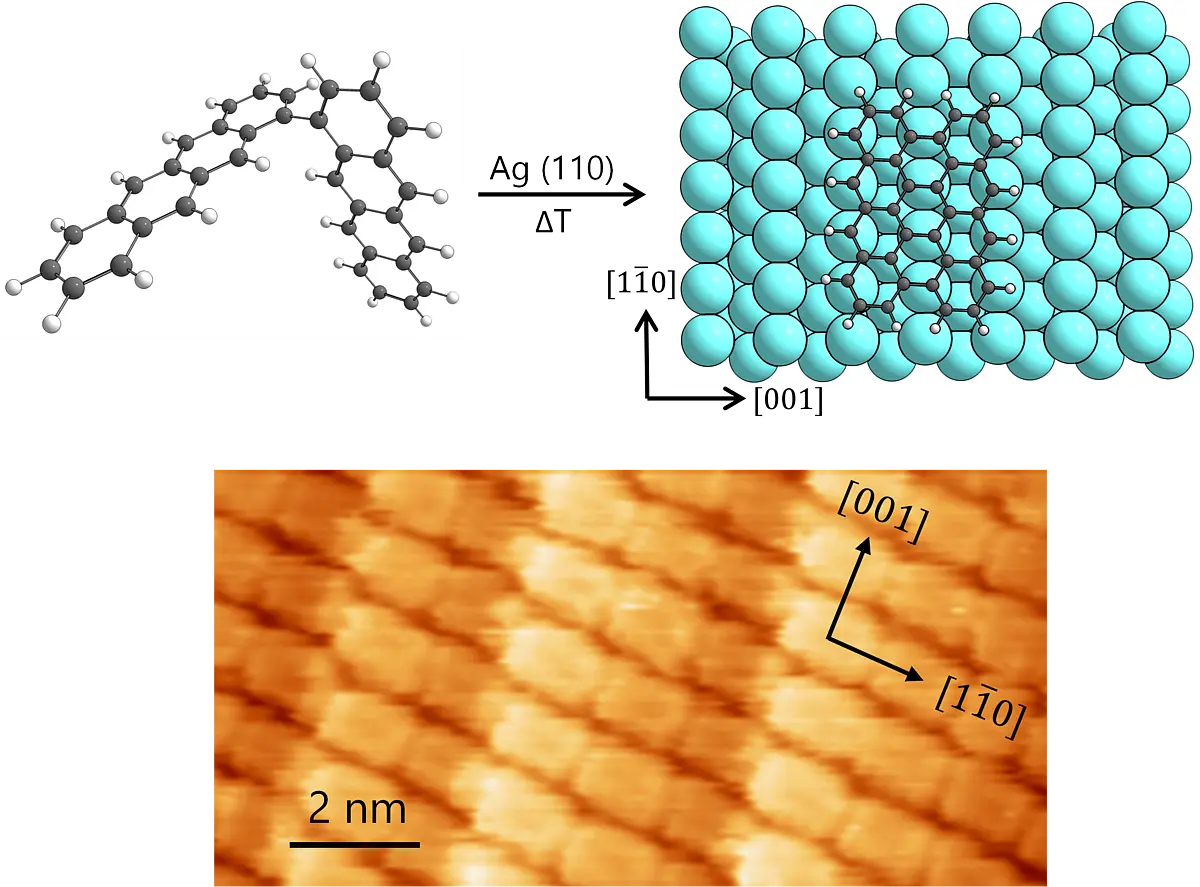
Highly Ordered Single Domain Peri-Tetracene Monolayers on Ag (110)

The on-surface reaction of 1,1’-bitetracene (Bi4A) to peri-tetracene (tetrabenzo[bc,ef,kl,no]coronene) (4-PA) on Cu (110) and Ag (110) is studied by photoemission, scanning tunneling microscopy (STM) and low energy electron diffraction (LEED). DFT computations suggest that the Ag (110) substrate is well suited for the formation of large area 4-PA monolayers with a preferential adsorption alignment of 4-PA molecules along the [11 ̅0] direction. The experiments confirm the formation of 4-PA and presence of large highly ordered 4-PA domains. Two distinct phases emerge, growing seamlessly over large areas and even spanning step edges. Evidence for charge transfer from the substrate to the molecule was found, resulting in a filling of the LUMO of 4-PA.

Highly Ordered Single Domain Peri-tetracene Monolayers on Ag (110), Maren Zirwick, Nina Kainbacher, John Bauer, Marie Wagner, Peter Puschnig, Thomas Chassé, Holger Bettinger, Heiko Peisert, The Journal of Physical Chemistry C, 129 (2025) 8447−8454.

Research Highlight 2022 of the Synchrotron SOLEIL

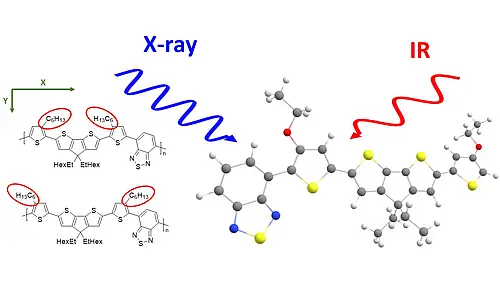
July 2023: Our recent research on self organization properties of "Low band gap polymers" is online (SUSTAINABLE ENERGY, page 90)! https://www.synchrotron-soleil.fr/highlights/2022/#page=90

Associated publication:

The preferred molecular orientation of the studied "Low band gap" polymers depends strongly on the position and kind (alkyl or alkoxy) of the side chain at the thienylene spacers. The homogeneous molecular orientation within the 50 nm thick films enables the comparison of different methods for the determination of the molecular orientation with different surface sensitivity: X-ray absorption (XAS) in fluoreszence and electron yield mode as well as Polarization Modulation Infrared Reflection-Absorption Spectroscopy (PM-IRRAS). All methods deliver comparable and consistent information about the orientation of polymers in thin films. We suppose that these results promote comprehensive studies of the interplay between the chemical structure of polymers and self-organization properties in thin films, even with standard methods available in the home-lab, such as PM-IRRAS.

Influence of the Side Chain Structure on the Electronic Structure and Self-Organization Properties of Low Band Gap Polymers, Sven Bölke, David Batchelor, Andreas Früh, Benedikt Lassalle-Kaiser, Tina Keller, Florian Trilling, Michael Forster, Ullrich Scherf, Thomas Chassé, Heiko Peisert, ACS Appl. Energy Mater. 5 (2022) 15290–15301.

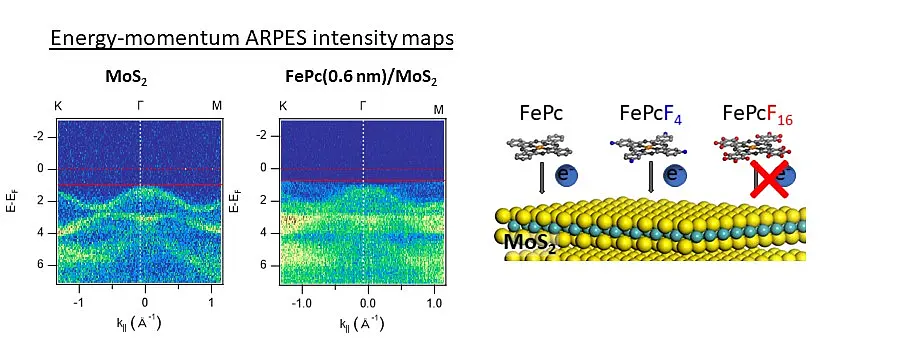
Charge Transfer from Organic Molecules to Molybdenum Disulfide: Influence of the Fluorination of Iron Phthalocyanine

Layered transition metal dichalcogenides (TMDCs), such as molybdenum disulfide (MoS2), are currently in the focus of interest due to their novel electronic properties. The adsorption of molecules is a promising way to tune the electronic structure of TMDCs. We study interface properties between MoS2 and differently fluorinated iron phthalocyanines (FePcFx, x = 0, 4, 16) using X-ray photoelectron spectroscopy (XPS), ultraviolet photoelectron spectroscopy (UPS), angle-resolved photoelectron spectroscopy (ARPES), and X-ray absorption spectroscopy (XAS). A key parameter for the charge transfer is the ionization potential of FePcFx. A distinct electron transfer from a molecule to a substrate is observed for FePc and FePcF4. From energy-momentum ARPES maps, we suppose that the substrate and FePc-related states hybridize at the interface. This study demonstrates that a controlled tuning of the electronic structure of MoS2 by electron donors is possible, driven by the ionization potential difference between the substrate and the adsorbate.

Charge Transfer from Organic Molecules to Molybdenum Disulfide: Influence of the Fluorination of Iron Phthalocyanine, Katharina Greulich, Axel Belser, Sven Bölke, Peter Grüninger, Reimer Karstens, Marie Sophie Sättele, Ruslan Ovsyannikov, Erika Giangrisostomi, Tamara V. Basova, Darya D. Klyamer, Thomas Chassé, Heiko Peisert, The Journal of Physical Chemistry C, 124 (2020) 16990–16999.