

“We are Africans, but we are not really in Africa”
by Kerstin Schopp
15.07.2026

On 26 March 2026, in a study hall at the Hassan II University of Casablanca, the Secretary-General of the European CIVIS University Alliance signed the African Charter for Transformative Research Collaboration (AC).
Since 5 July 2023, the AC has been a new framework for designing and developing research cooperation and partnerships. Its formulation was a co-creational process that included Africa’s major higher education constituencies and local stakeholders, who were able to contribute their interests and help shape the Charter. The AC aims to promote fairer and more diverse scientific collaboration, and defines core values for all researchers.
Before the CIVIS Secretary-General signed the AC, representatives and officials gave short speeches exploring the meanings of transformation, equality, and partnerships in the context of African-European university collaboration.
With my notebook on my knees and a pencil in my hand, I listened intently, taking notes to help me reflect on what I had learned and to integrate this knowledge into my own research on the African continent and my knowledge on (Education for) Sustainable Development. However, the most important comments for me came from my colleague from Mozambique, who sat next to me and couldn’t stop whispering in my ear, implicitly helping me to contextualize what I had heard [1].
An “uneven playing field in Africa” [2]
The AC emphasizes that, to this day, there are multilayered power imbalances and challenges in the global production of scientific knowledge, created by a Western-centric perspective that shapes this production. These are epistemologies that include the dominance of Western knowledge systems, languages, theories, and concepts; the assumption that “deficient” Africa must catch up with Western knowledge to enable development; resource constrain, given that many financial resources in Africa go towards basic education, which has implications for African research funding; and research agreements that are shaped by these asymmetries. [3]
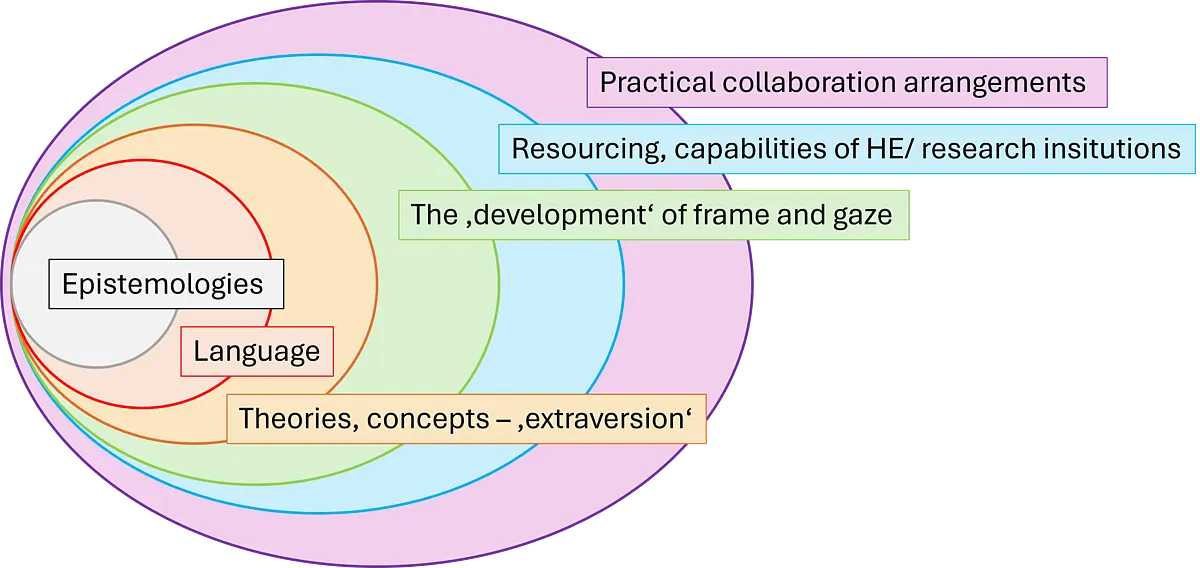
Picture 1: Multi-layered power imbalances in the global production of scientific knowledge. (Source: African Charter for Transformative Research Collaboration, p. 5)
While listening to the speakers who explained that partnerships need to be redesigned to address past and present inequalities and establish equitable partnerships, I noted what my colleague said to me. As her comments were remarkable and made me start to reflect during the event, I wanted to share her thoughts with others. For this reason, I will use some of her quotes below to provide valuable insights into how she experienced the event, as well as pairing them with my own impressions, and insights from the conference sessions.
“We are Africans, but we are not really in Africa.”
This quote can refer to two facts. Firstly, she emphasized how the entire event was organized, timed, and executed. For her, it felt very “un-African” to listen to the mainly white speakers that morning without celebrating the signing of the charter adequately. When another colleague cheered with a very distinctive voice after some photos had been taken, many people looked irritated. Her colleague then explained that people in Mozambique celebrate in this way when something joyful happens. However, there was no room in the plan for this non-European way of celebrating. Secondly, in my opinion, my colleague referred to the acknowledgement of African languages and knowledge in a landscape that is shaped by academic knowledge which has mostly been created in the Global North and then ‘exported’ to the rest of the world (see Picture 1: 1.-3.). This is also emphasized by the following quote:
“We have so much to offer, but it is not recognized.”
She referred to the way knowledge is created in universities and whispered to me that there is no room for local knowledge or languages in academia (see Picture 1: 1.-3.). When one speaker asked the question which knowledge is spread to the world and whose voices are heard, and whether there has been an Africanization of university knowledge, she nodded vigorously to demonstrate the relevance of these questions. For her, trust and decolonialization are fundamental to feeling that she can be African in Africa; to African universities uniting and finding their voices; to Africans being recognized. According to her, this last point would be reflected in academic interest in the African continent. The following quote is also closely connected:
“I don’t like the discussion on African scholarship.”
A key issue raised in all the speeches was visa constraints and funding for young African researchers who should have the opportunity for an academic stay in the Global North. My colleague, however, had an additional perspective: Europeans also need to come to Africa to experience the university and knowledge landscape there. Such an experience would broaden their understanding of different ways of thinking and ultimately transforms them. The strength of CIVIS and its African partner universities lies in their inherent plurality of knowledge, which must be recognized as beneficial to both European and African partners.
Recognizing this strength can contribute to the redress of power imbalances in global scientific knowledge creation, as set out in the AC principles, such as “Assume a non-universal validity of- and de-centre Western-centric-epistemological orientations and seek to build on existing or generate new alternatives from the continent” [4].
“Politics doesn’t work here, that means that we need to discuss it at home.”
Some speakers also mentioned power asymmetries expressed through different access to mobility (e.g. travel budget), as well as different priorities, contexts, expectations, and constraints (e.g. access to the internet). They then explained that the inflexibility of funders in the Global North means that these challenges cannot be adequately addressed, and they identified the need for CIVIS to liaise with the European Commission on visa behalf. For this reason, the practical operation needs to be challenged, just as the way how partnerships are designed (see Picture 1: 6.). When one speaker said, “[…] we have something in the pipeline, we will not change the world, but we will try”, my colleague just sighed. This reaction demonstrates the resignation and the feeling of being let down (again) when the wheels of politics turn too slowly to bring about any tangible change.
Notwithstanding, realities are complex, and it is necessary to unveil and discuss the mindsets, interests, needs, and expectations of all partners. During the conference, all participants agreed that the status quo must be changed. Signing the AC could be the first step towards decolonizing our academic partnerships, achieving equitable research collaboration, and fostering transregional sustainable development. It is now the task of the CIVIS alliance members to foster trust and mutual benefit, act in accordance with their own words, and to recognize the contribution of each partner to avoid letting down individual members of their partner universities, such as my colleague in Mozambique.
A speaker from South Africa shared a proverb from her home country: “If you want to go fast, go alone, if you want to go far, go together.” As members of the CIVIS alliance, the universities will not necessarily be the fastest, but their cooperation and awareness have the potential to make their partnership with African universities more decolonial and just.
----------------------------------------
Footnotes:
[1] This text has been approved by her: “The text reflects what we discussed. You translated that moment very well, and you are letting my voice be heard.”
[2] African Charter for Transformative Research Collaboration, p. 5: https://www.berlin-university-alliance.de/en/commitments/international/bcge/ressourcen/Africa-Charter.pdf (26.05.2026).
[3] African Charter for Transformative Research Collaboration, p. 5, 7-9. Quote: p. 5.
[4] African Charter for Transformative Research Collaboration, p. 7.
Autor: Kerstin Schopp
Short link to share article: https://uni-tuebingen.de/de/299607