2023 - 2024
Saulo Albuquerque, Sebastian H. Völkel, Kostas D. Kokkotas and Valdir B. Bezerra
Analog gravity systems provide the possibility to study several properties of black holes and exotic compact objects in laboratory experiments. In these systems, waves propagating through a medium can be described by equations similar to those governing perturbations around astrophysical compact objects. In contrast to astrophysical observations, laboratory experiments may provide direct access not only to characteristic oscillation frequencies, but also to the transmission and reflection of waves. In earlier works carried out in the group, we studied the inverse problem for astrophysical ultra-compact objects. The main idea was to use their characteristic frequencies and damping times, the so-called quasi-normal modes, to reconstruct properties of the effective potential governing the perturbations. The present works extend this idea to analog gravity systems, where similar inverse methods can be applied to quantities that are, in principle, directly measurable in the laboratory.
In our first paper [1], we present a semiclassical and non-parametric method to reconstruct an effective potential from transmission and reflection coefficients. The method applies to systems that show resonant tunnelling, where waves are temporarily trapped between a reflecting inner region and an outer potential barrier. As an example, we apply the reconstruction to an imperfect draining vortex, which has been proposed as an analog model of an extreme compact object. Although the inverse problem is in general not unique, the method provides an accurate effective potential under physically motivated assumptions.
A further complication appears when the effective potential depends explicitly on the energy of the wave. Such potentials occur in several areas of physics, including black-hole perturbation theory and rotating analog gravity systems. In our second paper [2], we extend known semiclassical inversion methods to this case. We show how energy-independent potentials can be constructed that reproduce the most important spectral and scattering properties of the original energy-dependent system.
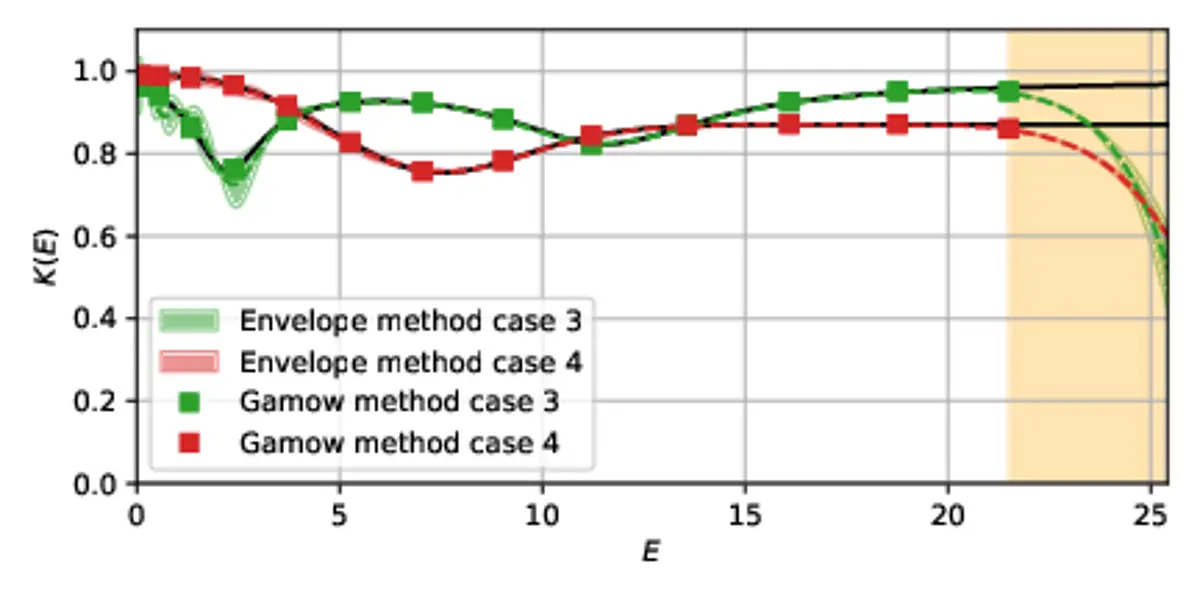
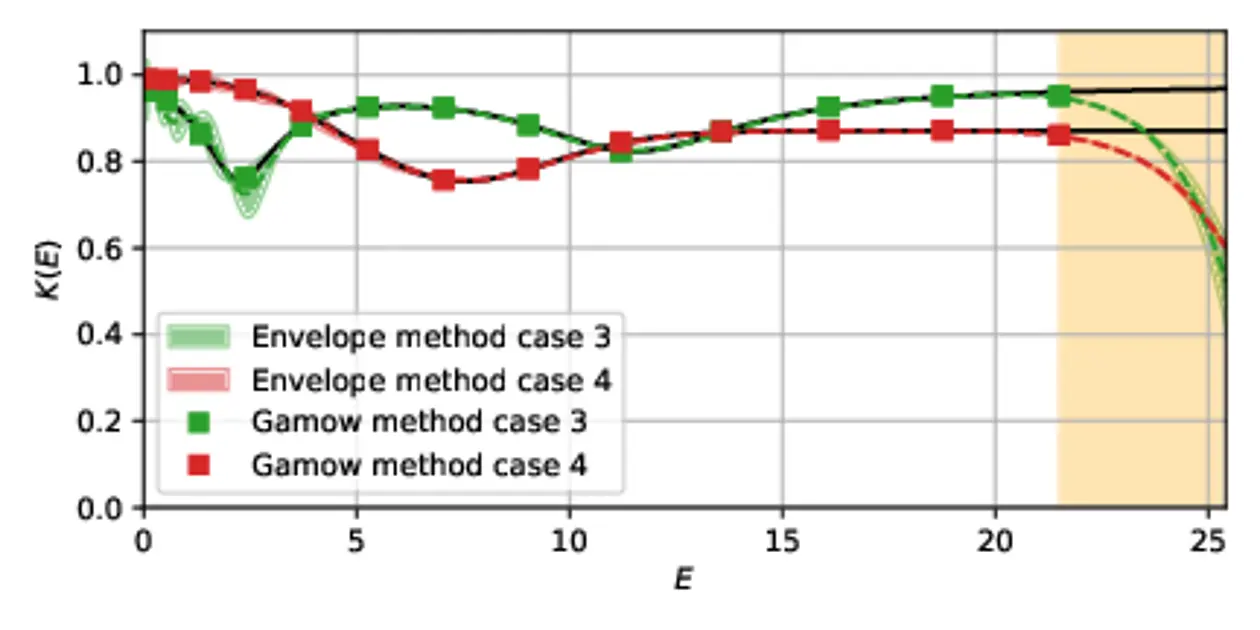
In our third paper [3], we combine both developments and study a rotating imperfect draining vortex with energy-dependent boundary conditions. From the resonant transmission spectrum, we reconstruct an effective potential with similar spectral properties to the original system. We also show that information about the boundary condition at the core of the vortex can be recovered. This includes the case in which the reflectivity of the core changes with the frequency of the incoming wave.
These results show that inverse methods originally developed for astrophysical compact objects can also be useful for analog gravity experiments. They may allow one to extract information about both the effective geometry and the central region of an analog system directly from its measured scattering properties.
[1] Albuquerque, S., Völkel, S.H., Kokkotas, K.D. & Bezerra, V.B. (2023). Inverse problem of analog gravity systems. Phys. Rev. D, 108, 124053. DOI: https://doi.org/10.1103/PhysRevD.108.124053
[2] Albuquerque, S., Völkel, S.H. & Kokkotas, K.D. (2024). Inverse problem in energy-dependent potentials using semiclassical methods. Phys. Rev. D, 109, 096014. DOI: https://doi.org/10.1103/PhysRevD.109.096014
[3] Albuquerque, S., Völkel, S.H., Kokkotas, K.D. & Bezerra, V.B. (2024). Inverse problem of analog gravity systems II: Rotation and energy-dependent boundary conditions. Phys. Rev. D, 110, 064084. DOI: https://doi.org/10.1103/PhysRevD.110.064084