
22.10.2026
Wi-REX in conversation 2026/2027: Between the need for protection and cultural hegemony – The diversity of threat scenarios
Online lecture series from 2. November 2026 - 08. February 2027 with Prof Léonie de Jonge
Right-wing extremism is a complex phenomenon that cannot be reduced to a single manifestation. To tackle it effectively, dialogue is needed between academia, practitioners and the public. The lecture series ‘Wi-REX in Conversation’ demonstrates that right-wing extremism is having an impact across a wide range of social spheres. Right-wing extremism manifests itself in concrete threats to local activists, in strategic campaigns against climate action, in the digital discrimination against people with disabilities, in the subtle politicisation of everyday culture and, last but not least, in the targeted influence exerted on academic and cultural institutions by right-wing governments.
The research landscape on right-wing extremism in Germany has so far lacked autonomy, networking and coherence. This is where the Knowledge Network for Research on Right-Wing Extremism (Wi-REX), which has been active since 1 January 2023, comes in: It systematises knowledge about the phenomenon of right-wing extremism, facilitates dialogue between academic and non-academic stakeholders, organises the transfer of knowledge from academia to practice, and supports early-career researchers. Over the five-year project period and through the structures that will develop as a result, the aim is thus to strengthen research into right-wing extremism as a whole.
Wi-REX is organised by four academic institutions with a strong track record in research into right-wing extremism: the Institute for Interdisciplinary Conflict and Violence Research (IKG) at Bielefeld University, the Centre of Excellence for Research on Right-Wing Extremism and Democracy (KReDo) at Leipzig University, the Institute for Democracy and Civil Society (IDZ) in Jena, and SO.CON – the Institute for Research and Development in Social Work at the Niederrhein University of Applied Sciences. Together, they lead the three platforms – Research, Early-Career Research and Knowledge Transfer – which make up the knowledge network.
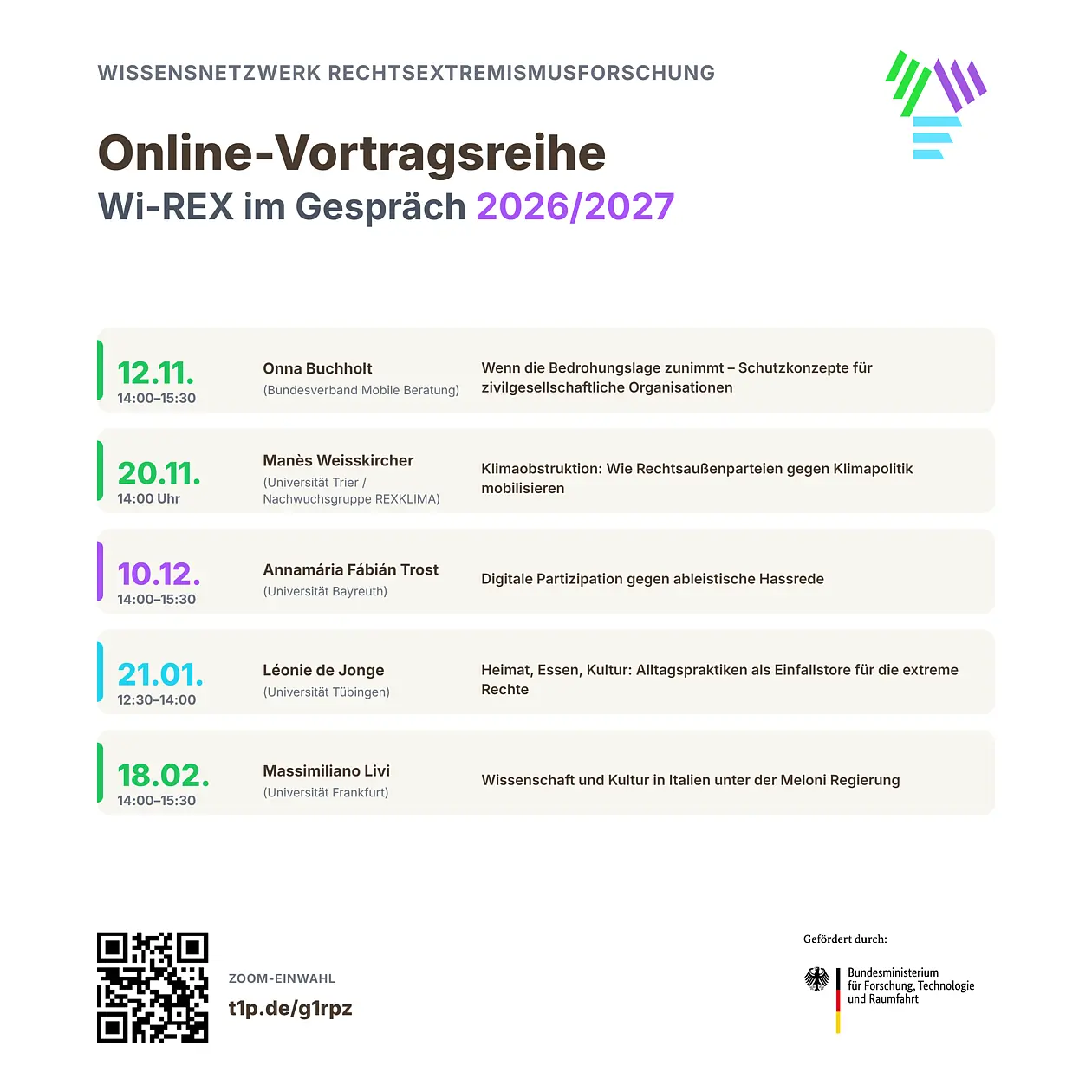
Online lecture series 2026/2027:
12.11.2026 – 14:00-15:30 Uhr Onna Buchholt (Federal Association for Mobile Counselling) | When the threat level rises – protection strategies for civil society organisations (in German) |
20.11.2026 – 14:00 Uhr Manès Weisskircher (University of Trier / REXKLIMA Early-Career Research Group) | Climate obstruction: How far-right parties are mobilising against climate policy (in German) |
10.12.2026 – 14:00-15:30 Uhr Annamária Fábián Trost | Digital participation against ableist hate speech (in German) |
21.01.2026 – 12:30-14:00 Uhr Léonie de Jonge | Home, food, culture: Everyday practices as gateways for the far right (in German) |
18.02.2026 – 14:00-15:30 Uhr Massimiliano Livi (University of Frankfurt) | Science and culture in Italy under the Meloni government (in German) |
Zoom dial-in: t1p.de/g1rpz (all events)