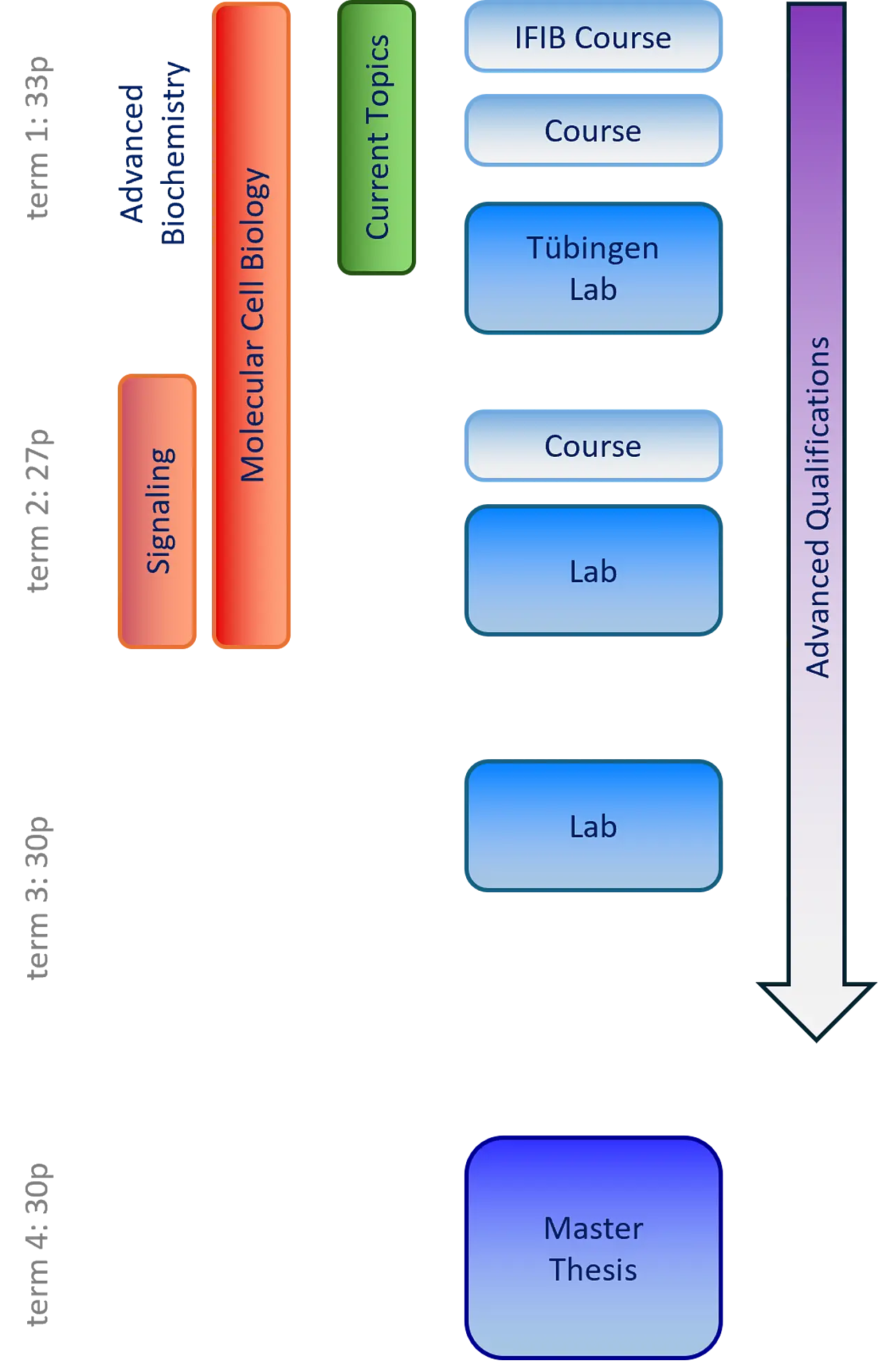
Courses are elements of the master program lasting about 75h plus preparation time. They typically consist of a theory part in the form of lectures and seminars plus a practical part. Most are evaluated by a combination of a protocol and an oral examination. You will select a total of 3+ course. Each course is 6 credit points according to ECTS.
IFIB courses (at least 1 from this pool)
- Cell biochemistry of organelles (Rapaport)
- Cell signaling (Feil)
- Chemical biology (Schwarzer)
- Genetic engineering (Gust, Fuß)
- Cellular Mechanisms of Anti-Cancer Therapy (Schulze-Osthoff, Eßmann)
- Post-transcriptional control / RNA (Jansen)
- Nucleosomes: from structure to function (Deindl)
- Microscopy techniques (Wolters)
Courses from contributing investigators
- Cell biochemistry with fluorescent fusion proteins (Rothbauer)
- Imaging from probe development to in vivo application (Bezier)
- Immunology (Weber & colleagues)
- Microbial pathogens (Wagner, Peschel, Götz & Wolz)
- Osteogenesis and wound closure in vitro (Ehnert)
- Pathobiochemistry (Weigert)
Apart from the requirement of at least 1 IFIB course, you are completely free to choose according to your personal preferences and aims. You could, for example, focus on clinically relevant topics like molecular medicine, pharmacology and pathobiochemistry. Or you could hone your technical skills with bioinformatics, microscopy and toxicology techniques. It's up to you.