
Publikationen


The AfD and Antifeminism in Germany, 2014–2025: Family First, Trans Panic Second
Autor*innen: Sabine Volk

Why is antifeminism particularly strong in the east of Germany? This article contributes to tackling this puzzle by studying antifeminism and far-right politics across different levels of the federal polity. Specifically, the paper analyses the politics of gender by the country’s key antifeminist party player, the far-right Alternative for Germany (AfD). To shed light on the specificities of the eastern German AfD, the paper compares the official political positioning of two eastern German AfD groups, AfD Saxony and AfD Thuringia, with the federal party. Methodologically, the research draws from a qualitative manifesto analysis of ten official documents (2014–2025). The systematic comparison of the manifestos across cases and time reveals that the party’s ideological profile on gender issues is highly homogeneous across groups. The AfD’s antifeminism has been overall consistent since 2014, while the party strategically focuses on radicalising anti-gender and anti-trans positions in recent years. The key difference between eastern German AfD groups and the federal party concerns issue salience, with eastern groups prioritising gender issues over ‘hard’ issues in their manifestos. The findings show that eastern German AfD groups are not ‘more’ antifeminist than the federal party, and underscores the need for further research into the puzzle.

Der Artikel ist am 25.11.2025 Open Access bei German Politics erschienen.


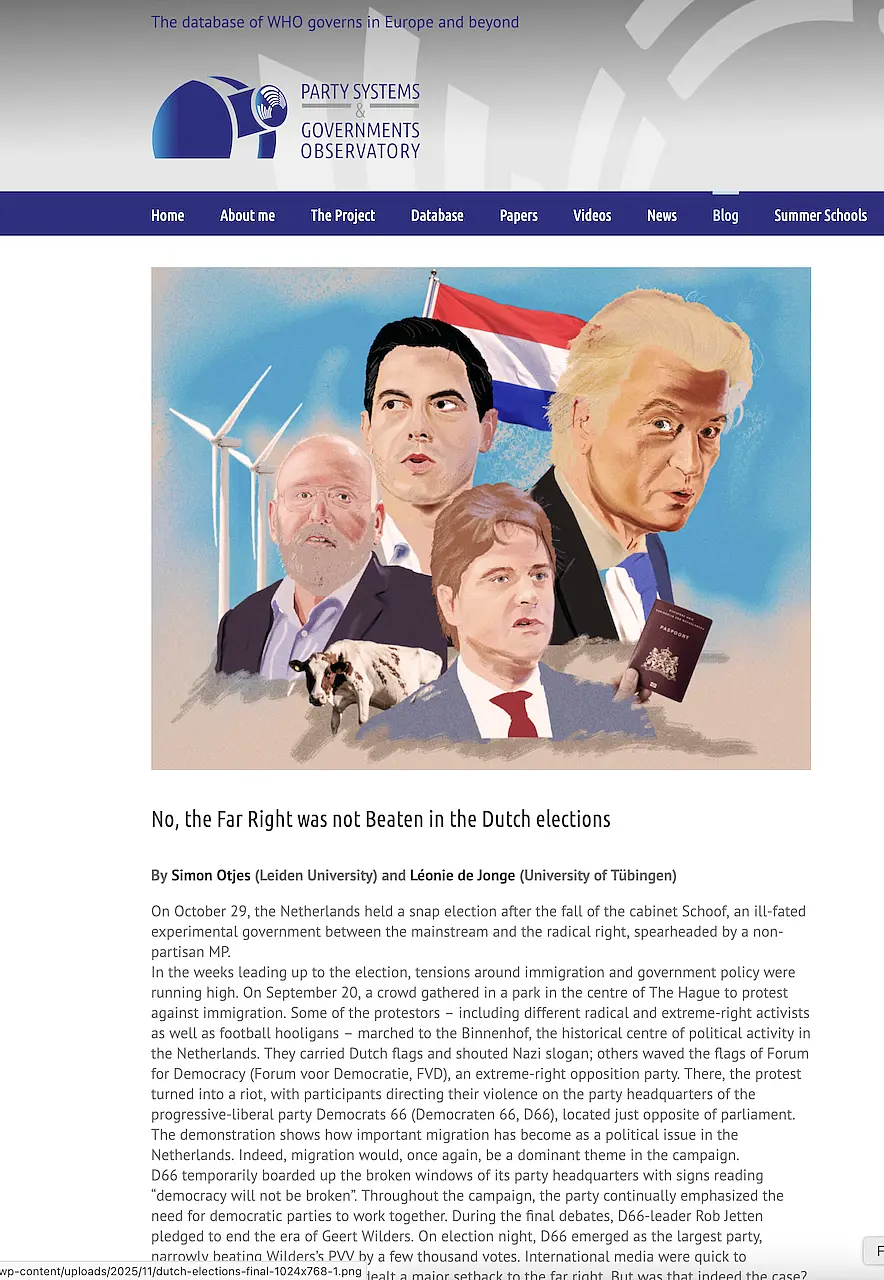
No, the Far Right was not Beaten in the Dutch elections

Autor*innen: Prof. Dr. Léonie de Jonge, Simon Otjes (Leiden University)

On October 29, the Netherlands held a snap election after the fall of the cabinet Schoof, an ill-fated experimental government between the mainstream and the radical right, spearheaded by a non-partisan MP.
In the weeks leading up to the election, tensions around immigration and government policy were running high. On September 20, a crowd gathered in a park in the centre of The Hague to protest against immigration. Some of the protestors – including different radical and extreme-right activists as well as football hooligans – marched to the Binnenhof, the historical centre of political activity in the Netherlands. They carried Dutch flags and shouted Nazi slogan; others waved the flags of Forum for Democracy (Forum voor Democratie, FVD), an extreme-right opposition party. There, the protest turned into a riot, with participants directing their violence on the party headquarters of the progressive-liberal party Democrats 66 (Democraten 66, D66), located just opposite of parliament.
The demonstration shows how important migration has become as a political issue in the Netherlands. Indeed, migration would, once again, be a dominant theme in the campaign.
D66 temporarily boarded up the broken windows of its party headquarters with signs reading “democracy will not be broken”. Throughout the campaign, the party continually emphasized the need for democratic parties to work together. During the final debates, D66-leader Rob Jetten pledged to end the era of Geert Wilders. On election night, D66 emerged as the largest party, narrowly beating Wilders’s PVV by a few thousand votes. International media were quick to comment that Dutch voters had dealt a major setback to the far right. But was that indeed the case?

Der Blogpost ist am 04.11.2025 Open Access bei WHO governs erschienen.


The Netherlands is trying to draw a line under a year of chaos with fresh elections – will it work?

Autor*innen: Léonie de Jonge, Esmee Bakker

Dutch voters are to elect a new parliament for the third time in just five years on October 29. Prime Minister Dick Schoof called a snap election following the collapse of his cabinet in June, just 11 months after it was sworn in.

The immediate trigger was the withdrawal of Geert Wilders’s far-right Party for Freedom (PVV) from the governing coalition. The PVV quit after coalition partners rejected its controversial ten-point plan on migration, which included using the army to secure borders and turning back all asylum seekers.

Der Beitrag ist am 21. Oktober 2025 Open Access bei The Conversation erschienen.


RightNow! Far-Right Normalization and Democratic Erosion: A Pre-Election Update from the Netherlands

Autor*innen: Iris Beau Segers, Léonie de Jonge

Just a month ahead of the Dutch elections, Léonie de Jonge and Iris B. Segers raise concerns about the growing normalization of extreme-right ideologies and actions, highlighted by the unprecedented violence that erupted during a recent anti-immigration demonstration in the Hague.

Der Blogpost ist am 30. September 2025 Open Access bei C-Rex Center for Research on Extremism online erschienen.


Snap Out of It? Governmental Instability and Far-Right Mainstreaming in the Dutch and French Elections of 2023/2024

Autor*innen: Marianna Griffini, Léonie de Jonge, Marta Lorimer

Neither the Netherlands nor France were expected to have new governments in 2024. Dutch voters were due to go back to the polls in 2025, while France was to hold the next legislative election in 2027. However, between the summer of 2023 and the summer of 2024, both Mark Rutte and Gabriel Attal government's term came to an early end, with snap elections being held in November 2023 in the Netherlands and June/July 2024 in France.

In this article, we compare the two elections to show how despite widely differing institutional conditions, both elections returned weakened governments dependent on the goodwill of the far right for their political survival. France and the Netherlands can be regarded as two ‘most different cases’ when it comes to their electoral and governmental systems. Whereas the former relies on a two-round majoritarian voting system favouring the emergence of clear and stable governmental majorities, the latter is based on a strongly proportional electoral system where post-electoral coalition building plays a key role. However, in this case, their electoral systems led both countries towards a similarly unstable equilibrium. Both countries departed from, and returned to, a situation of political instability. Moreover, the far right made remarkable inroads in both cases. Far-right ideas and personalities dominated the debate, contributing to a continued mainstreaming of their positions. In the Netherlands, Geert Wilders's Partij voor de Vrijheid (PVV – Party for Freedom) also gained a foot in a coalition government after laborious and lengthy inter-party negotiations. In France, the Rassemblement National (RN – National Rally) failed to win enough seats to form a government and faced continued demonisation, but still acquired a pivotal role in the government negotiations that followed the elections.

The article proceeds as follows. First, we trace the circumstances leading up to the snap elections. We then revisit the political campaigns in both countries, highlighting how they were dominated by the personalities and themes of the far right. Finally, we offer comparative insights on the implications of these developments.

Der Artikel ist am 01. Juli 2025 Open Access bei JCMS: Journal of Common Market Studies erschienen. 


The Netherlands: Political Developments and Data in 2024 – An Experimental Government with the Radical Right

Autor*innen: Léonie de Jonge & Simon Otjes

Following the 2023 national elections, the first half year of 2024 focused on negotiations between four parties from the centre-right to the radical right, resulting in the formation of the Schoof Cabinet. With an independent former top civil servant as Prime Minister, the new government proposed more stringent migration measures, budgetary discipline, democratic reforms and a long-term perspective for Dutch farmers, as well as a more open and transparent relationship between Parliament and the Cabinet. This marked the first time in over a century that the Prime Minister was not affiliated with one of the coalition parties. This arrangement paved the way for the most right-wing government in the Netherlands since the postwar era. In the second half of the year, however, the coalition's fragile nature became evident, as the Cabinet found itself on the brink of collapse on three separate occasions.

Der Artikel ist am 04. Juni 2025 Open Access bei European Journal of Political Research Political Data Yearbook erschienen.


Studieren ohne Angst

Autor*innen: Prof.*in Dr.*in Heike Radvan, Susanne Dyhr

Die Brandenburgische Technische Universität Cottbus-Senftenberg hat sich für ein Handlungskonzept gegen Rechts entschieden. Dafür gibt es viele Gründe…

Der Beitrag ist erschienen in DUZ Wissenschaft & Management, Ausgabe 04.2025, Seite 14–17.


Fortuyn versus Wilders versus Baudet: the evolution of populist radical right party organization in the Netherlands

Autor*innen: Léonie de Jonge und Gerrit Voerman 

Existing research has shown that there is considerable diversity when it comes to populist radical right party (PRRP) organization, but it is unclear why this is the case. The Netherlands provides an ideal laboratory to examine this question. Within two decades, the country witnessed the rise of several PRRPs, including the List Pim Fortuyn (LPF), the Party for Freedom (PVV) and Forum for Democracy (FvD). Despite ideological similarities, there are clear differences between these parties in terms of party organization. We argue that the organizational model of the FvD is a synthesis of the LPF and the PVV. To avoid internal dissension that brought about the demise of the LPF, the FvD adopted organizational elements of Geert Wilders’s ‘personal party’. The FvD also drew lessons from the financial limitations of the PVV by creating a large membership base. The findings show clear evidence of institutional learning. By learning from the experiences of others, PRRPs are becoming much better equipped to endure setbacks, which suggests that they are less likely to subside in the near future.

Der Beitrag ist Open Access in englischer Sprache im März 2025 bei European Political Science Review erschienen.


Rechte (T)Räume. Wie extrem rechte Parteien Raum konstruieren und darüber Diskurse radikalisieren.

Autor*innen: Rolf Frankenberger, Lena Hinz, Olaf Kühne, Bjarne Pfau & Emilia Schmid

Auch gegenwärtig kommt der Kategorie Raum in extrem rechten Diskursen besondere Bedeutung zu, insbesondere in Bezug auf die räumliche Kategorisierung des Eigenen in Abgrenzung zum Fremden (vgl. Frankenberger et al., 2024). Während das Raumverständnis im Nationalsozialismus eine umfangreiche wissenschaftliche Beachtung erfuhr (vgl. Körner, 2001; Mai, 2002), bleibt die Analyse von Raumverständnissen extrem rechter Akteure in der Gegenwart eher randständig. Oftmals beschränkt sich die Untersuchung der Zusammenhänge von Rechtsradikalismus und Raum auf das Themenfeld ‚Rechtsextremismus und ländlicher Raum‘ oder der räumlichen Verortung von Rechtsextremismus (vgl. Rolfes, 2011).

In unserer explorativen Studie zu Raumverständnissen extrem rechter Parteien haben wir insgesamt neun Partei- und Wahlprogramme aus dem Zeitraum von 2017 bis 2023 untersucht. Gerade weil sich diese Programme an eine breitere Öffentlichkeit richten, eignen sie sich, Vokabulare und deren Anschlussmöglichkeiten an nicht extreme Vokabulare in der Gesellschaft zu untersuchen. 

Ausgehend von den theoretischen Grundlagen im Neopragmatismus, stellen wir im Folgenden unsere methodische Herangehensweise und die zentralen Befunde der Studie vor und diskutieren die Leistungsfähigkeit neopragmatistischer Redeskriptions- und Vokabularanalyse für die Forschung zur extremen Rechten und zur Radikalisierung von gesellschaftlichen Diskursen.

Der Aufsatz ist im März 2025 Open Access erschienen in Kemmesies, U., Wetzels, P., Austin, B., Büscher, C., Dessecker, A. Hutter, S. Rieger, D. (Hrsg.): Motra-Monitor 2023/24. Wiesbaden: MOTRA, S. 406-419.


What is the AfD? Germany’s far-right party, explained

Autor*innen: Léonie de Jonge und Rolf Frankenberger

In the weeks ahead of the German election, the far-right party Alternative für Deutschland (AfD) consistently polled around 20%. For the first time, the AfD poses a challenge to mainstream parties’ longstanding strategy of isolating the far right.

The rise of the AfD is striking, given the country’s history of authoritarianism and National Socialism during the 1930s and 1940s. For decades, far-right movements were generally stigmatised and treated as pariahs. Political elites, mainstream parties, the media and civil society effectively marginalised the far right and limited its electoral prospects.

The AfD’s breakthrough in the 2017 federal election shattered this status quo. Winning 12.6% of the vote and securing 94 Bundestag seats, it became Germany’s third-largest party — unlocking viable political space to the right of the centre-right party CDU/CSU for the first time in the postwar era.

Ganzen Artikel lesen

Der Artikel ist am 21. Februar 2025 auf Englisch bei The Conversation erschienen.


These maps of support for Germany’s far-right AfD lay bare the depth of the urban-rural divide
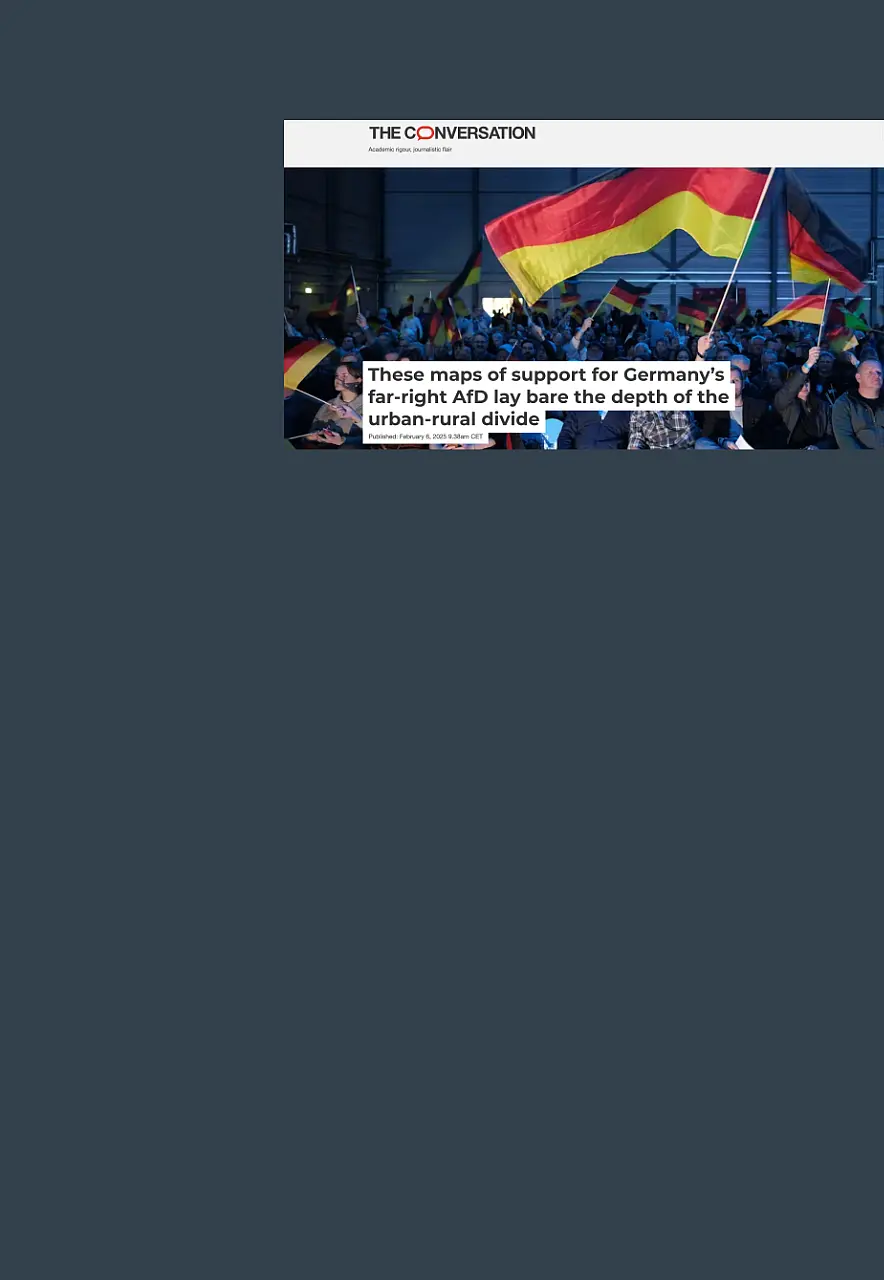
Autor: Rolf Frankenberger

The process of industrialisation, globalisation and urbanisation – spreading out from urban centres into the countryside – is one of the core developments of modern society. It has changed people’s lives in almost every part of the world. This is a process that has been going on for more than a century. New lifestyles have developed and traditional ones have been challenged.

A new division has emerged as a result between the urban and the rural. The two are more than just forms of settlements – they reflect ideals, values and lifestyles. Those who live in towns and cities lead almost entirely different lives to those who live in the countryside.

Where the two meet, there is potential for tension. And that tension can be politicised. In Germany, the Alternative für Deutschland (AfD), a far-right nationalist and völkisch party, is using the “urban-rural divide” to polarise and mobilise an electorate that is attracted by romanticised notions of purity, tradition, nation and rurality.

Using spatial and data analysis, we can illustrate the patterns of this politicisation.

Ganzen Artikel lesen

Der Artikel und eine Podcast-Folge zum Thema “Where support for Germany’s far-right AFD is growing and why” mit Rolf Frankenberger sind im Februar 2025 bei The Conversation erschienen.


Is the far right a global phenomenon? Comparing Europe and Latin America: A scholarly exchange

Autor*innen: Léonie de Jonge, Vasiliki Georgiadou, Daphne Halikiopoulou, Cristóbal Rovira Kaltwasser & Talita Tanscheit

The purpose of the Exchange feature is to publish discussions that engage, advance and initiate new debates in the study of nations and nationalism. This Exchange article is on the subject of the global far right. In the first part, Léonie de Jonge and Talita Tanscheit briefly introduce the topic, emphasising the need for such a dialogue. In the remainder of the exchange, Vasiliki Georgiadou, Daphne Halikiopoulou and Cristóbal Rovira Kaltwasser address the following four questions: (1) Is the far right a global phenomenon? (2) What is causing it? (3) What are the implications of the rise of the far right for democracy? (4) What can we learn from comparing Europe and Latin America? By attempting to deprovincialise scholarship on the far right, our goal is to foster cross-regional dialogue and highlight the importance of comparative research between these two regions.

Der Aufsatz ist im Dezember 2024 in englischer Sprache Open Access in Nations and Nationalism, S. 118, erschienen.


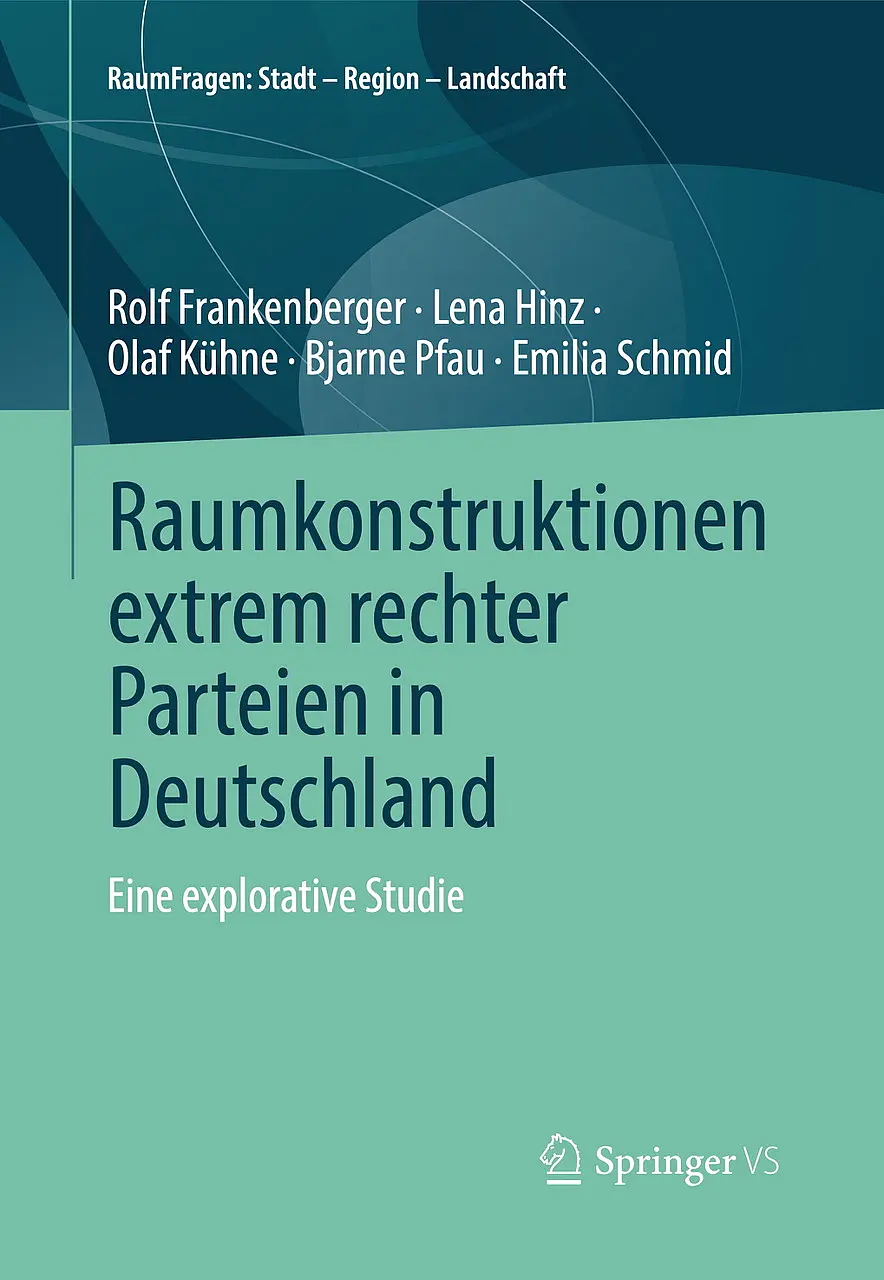
Raumkonstruktionen extrem rechter Parteien in Deutschland – Eine explorative Studie

Autor*innen: Rolf Frankenberger, Lena Hinz, Olaf Kühne, Bjarne Pfau & Emilia Schmid

Wie imaginieren extrem rechte Parteien Raum? Und wie werden diese Raumkonstruktionen in größere Narrative eingebettet?

In unserer neopragmatistisch ausgerichteten, explorativen, inhaltsanalytischen Untersuchung von Partei- und Wahlprogrammen extrem rechter Parteien in Deutschland zeigt sich die zentrale Bedeutung von Raumkategorien für die Konstruktion des Eigenen und des Fremden. Das Kernnarrativ extrem rechter Parteien bezieht sich dabei auf die Verteidigung des ‚gewachsenen Wesens des deutschen Volkes‘ und der ‚deutschen Nation‘ gegen vielfältige Bedrohungen von innen und außen. Hier eint sie trotz einiger Unterschiede in der Narration und im Vokabular der Rückgriff auf essentialistische Raum- und Gemeinschaftskonstruktionen.

Dabei greifen alle Parteien in unterschiedlichem Maße auf extrem rechte Ideologeme wie Fremdenfeindlichkeit, Antisemitismus, Anti-Islamismus und übersteigerten Nationalismus zurück. Anhand der kartographischen Aufarbeitung der Befunde wird aufgezeigt, dass sich diese Konstruktionen häufig in Selbstwidersprüche verstricken und nicht in konsistente Raum- und Weltbilder münden.

Die Studie ist im August 2024 Open Access bei Springer VS erschienen.


Researching far right extremism – a transdisciplinary, lifeworld, and political culture perspective

Autor*innen: Reiner Baur, Rolf Frankenberger, Markus Rieger-Ladich, Josef Schmid, Barbara Stauber, Ansgar Thiel & Tanja Thomas

Rechtsextremismus, verstanden sowohl als Ideologie der Ungleichheit und Ausgrenzung, die sich in Einstellungen und Verhalten manifestiert, als auch als heterogene, zum Teil gewaltaffine Bewegung, fordert demokratische Gesellschaften heraus und bedroht sie. Wir argumentieren, dass sozialwissenschaftliche Forschung dazu beitragen sollte, Demokratie und Zivilgesellschaft gegen die Bedrohung durch Rechtsextremismus zu stärken. Mit einer transdisziplinären, lebensweltlichen und politisch-kulturellen Perspektive kann die Sozialwissenschaft zu dieser Aufgabe beitragen und gleichzeitig die Fragmentierung des Forschungsfeldes überwinden helfen. In diesem Beitrag geben wir mit einem Fokus auf Deutschland zunächst einen Überblick über die aktuellen Entwicklungen in der sozialwissenschaftlichen Forschung. Zweitens skizzieren wir fünf Voraussetzungen für ein transdisziplinäres Forschungsprogramm zum Rechtsextremismus. Dabei plädieren wir sowohl für eine lebensweltliche Perspektive als auch für methodischen Pluralismus. Drittens schlagen wir vier übergreifende thematische Cluster als Taxonomie transdisziplinärer Forschungsperspektiven zum Rechtsextremismus vor: a) Rechtsextreme Ideologien und Wissenskonstruktionen; b) Rechtsextreme Akteure, Organisationen und Netzwerke; c) Rechtsextreme Diskurse, (digitale) Medien und Strategien im öffentlichen Raum; und d) Politische Bildung, Transfer und Implementierungsforschung zu Projekten gegen Rechtsextremismus. Viertens argumentieren wir, dass eine weitere Institutionalisierung unabdingbar ist, um die Forschung zum Rechtsextremismus nachhaltiger zu gestalten, die Forschung mit gesellschaftlichen Akteuren zu verbinden und die Forschungsergebnisse zur Stärkung der demokratischen Resilienz der Gesellschaft zu nutzen.

Die Research Note ist in der Zeitschrift für Vergleichende Politikwissenschaft, Volume 17, S. 275–295 im November 2023 in englischer Sprache Open Access  erschienen.