Publications

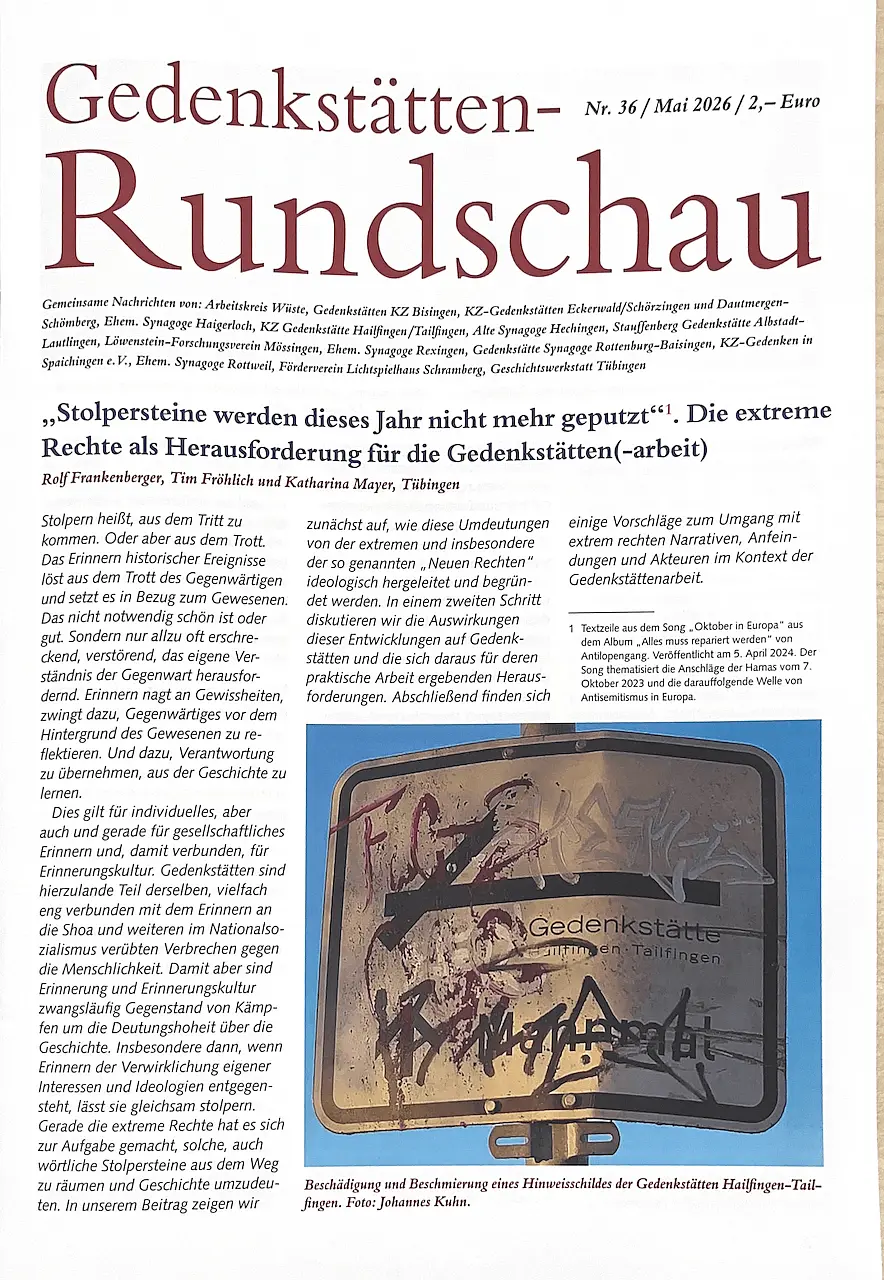
“The Stolpersteine will not be cleaned this year.” The far right as a challenge for memorials (and memorial work)
Autor*innen: Rolf Frankenberger, Tim Fröhlich, Katharina Mayer 

To stumble is to lose one’s footing. Or to break out of a rut. Remembering historical events breaks us out of the rut of the present and places it in relation to the past. Which is not necessarily pleasant or good. Rather, all too often it is frightening, unsettling, and challenges one’s own understanding of the present. Remembrance gnaws at certainties, forcing us to reflect on the present against the backdrop of the past. And to take responsibility, to learn from history. This applies to individual as well as collective remembrance and, by extension, to the culture of remembrance. In this country, memorial sites form part of this culture, often closely linked to the remembrance of the Shoah and other crimes against humanity committed under National Socialism. Consequently, however, remembrance and the culture of remembrance inevitably become the subject of struggles for interpretative authority over history. This is particularly true when remembrance stands in the way of the realisation of one’s own interests and ideologies, causing them, as it were, to stumble. The far right, in particular, has made it its mission to remove such stumbling blocks – including the literal ones – and to reinterpret history.In this article, the authors first demonstrate how these reinterpretations are ideologically derived and justified by the far right and, in particular, by the so-called ‘New Right’.In a second step, we discuss the implications of these developments for memorial sites and the challenges this poses for their practical work. Finally, we offer some suggestions on how to deal with far-right narratives, hostility and actors in the context of memorial work.

The article appeared in May 2026 in the print magazine Gedänkstätten-Rundschau No. 36 on pages 1–7. The journal is published twice a year and is available by subscription, in bookshops or through retailers in the region.


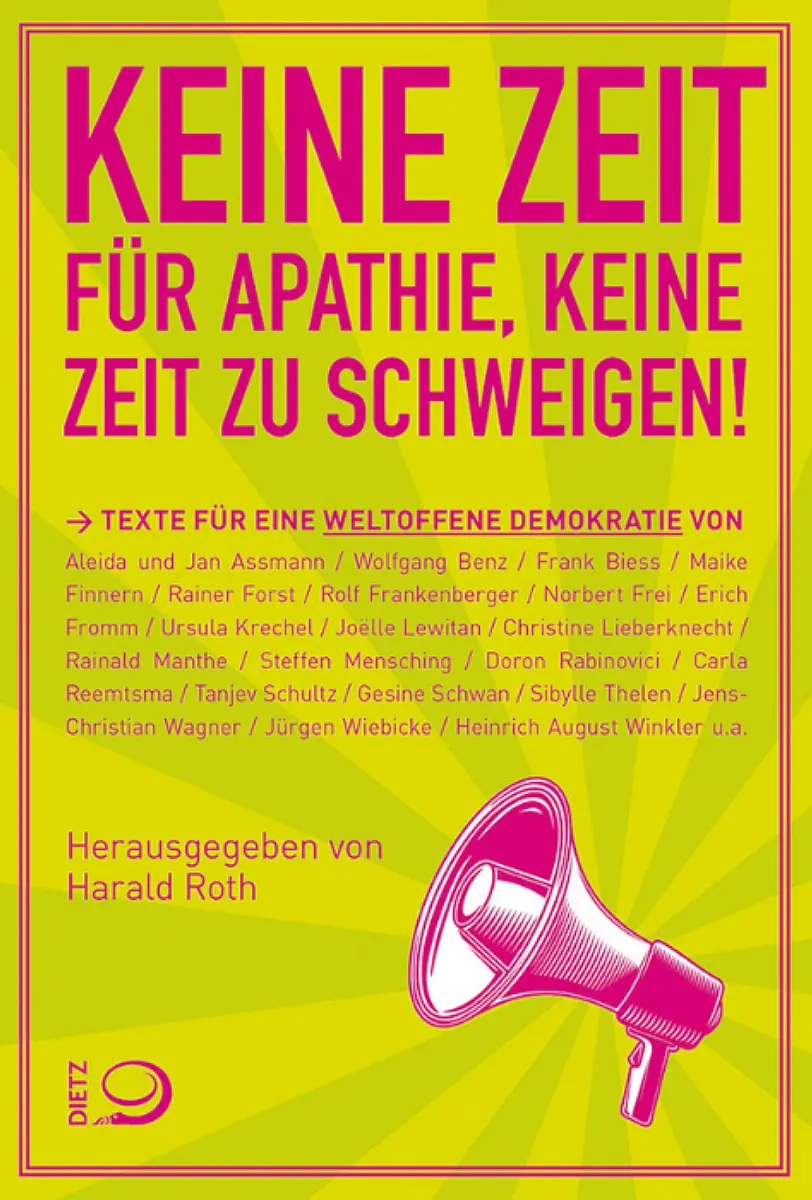
The Far Right, Fascism and Power

Autor: Rolf Frankenberger

The far right can no longer be viewed merely as a marginal political milieu, but rather as a key player in the struggle for social interpretive power, cultural hegemony and political dominance. This article examines how far-right movements and parties in Europe are shifting discourses, redefining the boundaries of what can be said, and transforming power relations within liberal democracies.
Starting from a conceptual classification of the ‘new’ far right, Rolf Frankenberger demonstrates that its programme and strategies can be productively analysed using approaches from fascism theory. At the same time, the text makes it clear that the contemporary far right cannot be reduced to historical analogies, but must be understood as a modern, adaptable and discursively powerful project. In a second step, drawing on Michel Foucault, the text examines how power, discourse and knowledge interlock in the right-wing culture war and how social norms are thereby shifted. The article combines precision in the history of ideas with contemporary analysis and offers a theoretically grounded approach to understanding the far right as a cultural, political and power-strategic formation of the present.

The text was published in 2026 in: Harald Roth (ed.): Keine Zeit für Apathie, keine Zeit zu schweigen. Bonn: Dietz, S.107-119.


City in Mind: Spatial patterns of Far-Right Mobilisation and their Explanation
Autor*innen: Helena Atteneder, Rolf Frankenberger, Bjarne Pfau

The study focuses on the spatial patterns of far-right mobilisation with a view to developing an explanatory model that is both theoretically and empirically sound. Based on the observation that common dichotomies such as urban versus rural or East versus West fail to adequately capture the complexity of political preferences, a relational approach to urbanity and rurality is proposed. These are not viewed merely as forms of settlement, but as social, cultural and media-shaped lifeworlds in which experiences of centrality, peripherality, visibility and marginalisation converge.

Spatial analyses and structural findings on the AfD’s electoral successes show that far-right mobilisation gains particular traction where socio-spatial disadvantage, infrastructural marginalisation and a lack of access to information overlap. In particular, the intertwining of lived experiences with media inequalities—for instance, in the context of local ‘news deserts’—thus emerges as a central factor in political polarisation. This approach offers an innovative perspective on the question of how spatial patterns of interpretation become politically effective.

The chapter was published in 2026 in the MOTRA Monitor 2024/2025 Open Access.


The Logic of Social Media and Far-Right Mobilization

Authors: Annett Heft, Miriam Milzner

This article analyzes the role of social media in the dissemination of content that threatens democracy online. It demonstrates that, compared to traditional social networks, algorithmically curated platforms enable a broader and more subtle dissemination of extremist content, independent of the reputation of individual users. This creates new avenues for reaching previously untapped target groups and potentially increases the reach of content that threatens democracy.

The article was published on March 19, 2026 Open Access by RECHTS.GESCHEHEN, the journal of the Documentation Center on Right-Wing Extremism at the General State Archives in Karlsruhe.


Democratic dissatisfaction, the far right, and party brand activation: lessons from the breakthrough (and downfall) of the Dutch New Social Contract

Autor*innen: Léonie de Jonge, Matthias Dilling

Far-right parties have been on the rise in European democracies. Their calls for a fundamental reorganization of democracy along nativist and people-centric lines have resonated with a growing share of voters who are dissatisfied with the political status quo. Other parties have predominantly responded to these developments by coopting the far right’s position and rhetoric – typically with no substantive electoral success. What else can parties do? This paper offers new insights in response to this question by investigating the breakthrough of Nieuw Sociaal Contract (New Social Contract, NSC) in the 2023 Dutch parliamentary election. Although NSC failed to sustain its success and missed re-election in 2025, its breakthrough offers broader lessons on how to respond to the far right. Drawing on evidence from the party’s manifestos and survey analysis, we show that NSC appealed to voters who are dissatisfied with the political status quo and supportive of stricter immigration policies – segments of the electorate inclined toward far-right parties – without reproducing far-right narratives. Instead, NSC integrated these positions within a platform highlighting technocratic trust and communitarian values rooted in Christian democratic thought. NSC’s breakthrough thus illustrates how dormant ideological traditions can be reactivated as constructive responses to contemporary public grievances.

This article is available since March 14, 2026 Open Access in Political Research Exchange.


The Far Right: Between heterogeneity and hybridity - Challenges for research

Autor*innen: Rolf Frankenberger und Leonie De Jonge

The question of what exactly constitutes the far right (its actors, ideologies andmanifestations) is of central importance to political science research in general and to comparative approaches in particular.
Current research highlights a twofold hybridity: firstly, at the empirical level, due to the heterogeneity and fluidity of the actors; secondly, at the conceptual level, due to the different theoretical approaches used to define the phenomenon. This dual hybridity poses considerable challenges for comparative analysis. Empirically, it requires a detailed examination, particularly of the ideological dimensions. Conceptually, it requires theoretical frameworks that can both identify the ideological core of the far right and explain subtypes and ‘family resemblances’ between different actors.

The chapter was published on 10 March 2026 in the open-access anthology Hybrid Right-Wing Extremism: Hegemony and Escapism in (Extreme) Right-Wing Networks, Cultures and Narratives by transcript Open Access.

The texts collected in the volume are expanded contributions from the summer school ‘Right-wing Extremism between Hegemony and Escapism’, which took place from 10 to 13 September 2024 at the University of Tübingen – in cooperation with the Institute for Research on Right-wing Extremism (IRex) and with the support of the University of Tübingen.


Pics or it didn’t happen! EU institutions’ visual communication and user engagement on Facebook and Instagram

Autor*innen: Olga Eisele, Tobias Heidenreich und Phoebe Maares

Eisele, O., Heidenreich, T., & Maares, P. (2026). Pics or it didn’t happen! EU institutions’ visual communication and user engagement on Facebook and Instagram. European Journal of Political Research, 1–26. doi:10.1017/S1475676526100668

Social media often follow a visual logic found to increase engagement, as images are more likely to attract attention, presenting information on a holistic-associative basis. For a political entity like the EU, social media are a promising route to overcome the remoteness to its citizens, identified as one of the crucial challenges to its public legitimacy. Against this broader background, our study analyses the influence of 10 years of EU visual social media communication on user engagement as an indicator of successfully creating visibility in a crucial communication space. For this purpose, we conducted an image-type analysis, combining quantitative and qualitative features of visual analysis: First, a subsample of posts was inductively analysed to identify recurring image types and subsequently used to implement a manual quantitative visual content analysis. Building on the results, we drew on a machine learning approach, allowing us to analyse over 40,000 posts, including more than 20,000 pictures. Our results emphasise the crucial influence of social media affordances in explaining user engagement with EU visual social media communication. Implications are discussed with reference to the ongoing discussion about the EU’s democratic deficit.

Der Artikel ist am 12. Februar 2026 online bei European Journal of Political Research erschienen.


A NEW HOPE? Local journalism as a mitigation hub for misinformation

Autor*innen: Gregory Perreault und Phoebe Maares

Perreault, G., & Maares, P. (2026). A NEW HOPE? Local journalism as a mitigation hub for misinformation. Journal of Applied Communication Research, 54(1), 130–136. doi.org/10.1080/00909882.2025.2573950

The rise of far-right extremism necessitates an evaluation of the ideal means of offering robust information quality to the public, even as hostile actors engage in expansive campaigns of misinformation. This forum manuscript centers on the role of local journalism as a means of combating misinformation, considering notable case studies from Germany and the United States. We argue that in order to enhance local journalism's ability to combat misinformation requires (1) response to misinformation through in-kind platforms and (2) response to misinformation through collaboration.

The article was published 29.01.2026 online by Journal of Applied Communication Research.


The Transnational public sphere in the context of Global challenges – Promises and Threats of Digital Media to Democratic governance

Authors:  Barbara Pfetsch, Curd Knüpfer und Annett Heft

Global problems and crises cannot be effectively addressed within the confines of the nation-state. Instead, they require transnational political action and public engagement. In democratic nation states, citizens are involved in political decisions through electoral participation and public debate. However, transnational politics suffers from a democratic deficit, lacking similar legitimating mechanisms. This entry to the Routledge Companion to Digital Media and Democracy examines the problem of legitimacy and lack of public deliberation of transnational politics in the context of globalization. 
We ask whether digital media ecologies can establish a democratic transnational public sphere to address this problem. The first section reviews theoretical perspectives on transnational public spheres, comparing democratic-normative and constructivist network approaches. The second section analyzes the nature of digital media ecologies and what kind of transnational public spheres they help create. While they could be conducive to democratic developments globally, they are more likely to amplify democratic dysfunctions: rather than mitigating political and social inequalities, dominant digital platforms – due to their commercial logic and ownership structures – exacerbate problems such as political bias, misinformation, and manipulation. We conclude by arguing that existing democratic dysfunctions are reinforced by the resurgence of the nation-state in international politics, which creates further challenges to the development of a transnational public sphere.

The chapter was published on 228.01.2026 in the book The Routledge Companion to Digital Media and Democracy by Routledge


Decoding inequalities in the journalistic field: A theoretical approach to how symbolic violence shapes journalistic career trajectories.

Author*innen: Kim Löhmann und Phoebe Maares

Löhmann, Kim, & Maares, Phoebe (2026). Decoding inequalities in the journalistic field: A theoretical approach to how symbolic violence shapes journalistic career trajectories. Journalism, 0(0). doi.org/10.1177/14648849261416555

Achieving diversity is a fraught process in the journalistic field, with persistent inequalities shaping the experiences of marginalized journalistic actors. By combining Bourdieu’s field theory and Crenshaw’s concept of intersectionality, we offer a conceptual framework tracing how marginalized journalistic actors experience symbolic violence and symbolic dominance in different journalistic fields around the globe. These experiences can stem from journalists’ lack of appropriate forms of capital, the “right” journalistic habitus and an understanding of the doxa shaping what journalism is: what it ought to look like and who can be considered a legitimate and authoritative member of a given journalistic field. We illustrate this conceptual framework using possible career trajectories of (marginalized) journalists to highlight various forms of symbolic violence experienced by (dis)empowered actors along the three main stages of journalistic careers—namely becoming a journalist, being a journalist and potentially leaving journalism later on.

The artile was published on January 16, 2026 Open Access in Journalism.


Right-wing conspiracy theories in hyper-partisan media—What would a ban on Compact magazine have meant for the anti-democratic online ecosystem?
Autor*innen: Kilian Bühling, Joana D. Becker, Xixuan Zhang und Annett Heft

Social media and other forms of online publication offer anti-democratic actors a space to network, with hyper-partisan media serving as sources of information and organizers of movements. This article takes the attempted ban of Compact magazine by the German Federal Ministry of the Interior in the summer of 2024 as an opportunity to examine the possible consequences of individual media bans for right-wing extremist and conspiracy theory information ecosystems. The study is based on an automated analysis of articles related to the far-right conspiracy theory of the “Great Replacement” from Compact, Junge Freiheit, Epoch Times, and PI News over a period of ten years. It shows that all of the media outlets examined are thematically similar in these articles. Compact is used most frequently, but PI News publishes the largest number of articles with the highest toxicity. In the practice of regulating harmful online ecosystems, a conflict of objectives can therefore arise, requiring a choice between prioritizing the containment of the most toxic and the most influential actors.

The article was published in the series “Wissen schafft Demokratie. Schwerpunkt Demokratiegefährdung" online by the Institute for Democracy and Civil Society Jena.


How to counter the far right: lessons from Brazil

Autor*innen: Léonie de Jonge, Talita Tanscheit

Over the past few decades, the far right has been advancing across the globe, both electorally and through increased street–level mobilisation (Mudde 2019). While much attention has been paid to the causes and consequences of this rise, much less is known about how to counter it effectively. This policy brief outlines key strategic responses to the far right and draws lessons from Brazil, a country in which far right forces rapidly rose to power but subsequently were pushed back. The Brazilian case highlights how coordinated, multi–actor efforts can curb far right momentum and help safeguard democratic institutions.

Der Artikel ist im November 2025 Open Access bei der Friedrich-Ebert-Stiftung in Bonn erschienen.


The AfD and Antifeminism in Germany, 2014–2025: Family First, Trans Panic Second

Author: Sabine Volk

Why is antifeminism particularly strong in the east of Germany? This article contributes to tackling this puzzle by studying antifeminism and far-right politics across different levels of the federal polity. Specifically, the paper analyses the politics of gender by the country’s key antifeminist party player, the far-right Alternative for Germany (AfD). To shed light on the specificities of the eastern German AfD, the paper compares the official political positioning of two eastern German AfD groups, AfD Saxony and AfD Thuringia, with the federal party. Methodologically, the research draws from a qualitative manifesto analysis of ten official documents (2014–2025). The systematic comparison of the manifestos across cases and time reveals that the party’s ideological profile on gender issues is highly homogeneous across groups. The AfD’s antifeminism has been overall consistent since 2014, while the party strategically focuses on radicalising anti-gender and anti-trans positions in recent years. The key difference between eastern German AfD groups and the federal party concerns issue salience, with eastern groups prioritising gender issues over ‘hard’ issues in their manifestos. The findings show that eastern German AfD groups are not ‘more’ antifeminist than the federal party, and underscores the need for further research into the puzzle.

This article is available since November 25, 2025 open access in the journal German Politics.


No, the Far Right was not beaten in the Dutch elections

Authors: Prof. Dr. Léonie de Jonge, Simon Otjes (Leiden University)

On October 29, the Netherlands held a snap election after the fall of the cabinet Schoof, an ill-fated experimental government between the mainstream and the radical right, spearheaded by a non-partisan MP.
In the weeks leading up to the election, tensions around immigration and government policy were running high. On September 20, a crowd gathered in a park in the centre of The Hague to protest against immigration. Some of the protestors – including different radical and extreme-right activists as well as football hooligans – marched to the Binnenhof, the historical centre of political activity in the Netherlands. They carried Dutch flags and shouted Nazi slogan; others waved the flags of Forum for Democracy (Forum voor Democratie, FVD), an extreme-right opposition party. There, the protest turned into a riot, with participants directing their violence on the party headquarters of the progressive-liberal party Democrats 66 (Democraten 66, D66), located just opposite of parliament.
The demonstration shows how important migration has become as a political issue in the Netherlands. Indeed, migration would, once again, be a dominant theme in the campaign.
D66 temporarily boarded up the broken windows of its party headquarters with signs reading “democracy will not be broken”. Throughout the campaign, the party continually emphasized the need for democratic parties to work together. During the final debates, D66-leader Rob Jetten pledged to end the era of Geert Wilders. On election night, D66 emerged as the largest party, narrowly beating Wilders’s PVV by a few thousand votes. International media were quick to comment that Dutch voters had dealt a major setback to the far right. But was that indeed the case?

The blog post was published on November 4, 2025 Open Access in WHO governs.


The Netherlands is trying to draw a line under a year of chaos with fresh elections – will it work?

Authors: Léonie de Jonge, Esmee Bakker

Dutch voters are to elect a new parliament for the third time in just five years on October 29. Prime Minister Dick Schoof called a snap election following the collapse of his cabinet in June, just 11 months after it was sworn in.

The immediate trigger was the withdrawal of Geert Wilders’s far-right Party for Freedom (PVV) from the governing coalition. The PVV quit after coalition partners rejected its controversial ten-point plan on migration, which included using the army to secure borders and turning back all asylum seekers.

The article was published Open Access in The Conversation on October 21, 2025.


Assessing the Role of Proximity, Authenticity, and Professionalism in Struggles Over Journalistic Authority in Fan Communities

Authors: Clara Juarez Miro, Phoebe Maares & Jonathan Hendrickx 

Global declines in news consumption underscore the tension between journalists’ ideals of detachment and audience demands for engagement. In hybrid digital environments, non-traditional journalistic actors can assert authority in specific communities by deviating from traditional values. As these actors challenge traditional business models, their emergence has destabilized the journalistic field. Yet, scholarly understanding of how community membership shapes claims of journalistic authority is limited. To address this gap, we examine how diverse journalistic actors in two niche communities base their claims on (1) proximity to sources; (2) authenticity; and (3) professionalism. Drawing on interviews from two fandom community events, the Eurovision Song Contest and re:publica, this study disentangles how diverse actors can claim authority while meeting community needs, which is crucial to journalism’s prevalence amid the ongoing economic transformation in the journalistic landscape.

This article is available since October 15, 2025 open access in the journal Journalism Studies.


Autonomy, Objectivity, and Transparency: The Meaning and Negotiation of Journalistic Values Across Different Journalistic Beats

Authors: Phoebe Maares, Kim Löhmann, Folker Hanusch & Daniel Nölleke

As an institution, journalism relies on several key normative values to claim authority and legitimacy—autonomy, objectivity, and transparency. Although these concepts have been widely studied, most research employs quantitative approaches or focuses on specific beats, often political journalism. Drawing on fifty-five in-depth interviews with Austrian journalists, we examine the meaning of these journalistic values and their relevance in political, lifestyle, sports, and economic journalism. We find that autonomy is universally valued, though commercial influences and pressures are more frequently noted in lifestyle and sports journalism. Objectivity is emphasized in political and economic journalism but less prioritized in “softer” news beats, where subjective perspectives are more widely accepted. Transparency is important across all fields, yet differences emerge between “hard” and “soft” news regarding the necessity to disclose sources or funding agencies. Thus, universality across beats cannot be assumed, and the heterogeneity of the journalistic field, in terms of its application of different normative values, needs to be considered in future studies.

This article is available since Octobre 1, 2025 open access in the journal The International Journal of Press/Politics.


RightNow! Far-Right Normalization and Democratic Erosion: A Pre-Election Update from the Netherlands

Authors: Iris Beau Segers, Léonie de Jonge

Just a month ahead of the Dutch elections, Léonie de Jonge and Iris B. Segers raise concerns about the growing normalization of extreme-right ideologies and actions, highlighted by the unprecedented violence that erupted during a recent anti-immigration demonstration in the Hague.

The blog post was published online on September, 30 2025 Open Access at C-Rex Center for Research on Extremism.


Diversity in the journalistic self-image: An analysis of the self-perception and external perception of the roles of traditional and peripheral actors
Authors: Kim Löhmann, Phoebe Maares, Folker Hanusch & Daniel Nölleke

Peripheral journalistic actors are increasingly producing and disseminating journalism-like content in digital spaces, thereby blurring the boundaries of journalism. Many of these actors wish to make a lasting contribution to diversity of content, perspectives and participants in public discourse, a goal that is often attributed to their self-perception of their role. However, we currently know little about how the self-perceptions and external perceptions of peripheral journalistic actors differ from those of traditional journalists, what role diversity plays in their daily work, and whether there are differences across departments. This study addresses this gap based on 119 qualitative interviews with peripheral and traditional female journalists from Austria working in the fields of politics, business, sport and lifestyle. Whilst the differences and the perceived significance of diversity in the self-perceptions of peripheral and traditional female journalists can be understood as markers distinguishing the practitioners from their respective departments, diversity in journalism generally features less prominently than normative expectations might suggest. The findings provide initial systematic insights into the self-perception and external perception of the roles of peripheral and traditional actors in journalism across various sectors and contribute to a more precise understanding of the relevance of diversity in journalism.
The article was published on August 25, 2025  Open Access by Medien und Kommunikationswissenschaft.


Attributing coordinated social media manipulation: a theoretical model and typology

Authors: Daniel Thiele, Miriam Milzner, Annett Heft, Baoning Gong, Barbara Pfetsch

Social media are key arenas for public opinion formation, but are susceptible to coordinated social media manipulation (CSMM), that is, the orchestrated activity of multiple accounts to increase content visibility and deceive audiences. Despite advances in detecting and characterizing CSMM, the attribution problem—identifying the principals behind CSMM campaigns—has received little scholarly attention. In this article, we address this gap by synthesizing existing research and developing a theoretical model for understanding CSMM. We propose a consolidated definition of CSMM, identify its key observable and hidden characteristics, and present a rational choice model for inferring principals’ strategic decisions from campaign features. In addition, we present a typology of CSMM campaigns, linking variations in scale, elaborateness, and disguise to principals’ resources, stakes, and influence strategies. Our contribution provides researchers with conceptual and heuristic tools for attribution and invites interdisciplinary and comparative research on CSMM campaigns.

Der Artikel ist am 29. Juli 2025 Open Access bei New Media & Society erschienen.


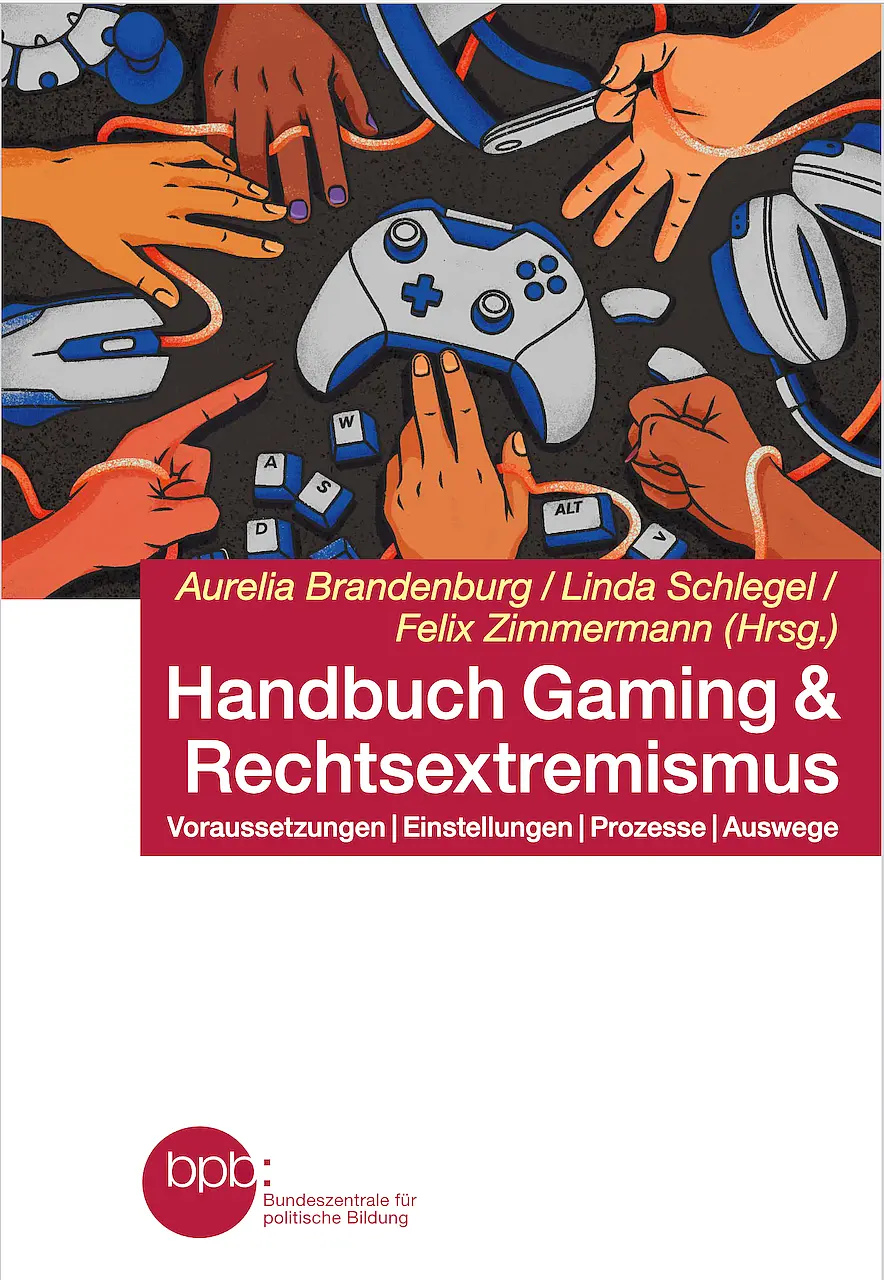
Far right games and modifications

Author: Mareike Stürenberg

This chapter examines digital games and mods that convey right-wing and far-right content. It argues that video games. like any other cultural medium, have political implications and can be used to spread right-wing ideologies. It also discusses how political groups make use of games as a tool for radicalisation and the role modifications play in spreading right-wing ideology. Finally, the chapter addresses the insufficient research on the effects of these games on their users.

The article was published on July, 14 2025 Open Access published in the handbook Gaming and Right-Wing Extremism: Causes, Consequences, Solutions by the Federal Agency for Civic Education. 


Chat groups as local civic infrastructure: A case study of “Solidary neighborhood help” Telegram groups during the COVID-19 pandemic in Germany

Authors: Olga Pasitselska, Killian Buehling, Emilija Gagrčin

Messaging groups are emerging as “meso-spaces”—digital environments that enable sustained dialogue and collective action through their distinct affordances. We examine how such spaces facilitate civic self-organization through their hybrid online/offline, public/private, and local/global dynamics and how they function as local civic infrastructure during times of crisis. Using a mixed-methods analytical approach, we examined 47 public Telegram groups from Germany during the COVID-19 pandemic. We identified a fundamental tension between political discussion and practical help in these spaces, resolvable through active horizontal participation (including norm negotiation and self-moderation), or strict vertical moderation. Additional challenges included a lack of access to vulnerable groups and limited outreach to local civil society actors, both of which hindered group activity and structural connections within local civic infrastructure. Despite these challenges, our study highlights the potential of local chat groups for self-organization, albeit primarily among privileged urban individuals. We discuss the implications for democratic theory and practice.

The article was published on July 13, 2025 Open Access by New Media & Society.


Snap Out of It? Governmental Instability and Far-Right Mainstreaming in the Dutch and French Elections of 2023/2024

Authors: Marianna Griffini, Léonie de Jonge, Marta Lorimer

Neither the Netherlands nor France were expected to have new governments in 2024. Dutch voters were due to go back to the polls in 2025, while France was to hold the next legislative election in 2027. However, between the summer of 2023 and the summer of 2024, both Mark Rutte and Gabriel Attal government's term came to an early end, with snap elections being held in November 2023 in the Netherlands and June/July 2024 in France.

In this article, we compare the two elections to show how despite widely differing institutional conditions, both elections returned weakened governments dependent on the goodwill of the far right for their political survival. France and the Netherlands can be regarded as two ‘most different cases’ when it comes to their electoral and governmental systems. Whereas the former relies on a two-round majoritarian voting system favouring the emergence of clear and stable governmental majorities, the latter is based on a strongly proportional electoral system where post-electoral coalition building plays a key role. However, in this case, their electoral systems led both countries towards a similarly unstable equilibrium. Both countries departed from, and returned to, a situation of political instability. Moreover, the far right made remarkable inroads in both cases. Far-right ideas and personalities dominated the debate, contributing to a continued mainstreaming of their positions. In the Netherlands, Geert Wilders's Partij voor de Vrijheid (PVV – Party for Freedom) also gained a foot in a coalition government after laborious and lengthy inter-party negotiations. In France, the Rassemblement National (RN – National Rally) failed to win enough seats to form a government and faced continued demonisation, but still acquired a pivotal role in the government negotiations that followed the elections.

The article proceeds as follows. First, we trace the circumstances leading up to the snap elections. We then revisit the political campaigns in both countries, highlighting how they were dominated by the personalities and themes of the far right. Finally, we offer comparative insights on the implications of these developments.

The article was published Open Access on July 1, 2025 in JCMS: Journal of Common Market Studies. 


Understanding the role of community membership in journalistic authority claims: a framework informed by boundary work and fan studies

Autor*innen:  Clara Juarez Miro, Phoebe Maares, Jonathan Hendrickx & Folker Hanusch

Digitalization and declines in news use underscore the tension between journalistic ideals of detachment and audience communities’ demands for journalistic actors’ engagement. This is enhanced by the emergence of non-traditional actors who can effectively assert journalistic authority within communities by deviating from specific traditional journalistic values. However, scholarly understanding of the role of community membership in claims of journalistic authority remains limited. To address this, we propose a theoretical framework that draws on boundary work and fan studies. This framework allows us to examine how diverse journalistic actors in a variety of communities can base their journalistic authority claims on their: (1) proximity to news sources and protagonists; (2) authenticity as perceived by the audience community; and (3) professionalism in relation to the journalistic field. Through empirical research, this framework may help us to better understand how diverse journalistic actors can claim authority while meeting communities’ diverse needs.

The article was published on June 13, 2025 Open Access by Communication Theory.


The Netherlands: Political Developments and Data in 2024 – An Experimental Government with the Radical Right

Authors: Léonie de Jonge & Simon Otjes

Following the 2023 national elections, the first half year of 2024 focused on negotiations between four parties from the centre-right to the radical right, resulting in the formation of the Schoof Cabinet. With an independent former top civil servant as Prime Minister, the new government proposed more stringent migration measures, budgetary discipline, democratic reforms and a long-term perspective for Dutch farmers, as well as a more open and transparent relationship between Parliament and the Cabinet. This marked the first time in over a century that the Prime Minister was not affiliated with one of the coalition parties. This arrangement paved the way for the most right-wing government in the Netherlands since the postwar era. In the second half of the year, however, the coalition's fragile nature became evident, as the Cabinet found itself on the brink of collapse on three separate occasions.

The article was published Open Access on 4 June 2025 in the European Journal of Political Research Political Data Yearbook.


Real freelancers, contingent workers, and journopreneurs. Mapping atypical journalistic work in Western Europe

Author: Phoebe Maares

While there has been growing scholarly interest in freelance and other atypically employed journalistic workers in the past 20 years, most of it has been addressed through single-case studies. This study examines atypical journalism from a Bourdieusian perspective through Multiple Correspondence Analysis, including the resources that atypical journalists have amassed to participate in the journalistic field and how these shape their journalistic culture. Drawing on 430 survey respondents from Austria, Denmark, France, the Netherlands, and the UK, results indicate that despite being well-educated, atypical journalistic workers experience economic precarity, have little contact with the professional community, and occupy marginalized positions within the journalistic field. Most noteworthy differences occur at the country level, indicating that the historical genesis of the national field shapes atypical journalistic culture more profoundly than employment status.

The article was published on May 13, 2025 Open Access by Journalism.


To study without fear

Authors: Prof.*in Dr.*in Heike Radvan, Susanne Dyhr

The Brandenburg University of Technology Cottbus-Senftenberg has adopted an action plan to combat right-wing extremism. There are many reasons for this…

The article was published in DUZ Wissenschaft & Management, Issue 04.2025, pages 14–17.


LGDE: Local Graph-based Dictionary Expansion

Authors: Juni Schindler, Sneha Jha, Xixuan Zhang, Kilian Buehling, Annett Heft, Mauricio Barahona

We present Local Graph-based Dictionary Expansion (LGDE), a method for data-driven discovery of the semantic neighborhood of words using tools from manifold learning and network science. At the heart of LGDE lies the creation of a word similarity graph from the geometry of word embeddings followed by local community detection based on graph diffusion. The diffusion in the local graph manifold allows the exploration of the complex nonlinear geometry of word embeddings to capture word similarities based on paths of semantic association, over and above direct pairwise similarities. Exploiting such semantic neighborhoods enables the expansion of dictionaries of pre-selected keywords, an important step for tasks in information retrieval, such as database queries and online data collection. We validate LGDE on two user-generated English-language corpora and show that LGDE enriches the list of keywords with improved performance relative to methods based on direct word similarities or co-occurrences. We further demonstrate our method through a real-world use case from communication science, where LGDE is evaluated quantitatively on the expansion of a conspiracy-related dictionary from online data collected and analyzed by domain experts. Our empirical results and expert user assessment indicate that LGDE expands the seed dictionary with more useful keywords due to the manifold-learning-based similarity network.

The article was pubished on June 9, 2025 Open Access by Computational Linguistics.


Fortuyn versus Wilders versus Baudet: the evolution of populist radical right party organization in the Netherlands

Authors: Léonie de Jonge und Gerrit Voerman 

Existing research has shown that there is considerable diversity when it comes to populist radical right party (PRRP) organization, but it is unclear why this is the case. The Netherlands provides an ideal laboratory to examine this question. Within two decades, the country witnessed the rise of several PRRPs, including the List Pim Fortuyn (LPF), the Party for Freedom (PVV) and Forum for Democracy (FvD). Despite ideological similarities, there are clear differences between these parties in terms of party organization. We argue that the organizational model of the FvD is a synthesis of the LPF and the PVV. To avoid internal dissension that brought about the demise of the LPF, the FvD adopted organizational elements of Geert Wilders’s ‘personal party’. The FvD also drew lessons from the financial limitations of the PVV by creating a large membership base. The findings show clear evidence of institutional learning. By learning from the experiences of others, PRRPs are becoming much better equipped to endure setbacks, which suggests that they are less likely to subside in the near future.

The article was published Open Access in English in March 2025 in the European Political Science Review.


Right-Wing Spaces: How Far-Right Parties Construct Space and Radicalize Discourse Around It

Authors: Rolf Frankenberger, Lena Hinz, Olaf Kühne, Bjarne Pfau & Emilia Schmid

Even today, the category of space holds particular significance in far-right discourse, especially with regard to the spatial categorization of “the self” in contrast to “the other” (see Frankenberger et al., 2024). While the understanding of space under National Socialism has received extensive scholarly attention (see Körner, 2001; Mai, 2002), the analysis of far-right actors’ conceptions of space remains rather marginal in the present day. Often, research into the connections between right-wing radicalism and space is limited to the topic of “right-wing extremism and rural areas” or the spatial localization of right-wing extremism (see Rolfes, 2011).

In our exploratory study on the spatial conceptions of far-right parties, we examined a total of nine party and election platforms from the period 2017 to 2023. Precisely because these platforms are aimed at a broader public, they are well-suited for examining vocabularies and their potential connections to non-extreme vocabularies in society.

Building on the theoretical foundations of neopragmatism, we present below our methodological approach and the central findings of the study, and discuss the effectiveness of neopragmatic discourse re-description and vocabulary analysis for research on the far right and the radicalization of social discourses.

The article was published Open Access in March 2025 in: Kemmesies, U., Wetzels, P., Austin, B., Büscher, C., Dessecker, A., Hutter, S., Rieger, D. (Eds.): MOTRA Monitor 2023/24. Wiesbaden: MOTRA, pp. 406–419.


What is the AfD? Germany’s far-right party, explained

Authors: Léonie de Jonge und Rolf Frankenberger

In the weeks ahead of the German election, the far-right party Alternative für Deutschland (AfD) consistently polled around 20%. For the first time, the AfD poses a challenge to mainstream parties’ longstanding strategy of isolating the far right.

The rise of the AfD is striking, given the country’s history of authoritarianism and National Socialism during the 1930s and 1940s. For decades, far-right movements were generally stigmatised and treated as pariahs. Political elites, mainstream parties, the media and civil society effectively marginalised the far right and limited its electoral prospects.

The AfD’s breakthrough in the 2017 federal election shattered this status quo. Winning 12.6% of the vote and securing 94 Bundestag seats, it became Germany’s third-largest party — unlocking viable political space to the right of the centre-right party CDU/CSU for the first time in the postwar era.

Read full article

The article was published in English on 21 February 2025 in The Conversation.


Veiled conspiracism: Particularities and convergence in the styles and functions of conspiracy-related communication across digital platforms

Authors: Killian Buehling, Xixuan Zhang, Annett Heft

Digital communication venues are essential infrastructures for anti-democratic actors to spread harmful content such as conspiracy theories. Capitalizing on platform affordances, they leverage conspiracy theories to mainstream their political views in broader public discourse. We compared the word choice, language style, and communicative function of conspiracy-related content to understand its platform-dependent differences and convergence. Our cases are the conspiracy theories of the New World Order and Great Replacement, which we analyzed on 4chan/pol/, Twitter, and seven alternative US news media longitudinally from 2011 to 2021. The conspiracy-related texts were comparatively analyzed using a multi-method approach of computational and quantitative text analyses. Our results show that conspiracy narrations are increasingly present in all venues. While language differs vastly between platforms, we observed a style convergence between Twitter and 4chan. The results show how more coded language veils the spread of racist and antisemitic content beyond the so-called dark platforms.

The article was published on February 13, 2025 Open Access in the Journal New Media & Society.


These maps of support for Germany’s far-right AfD lay bare the depth of the urban-rural divide
Author: Rolf Frankenberger

The process of industrialisation, globalisation and urbanisation – spreading out from urban centres into the countryside – is one of the core developments of modern society. It has changed people’s lives in almost every part of the world. This is a process that has been going on for more than a century. New lifestyles have developed and traditional ones have been challenged.

A new division has emerged as a result between the urban and the rural. The two are more than just forms of settlements – they reflect ideals, values and lifestyles. Those who live in towns and cities lead almost entirely different lives to those who live in the countryside.

Where the two meet, there is potential for tension. And that tension can be politicised. In Germany, the Alternative für Deutschland (AfD), a far-right nationalist and völkisch party, is using the “urban-rural divide” to polarise and mobilise an electorate that is attracted by romanticised notions of purity, tradition, nation and rurality.

Using spatial and data analysis, we can illustrate the patterns of this politicisation.

Read article

The article and a Podcast on the topic “Where support for Germany’s far-right AfD is growing and why”, featuring Rolf Frankenberger, were published in February 2025 in The Conversation.


The Transnational Nature of Far-Right Conspiracy Theories Online and Their Adaptation to Specific Countries
Authors:  Xixuan Zhang, Joana D. Becker, Annett Heft, Killian Buehling

Conspiracy theories have never been confined by geopolitical borders. However, advances in digital technology have significantly increased the potential for interaction between individuals and groups from different countries. Using the example of the conspiracy theory known as the “Great Replacement,” this article examines the reasons behind the cross-border connectivity of conspiracy theories and discusses factors that shape their dissemination on digital platforms and in media environments.

The blog post was published on December 18, 2024, as open access by the Weizenbaum Institute (first published by the NEOVEX Project).


Is the far right a global phenomenon? Comparing Europe and Latin America: A scholarly exchange

Authors: Léonie de Jonge, Vasiliki Georgiadou, Daphne Halikiopoulou, Cristóbal Rovira Kaltwasser & Talita Tanscheit

The purpose of the Exchange feature is to publish discussions that engage, advance and initiate new debates in the study of nations and nationalism. This Exchange article is on the subject of the global far right. In the first part, Léonie de Jonge and Talita Tanscheit briefly introduce the topic, emphasising the need for such a dialogue. In the remainder of the exchange, Vasiliki Georgiadou, Daphne Halikiopoulou and Cristóbal Rovira Kaltwasser address the following four questions: (1) Is the far right a global phenomenon? (2) What is causing it? (3) What are the implications of the rise of the far right for democracy? (4) What can we learn from comparing Europe and Latin America? By attempting to deprovincialise scholarship on the far right, our goal is to foster cross-regional dialogue and highlight the importance of comparative research between these two regions.

The article was published in Dzember 2024 Open Access in Nations and Nationalism, S. 118.


Attention Is All They Need: Eine Analyse der Nutzung generativer KI in rechtsalternativen Netzwerken
Authors: Christian Donner, Lena-Maria Böswald, Maik Fielitz, Harald Sick, Rita Gsenger, Annett Heft, Wyn Brodersen, Holger Marcks

Generative artificial intelligence is increasingly being used to disseminate political content—including in far-right contexts. Thanks to freely accessible image generators, the digital image market is flooded with imagery evoking a romanticized view of the Austrian tricolor, malicious deepfakes of the chancellor, and visualizations of deportation fantasies. At least, this is the impression one might get if reports of an AI revolution in politics are to be believed. Empirically, however, this assessment holds less true—at least not on Telegram, a platform popular in these circles. Not even one in 20 images is based on generative AI. Our study also reveals a nuanced use of such images. Simply assuming an intent to deceive falls short in this context.

The article was published in Oktober 2024 Open Access by the Online magazine Machine Against the Rage.


Copycats? Do right-wing groups emulate left-wing digital advocacy organizations?

Authors: Nina Hall, Annett Heft, Vaughan Michael

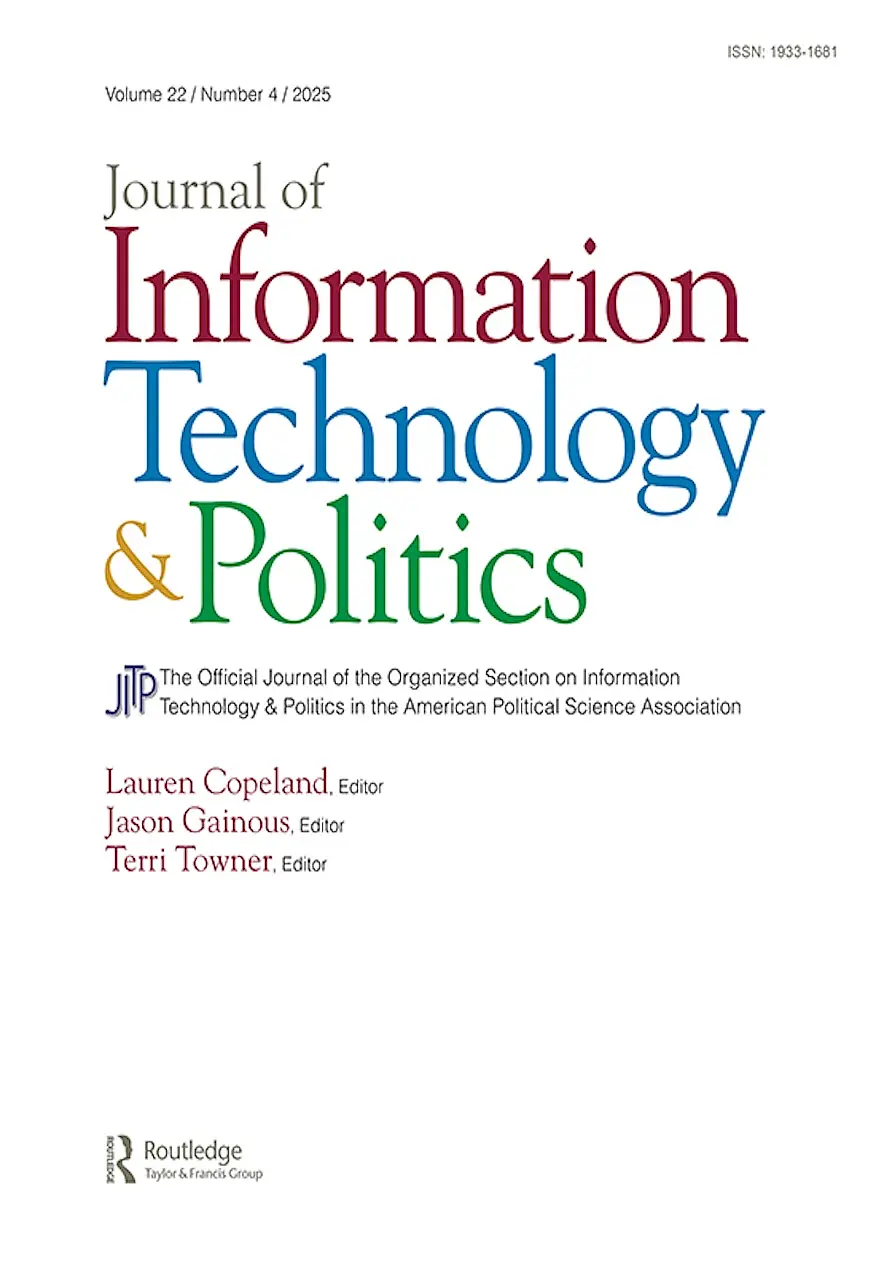
In 1998 MoveOn pioneered a new and powerful form of digitally enabled, multi-issue, member-driven, rapid response, advocacy organization. This model quickly spread around the world as progressive activists emulated it in twenty other countries. These digital advocacy organizations share progressive values and have been influential actors in their national contexts. What is surprising is that right-wing actors have replicated this new organization model. We examine four right-wing digital advocacy organizations: Grassfire (United States), Advance (Australia), Patriot Petition (Germany), and CitizenGo (transnational). We find that all four ‘copycat’ organizations are rapid-response, multi-issue, on-line campaigning organizations, like their left-wing counterparts. However, none appear to be fully-member driven in their funding and decision-making, rather the right has a tendency towards “astroturfing”. We also find that these right-wing organizations explicitly sought to emulate the organizational model of their left-wing counterparts, and there was no evidence of transnational diffusion on the right. This article enriches our understanding of right-wing digital advocacy organizations, and how learning and emulation occur across partisan divides.

Der Artikel ist am 24. Oktober 2024 Open Acces bei Journal of Information Technology & Politics erschienen.


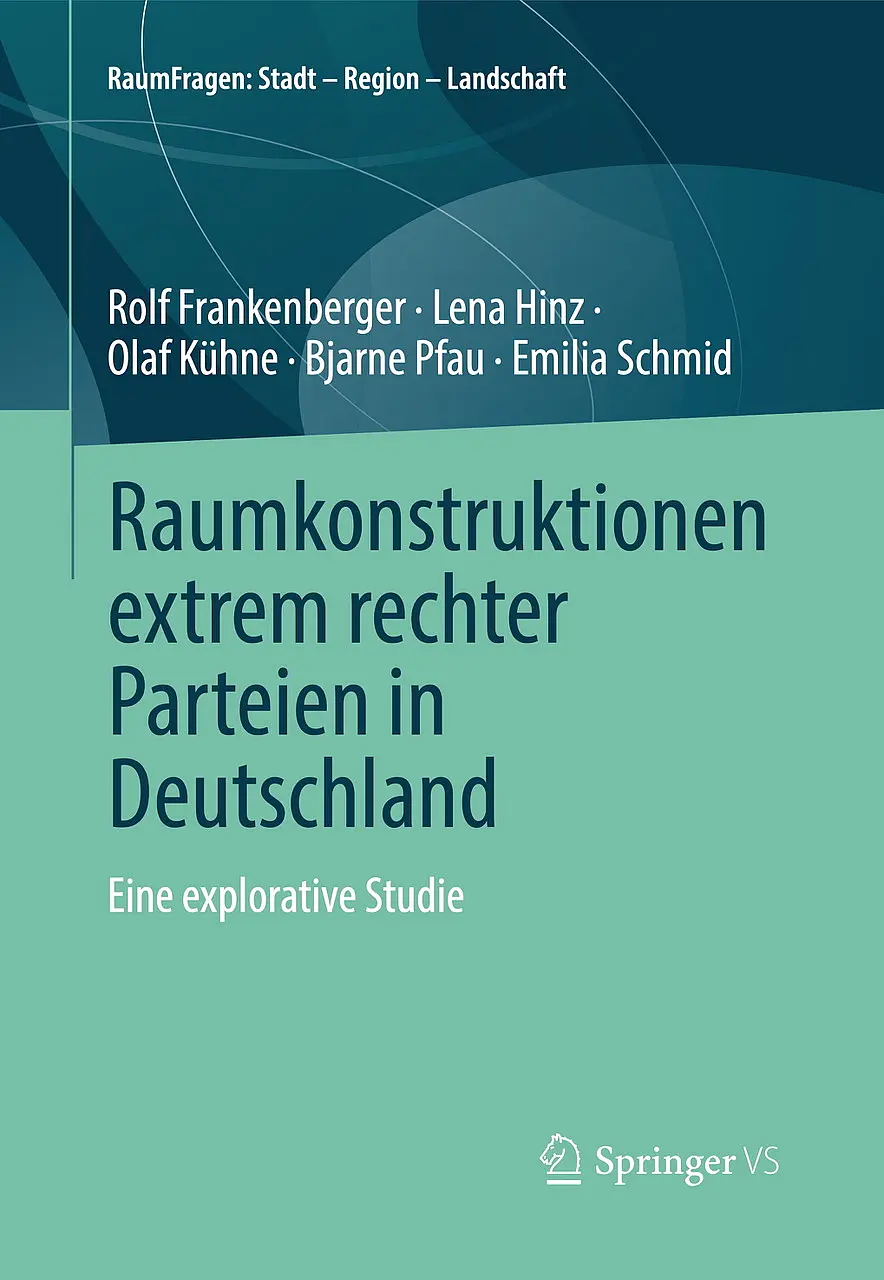
Raumkonstruktionen extrem rechter Parteien in Deutschland – Eine explorative Studie

Authors: Rolf Frankenberger, Lena Hinz, Olaf Kühne, Bjarne Pfau & Emilia Schmid

Wie imaginieren extrem rechte Parteien Raum? Und wie werden diese Raumkonstruktionen in größere Narrative eingebettet?

In unserer neopragmatistisch ausgerichteten, explorativen, inhaltsanalytischen Untersuchung von Partei- und Wahlprogrammen extrem rechter Parteien in Deutschland zeigt sich die zentrale Bedeutung von Raumkategorien für die Konstruktion des Eigenen und des Fremden. Das Kernnarrativ extrem rechter Parteien bezieht sich dabei auf die Verteidigung des ‚gewachsenen Wesens des deutschen Volkes‘ und der ‚deutschen Nation‘ gegen vielfältige Bedrohungen von innen und außen. Hier eint sie trotz einiger Unterschiede in der Narration und im Vokabular der Rückgriff auf essentialistische Raum- und Gemeinschaftskonstruktionen.

Dabei greifen alle Parteien in unterschiedlichem Maße auf extrem rechte Ideologeme wie Fremdenfeindlichkeit, Antisemitismus, Anti-Islamismus und übersteigerten Nationalismus zurück. Anhand der kartographischen Aufarbeitung der Befunde wird aufgezeigt, dass sich diese Konstruktionen häufig in Selbstwidersprüche verstricken und nicht in konsistente Raum- und Weltbilder münden.

The book was published in August 2024 Open Access by Springer VS.


Researching far right extremism – a transdisciplinary, lifeworld, and political culture perspective

Authors: Reiner Baur, Rolf Frankenberger, Markus Rieger-Ladich, Josef Schmid, Barbara Stauber, Ansgar Thiel & Tanja Thomas

Right-wing extremism, understood both as an ideology of inequality and exclusion that manifests itself in attitudes and behavior, and as a heterogeneous movement that is, in part, prone to violence, poses a challenge to and threatens democratic societies. We argue that social science research should contribute to strengthening democracy and civil society against the threat posed by right-wing extremism. With a transdisciplinary, lifeworld-oriented, and politico-cultural perspective, the social sciences can contribute to this task while simultaneously helping to overcome the fragmentation of the research field. In this article, with a focus on Germany, we first provide an overview of current developments in social science research. Second, we outline five prerequisites for a transdisciplinary research program on right-wing extremism. In doing so, we advocate both a lifeworld perspective and methodological pluralism. Third, we propose four overarching thematic clusters as a taxonomy of transdisciplinary research perspectives on right-wing extremism: a) right-wing extremist ideologies and knowledge constructions; b) Right-wing extremist actors, organizations, and networks; c) Right-wing extremist discourses, (digital) media, and strategies in the public sphere; and d) Civic education, transfer, and implementation research on projects against right-wing extremism. Fourth, we argue that further institutionalization is essential to make research on right-wing extremism more sustainable, to link research with societal actors, and to use research findings to strengthen society’s democratic resilience.

The research note was published Open Access  in English in the Zeitschrift für Vergleichende Politikwissenschaft (Volume 17, pp. 275–295) in November 2023.