Publikationen

"Antisemitismus(kritik) in Bildung und Sozialer Arbeit - Kontinuitäten, Leerstellen, Aktualisierungen“

Herausgegeben von Marina Chernivsky, Gesa Köbberling, Friederike Lorenz-Sinai, Wiebke Scharathow und erschienen in der Reihe Aus der Reihe: Antisemitismus in institutionellen Kontexten im Beltz Verlag. 

Die fachwissenschaftliche Debatte zu Antisemitismus in institutionellen Kontexten der Bildung und der Sozialen Arbeit hat eine vergleichsweise junge Geschichte. Erst mit der zunehmenden Thematisierung des gegenwärtigen Antisemitismus aus jüdischen Perspektiven und einzelnen empirischen Studien zu Antisemitismus in Bildungssettings entwickelten sich in den letzten Jahren antisemitismuskritische und intersektionale Analysen. Diese rücken die Auswirkungen antisemitischer Strukturen und Praktiken stärker in das Bewusstsein der Fachöffentlichkeit. Die gesellschaftspolitischen Entwicklungen, die aufgeladenen und politisierten Diskussionen um Antisemitismus in der postnationalsozialistischen, postkolonialen Gesellschaft verdeutlichen den Bedarf an und Herausforderungen von antisemitismuskritischen und intersektionalen Bündnissen sowie solidarischen Netzwerken. Der Sammelband hat das Ziel, Einblicke in Desiderate und Aktualisierungen antisemitismuskritischer, intersektionaler Forschung, Bildung, Sozialer Arbeit zu ermöglichen und neuere Entwicklungen auszuloten.

https://beltz.de/fachmedien/erziehungswissenschaft/antisemitismus-kritik-in-bildung-und-sozialer-arbeit/BEL448826


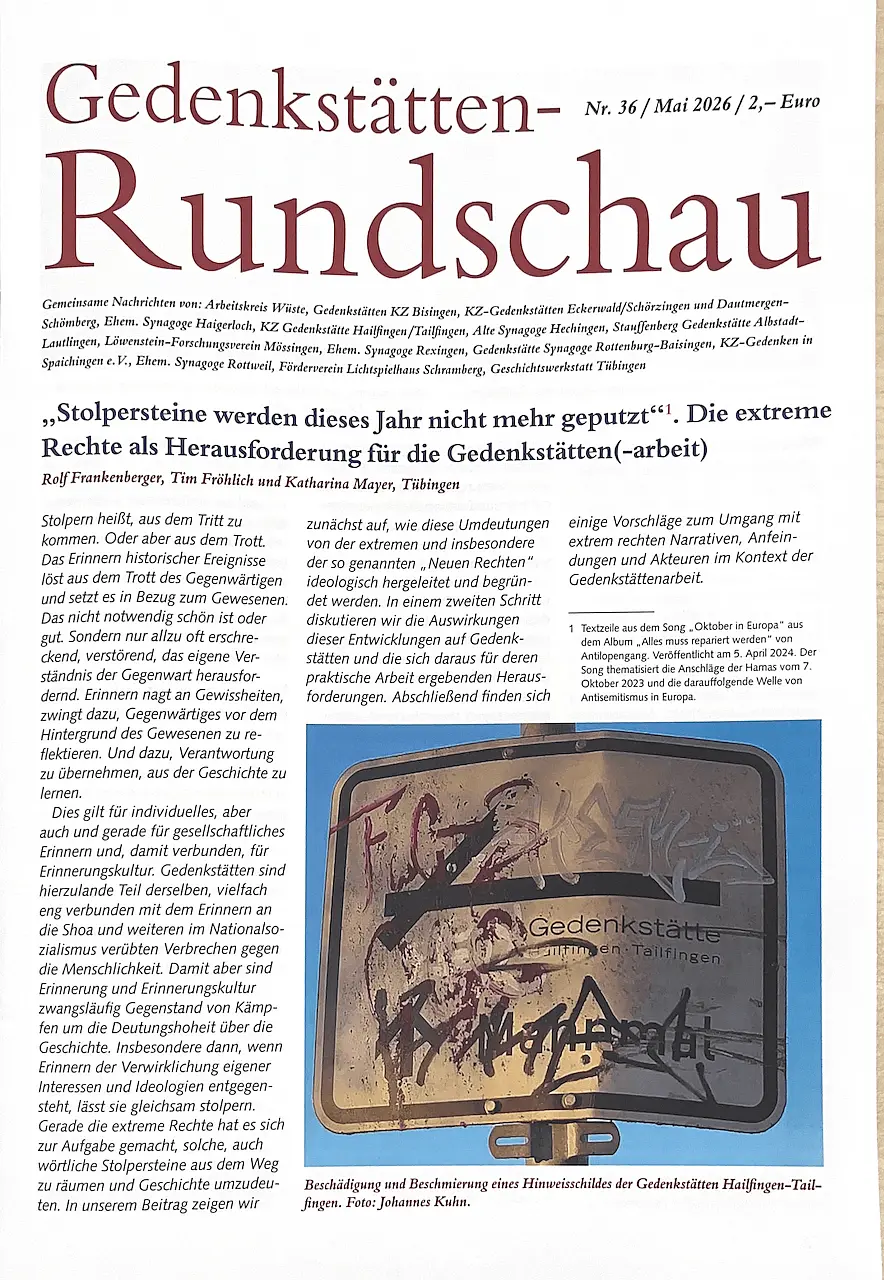
„Stolpersteine werden dieses Jahr nicht mehr geputzt“. Die extreme Rechte als Herausforderung für die Gedenkstätten(-arbeit)
Autor*innen: Rolf Frankenberger, Tim Fröhlich, Katharina Mayer 

Stolpern heißt, aus dem Tritt zu kommen. Oder aber aus dem Trott. Das Erinnern historischer Ereignisse löst aus dem Trott des Gegenwärtigen und setzt es in Bezug zum Gewesenen. Das nicht notwendig schön ist oder gut. Sondern nur allzu oft erschreckend, verstörend, das eigene Verständnis der Gegenwart herausfordernd. Erinnern nagt an Gewissheiten, zwingt dazu Gegenwärtiges vor dem Hintergrund des Gewesenen zu reflektieren. Und dazu, Verantwortung zu übernehmen, aus der Geschichte zu lernen. Dies gilt für individuelles, aber auch gesellschaftliches Erinnern und, damit verbunden, für Erinnerungskultur. Gedenkstätten sind hierzulande Teil derselben, vielfach eng verbunden mit dem Erinnern an die Shoa und weiteren im Nationalsozialismus verübten Verbrechen gegen die Menschlichkeit. Damit aber sind Erinnerung und Erinnerungskultur zwangläufig Gegenstand von Kämpfen um die Deutungshoheit über die Geschichte. Insbesondere dann, wenn Erinnern der Verwirklichung eigener Interessen und Ideologien entgegensteht, lässt sie gleichsam stolpern. Gerade die extreme Rechte hat es sich zur Aufgabe gemach, solche, auch wörtliche Stolpersteine aus dem Weg zu räumen und Geschichte umzudeuten.
Im Beitrag zeigen die Autor*innen zunächst auf, wie diese Umdeutungen von der extremen und insbesondere der sogenannten “Neuen Rechten” ideologisch hergeleitet und begründet werden. In einem zweiten Schritt diskutieren wir die Auswirkungen dieser Entwicklungen auf Gedenkstätten und die sich daraus für deren praktische Arbeit ergebenden Herausforderungen. Abschließend finden sich einige Vorschläge zum Umgang mit extrem rechten Narrativen, Anfeindungen und Akteuren im Kontext der Gedenkstättenarbeit.

Der Artikel ist im Mai 2026 gedruckt in der Gedänkstätten-Rundschau Nr. 36 auf den Seiten 1-7 erschienen. Die Zeitschrift erscheint halbjährlich und ist als Abo, im Buchhandel oder über Verkaufsstellen der Region erhältlich.


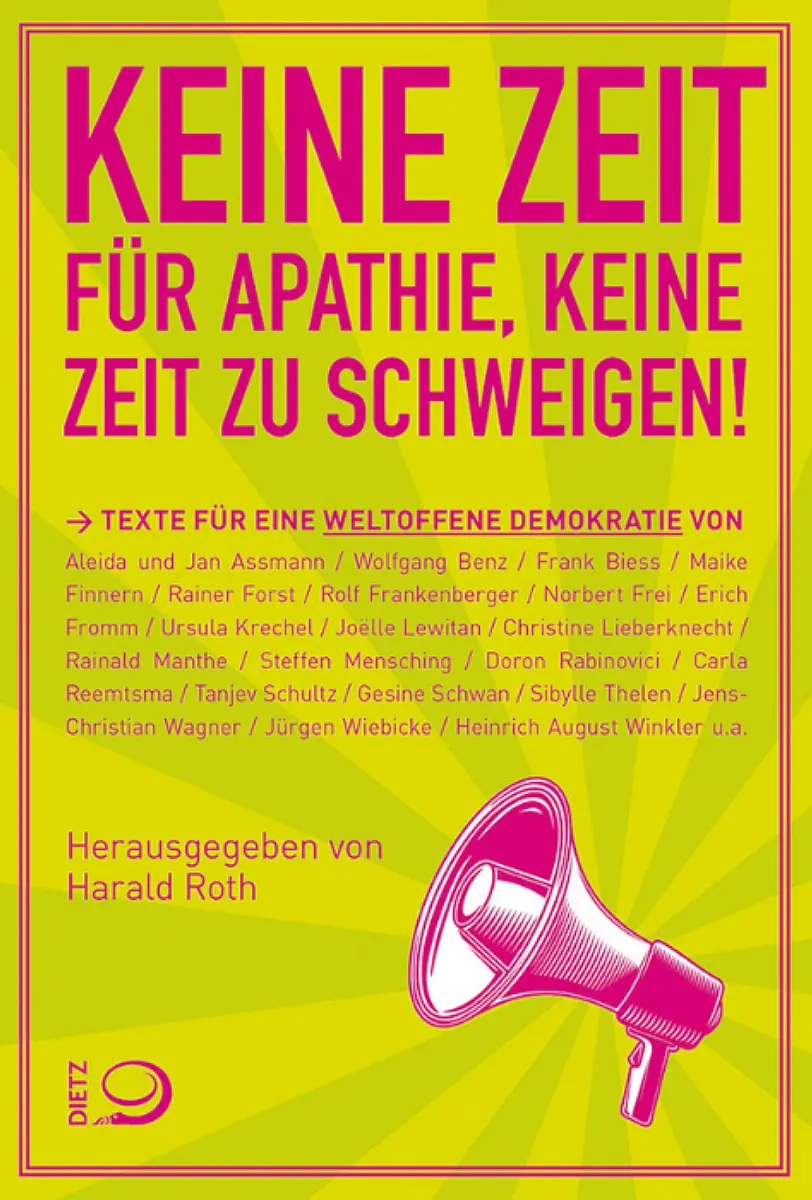
Die extreme Rechte, der Faschismus und die Macht

Autor: Rolf Frankenberger

Die extreme Rechte ist längst nicht mehr nur als randständiges politisches Milieu zu begreifen, sondern als Akteurin im Kampf um gesellschaftliche Deutungsmacht, kulturelle Hegemonie und politische Herrschaft. Der Beitrag untersucht, wie extrem rechte Bewegungen und Parteien in Europa Diskurse verschieben, Grenzen des Sagbaren neu ziehen und Machtverhältnisse in liberalen Demokratien transformieren.
Ausgehend von einer begrifflichen Einordnung der „neuen“ extremen Rechten zeigt Rolf Frankenberger, dass deren Programmatik und Strategien produktiv mit Ansätzen der Faschismustheorie analysiert werden können. Zugleich macht der Text deutlich, dass sich die gegenwärtige extreme Rechte nicht in historischen Analogien erschöpft, sondern als modernes, anpassungsfähiges und diskursiv wirkmächtiges Projekt verstanden werden muss. In einem zweiten Schritt wird mit Rückgriff auf Michel Foucault herausgearbeitet, wie Macht, Diskurs und Wissen im rechten Kulturkampf ineinandergreifen und wie auf diese Weise gesellschaftliche Normalitäten verschoben werden. Der Beitrag verbindet ideengeschichtliche Präzision mit gegenwartsbezogener Analyse und bietet einen theoretisch fundierten Zugang zum Verständnis der extremen Rechten als kultureller, politischer und machtstrategischer Formation der Gegenwart.

Der Text ist 2026 in: Harald Roth (Hrsg.): Keine Zeit für Apathie, keine Zeit zu schweigen. Bonn: Dietz, S.107-119, erschienen.


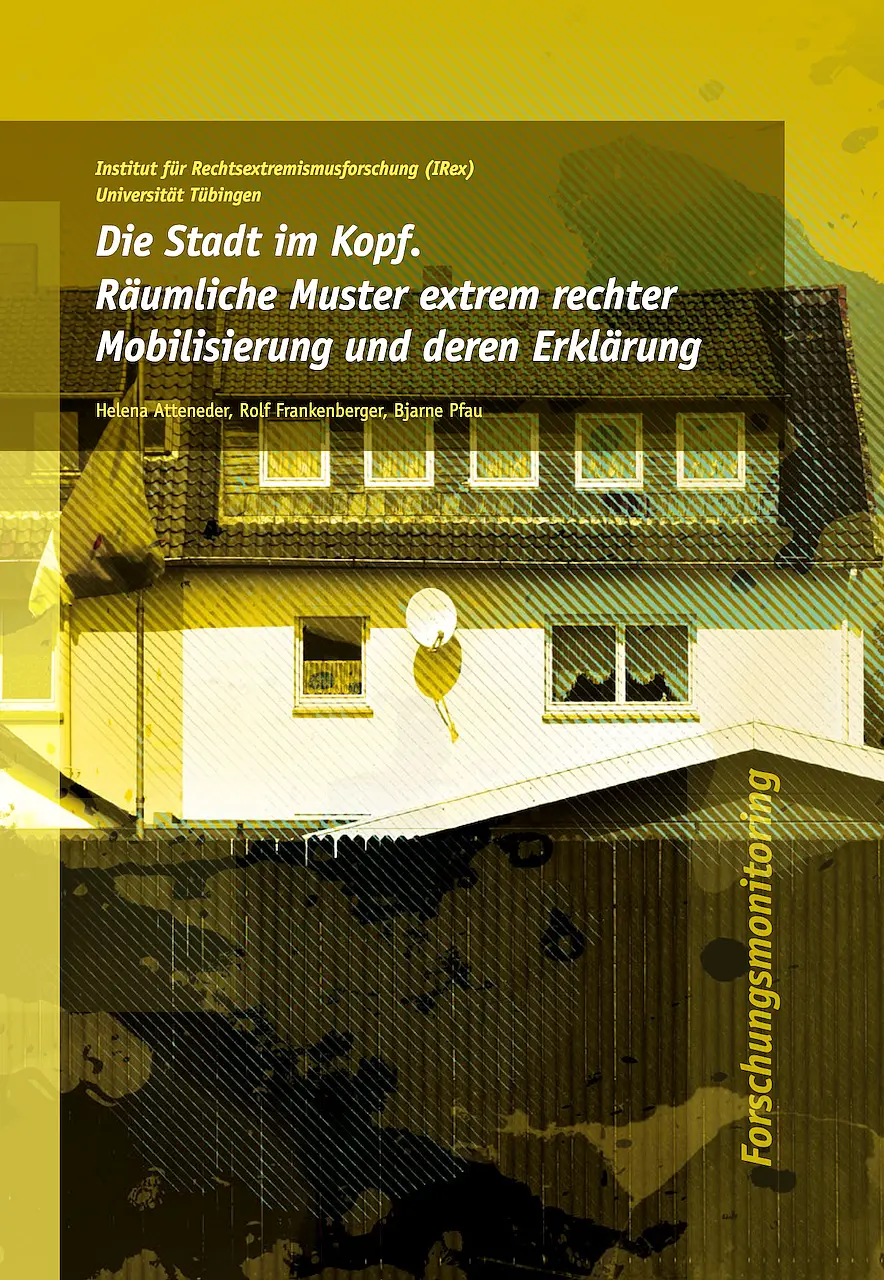
Die Stadt im Kopf. Räumliche Muster extrem rechter Mobilisierung und deren Erklärung
Autor*innen: Helena Atteneder, Rolf Frankenberger, Bjarne Pfau

Im Mittelpunkt der Untersuchung stehen räumliche Muster extrem rechter Mobilisierung um daraus ein theoretisch wie empirisch anschlussfähiges Erklärungsmodell zu entwickeln. Ausgehend von der Diagnose, dass gängige Dichotomien wie Stadt versus Land oder Ost versus West die Komplexität politischer Präferenzen nur unzureichend erfassen, wird ein relationaler Zugang zu Urbanität und Ruralität vorgeschlagen. Diese erscheinen nicht als bloße Siedlungsformen, sondern als sozial, kulturell und medial hervorgebrachte Lebenswelten, in denen sich Erfahrungen von Zentralität, Peripherie, Sichtbarkeit und Marginalisierung verdichten. 
Räumliche Analysen und struktureller Befunde zu Wahlerfolgen der AfD zeigen, dass extrem rechte Mobilisierung dort besonders anschlussfähig wird, wo sich sozialräumliche Benachteiligung, infrastrukturelle Peripherisierung und informationelle Unterversorgung überlagern. Insbesondere die Verschränkung von lebensweltlichen Erfahrungen mit medialen Ungleichheiten, etwa im Kontext lokaler „Nachrichtenwüsten“, rückt so als zentraler Faktor politischer Polarisierung in den Blick. Dieser Ansatz bildet einen innovativen Zugriff auf die Frage, wie räumliche Deutungsmuster politisch wirksam werden. 

Das Kapitel ist 2026 im MOTRA-Monitor 2024/2025 Open Access erschienen.


Die Logiken sozialer Medien und extrem rechte Mobilisierung

Autor*innen: Annett Heft, Miriam Milzner

Der Beitrag analysiert die Rolle sozialer Medien bei der Verbreitung demokratiegefährdender Inhalte im Netz. Er zeigt, dass algorithmisch kuratierte Plattformen im Vergleich zu klassischen sozialen Netzwerken eine breitere und subtilere Verbreitung extremistischer Inhalte ermöglichen, die unabhängig von der Reputation einzelner Akteur:innen ist. Dadurch entstehen neue Zugänge zu bislang unadressierten Zielgruppen und eine potentiell gesteigerte Reichweite demokratiegefährdender Inhalte.

Der Artikel ist am 19.03.2026 Open Access bei RECHTS.GESCHEHEN, dem Journal der Dokumentationsstelle Rechtsextremismus im Generallandesarchiv Karlsruhe, erschienen.


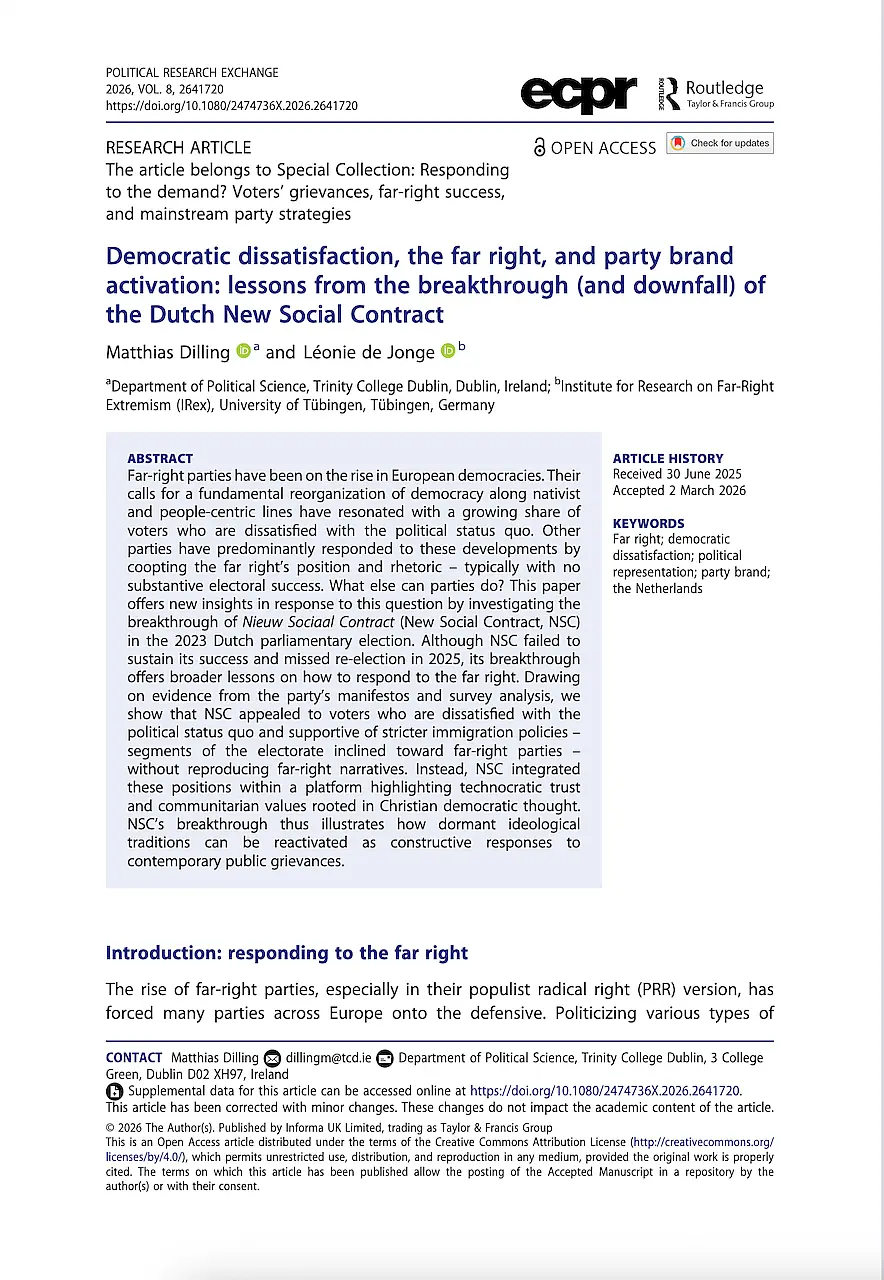
Democratic dissatisfaction, the far right, and party brand activation: lessons from the breakthrough (and downfall) of the Dutch New Social Contract
Autor*innen: Léonie de Jonge, Matthias Dilling

Far-right parties have been on the rise in European democracies. Their calls for a fundamental reorganization of democracy along nativist and people-centric lines have resonated with a growing share of voters who are dissatisfied with the political status quo. Other parties have predominantly responded to these developments by coopting the far right’s position and rhetoric – typically with no substantive electoral success. What else can parties do? This paper offers new insights in response to this question by investigating the breakthrough of Nieuw Sociaal Contract (New Social Contract, NSC) in the 2023 Dutch parliamentary election. Although NSC failed to sustain its success and missed re-election in 2025, its breakthrough offers broader lessons on how to respond to the far right. Drawing on evidence from the party’s manifestos and survey analysis, we show that NSC appealed to voters who are dissatisfied with the political status quo and supportive of stricter immigration policies – segments of the electorate inclined toward far-right parties – without reproducing far-right narratives. Instead, NSC integrated these positions within a platform highlighting technocratic trust and communitarian values rooted in Christian democratic thought. NSC’s breakthrough thus illustrates how dormant ideological traditions can be reactivated as constructive responses to contemporary public grievances.

Der Artikel ist am 14.03.2026 Open Access im Journal Political Research Exchange erschienen.


Die extreme Rechte zwischen Heterogenität und Hybridität - Herausforderungen für die Forschung

Autor*innen: Rolf Frankenberger und Leonie De Jonge

Die Frage, was genau die extreme Rechte ausmacht (ihre Akteure, Ideologien und
Ausprägungen), ist für die politikwissenschaftliche Forschung im Allgemeinen und für vergleichende Ansätze im Besonderen von zentraler Bedeutung. 
Aktuelle Forschung hebt eine zweifache Hybridität hervor: erstens auf der empirischen Ebene aufgrund der Heterogenität und Fluidität der Akteure; zweitens auf der konzeptionellen Ebene aufgrund der unterschiedlichen theoretischen Ansätze, die zur Definition des Phänomens herangezogen werden. Diese doppelte Hybridität stellt die vergleichende Analyse vor erhebliche Herausforderungen. Empirisch erfordert sie eine detaillierte Untersuchung, insbesondere der ideologischen Dimensionen. Konzeptionell erfordert sie Rahmenkonzepte, die sowohl den ideologischen Kern der extremen Rechten identifizieren als auch Subtypen und »Familienähnlichkeiten« zwischen verschiedenen Akteuren erklären können. 

Das Kapitel ist am 10.03.2026 im Sammelband Hybrider Rechtsextremismus: Hegemonie und Eskapismus in (extrem) rechten Netzwerken, Kulturen und Narrativen Open Access bei transcript erschienen.

Die im Band versammelten Texte sind ausgearbeitete Beiträge der Summer School »Rechtsextremismus zwischen Hegemonie und Eskapismus«, die vom 10. bis 13. September 2024 an der Universität Tübingen – in Kooperation mit dem Institut für Rechtsextremismusforschung (IRex) und mit Unterstützung des Universitätsbundes Tübingen – stattgefunden hat. 


Pics or it didn’t happen! EU institutions’ visual communication and user engagement on Facebook and Instagram

Autor*innen: Olga Eisele, Tobias Heidenreich und Phoebe Maares

Eisele, O., Heidenreich, T., & Maares, P. (2026). Pics or it didn’t happen! EU institutions’ visual communication and user engagement on Facebook and Instagram. European Journal of Political Research, 1–26. doi:10.1017/S1475676526100668

Social media often follow a visual logic found to increase engagement, as images are more likely to attract attention, presenting information on a holistic-associative basis. For a political entity like the EU, social media are a promising route to overcome the remoteness to its citizens, identified as one of the crucial challenges to its public legitimacy. Against this broader background, our study analyses the influence of 10 years of EU visual social media communication on user engagement as an indicator of successfully creating visibility in a crucial communication space. For this purpose, we conducted an image-type analysis, combining quantitative and qualitative features of visual analysis: First, a subsample of posts was inductively analysed to identify recurring image types and subsequently used to implement a manual quantitative visual content analysis. Building on the results, we drew on a machine learning approach, allowing us to analyse over 40,000 posts, including more than 20,000 pictures. Our results emphasise the crucial influence of social media affordances in explaining user engagement with EU visual social media communication. Implications are discussed with reference to the ongoing discussion about the EU’s democratic deficit.

Der Artikel ist am 12. Februar 2026 online bei European Journal of Political Research erschienen.


A NEW HOPE? Local journalism as a mitigation hub for misinformation

Autor*innen: Gregory Perreault und Phoebe Maares

Perreault, G., & Maares, P. (2026). A NEW HOPE? Local journalism as a mitigation hub for misinformation. Journal of Applied Communication Research, 54(1), 130–136. doi.org/10.1080/00909882.2025.2573950

The rise of far-right extremism necessitates an evaluation of the ideal means of offering robust information quality to the public, even as hostile actors engage in expansive campaigns of misinformation. This forum manuscript centers on the role of local journalism as a means of combating misinformation, considering notable case studies from Germany and the United States. We argue that in order to enhance local journalism's ability to combat misinformation requires (1) response to misinformation through in-kind platforms and (2) response to misinformation through collaboration.

Der Artikel ist am 29. Januar 2026 online bei Journal of Applied Communication Research erschienen.


The Transnational public sphere in the context of Global challenges – Promises and Threats of Digital Media to Democratic governance

Autor*innen:  Barbara Pfetsch, Curd Knüpfer, Annett Heft

Global problems and crises cannot be effectively addressed within the confines of the nation-state. Instead, they require transnational political action and public engagement. In democratic nation states, citizens are involved in political decisions through electoral participation and public debate. However, transnational politics suffers from a democratic deficit, lacking similar legitimating mechanisms. This entry to the Routledge Companion to Digital Media and Democracy examines the problem of legitimacy and lack of public deliberation of transnational politics in the context of globalization. 
We ask whether digital media ecologies can establish a democratic transnational public sphere to address this problem. The first section reviews theoretical perspectives on transnational public spheres, comparing democratic-normative and constructivist network approaches. The second section analyzes the nature of digital media ecologies and what kind of transnational public spheres they help create. While they could be conducive to democratic developments globally, they are more likely to amplify democratic dysfunctions: rather than mitigating political and social inequalities, dominant digital platforms – due to their commercial logic and ownership structures – exacerbate problems such as political bias, misinformation, and manipulation. We conclude by arguing that existing democratic dysfunctions are reinforced by the resurgence of the nation-state in international politics, which creates further challenges to the development of a transnational public sphere.

Das Kapitel ist am 28.01.2026 in: Papacharissi, Z. (Hrsg.). The Routledge Companion to Digital Media and Democracy bei Routledge erschienen. 


Decoding inequalities in the journalistic field: A theoretical approach to how symbolic violence shapes journalistic career trajectories.

Autor*innen: Kim Löhmann und Phoebe Maares

Löhmann, Kim, & Maares, Phoebe (2026). Decoding inequalities in the journalistic field: A theoretical approach to how symbolic violence shapes journalistic career trajectories. Journalism, 0(0). doi.org/10.1177/14648849261416555

Achieving diversity is a fraught process in the journalistic field, with persistent inequalities shaping the experiences of marginalized journalistic actors. By combining Bourdieu’s field theory and Crenshaw’s concept of intersectionality, we offer a conceptual framework tracing how marginalized journalistic actors experience symbolic violence and symbolic dominance in different journalistic fields around the globe. These experiences can stem from journalists’ lack of appropriate forms of capital, the “right” journalistic habitus and an understanding of the doxa shaping what journalism is: what it ought to look like and who can be considered a legitimate and authoritative member of a given journalistic field. We illustrate this conceptual framework using possible career trajectories of (marginalized) journalists to highlight various forms of symbolic violence experienced by (dis)empowered actors along the three main stages of journalistic careers—namely becoming a journalist, being a journalist and potentially leaving journalism later on.

Der Artikel ist am 16. Januar 2026 Open Access bei Journalism erschienen.


Rechte Verschwörungstheorien in hyperparteiischen Medien - Was hätte ein Verbot des Compact-Magazins für das antidemokratische Online-Ökosystem bedeutet?
Autor*innen: Kilian Bühling, Joana D. Becker, Xixuan Zhang und Annett Heft

Buehling, K., Becker, J. D., Zhang, X. & Heft, A. (2025). Rechte Verschwörungstheorien in hyperparteiischen Medien – Was hätte ein Verbot des Compact-Magazins für das antidemokratische Online-Ökosystem bedeutet? In: Institut für Demokratie und Zivilgesellschaft (Hg.). Wissen schafft Demokratie. Schwerpunkt Demokratiegefährdung online, Band 18. Jena, 82–99.

Social-Media und andere Online-Publikationsformen bieten antidemokratischen Akteur*innen Raum zur Vernetzung, wobei hyperparteiische Medien als Informationsquelle und Bewegungsorganisatoren fungieren. Dieser Artikel nimmt das versuchte Verbot des Compact-Magazins durch das Bundesinnenministerium im Sommer 2024 zum Anlass, mögliche Folgen einzelner Medienverbote für rechtsextreme und verschwörungstheoretische Informationsökosysteme zu untersuchen. Die Studie stützt sich auf eine automatisierte Analyse von Artikeln mit Bezug zur rechtsextremen Verschwörungstheorie des „Großen Austauschs“ aus Compact, Junge Freiheit, Epoch Times und PI News über einen Zeitraum von zehn Jahren. Sie zeigt, dass sich alle untersuchten Medien in diesen Artikeln thematisch ähneln. Compact wird am häufigsten genutzt, jedoch veröffentlicht PI News die größte Artikelzahl mit der höchsten Toxizität. In der Praxis der Regulierung schädlicher Online-Ökosysteme kann daher ein Zielkonflikt entstehen, bei dem zwischen der Eindämmung der toxischsten und reichweitenstärksten Akteur*innen priorisiert werden muss.

Der Beitrag ist 2025 in der Schriftenreihe Wissen schafft Demokratie. Schwerpunkt Demokratiegefährdung online beim Institut für Demokratie und Zivilgesellschaft erschienen.


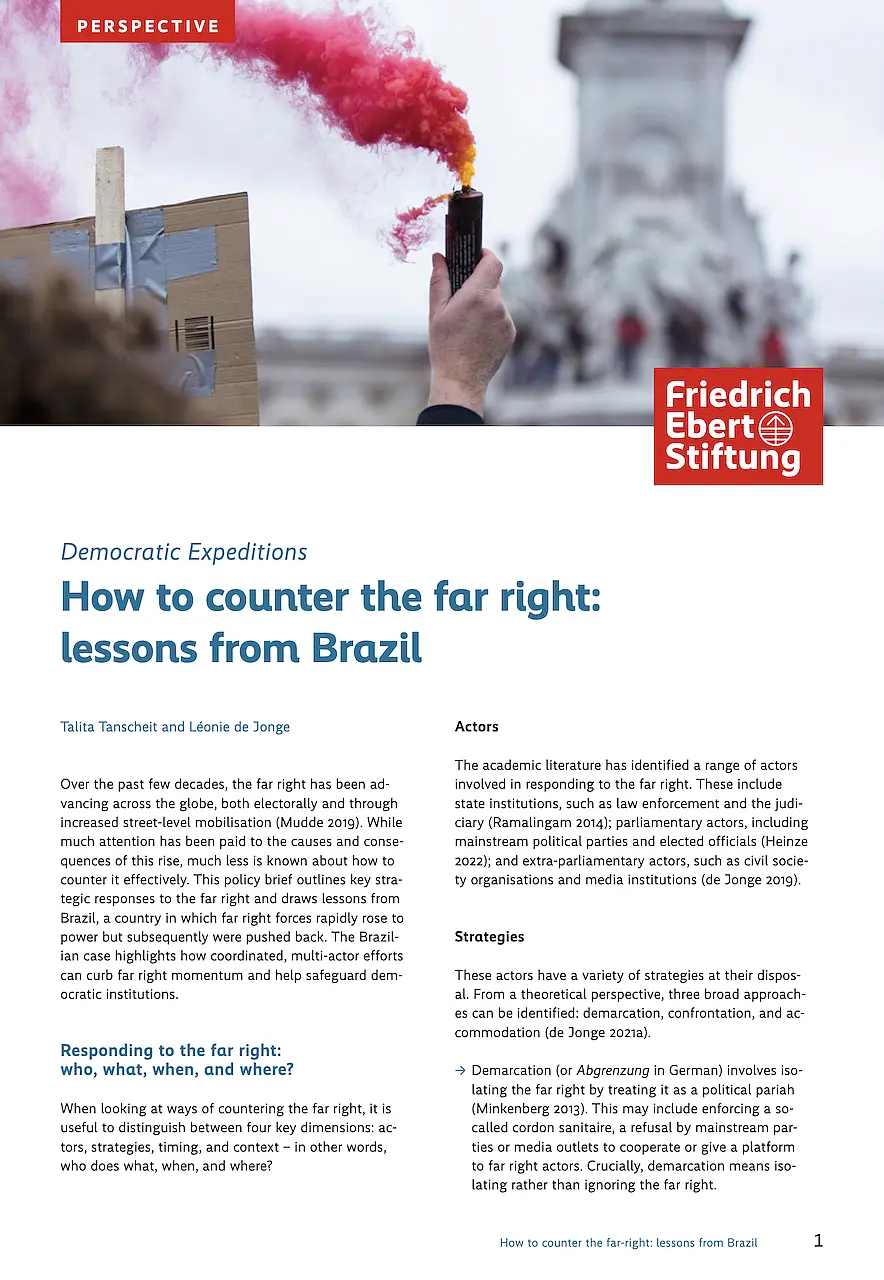
How to counter the far right: lessons from Brazil

Autor*innen: Léonie de Jonge, Talita Tanscheit

Over the past few decades, the far right has been advancing across the globe, both electorally and through increased street–level mobilisation (Mudde 2019). While much attention has been paid to the causes and consequences of this rise, much less is known about how to counter it effectively. This policy brief outlines key strategic responses to the far right and draws lessons from Brazil, a country in which far right forces rapidly rose to power but subsequently were pushed back. The Brazilian case highlights how coordinated, multi–actor efforts can curb far right momentum and help safeguard democratic institutions.

Der Artikel ist im November 2025 Open Access bei der Friedrich-Ebert-Stiftung in Bonn erschienen.


The AfD and Antifeminism in Germany, 2014–2025: Family First, Trans Panic Second
Autor*innen: Sabine Volk

Why is antifeminism particularly strong in the east of Germany? This article contributes to tackling this puzzle by studying antifeminism and far-right politics across different levels of the federal polity. Specifically, the paper analyses the politics of gender by the country’s key antifeminist party player, the far-right Alternative for Germany (AfD). To shed light on the specificities of the eastern German AfD, the paper compares the official political positioning of two eastern German AfD groups, AfD Saxony and AfD Thuringia, with the federal party. Methodologically, the research draws from a qualitative manifesto analysis of ten official documents (2014–2025). The systematic comparison of the manifestos across cases and time reveals that the party’s ideological profile on gender issues is highly homogeneous across groups. The AfD’s antifeminism has been overall consistent since 2014, while the party strategically focuses on radicalising anti-gender and anti-trans positions in recent years. The key difference between eastern German AfD groups and the federal party concerns issue salience, with eastern groups prioritising gender issues over ‘hard’ issues in their manifestos. The findings show that eastern German AfD groups are not ‘more’ antifeminist than the federal party, and underscores the need for further research into the puzzle.

Der Artikel ist am 25.11.2025 Open Access bei German Politics erschienen.


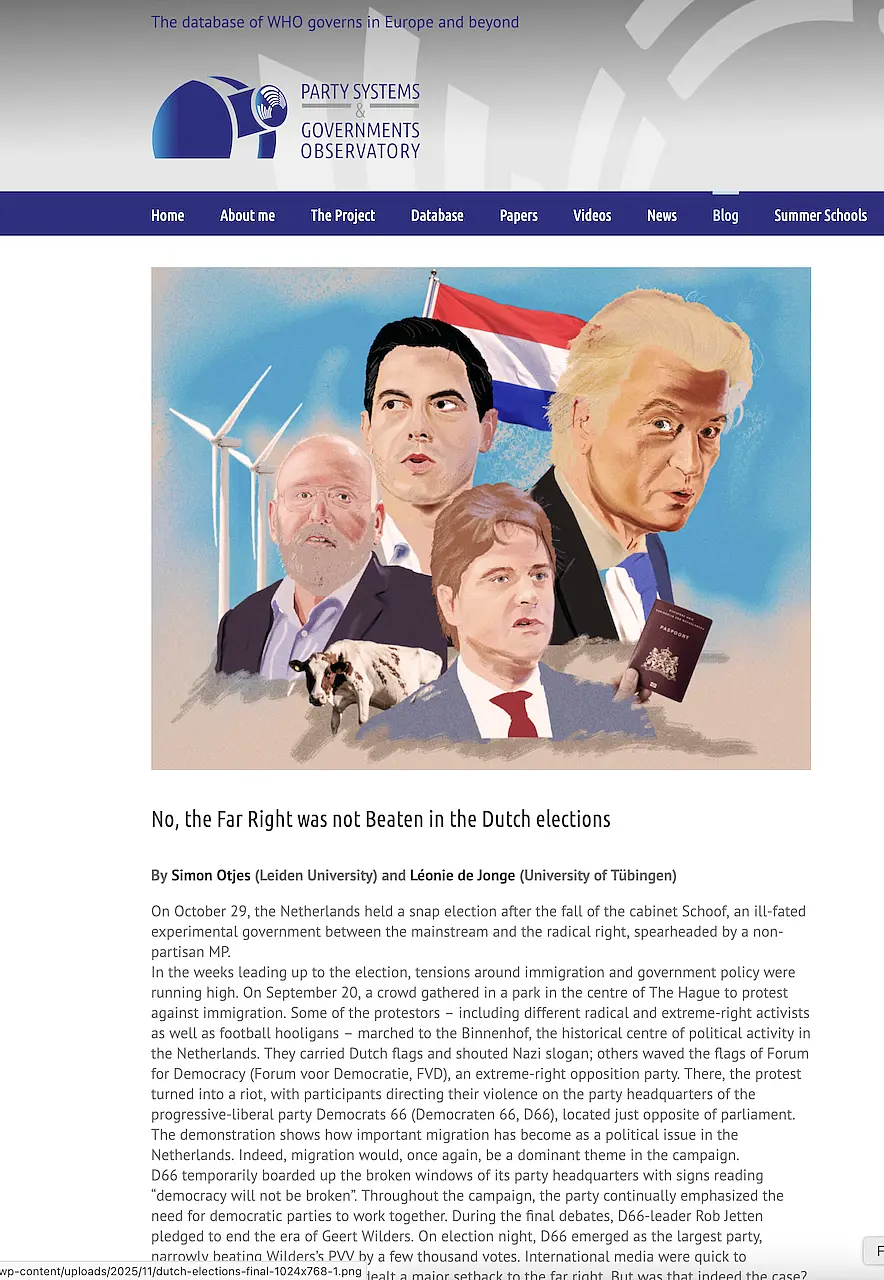
No, the Far Right was not beaten in the Dutch elections

Autor*innen: Prof. Dr. Léonie de Jonge, Simon Otjes (Leiden University)

On October 29, the Netherlands held a snap election after the fall of the cabinet Schoof, an ill-fated experimental government between the mainstream and the radical right, spearheaded by a non-partisan MP.
In the weeks leading up to the election, tensions around immigration and government policy were running high. On September 20, a crowd gathered in a park in the centre of The Hague to protest against immigration. Some of the protestors – including different radical and extreme-right activists as well as football hooligans – marched to the Binnenhof, the historical centre of political activity in the Netherlands. They carried Dutch flags and shouted Nazi slogan; others waved the flags of Forum for Democracy (Forum voor Democratie, FVD), an extreme-right opposition party. There, the protest turned into a riot, with participants directing their violence on the party headquarters of the progressive-liberal party Democrats 66 (Democraten 66, D66), located just opposite of parliament.
The demonstration shows how important migration has become as a political issue in the Netherlands. Indeed, migration would, once again, be a dominant theme in the campaign.
D66 temporarily boarded up the broken windows of its party headquarters with signs reading “democracy will not be broken”. Throughout the campaign, the party continually emphasized the need for democratic parties to work together. During the final debates, D66-leader Rob Jetten pledged to end the era of Geert Wilders. On election night, D66 emerged as the largest party, narrowly beating Wilders’s PVV by a few thousand votes. International media were quick to comment that Dutch voters had dealt a major setback to the far right. But was that indeed the case?

Der Blogpost ist am 04.11.2025 Open Access bei WHO governs erschienen.


The Netherlands is trying to draw a line under a year of chaos with fresh elections – will it work?

Autor*innen: Léonie de Jonge, Esmee Bakker

Dutch voters are to elect a new parliament for the third time in just five years on October 29. Prime Minister Dick Schoof called a snap election following the collapse of his cabinet in June, just 11 months after it was sworn in.

The immediate trigger was the withdrawal of Geert Wilders’s far-right Party for Freedom (PVV) from the governing coalition. The PVV quit after coalition partners rejected its controversial ten-point plan on migration, which included using the army to secure borders and turning back all asylum seekers.

Der Beitrag ist am 21. Oktober 2025 Open Access bei The Conversation erschienen.


Assessing the Role of Proximity, Authenticity, and Professionalism in Struggles Over Journalistic Authority in Fan Communities

Autor*innen: Clara Juarez Miro, Phoebe Maares & Jonathan Hendrickx 

Global declines in news consumption underscore the tension between journalists’ ideals of detachment and audience demands for engagement. In hybrid digital environments, non-traditional journalistic actors can assert authority in specific communities by deviating from traditional values. As these actors challenge traditional business models, their emergence has destabilized the journalistic field. Yet, scholarly understanding of how community membership shapes claims of journalistic authority is limited. To address this gap, we examine how diverse journalistic actors in two niche communities base their claims on (1) proximity to sources; (2) authenticity; and (3) professionalism. Drawing on interviews from two fandom community events, the Eurovision Song Contest and re:publica, this study disentangles how diverse actors can claim authority while meeting community needs, which is crucial to journalism’s prevalence amid the ongoing economic transformation in the journalistic landscape.

Der Artikel ist am 15. Oktober 2025 bei Journalism Studies erschienen.


Autonomy, Objectivity, and Transparency: The Meaning and Negotiation of Journalistic Values Across Different Journalistic Beats

Autor*innen: Phoebe Maares, Kim Löhmann, Folker Hanusch, Daniel Nölleke 

As an institution, journalism relies on several key normative values to claim authority and legitimacy–autonomy, objectivity, and transparency. Although these concepts have been widely studied, most research employs quantitative approaches or focuses on specific beats, often political journalism. Drawing on fifty-five in-depth interviews with Austrian journalists, we examine the meaning of these journalistic values and their relevance in political, lifestyle, sports, and economic journalism. We find that autonomy is universally valued, though commercial influences and pressures are more frequently noted in lifestyle and sports journalism. Objectivity is emphasized in political and economic journalism but less prioritized in “softer” news beats, where subjective perspectives are more widely accepted. Transparency is important across all fields, yet differences emerge between “hard” and “soft” news regarding the necessity to disclose sources or funding agencies. Thus, universality across beats cannot be assumed, and the heterogeneity of the journalistic field, in terms of its application of different normative values, needs to be considered in future studies.

Der Artikel ist am 1. Oktober 2025 bei The International Journal of Press/Politics erschienen.


RightNow! Far-Right Normalization and Democratic Erosion: A Pre-Election Update from the Netherlands

Autor*innen: Iris Beau Segers, Léonie de Jonge

Just a month ahead of the Dutch elections, Léonie de Jonge and Iris B. Segers raise concerns about the growing normalization of extreme-right ideologies and actions, highlighted by the unprecedented violence that erupted during a recent anti-immigration demonstration in the Hague.

Der Blogpost ist am 30. September 2025 Open Access bei C-Rex Center for Research on Extremism online erschienen.


Diversität im journalistischen Selbstverständnis: Eine Analyse des Rollenselbst- und -fremdbildes traditioneller und peripherer Akteur*innen im österreichischen Journalismus
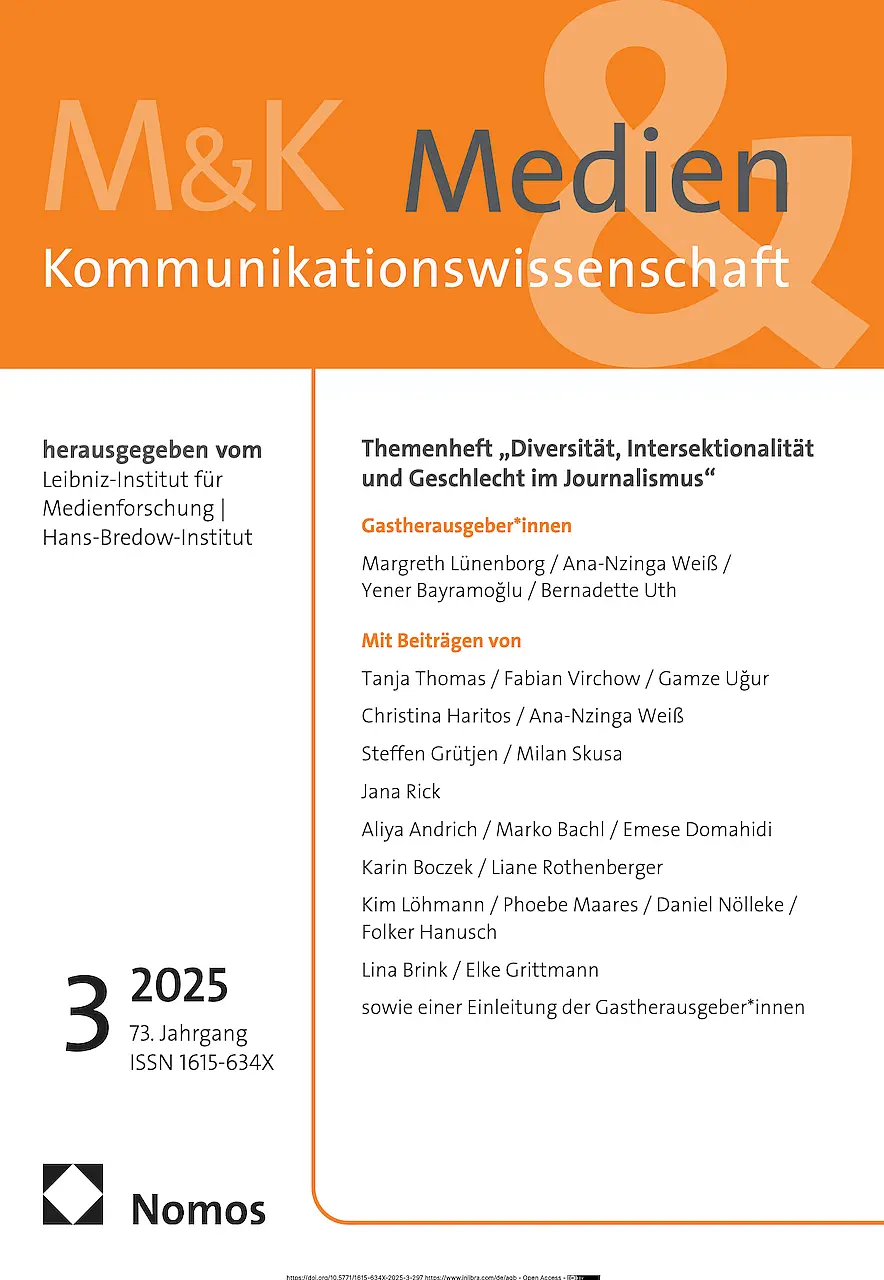
Autor*innen: Kim Löhmann, Phoebe Maares, Folker Hanusch & Daniel Nölleke

Periphere journalistische Akteure produzieren und verbreiten vermehrt Journalismus-ähnliche Inhalte in digitalen Räumen und lassen dadurch die Grenzen des Journalismus zunehmend verschwimmen. Viele dieser Akteure wollen nachhaltig zur Inhalts-, Perspektiven- und Akteurs-Diversität im öffentlichen Diskurs beitragen, wodurch dieser Anspruch oft ihrem Rollenselbstbild zugeschrieben wird. Wir wissen jedoch bislang wenig darüber, wie sich Rollenselbst- und -fremdbilder peripherer journalistischer Akteurinnen von jenen traditioneller Journalistinnen unterscheiden, welche Rolle Diversität in ihrer täglichen Arbeit spielt, und ob es Ressort-Unterschiede gibt. Diese Studie adressiert diese Lücke auf Basis von 119 qualitativen Interviews mit peripheren und traditionellen Journalistinnen aus Österreich in den Bereichen Politik, Wirtschaft, Sport und Lifestyle. Während die Unterschiede und zugeschriebene Bedeutsamkeit von Diversität in den Rollenselbstbildern von peripheren und traditionellen Journalistinnen als Grenzmarker zwischen den Akteur*innen und ihren jeweiligen Ressorts verstanden werden können, steht Diversität im Journalismus allgemein weniger im Vordergrund, als es normative Erwartungen vermuten lassen würden. Die Ergebnisse liefern erste systematische Erkenntnisse zum Rollenselbst- und -fremdbild peripherer und traditioneller Akteure im Journalismus über verschiedene Ressorts hinweg und tragen zu einem genaueren Verständnis der Relevanz von Diversität im Journalismus bei.
Der Artikel ist 25. August 2025 Open Access bei Medien und Kommunikationswissenschaft erschienen.


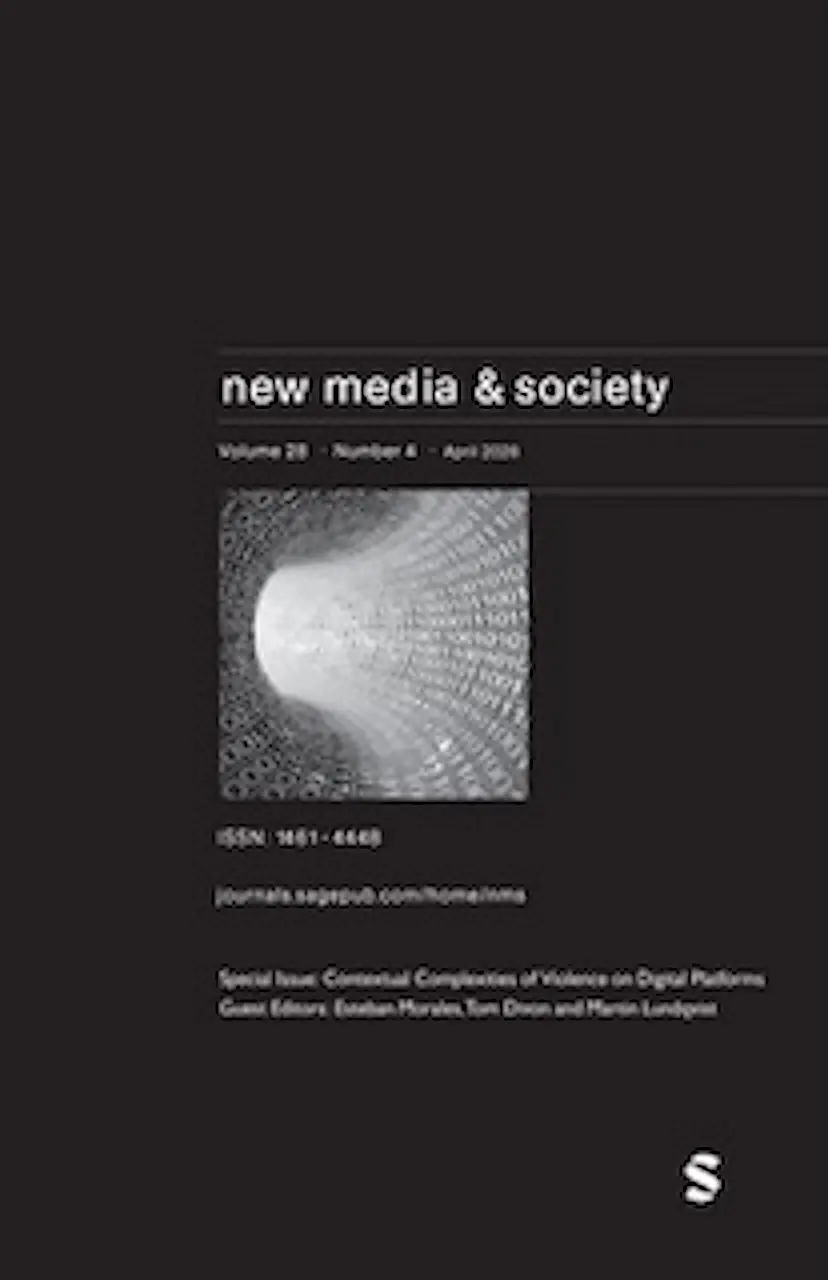
Attributing coordinated social media manipulation: a theoretical model and typology

Autor*innen: Daniel Thiele, Miriam Milzner, Annett Heft, Baoning Gong, Barbara Pfetsch

Social media are key arenas for public opinion formation, but are susceptible to coordinated social media manipulation (CSMM), that is, the orchestrated activity of multiple accounts to increase content visibility and deceive audiences. Despite advances in detecting and characterizing CSMM, the attribution problem—identifying the principals behind CSMM campaigns—has received little scholarly attention. In this article, we address this gap by synthesizing existing research and developing a theoretical model for understanding CSMM. We propose a consolidated definition of CSMM, identify its key observable and hidden characteristics, and present a rational choice model for inferring principals’ strategic decisions from campaign features. In addition, we present a typology of CSMM campaigns, linking variations in scale, elaborateness, and disguise to principals’ resources, stakes, and influence strategies. Our contribution provides researchers with conceptual and heuristic tools for attribution and invites interdisciplinary and comparative research on CSMM campaigns.

Der Artikel ist am 29. Juli 2025 Open Access bei New Media & Society erschienen.


Rechte Spiele & Modifikationen

Autorin: Mareike Stürenberg

Das Kapitel widmet sich der Untersuchung von digitalen Spielen und Modifikationen, die rechte und rechtsextreme Inhalte transportieren. Es wird argumentiert, dass Videospiele, wie jedes kulturelle Medium, politische Implikationen aufweisen und rechte Ideologien verbreiten können. Zudem wird erörtert, wie politische Gruppierungen Spiele als Medium zur Radikalisierung nutzen und welche Rolle Modifikationen in der Verbreitung rechter Ideologie spielen. Abschließend wird auf die unzureichende Forschungslage zu den Auswirkungen dieser Spiele auf ihre Nutzer eingegangen.

Der Beitrag ist am 14. Juli 2025 Open Access im Handbuch Gaming und Rechtsextremismus: Voraussetzungen, Folgen, Auswege der Bundeszentrale für politische Bildung erschienen. 


Chat groups as local civic infrastructure: A case study of “Solidary neighborhood help” Telegram groups during the COVID-19 pandemic in Germany

Autor*innen: Olga Pasitselska, Killian Buehling, Emilija Gagrčin

Messaging groups are emerging as “meso-spaces”—digital environments that enable sustained dialogue and collective action through their distinct affordances. We examine how such spaces facilitate civic self-organization through their hybrid online/offline, public/private, and local/global dynamics and how they function as local civic infrastructure during times of crisis. Using a mixed-methods analytical approach, we examined 47 public Telegram groups from Germany during the COVID-19 pandemic. We identified a fundamental tension between political discussion and practical help in these spaces, resolvable through active horizontal participation (including norm negotiation and self-moderation), or strict vertical moderation. Additional challenges included a lack of access to vulnerable groups and limited outreach to local civil society actors, both of which hindered group activity and structural connections within local civic infrastructure. Despite these challenges, our study highlights the potential of local chat groups for self-organization, albeit primarily among privileged urban individuals. We discuss the implications for democratic theory and practice.

Der Artikel ist am 13. Juli 2025 Open Access bei  New Media & Society erschienen.


Snap Out of It? Governmental Instability and Far-Right Mainstreaming in the Dutch and French Elections of 2023/2024

Autor*innen: Marianna Griffini, Léonie de Jonge, Marta Lorimer

Neither the Netherlands nor France were expected to have new governments in 2024. Dutch voters were due to go back to the polls in 2025, while France was to hold the next legislative election in 2027. However, between the summer of 2023 and the summer of 2024, both Mark Rutte and Gabriel Attal government's term came to an early end, with snap elections being held in November 2023 in the Netherlands and June/July 2024 in France.

In this article, we compare the two elections to show how despite widely differing institutional conditions, both elections returned weakened governments dependent on the goodwill of the far right for their political survival. France and the Netherlands can be regarded as two ‘most different cases’ when it comes to their electoral and governmental systems. Whereas the former relies on a two-round majoritarian voting system favouring the emergence of clear and stable governmental majorities, the latter is based on a strongly proportional electoral system where post-electoral coalition building plays a key role. However, in this case, their electoral systems led both countries towards a similarly unstable equilibrium. Both countries departed from, and returned to, a situation of political instability. Moreover, the far right made remarkable inroads in both cases. Far-right ideas and personalities dominated the debate, contributing to a continued mainstreaming of their positions. In the Netherlands, Geert Wilders's Partij voor de Vrijheid (PVV – Party for Freedom) also gained a foot in a coalition government after laborious and lengthy inter-party negotiations. In France, the Rassemblement National (RN – National Rally) failed to win enough seats to form a government and faced continued demonisation, but still acquired a pivotal role in the government negotiations that followed the elections.

The article proceeds as follows. First, we trace the circumstances leading up to the snap elections. We then revisit the political campaigns in both countries, highlighting how they were dominated by the personalities and themes of the far right. Finally, we offer comparative insights on the implications of these developments.

Der Artikel ist am 01. Juli 2025 Open Access bei JCMS: Journal of Common Market Studies erschienen. 


Understanding the role of community membership in journalistic authority claims: a framework informed by boundary work and fan studies
Autor*innen:  Clara Juarez Miro, Phoebe Maares, Jonathan Hendrickx & Folker Hanusch

Digitalization and declines in news use underscore the tension between journalistic ideals of detachment and audience communities’ demands for journalistic actors’ engagement. This is enhanced by the emergence of non-traditional actors who can effectively assert journalistic authority within communities by deviating from specific traditional journalistic values. However, scholarly understanding of the role of community membership in claims of journalistic authority remains limited. To address this, we propose a theoretical framework that draws on boundary work and fan studies. This framework allows us to examine how diverse journalistic actors in a variety of communities can base their journalistic authority claims on their: (1) proximity to news sources and protagonists; (2) authenticity as perceived by the audience community; and (3) professionalism in relation to the journalistic field. Through empirical research, this framework may help us to better understand how diverse journalistic actors can claim authority while meeting communities’ diverse needs.

Der Artikel ist am 13. Juni 2025 Open Access bei Communication Theory erschienen.


The Netherlands: Political Developments and Data in 2024 – An Experimental Government with the Radical Right

Autor*innen: Léonie de Jonge & Simon Otjes

Following the 2023 national elections, the first half year of 2024 focused on negotiations between four parties from the centre-right to the radical right, resulting in the formation of the Schoof Cabinet. With an independent former top civil servant as Prime Minister, the new government proposed more stringent migration measures, budgetary discipline, democratic reforms and a long-term perspective for Dutch farmers, as well as a more open and transparent relationship between Parliament and the Cabinet. This marked the first time in over a century that the Prime Minister was not affiliated with one of the coalition parties. This arrangement paved the way for the most right-wing government in the Netherlands since the postwar era. In the second half of the year, however, the coalition's fragile nature became evident, as the Cabinet found itself on the brink of collapse on three separate occasions.

Der Artikel ist am 04. Juni 2025 Open Access bei European Journal of Political Research Political Data Yearbook erschienen.


Real freelancers, contingent workers, and journopreneurs. Mapping atypical journalistic work in Western Europe
Author: Phoebe Maares

While there has been growing scholarly interest in freelance and other atypically employed journalistic workers in the past 20 years, most of it has been addressed through single-case studies. This study examines atypical journalism from a Bourdieusian perspective through Multiple Correspondence Analysis, including the resources that atypical journalists have amassed to participate in the journalistic field and how these shape their journalistic culture. Drawing on 430 survey respondents from Austria, Denmark, France, the Netherlands, and the UK, results indicate that despite being well-educated, atypical journalistic workers experience economic precarity, have little contact with the professional community, and occupy marginalized positions within the journalistic field. Most noteworthy differences occur at the country level, indicating that the historical genesis of the national field shapes atypical journalistic culture more profoundly than employment status.

The article was published Open Access by Journalism.


Studieren ohne Angst

Autor*innen: Prof.*in Dr.*in Heike Radvan, Susanne Dyhr

Die Brandenburgische Technische Universität Cottbus-Senftenberg hat sich für ein Handlungskonzept gegen Rechts entschieden. Dafür gibt es viele Gründe…

Der Beitrag ist erschienen in DUZ Wissenschaft & Management, Ausgabe 04.2025, Seite 14–17.


LGDE: Local Graph-based Dictionary Expansion

Autor*innen: Juni Schindler, Sneha Jha, Xixuan Zhang, Kilian Buehling, Annett Heft, Mauricio Barahona

We present Local Graph-based Dictionary Expansion (LGDE), a method for data-driven discovery of the semantic neighborhood of words using tools from manifold learning and network science. At the heart of LGDE lies the creation of a word similarity graph from the geometry of word embeddings followed by local community detection based on graph diffusion. The diffusion in the local graph manifold allows the exploration of the complex nonlinear geometry of word embeddings to capture word similarities based on paths of semantic association, over and above direct pairwise similarities. Exploiting such semantic neighborhoods enables the expansion of dictionaries of pre-selected keywords, an important step for tasks in information retrieval, such as database queries and online data collection. We validate LGDE on two user-generated English-language corpora and show that LGDE enriches the list of keywords with improved performance relative to methods based on direct word similarities or co-occurrences. We further demonstrate our method through a real-world use case from communication science, where LGDE is evaluated quantitatively on the expansion of a conspiracy-related dictionary from online data collected and analyzed by domain experts. Our empirical results and expert user assessment indicate that LGDE expands the seed dictionary with more useful keywords due to the manifold-learning-based similarity network.

Der Artikel ist am 9. Juni 2025 Open Access bei Computational Linguistics erschienen.


Fortuyn versus Wilders versus Baudet: the evolution of populist radical right party organization in the Netherlands

Autor*innen: Léonie de Jonge und Gerrit Voerman 

Existing research has shown that there is considerable diversity when it comes to populist radical right party (PRRP) organization, but it is unclear why this is the case. The Netherlands provides an ideal laboratory to examine this question. Within two decades, the country witnessed the rise of several PRRPs, including the List Pim Fortuyn (LPF), the Party for Freedom (PVV) and Forum for Democracy (FvD). Despite ideological similarities, there are clear differences between these parties in terms of party organization. We argue that the organizational model of the FvD is a synthesis of the LPF and the PVV. To avoid internal dissension that brought about the demise of the LPF, the FvD adopted organizational elements of Geert Wilders’s ‘personal party’. The FvD also drew lessons from the financial limitations of the PVV by creating a large membership base. The findings show clear evidence of institutional learning. By learning from the experiences of others, PRRPs are becoming much better equipped to endure setbacks, which suggests that they are less likely to subside in the near future.

Der Beitrag ist Open Access in englischer Sprache im März 2025 bei European Political Science Review erschienen.


Rechte (T)Räume. Wie extrem rechte Parteien Raum konstruieren und darüber Diskurse radikalisieren.

Autor*innen: Rolf Frankenberger, Lena Hinz, Olaf Kühne, Bjarne Pfau & Emilia Schmid

Auch gegenwärtig kommt der Kategorie Raum in extrem rechten Diskursen besondere Bedeutung zu, insbesondere in Bezug auf die räumliche Kategorisierung des Eigenen in Abgrenzung zum Fremden (vgl. Frankenberger et al., 2024). Während das Raumverständnis im Nationalsozialismus eine umfangreiche wissenschaftliche Beachtung erfuhr (vgl. Körner, 2001; Mai, 2002), bleibt die Analyse von Raumverständnissen extrem rechter Akteure in der Gegenwart eher randständig. Oftmals beschränkt sich die Untersuchung der Zusammenhänge von Rechtsradikalismus und Raum auf das Themenfeld ‚Rechtsextremismus und ländlicher Raum‘ oder der räumlichen Verortung von Rechtsextremismus (vgl. Rolfes, 2011).

In unserer explorativen Studie zu Raumverständnissen extrem rechter Parteien haben wir insgesamt neun Partei- und Wahlprogramme aus dem Zeitraum von 2017 bis 2023 untersucht. Gerade weil sich diese Programme an eine breitere Öffentlichkeit richten, eignen sie sich, Vokabulare und deren Anschlussmöglichkeiten an nicht extreme Vokabulare in der Gesellschaft zu untersuchen. 

Ausgehend von den theoretischen Grundlagen im Neopragmatismus, stellen wir im Folgenden unsere methodische Herangehensweise und die zentralen Befunde der Studie vor und diskutieren die Leistungsfähigkeit neopragmatistischer Redeskriptions- und Vokabularanalyse für die Forschung zur extremen Rechten und zur Radikalisierung von gesellschaftlichen Diskursen.

Der Aufsatz ist im März 2025 Open Access erschienen in Kemmesies, U., Wetzels, P., Austin, B., Büscher, C., Dessecker, A. Hutter, S. Rieger, D. (Hrsg.): Motra-Monitor 2023/24. Wiesbaden: MOTRA, S. 406-419.


What is the AfD? Germany’s far-right party, explained

Autor*innen: Léonie de Jonge und Rolf Frankenberger

In the weeks ahead of the German election, the far-right party Alternative für Deutschland (AfD) consistently polled around 20%. For the first time, the AfD poses a challenge to mainstream parties’ longstanding strategy of isolating the far right.

The rise of the AfD is striking, given the country’s history of authoritarianism and National Socialism during the 1930s and 1940s. For decades, far-right movements were generally stigmatised and treated as pariahs. Political elites, mainstream parties, the media and civil society effectively marginalised the far right and limited its electoral prospects.

The AfD’s breakthrough in the 2017 federal election shattered this status quo. Winning 12.6% of the vote and securing 94 Bundestag seats, it became Germany’s third-largest party — unlocking viable political space to the right of the centre-right party CDU/CSU for the first time in the postwar era.

Ganzen Artikel lesen

Der Artikel ist am 21. Februar 2025 auf Englisch bei The Conversation erschienen.


Veiled conspiracism: Particularities and convergence in the styles and functions of conspiracy-related communication across digital platforms

Autor*innen: Killian Buehling, Xixuan Zhang, Annett Heft

Digital communication venues are essential infrastructures for anti-democratic actors to spread harmful content such as conspiracy theories. Capitalizing on platform affordances, they leverage conspiracy theories to mainstream their political views in broader public discourse. We compared the word choice, language style, and communicative function of conspiracy-related content to understand its platform-dependent differences and convergence. Our cases are the conspiracy theories of the New World Order and Great Replacement, which we analyzed on 4chan/pol/, Twitter, and seven alternative US news media longitudinally from 2011 to 2021. The conspiracy-related texts were comparatively analyzed using a multi-method approach of computational and quantitative text analyses. Our results show that conspiracy narrations are increasingly present in all venues. While language differs vastly between platforms, we observed a style convergence between Twitter and 4chan. The results show how more coded language veils the spread of racist and antisemitic content beyond the so-called dark platforms.

Der Artikel ist am 13. Februar 2025 Open Access bei New Media & Society erschienen.


These maps of support for Germany’s far-right AfD lay bare the depth of the urban-rural divide
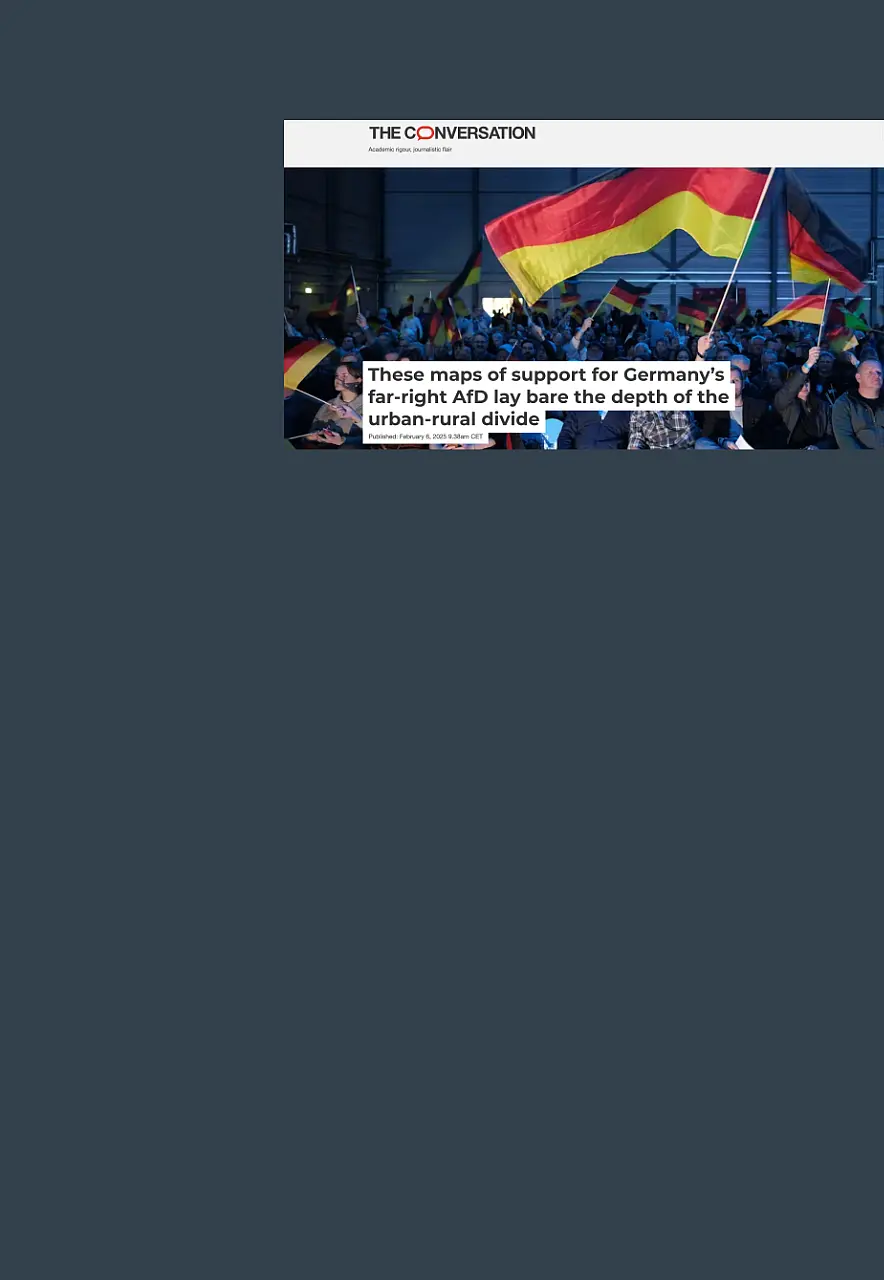
Autor: Rolf Frankenberger

The process of industrialisation, globalisation and urbanisation – spreading out from urban centres into the countryside – is one of the core developments of modern society. It has changed people’s lives in almost every part of the world. This is a process that has been going on for more than a century. New lifestyles have developed and traditional ones have been challenged.

A new division has emerged as a result between the urban and the rural. The two are more than just forms of settlements – they reflect ideals, values and lifestyles. Those who live in towns and cities lead almost entirely different lives to those who live in the countryside.

Where the two meet, there is potential for tension. And that tension can be politicised. In Germany, the Alternative für Deutschland (AfD), a far-right nationalist and völkisch party, is using the “urban-rural divide” to polarise and mobilise an electorate that is attracted by romanticised notions of purity, tradition, nation and rurality.

Using spatial and data analysis, we can illustrate the patterns of this politicisation.

Ganzen Artikel lesen

Der Artikel und eine Podcast-Folge zum Thema “Where support for Germany’s far-right AFD is growing and why” mit Rolf Frankenberger sind im Februar 2025 bei The Conversation erschienen.


Die Transnationalität rechtsextremer Verschwörungstheorien online und ihre länderspezifische Adaption
Autor*innen:  Xixuan Zhang, Joana D. Becker, Annett Heft, Killian Buehling

Verschwörungstheorien haben auch in der Vergangenheit nicht an geopolitischen Grenzen Halt gemacht. Doch die Entwicklungen digitaler Technologien haben das Potenzial für Interaktionen zwischen Einzelnen und Gruppen aus verschiedenen Ländern erheblich verstärkt. Der Beitrag untersucht am Beispiel der Verschwörungstheorie des sogenannten „Großen Austauschs“ Gründe für die länderübergreifende Anschlussfähigkeit von Verschwörungstheorien und diskutiert Faktoren, die deren Verbreitung in digitalen Plattformen und Medienumgebungen prägen.

Der Blogpost ist am 18. Dezember 2024 Open Access bei Weizenbaum Institute erschienen (Erstpublikation bei NEOVEX Projekt).


Is the far right a global phenomenon? Comparing Europe and Latin America: A scholarly exchange

Autor*innen: Léonie de Jonge, Vasiliki Georgiadou, Daphne Halikiopoulou, Cristóbal Rovira Kaltwasser & Talita Tanscheit

The purpose of the Exchange feature is to publish discussions that engage, advance and initiate new debates in the study of nations and nationalism. This Exchange article is on the subject of the global far right. In the first part, Léonie de Jonge and Talita Tanscheit briefly introduce the topic, emphasising the need for such a dialogue. In the remainder of the exchange, Vasiliki Georgiadou, Daphne Halikiopoulou and Cristóbal Rovira Kaltwasser address the following four questions: (1) Is the far right a global phenomenon? (2) What is causing it? (3) What are the implications of the rise of the far right for democracy? (4) What can we learn from comparing Europe and Latin America? By attempting to deprovincialise scholarship on the far right, our goal is to foster cross-regional dialogue and highlight the importance of comparative research between these two regions.

Der Aufsatz ist im Dezember 2024 in englischer Sprache Open Access in Nations and Nationalism, S. 118, erschienen.


Attention Is All They Need: Eine Analyse der Nutzung generativer KI in rechtsalternativen Netzwerken
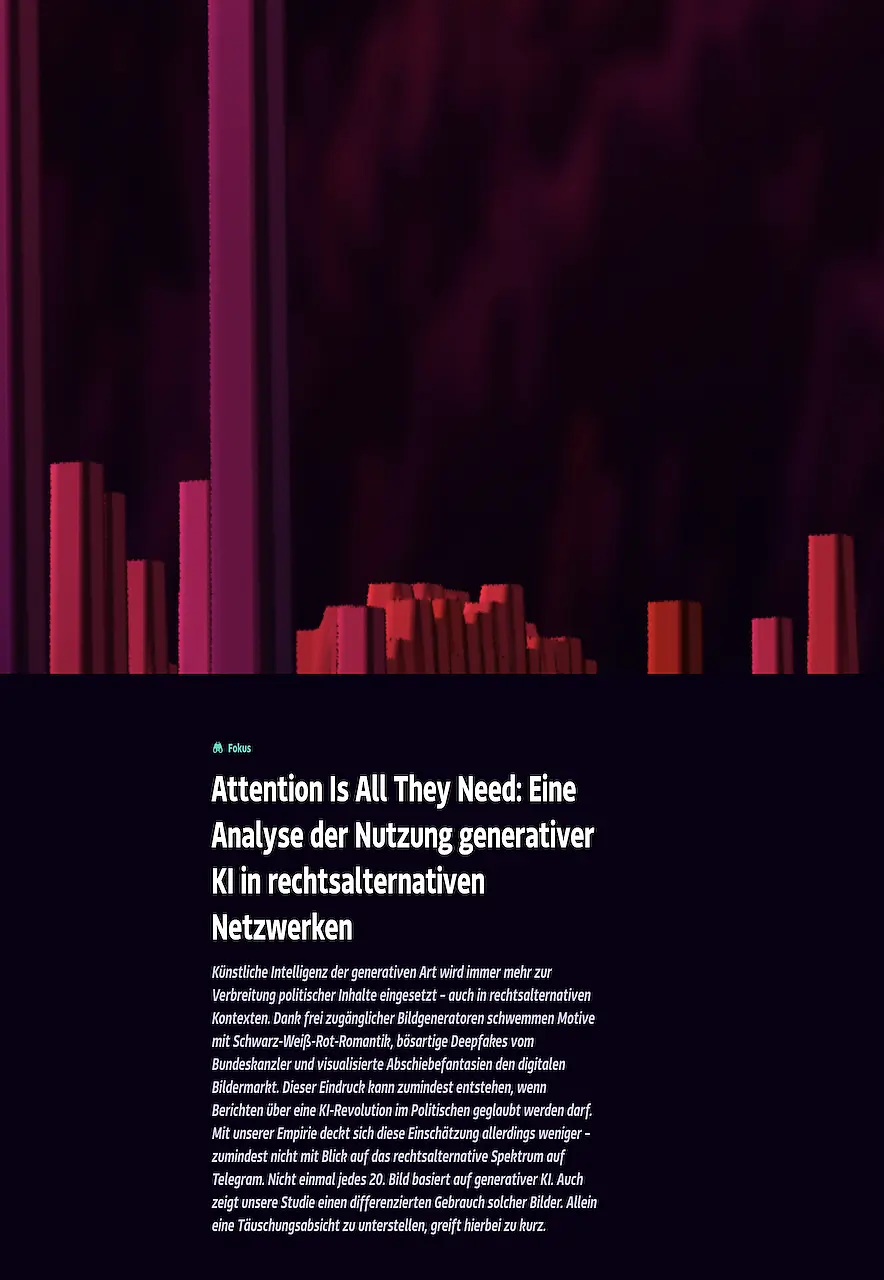
Autor*innen: Christian Donner, Lena-Maria Böswald, Maik Fielitz, Harald Sick, Rita Gsenger, Annett Heft, Wyn Brodersen, Holger Marcks

Künstliche Intelligenz der generativen Art wird immer mehr zur Verbreitung politischer Inhalte eingesetzt – auch in rechtsalternativen Kontexten. Dank frei zugänglicher Bildgeneratoren schwemmen Motive mit Schwarz-Weiß-Rot-Romantik, bösartige Deepfakes vom Bundeskanzler und visualisierte Abschiebefantasien den digitalen Bildermarkt. Dieser Eindruck kann zumindest entstehen, wenn Berichten über eine KI-Revolution im Politischen geglaubt werden darf. Empirisch deckt sich diese Einschätzung allerdings weniger – zumindest nicht auf der in den Kreisen beliebten Plattform Telegram. Nicht einmal jedes 20. Bild basiert auf generativer KI. Auch zeigt unsere Studie einen differenzierten Gebrauch solcher Bilder. Allein eine Täuschungsabsicht zu unterstellen, greift hierbei zu kurz.

Der Artikel ist im Oktober 2024 Open Access bei Machine Against the Rage erschienen.


Copycats? Do right-wing groups emulate left-wing digital advocacy organizations?

Autor*innen: Nina Hall, Annett Heft, Vaughan Michael

In 1998 MoveOn pioneered a new and powerful form of digitally enabled, multi-issue, member-driven, rapid response, advocacy organization. This model quickly spread around the world as progressive activists emulated it in twenty other countries. These digital advocacy organizations share progressive values and have been influential actors in their national contexts. What is surprising is that right-wing actors have replicated this new organization model. We examine four right-wing digital advocacy organizations: Grassfire (United States), Advance (Australia), Patriot Petition (Germany), and CitizenGo (transnational). We find that all four ‘copycat’ organizations are rapid-response, multi-issue, on-line campaigning organizations, like their left-wing counterparts. However, none appear to be fully-member driven in their funding and decision-making, rather the right has a tendency towards “astroturfing”. We also find that these right-wing organizations explicitly sought to emulate the organizational model of their left-wing counterparts, and there was no evidence of transnational diffusion on the right. This article enriches our understanding of right-wing digital advocacy organizations, and how learning and emulation occur across partisan divides.

Der Artikel ist am 24. Oktober 2024 Open Acces bei Journal of Information Technology & Politics erschienen.


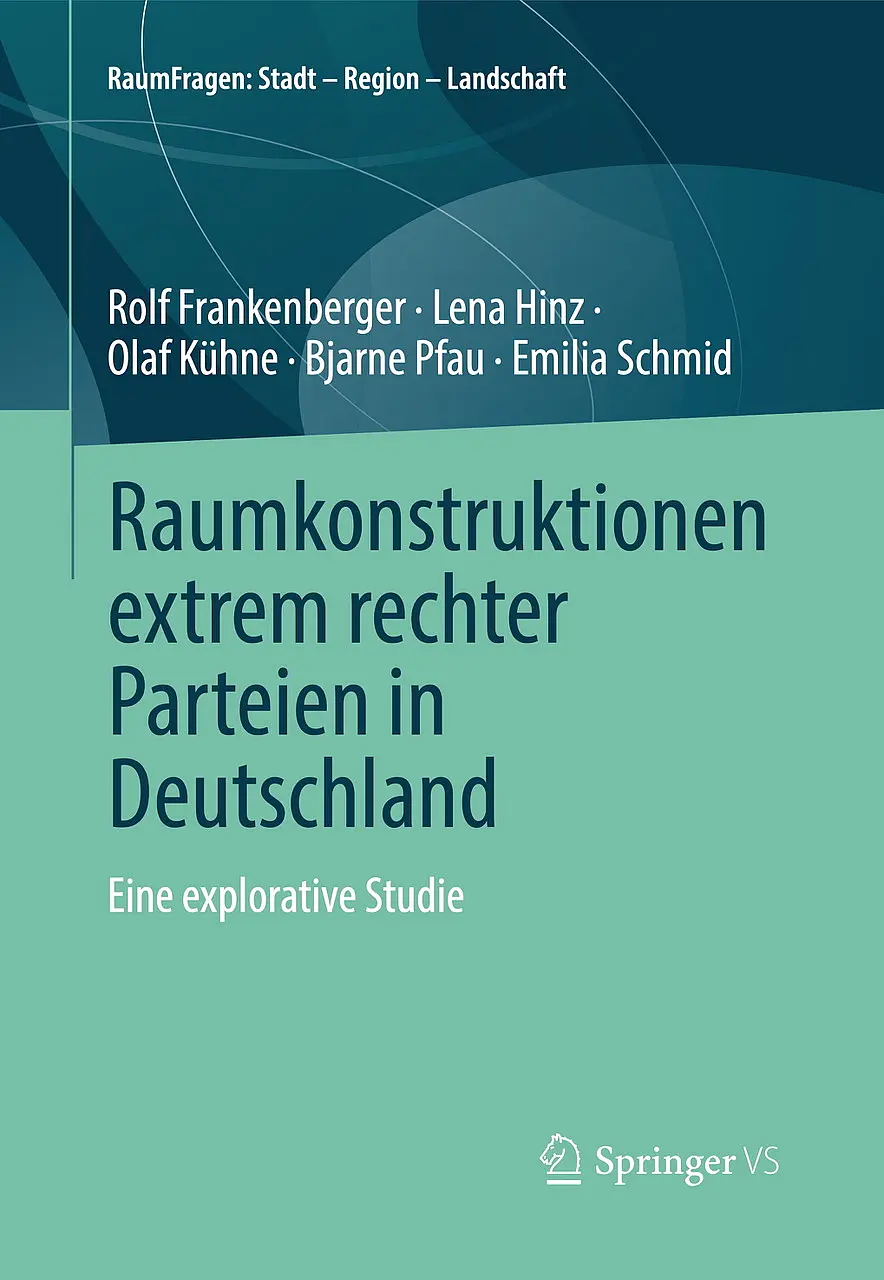
Raumkonstruktionen extrem rechter Parteien in Deutschland – Eine explorative Studie

Autor*innen: Rolf Frankenberger, Lena Hinz, Olaf Kühne, Bjarne Pfau & Emilia Schmid

Wie imaginieren extrem rechte Parteien Raum? Und wie werden diese Raumkonstruktionen in größere Narrative eingebettet?

In unserer neopragmatistisch ausgerichteten, explorativen, inhaltsanalytischen Untersuchung von Partei- und Wahlprogrammen extrem rechter Parteien in Deutschland zeigt sich die zentrale Bedeutung von Raumkategorien für die Konstruktion des Eigenen und des Fremden. Das Kernnarrativ extrem rechter Parteien bezieht sich dabei auf die Verteidigung des ‚gewachsenen Wesens des deutschen Volkes‘ und der ‚deutschen Nation‘ gegen vielfältige Bedrohungen von innen und außen. Hier eint sie trotz einiger Unterschiede in der Narration und im Vokabular der Rückgriff auf essentialistische Raum- und Gemeinschaftskonstruktionen.

Dabei greifen alle Parteien in unterschiedlichem Maße auf extrem rechte Ideologeme wie Fremdenfeindlichkeit, Antisemitismus, Anti-Islamismus und übersteigerten Nationalismus zurück. Anhand der kartographischen Aufarbeitung der Befunde wird aufgezeigt, dass sich diese Konstruktionen häufig in Selbstwidersprüche verstricken und nicht in konsistente Raum- und Weltbilder münden.

Die Studie ist im August 2024 Open Access bei Springer VS erschienen.


Researching far right extremism – a transdisciplinary, lifeworld, and political culture perspective

Autor*innen: Reiner Baur, Rolf Frankenberger, Markus Rieger-Ladich, Josef Schmid, Barbara Stauber, Ansgar Thiel & Tanja Thomas

Rechtsextremismus, verstanden sowohl als Ideologie der Ungleichheit und Ausgrenzung, die sich in Einstellungen und Verhalten manifestiert, als auch als heterogene, zum Teil gewaltaffine Bewegung, fordert demokratische Gesellschaften heraus und bedroht sie. Wir argumentieren, dass sozialwissenschaftliche Forschung dazu beitragen sollte, Demokratie und Zivilgesellschaft gegen die Bedrohung durch Rechtsextremismus zu stärken. Mit einer transdisziplinären, lebensweltlichen und politisch-kulturellen Perspektive kann die Sozialwissenschaft zu dieser Aufgabe beitragen und gleichzeitig die Fragmentierung des Forschungsfeldes überwinden helfen. In diesem Beitrag geben wir mit einem Fokus auf Deutschland zunächst einen Überblick über die aktuellen Entwicklungen in der sozialwissenschaftlichen Forschung. Zweitens skizzieren wir fünf Voraussetzungen für ein transdisziplinäres Forschungsprogramm zum Rechtsextremismus. Dabei plädieren wir sowohl für eine lebensweltliche Perspektive als auch für methodischen Pluralismus. Drittens schlagen wir vier übergreifende thematische Cluster als Taxonomie transdisziplinärer Forschungsperspektiven zum Rechtsextremismus vor: a) Rechtsextreme Ideologien und Wissenskonstruktionen; b) Rechtsextreme Akteure, Organisationen und Netzwerke; c) Rechtsextreme Diskurse, (digitale) Medien und Strategien im öffentlichen Raum; und d) Politische Bildung, Transfer und Implementierungsforschung zu Projekten gegen Rechtsextremismus. Viertens argumentieren wir, dass eine weitere Institutionalisierung unabdingbar ist, um die Forschung zum Rechtsextremismus nachhaltiger zu gestalten, die Forschung mit gesellschaftlichen Akteuren zu verbinden und die Forschungsergebnisse zur Stärkung der demokratischen Resilienz der Gesellschaft zu nutzen.

Die Research Note ist in der Zeitschrift für Vergleichende Politikwissenschaft, Volume 17, S. 275–295 im November 2023 in englischer Sprache Open Access  erschienen.