Zentrum für Molekularbiologie der Pflanzen (ZMBP)

Research Group Contreras

Mechanistic and structural diversity of plant intracellular immune receptors

Our group combines biochemistry, structural biology, and phylogenomics to unravel the molecular mechanisms that enable NLRs to detect pathogens and activate immune responses, with a particular emphasis on NLR pairs and networks. We aim to uncover and characterize NLR structural and functional diversity, and to place this diversity in an evolutionary context. By doing so, we seek to reveal new molecular mechanisms that drive plant–microbe interactions and shape plant evolution.

Research | People | Publications

Contact

Dr. Mauricio P. Contreras
Junior Group Leader

Department of Plant Biochemistry
Center for Plant Molecular Biology (ZMBP)
University of Tübingen
Auf der Morgenstelle 32,
D-72076, Tübingen Germany

Room: 5X18
mauricio.contrerasspam prevention@zmbp.uni-tuebingen.de
Twitter/X: @mpcontreras4
Bluesky: @mpcontreras.bsky.social
ORCID: 0000-0001-6002-0730
Google scholar: Mauricio P. Contreras


Research

How do plant immune receptors mediate disease resistance in the face of rapidly evolving pathogens and changing environments?

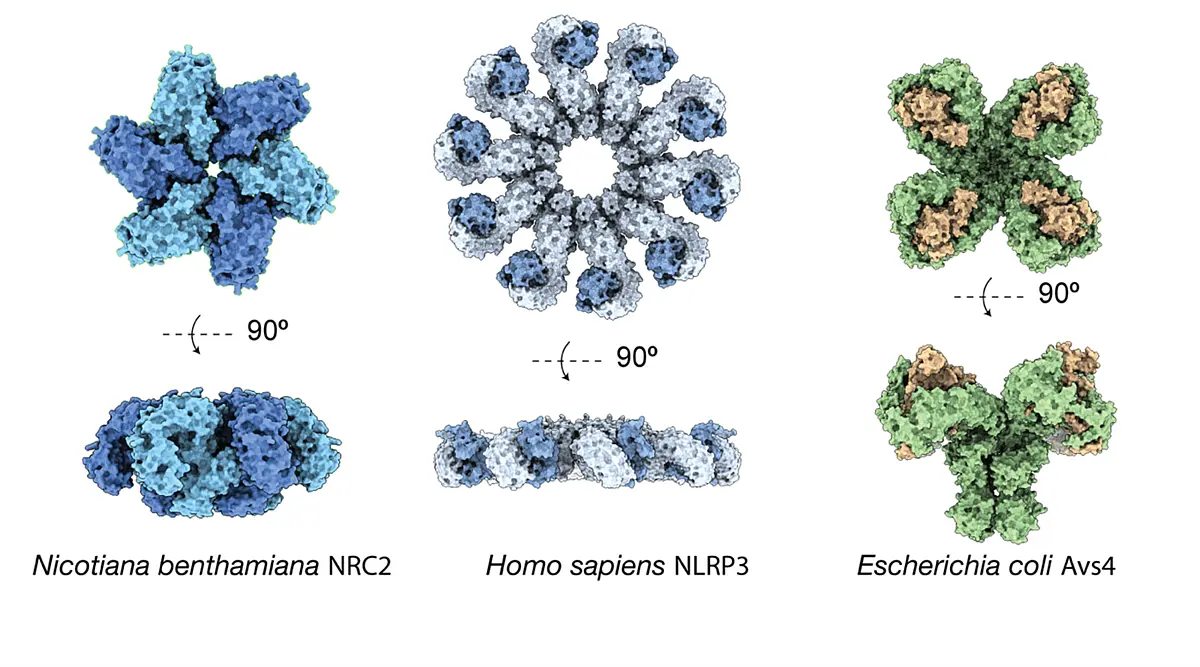
The host–microbe co-evolutionary arms race has driven the emergence of remarkable molecular innovations in non-self recognition and immunity, many of which remain elusive. Central to this arms race are nucleotide-binding leucine-rich repeat (NLR) immune receptors, which mediate innate immunity across all kingdoms of life (1, 2). During infection, NLRs recognize pathogen-derived molecules and activate immune responses. How do NLRs convert pathogen perception into immunity? Following activation by pathogens, NLRs assemble into oligomeric signaling complexes known as inflammasomes in animals and bacteria, or resistosomes in plants (Figure 1). Formation of these complexes ultimately triggers programmed cell death, which is thought to restrict pathogen advance via diverse mechanisms (1, 2). 
 

Figure 1: Following activation, NLRs across all kingdoms of life assemble into oligomeric signaling complexes. The assembly of these NLR oligomers, termed inflammasomes in animals or resistosomes in plants, ultimately leads to immune signaling and programmed cell death, suggesting this is an evolutionarily ancient defense mechanism.


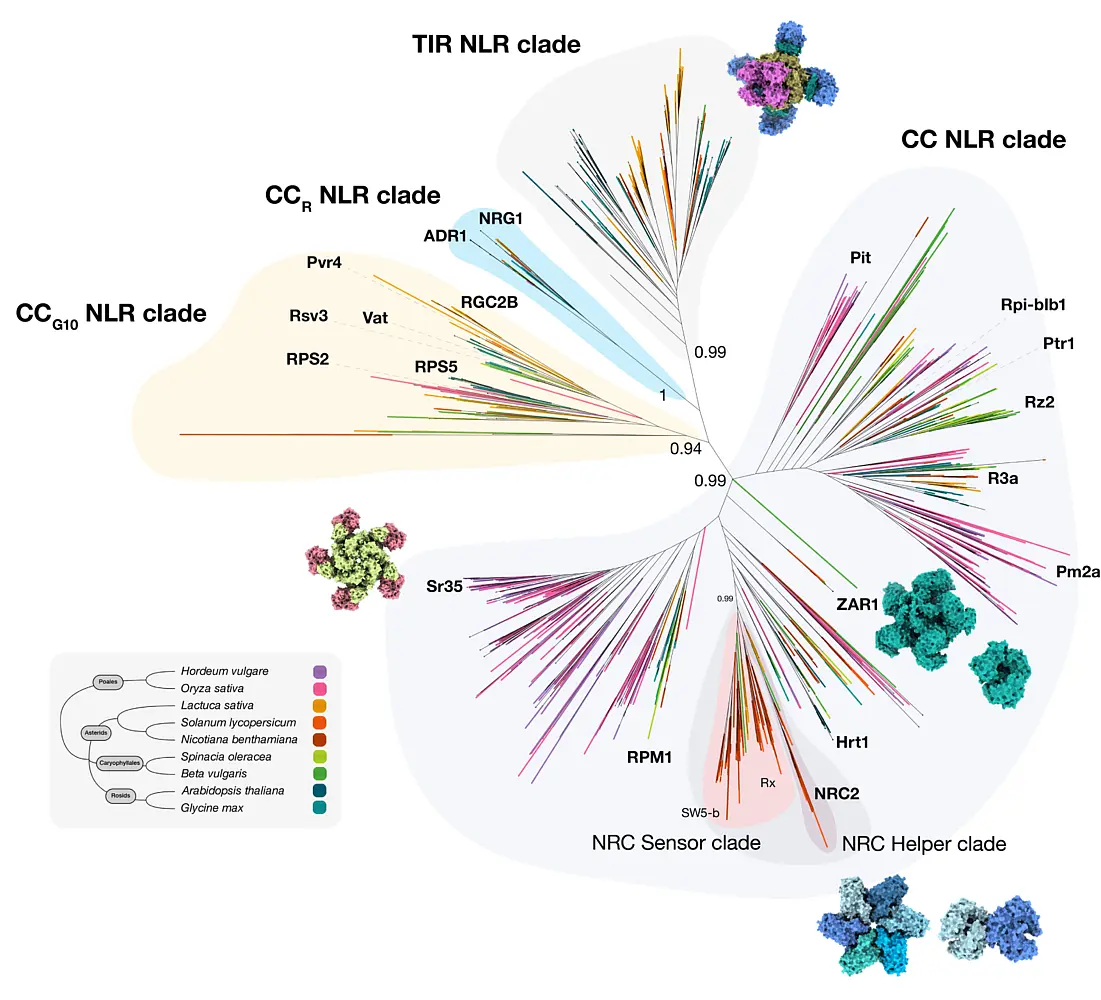
Plants lack adaptive immunity and therefore rely entirely on innate immune mechanisms to defend against infection. This dependence, combined with an intense co-evolutionary arms race with pathogens, has driven the remarkable diversification of NLR immune receptors. NLRs are among the most diverse proteins in plants, accounting for about one percent of all plant genes (4). They exhibit extensive structural and functional diversity, even within a single species (5), yet much of this diversity remains unexplored (Figure 2). Most crop disease resistance (R) genes encode NLRs, making them key components of plant immunity and important targets for agricultural improvement (3). Understanding how NLRs recognize pathogens and initiate defense responses is therefore essential for developing durable and sustainable strategies for crop protection and global food security.

Figure 2: NLRs exhibit incredible structural and functional diversity, yet most of this diversity remains unexplored. Phylogenetic tree is based on the NB‐ARC domains extracted from the NLRome of nine selected species representing poales, asterids, caryophyllales, and rosids. Branches of the tree are colored according to species, as indicated in the species overview tree. Solved structures of resting state or activated NLRs are placed next to the branches, highlight how few NLR clades we have structural information for. Adapted from Contreras et al. 2023, EMBO Reports (2).


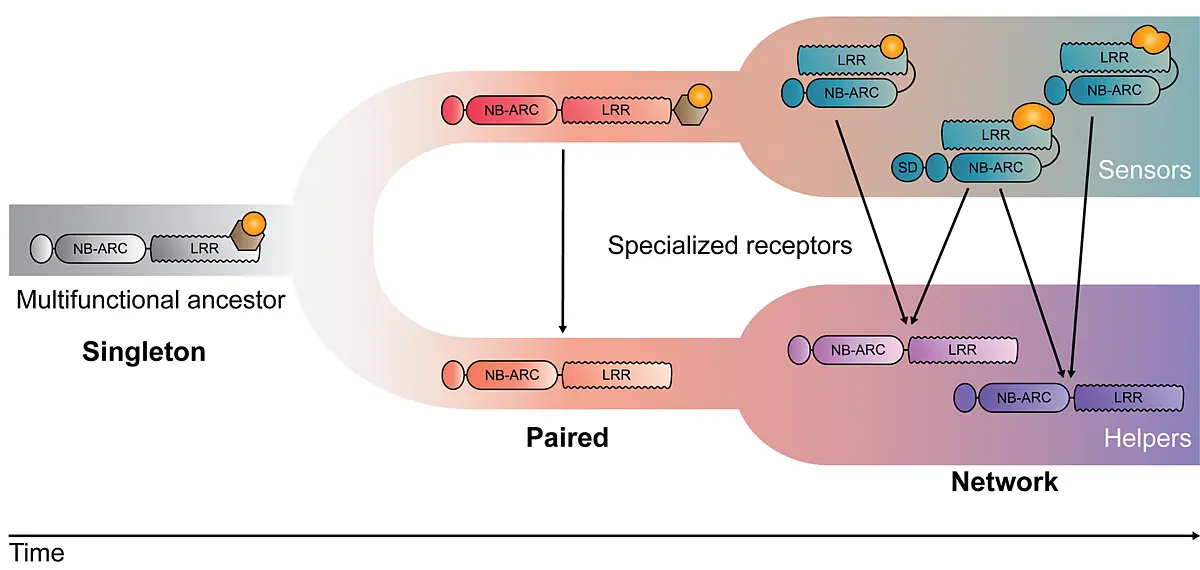
Over evolutionary time, and likely in response to pathogen pressure, NLRs have evolved from individual multi-functional immune receptors (singletons) into receptor pairs and complex networks of functionally specialized proteins (Figure 3) (2, 6, 7). Sensor NLRs can sense pathogen attack and then signal to helper NLRs, which can initiate immune signaling. Understanding the molecular mechanisms by which these interconnected immune receptors mediate defense is a central focus of our research (8–12). We are particularly interested in how distinct mechanisms of NLR activation have driven, or possibly constrained, the emergence of complexity in immune receptor networks.

Figure 3: NLRs have evolved from multifunctional “singletons” to complex immune receptor pairs and networks.   While singletons can mediate both pathogen sensing and downstream immune signaling, NLRs have duplicated and diversified over evolutionary time, leading to the appearance of specialized receptors that can be defined as either “sensors” or “helpers,” forming connections that range from pairs to complex networks.


References:

1.    W.-C. Chou, S. Jha, M. W. Linhoff, J. P.-Y. Ting, The NLR gene family: from discovery to present day. Nature Reviews Immunology, 1-20 (2023).
2.    M. P. Contreras, D. Lüdke, H. Pai, A. Toghani, S. Kamoun, NLR receptors in plant immunity: making sense of the alphabet soup. EMBO reports 24, e57495 (2023).
3.    J. Kourelis, R. A. Van Der Hoorn, Defended to the nines: 25 years of resistance gene cloning identifies nine mechanisms for R protein function. The Plant Cell 30, 285-299 (2018).
4.    A. Toghani, Y. Sugihara, S. Kamoun, Deep-learning-based annotation of 230 superasterid genomes reveals a harmonized dataset of 91,366 NLRs. Zenodo,  (2025).
5.    A. C. Barragan, D. Weigel, Plant NLR diversity: the known unknowns of pan-NLRomes. The Plant Cell 33, 814-831 (2021).
6.    H. Adachi, L. Derevnina, S. Kamoun, NLR singletons, pairs, and networks: evolution, assembly, and regulation of the intracellular immunoreceptor circuitry of plants. Current opinion in plant biology 50, 121-131 (2019).
7.    H. Adachi, S. Kamoun, NLR receptor networks in plants. Essays in Biochemistry 66, 541-549 (2022).
8.    M. P. Contreras et al., Resurrection of plant disease resistance proteins via helper NLR bioengineering. Science Advances 9, eadg3861 (2023).
9.    M. P. Contreras et al., The nucleotide‐binding domain of NRC‐dependent disease resistance proteins is sufficient to activate downstream helper NLR oligomerization and immune signaling. New Phytologist 243, 345-361 (2024).
10.    M. P. Contreras et al., Sensor NLR immune proteins activate oligomerization of their NRC helpers in response to plant pathogens. The EMBO Journal 42, e111519 (2023).
11.    J. Madhuprakash et al., A disease resistance protein triggers oligomerization of its NLR helper into a hexameric resistosome to mediate innate immunity. Science Advances 10, eadr2594 (2024).
12.    M. Selvaraj et al., Activation of plant immunity through conversion of a helper NLR homodimer into a resistosome. Plos Biology 22, e3002868 (2024).