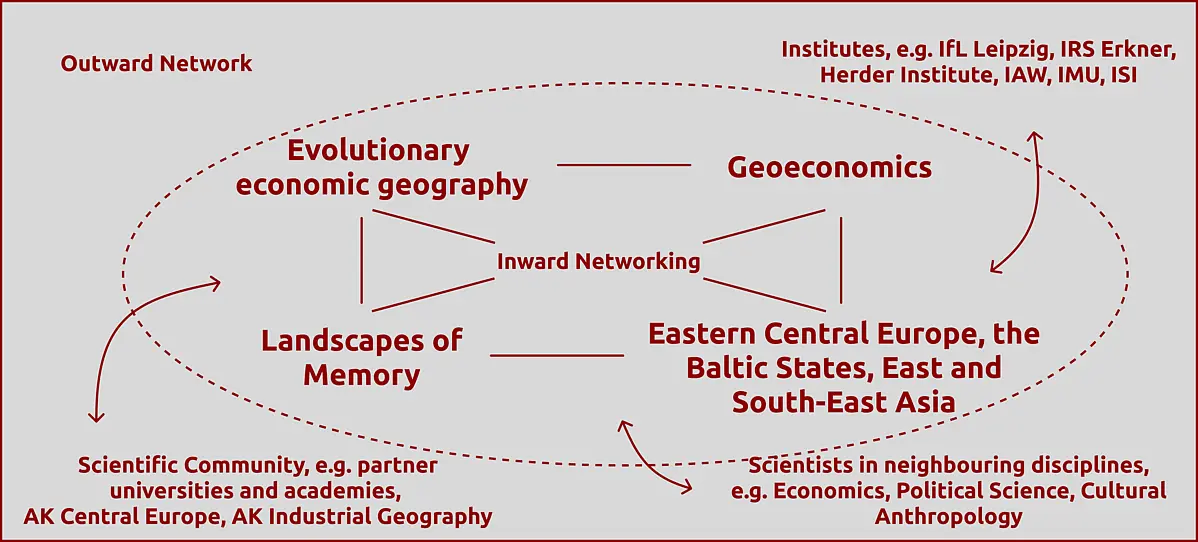
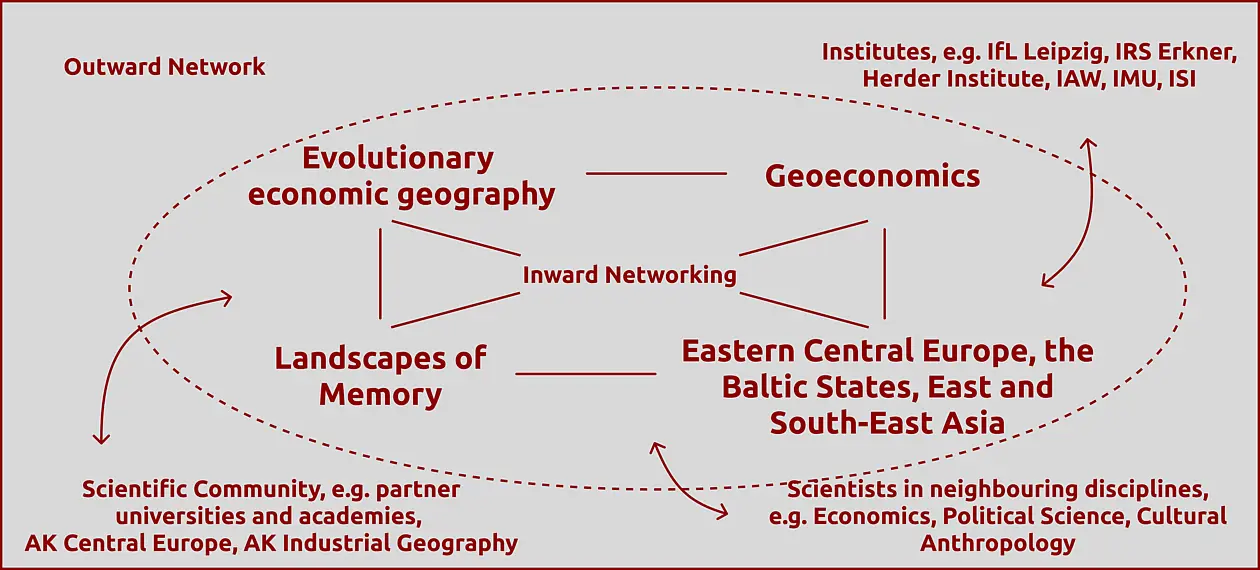
At the Chair of Economic Geography, the research focus is on a theory-driven and application-oriented economic geography. The research centres on issues of short- to long-term economic and regional change, as well as their spatially differentiated causes, trajectories and consequences. In particular, we adopt an evolutionary theoretical approach, whilst also incorporating political-economic and cultural-geographical perspectives. Our main areas of research centre on evolutionary economic geography, geoeconomics and landscapes of memory.
Evolutionary economic geography. Evolutionary economic geography is one of the newest and most dynamic fields of research within economic geography and has a wide range of interdisciplinary links, including to evolutionary economics, organisational sociology and psychology, and economic history. Our research centres on processes of economic change at various scales. A particular focus is on organisational routines and their significance for long-term change, organisational innovation and regional transformation. Furthermore, we examine transformation processes, structural change and manifestations of economic crises, as well as the transition to service- and knowledge-based economies. Particular attention is paid to the question of how historically evolved structures, institutional frameworks and entrepreneurial adaptation processes shape the development potential and competitiveness of organisations, sectors and regions.
Geoeconomics. Geoeconomics examines the spatial dimensions of the interplay between economics and politics within the context of a changing world order. From an economic geography perspective, we investigate how geopolitical conflicts, economic power relations and state strategies alter the organisation and spatial structure of economic processes. The focus is on the increasing politicisation of international economic relations, the reorganisation of global production and value-added networks, and issues of economic security, resilience and strategic dependencies. Of particular interest are the spatial impacts of trade conflicts, sanctions, investment controls and industrial policy strategies, as well as the significance of critical infrastructure, technologies and resources. In doing so, we examine how companies, regions and states respond to geo-economic uncertainties, reassess existing interdependencies and reorganise economic relations. Particular attention is paid to the interplay between global shifts in power and regional economic change.
Landscapes of Memory. Forms of remembrance in the guise of ‘landscapes of memory’ are highly prevalent and relevant across diverse cultural contexts. The research group takes up the concept of landscapes of memory and develops it further, both theoretically and empirically. The aim of the research is to make the concept more dynamic and to apply it to a wide range of cultural contexts, including those outside Europe, such as the Republic of Korea.
The regional focus of our work lies, on the one hand, in Central and Eastern Europe – particularly in Poland and the Baltic states – as well as in eastern Germany. Another regional research focus is East and South-East Asia, particularly the Republic of Korea, Singapore and Japan. These regional contexts also serve as areas of investigation for issues relating to economic and regional change, geo-economic interdependencies and processes of cultural memory. The Chair holder is a member of the Herder Research Council, the Executive Committee of the German-Polish Textbook Commission and the European Centre for Federalism Research.