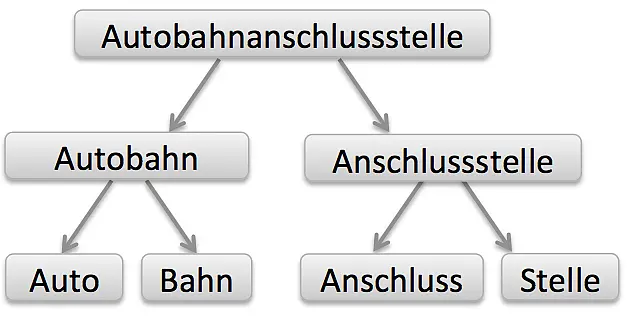
Composition is a very productive word formation process in German. For many applications, it is helpful to have information about the parts of the compound, as usually the semantic interpretation is based on the meaning of its parts. In GermaNet, nominal compounds are therefore split into their constituent parts, i.e., modifier and head. This splitting identifies the immediate constituents at each level of analysis and thus reflects the recursive nature of compounds that have more than two constituent parts such as Autobahnanschlussstelle(‘motorway junction’). The immediate constituents of this compound are Autobahn and Anschlussstelle, with the first constituent then splitting further into Auto and Bahn and the second constituent further split into Anschluss and Stelle (see Figure 1).
What makes compound splitting for German a challenging task is the fact that compounding is not always simple string concatenation, but often involves the presence of intervening linking elements or the elision of word-final characters in the modifier constituent of a compound (Henrich & Hinrichs, 2011). In GermaNet, all modifiers are lemmatized and if a modifier is ambiguous with respect to its word class (due to conversion), both possibilities are specified:
Laufschuhe: lauf- (en) [verb] and (der) Lauf [noun]
Baustelle: bau- (en) [verb] and (der) Bau [noun]
Compound splitting in GermaNet is supported by an automatic algorithm, which combines several individual compound splitters. Please see the referenced paper below for more information on the automatic splitting. All automatically split compounds are manually post-corrected and enriched with relevant properties before they are inserted into GermaNet.
Properties
The following properties are specified for modifiers and/or heads:
Abbreviation
If one part of the compound is an abbreviation, it is labelled as Abkürzung.
Examples:
Compound
Modifier
Head
SIM-Karte
SIM (abbreviation)
Karte
ISO-Norm
ISO (abbreviation)
Norm
Bonus-CD
Bonus
CD (abbreviation)
Affixoid
Affixoids are morphemes with a special status between bound and free morphemes. As they have a clearly assigned meaning, it makes sense to split the respective words. The bound morpheme is labelled as Affixoid.
Examples:
Compound
Modifier
Head
Grundfrage
grund (affixoid)
Frage
Riesenchance
riesen (affixoid)
Chance
Hauptsaison
haupt (affixoid)
Saison
Generalschlüssel
general (affixoid)
Schlüssel
Foreign Word
If one part (or more) of the compound is not a German word, it is labelled as Fremdwort. Note that those constituents which are borrowed words but are nowadays used as loanwords defined in a standard German dictionary (such as Duden) are not considered as foreign words in GermaNet (e.g. Drink and Pool in the examples below).
Examples:
Compound
Modifier
Head
Longydrink
long (foreign word)
Drink
Swimmingpool
swimming (foreign word)
Pool
Logdatei
log (foreign word)
Datei
Konfix
The label Konfix refers to a word which is borrowed from a foreign language, in many cases from Latin or Greek, and whose meaning stems from that particular language. Konfixes are bound morphemes, but in opposition to all other affixes two Konfixes can be combined to form a so-called Konfixkompositum. Those Konfixkomposita are not split in GermaNet, whereas compounds existing of a Konfix and a native word are split.
Examples:
Compound
Modifier
Head
Milligramm
milli (Konfix)
Gramm
Zentimeter
zenti (Konfix)
Meter
Monokultur
mono (Konfix)
Kultur
Opaque Morpheme
Modifiers whose meaning is not transparent any more without considering the etymology of the word are labelled with the property opaques Morphem.
Examples:
Compound
Modifier
Head
Himbeere
Him (opaque morpheme)
Beere
Karfreitag
Kar (opaque morpheme)
Freitag
Sintflut
Sint (opaque morpheme)
Flut
Lebkuchen
Leb (opaque morpheme)
Kuchen
Elfenbein
Elfen (opaque morpheme)
Bein
Proper Name
If the whole compound is a named entity, it is not split in GermaNet. If only the modifier is a proper name, the compound is split and the label Eigenname is added to the modifier.
Examples:
Compound
Modifier
Head
Hubbleteleskop
Hubble (proper name)
Teleskop
Wertherstimmung
Werther (proper name)
Stimmung
Hiobsbotschaft
Hiob (proper name)
Botschaft
Virtual Word Form
Virtual word forms, labelled as Virtuelle Bildung, are regularly built according to existing word formation rules. However, they do not exist in isolation, but only as part of a compound.
Examples:
Compound
Modifier
Head
Einflussnahme
Einfluss
Nahme (virtual word form)
Fragesteller
Frage
Steller (virtual word form)
Farbgebung
Farbe
Gebung (virtual word form)
Word Group
Modifiers consisting of a phrase are marked as Wortgruppe and the parts of the phrase are annotated as the modifier.
Examples:
Compound
Modifier
Head
Dreiwege-Katalysator
drei Weg (word group)
Katalysator
Nacht-und-Nebel-Aktion
Nacht und Nebel (word group)
Aktion
Pro-Kopf-Einkommen
pro Kopf (word group)
Einkommen
The following table gives an overview of the constituent parts of a compound (i.e. modifier and head) and the corresponding properties that are annotated for each constituent in GermaNet:
Property
Modifier
Head
Abbreviation
x
x
Affixoid
x
x
Foreign Word
x
x
Konfix
x
Opaque Morpheme
x
x
Proper Name
x
Virtual Word Form
x
Word Group
x
Disambiguation of Compound Components
Since the semantic interpretation of compounds typically depends on the meanings of their constituent elements, the availability of detailed information about these components is of considerable analytical value for many applications. However, the components of compounds are often polysemous, which makes adequate computational analysis difficult unless the relevant sense of each component is taken into account. As a result, the polysemous constituents of the compounds contained in GermaNet have been systematically disambiguated, and all compound components have been annotated with the IDs of the corresponding lexical units.
Modifier Disambiguation
The link between a modifier and its respective sense is established through the specification of the corresponding ID. The semantic relationship between a compound and its modifier allows for a wide range of possible interpretations.
Examples:
Compound
Modifier
Head
Eiswürfel
Eis ID_01 (frozen water)
Würfel
Eisbecher
Eis ID_02 (ice cream)
Becher
Süßwasser
süß ID_03 (taste-specific)
Wasser
If a compound contains two different modifiers, disambiguation is carried out for both components.
Example:
Compound
Modifier
Head
Laufschuh
Lauf ID_04 (running motion)
Schuh
lauf- (en) ID_05 (moving quickly on foot)
Schuh
A modifier can sometimes be interpreted in multiple ways; in such cases, all potential meaning variants are recorded by specifying the relevant IDs.
Examples:
Compound
Modifier
Head
Glaubensfrage
Glaube ID_06 (an unproven conviction)
Glaube ID_07 (religious belief)
Frage
Spielvariante
Spiel ID_08 (sport competition)
Spiel ID_09 (activity done for fun)
Spiel ID_10 (artistic performance)
Variante
If the modifier is an affixoid, confix, foreign word, semantically opaque morpheme, a word class not included in GermaNet, or a complex word group, a semantic assignment is not possible.
Head Disambiguation
In most cases, a compound appears within the conceptual hierarchy as a direct or indirect hyponym of a higher-level hypernym. Accordingly, the head constituent is assigned the ID of the hypernym, since the compound semantically represents a subcategory of that hypernym.
Examples:
Compound
Modifier
Head
Hausschuh
Haus ID_11
Schuh ID_12 (footwear)
Fahrkarte
fahren ID_13
Karte ID_14 (ticket, receipt)
Landkarte
Land ID_15
Karte ID_16 (map)
Chipkarte
Chip ID_17
Karte ID_18 (data carrier)
If the compound has a different hypernym than the head constituent, the head’s ID is assigned when the compound can semantically be interpreted as a type of that head.
Examples:
Compound
Modifier
Head
Backform
backen ID_19
Form ID_20 (artifact)
Surfbrett
surfen ID_21
Brett ID_22 (board)
A Backform is a kind of Form (as an artifact), and a Surfbrett is a kind of Brett; however, their respective hypernyms in GermaNet are kitchenware for Backform and winter sports equipment for Surfbrett.
If the compound cannot be semantically interpreted as a kind of its head, no ID is assigned to the head constituent. For example, a Nichtraucher (“non-smoker”) is not a type of Raucher (“smoker”), and Acrylglas (“acrylic glass”) is not a type of Glas (“glass”).
Similarly, no ID is assigned if there is a part–whole relation between the compound and the head constituent. In such cases, the relation to the head is recorded explicitly as a part–whole relation. For example, Viertelliter (“quarter liter”) is not a type of Liter (“liter”), but part of a liter, so no head ID is given. Instead, the part–whole relation is recorded as: Viertelliter – has_portion_holonym – Liter
Figurative Meanings
If a compound is used idiomatically or metaphorically in its overall meaning, no semantic sense is assigned to either constituent.
If only the head constituent is used metaphorically, no ID is assigned to the head, but the modifier is still disambiguated.
Examples:
Compound
Modifier
Head
Baulöwe
Bau ID_23
bauen ID_24
Löwe
Glückspilz
Glück ID_25
Pilz
Zaunkönig
Zaun ID_26
König
Download
In addition to the information described above that is included in GermaNet (since release 8.0), a list of split compounds with their modifier(s) and head is freely available for download here:
GermaNet v8.0 (2013): list of 40437 split nominal compounds (v8.0: Original list released on May 31, 2013, updated on June 12, 2013.)
The list of compound data is free for academic research as defined in GermaNet's academic research licence agreement. For any other intended purposes, please contact us.
The format of these split compounds is one compound per line: first the compound itself, then a <tab> space, then the modifier (in case of two modifiers, these are separated by the pipe (|) symbol), then a <tab> space again, and finally the head. For example:
Apfelbaum Apfel Baum Goldmünze Gold Münze Laufband laufen|Lauf Band
Reference
The following paper describes the automatic compound splitting that is performed before the manual post-correction. If you want to use the split compounds in the context of scientific or research work, please refer to the paper: