
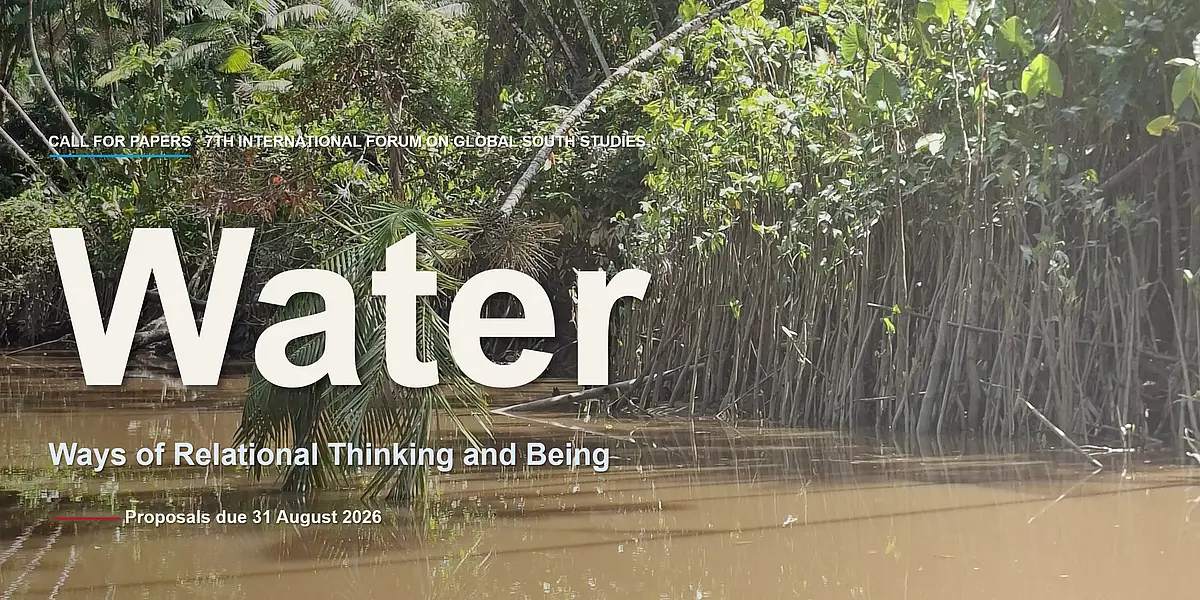
7th International Forum on Global South Studies
Water: Ways of Relational Thinking and Being
16 - 27 November 2026
Hybrid
Languages: English, French, Spanish, Portuguese.
 The programme will be published soon.
The Interdisciplinary Centre for Global South Studies at the University of Tübingen, in cooperation with its partner universities, invites scholars, activists, and artists to present their work at the 7th edition of the International Forum of Global South Studies. This year, the Forum encourages epistemological, theoretical and artistic interventions that explore the quintessential vital element of water. Access to water is key to survival for humans, animals and plants alike and, across the globe, it is at the heart of many of today’s most arduous economic and political conflicts. We dedicate this year’s edition to water - as a substance, as a medium, a way of thinking and an ever more scarce commodity - because it has emerged as a powerful analytical tool for reading key issues on life on our planet across the Humanities, Social and Political Sciences, Earth Sciences, and related forms of artistic creation and activism.
Taking up the inspiring epistemologies of confluence (Bispo dos Santos, 2026), we see water as key for reimagining cosmopolitics in a ‘world of many worlds’ (Cadena; Blaser, 2018) with a focus on key questions of sustainability, inequality, extractivism, (hydro)colonialism, and human and more-than-human relations. Thinking through water in its material and symbolic dimensions, as water bodies, hydrological ecosystems, hydro-infrastructures, oceans, we are able to confront varied epistemological questions, including those that reassess the relationships between nature and culture, and between social practices and political agencies. We are also able to interrogate the impacts of extractive processes and the acceleration imposed by colonial modernity on territories, bodies, languages, and memories. Further, since management of water as a resource is mainly focused on its being either too much or too little, we are not only interested in the presence and roles of water for organising life on our planet, but also on its absence. Therefore, we also invite presentations that attend to the absence or scarcity of water and thus dovetail oceanic/water studies and desert studies.
Themes include but are not limited to:
water and climate crisis
politics of water: hydropolitics and geopolitics
indigenous knowledges on water
figurations of water in literature, media discourses and the arts
social practices related to water
water: memory, archive and history
island and ocean studies
hydroecology, blue humanities
territorialization, weaponization, and militarization of water
gendered relations with water
Organising Committee:
Jacky Kosgei (Universität Tübingen)
Esteban Morera Aparicio (Universität Tübingen)
Adalberto Müller (Universidade Federal Fluminense, Brasilien)
Louis Nana (Universität Tübingen)
Scientific Committee:
Susanne Goumegou (Universität Tübingen)
Ivonne Sánchez Becerril (UNAM, Mexiko)
Douglas Andrews (University of the Witwatersrand, Südafrika)
Brahma Prakash (Jawaharlal Nehru University -Indien)
Saliou Dione (UCAD-Dakar, Senegal)
Louis Obou (UFHBc-Abidjan, Côte d'Ivoire)
Armando Velázquez (UNAM, Mexiko)
Partner universities
