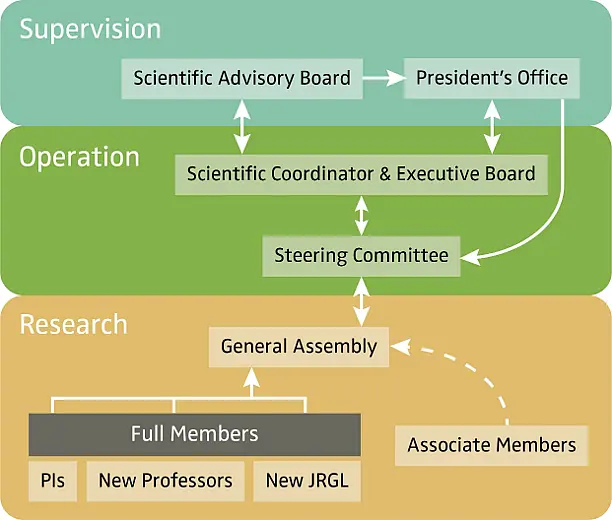
The Team of the Cluster of Excellence consists of members of the Cluster and Early Career Researchers (ECR´s).
25 Primary Investigators (PI´s) and four associated Primary Investigators rooted both in the Faculty of Science (geosciences, archaeological sciences, psychology, computer science, QBiC) and in the Faculty of Humanities (linguistics, archaeology, archaeometry) have been involved as proponents of the Cluster of Excellence, and are now members of it.
All full members (PI´s, future hired Professors, Independent Junior Research Group Leader) of the Cluster form the General Assembly. It will convene at least once a year and will vote on the Executive Board members and the members of the Steering Committee every 3.5 years or as the need arises. The General Assembly will also vote to accept HUMAN ORIGINS associated members, who will be able to participate in the Cluster´s funding programs but will not have voting privileges and appoint two ombudspersons for 3.5-year terms. The PIs and members will come together in annual retreats, symposia and other activities of the Cluster.
The General Assembly has elected the Executive Board, which is responsible for the day-to day management of the Cluster in cooperation with the Scientific Coordinator. It reports at least two times a year to the President´s office , to the Scientific Advisory Board and to the Steering Committee on progress of the Cluster.
The Steering Committee includes the Executive Board, representatives of each research area, as well as representatives of equal opportunity and early career researchers, as well as a representative of the University’s President’s Office. It will be chaired by the main spokesperson. A representative of the Ethics Laboratory, a Representative for Outreach and a PhD candidate Representative will also participate in an advisory role. The Steering Committee coordinates essential activities of the cluster and vote on strategic decisions regarding hiring, ethics, outreach and particularly funding.
Quality control will be ensured through an external Scientific Advisory Board, comprising top international senior researchers in their respective fields, representing biological anthropology and associated topics (e.g., paleogenetics), cultural studies (e.g., paleolithic archaeology, cognition) and aspects of the archaeological sciences (e.g., geochronology, paleoenvironments). One member of the board represents the humanities (e.g., history, cultural anthropology, sociology, theology) and will advise on scientific outreach, while another will advise on ethical considerations of the cluster, especially with regards to the new Ethics Laboratory (in preparation).
The Cluster of Excellence HUMAN ORIGINS includes three Independent Junior Research Groups, all lead by an Independent Junior Research Group Leader (JRGL). They are independently building their own research group and research topics on Biomechanics, Experimental Archaeology and Geno-Phenotype Evolution in Space.