27.07.2026
Breakthrough for two University of Tübingen AI startups
Ontic Labs and Feyer each to receive three million euros as they reach second round of Europe-wide competition
Two artificial intelligence startup companies from Tübingen have come through the first round of the German government’s Next Frontier AI Challenge. Ontic Labs and Feyer are now among the three German teams – out of a total of ten selected across Europe – which will each receive an initial three million euros for growth and development from the Federal Agency for Breakthrough Innovation known by its German acronym, SPRIND. Both companies are linked to the University of Tübingen’s AI Center and the Cluster of Excellence in Machine Learning, and with the Cyber Valley Innovation Campus.
The Next Frontier AI Challenge is aimed at new European companies developing basic AI technologies with exceptionally high innovation potential and which could have a long-term economic and social impact. The goal is to build three European AI startups within 24 months which will be valued in the billions after successful funding and two further stages of the competition.
Machines that understand the physical world
Ontic Labs is developing a model designed to help machines understand physical contexts. While today’s AI models primarily focus on capturing what the world looks like, Ontic Labs’ technology seeks to learn how it works; this will enable its robots to interact in more complex ways with their environment. “We’re developing a foundational model that learns how the world works physically from videos and experiences. Our goal is to be able to train robots using this model,” says Georg Martius, co-founder of Ontic Labs and University of Tübingen professor. “This will lay the ground-work for more versatile robotic systems that can be deployed in a wide variety of fields in the future.”
Ontic Labs GmbH
- Founders: Dr. Omid Taheri, Mikel Zhobro, Dr. Wieland Brendel, Prof. Dr. Georg Martius, Prof. Dr. Gerard Pons-Moll
- Participating institutions: Max Planck Institute for Intelligent Systems, Machine Learning: New Perspectives for Science Cluster of Excellence and AI Center Tübingen (both University of Tübingen), ELLIS Institute Tübingen
- www.onticlabs.io
AI driving development of industrial hardware
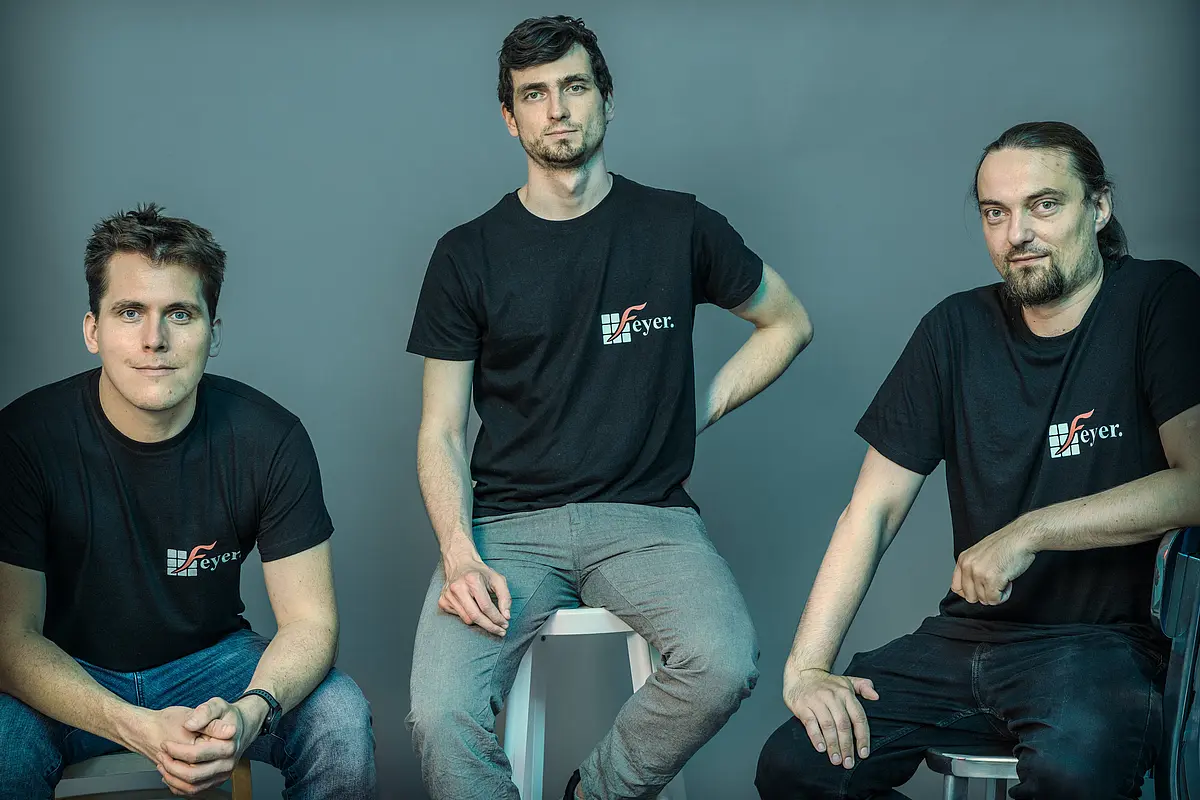
Feyer develops AI systems able to design novel industrial hardware. By combining AI methods with physical simulations, the aim is to develop and evaluate new technical concepts more quickly. “For more than ten years, we have been developing AI systems that autonomously design new physical experiments and technologies in basic research, ranging from quantum systems and novel microscopes to gravitational wave detectors,” says Mario Krenn, Feyer scientific director and Professor of Machine Learning at the University of Tübingen. “Feyer is making it possible to transfer this technology to industrial applications. It has the potential to become a key driver of unexpected hardware innovations in Europe’s high-tech sector: from laser, quantum, and microscopy technologies to microchip production and new solutions for the energy sector.”
Feyer GmbH
- Founders: Jonathan Klimesch, Sören Arlt, Prof. Dr. Mario Krenn
- Participating institutions: Machine Learning: New Perspectives for Science Cluster of Excellence and AI Center Tübingen (both University of Tübingen)
- www.feyer.ai
Peter Gehler, Professor of Machine Learning Engineering and Technology Transfer at the Tübingen AI Center, supported the teams with their applications. “The fact that two teams from our community are among the projects selected across Europe sends a strong signal about AI transfer in Tübingen,” he says. “Our research not only produces cutting-edge scientific achievements but increasingly also companies that have the potential to transform entire industries. This success demonstrates that the innovation ecosystem in Tübingen is working exceptionally well.”
“This success in the Next Frontier AI SPRIND Challenge demonstrates Tübingen’s international competitiveness as a center of research and innovation,” said University President Karla Pollmann. “Tübingen and the Baden-Württemberg region is now one of the most dynamic AI hubs in Europe: In the Cyber Valley Innovation Campus startup network alone, there are over 100 new AI and robotics companies, and the number is growing.”
SPRIND Challenges
SPRIND Challenges are competitions in which participating teams receive rapid and streamlined financial support to develop innovative solutions to the major social and technological challenges of our time. In SPRIND Challenges, teams compete in a multi-stage competition. At the end of each stage, the teams’ work is evaluated, and only the best teams remain in the competition and receive further financial support.
Federal Agency for Breakthrough Innovation press release (in German) Pressemitteilung der Bundesagentur für Sprunginnovationen
Based on the Press release of the University of Tübingen