

21.07.2026
Soapbox Science made a splash in Tübingen
Twelve researchers, a few soapboxes, and an audience of curious passers-by
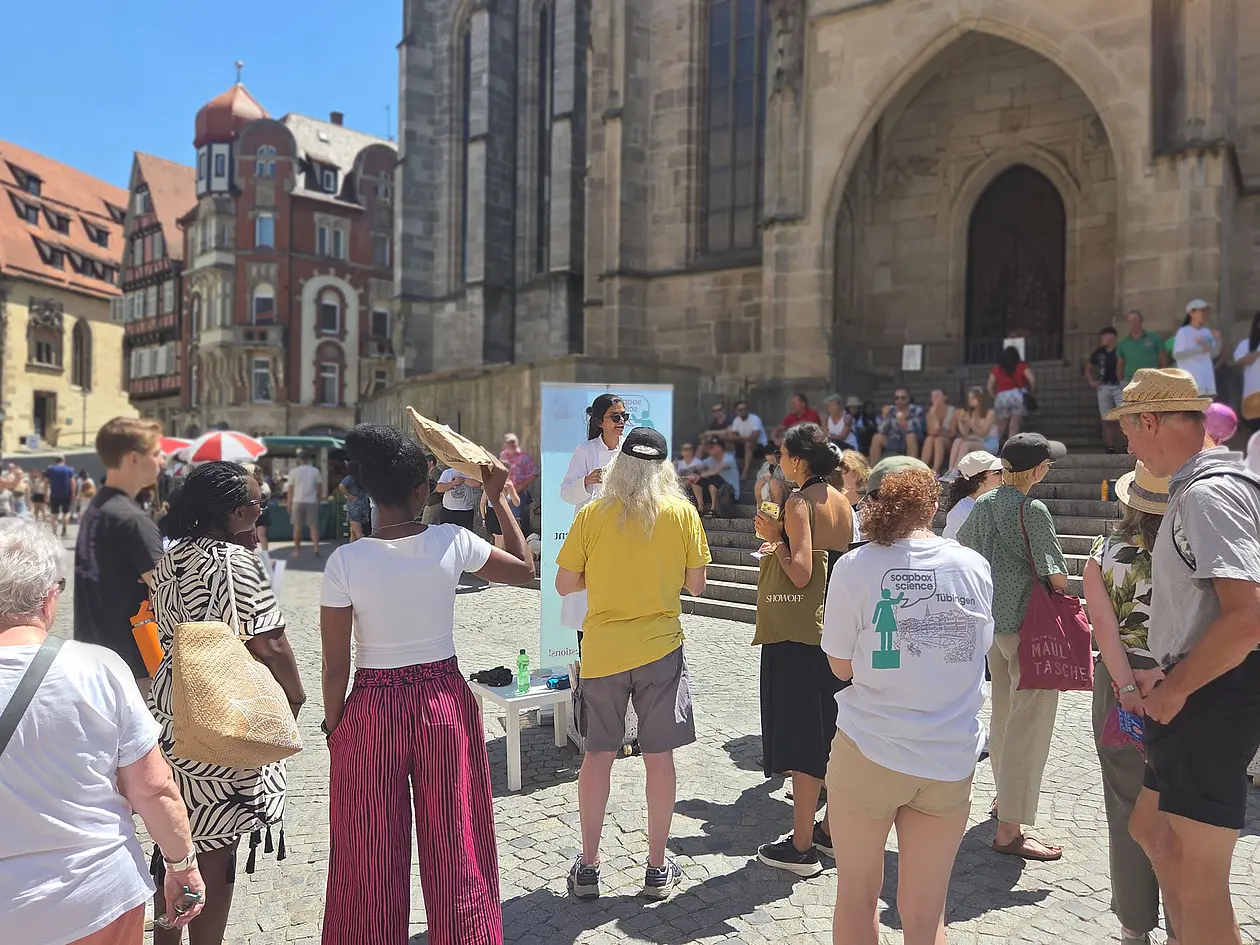
- Second edition: twelve non-binary and women researchers took to soapboxes at Tübingen's Holzmarkt on 11 July 2026.
- Science on the street: twelve-minute talks, no jargon, direct dialogue with passers-by.
- Visibility matters: organised by the Max Planck Institute for Biological Cybernetics and Team Equity of the University of Tübingen to spotlight non-binary and women scientists.
On Saturday, 11 July 2026, Tübingen's Holzmarkt once again became a meeting place for science and the public. At the second edition of Soapbox Science Tübingen, twelve non-binary and women researchers from different institutions of the Tübingen research community presented their work in the heart of the city. Despite temperatures exceeding 30°C, numerous visitors stopped to listen, ask questions, and engage with the speakers. Inspired by London's Speakers' Corner, Soapbox Science replaces the lecture hall with a soapbox: researchers spoke directly to passers-by in twelve-minute talks, delivered in German or English between 1:00 and 4:00 p.m. Each talk was repeated four times, so visitors who missed the start could simply stay for the next round.
Hands-on science with a robot and a football
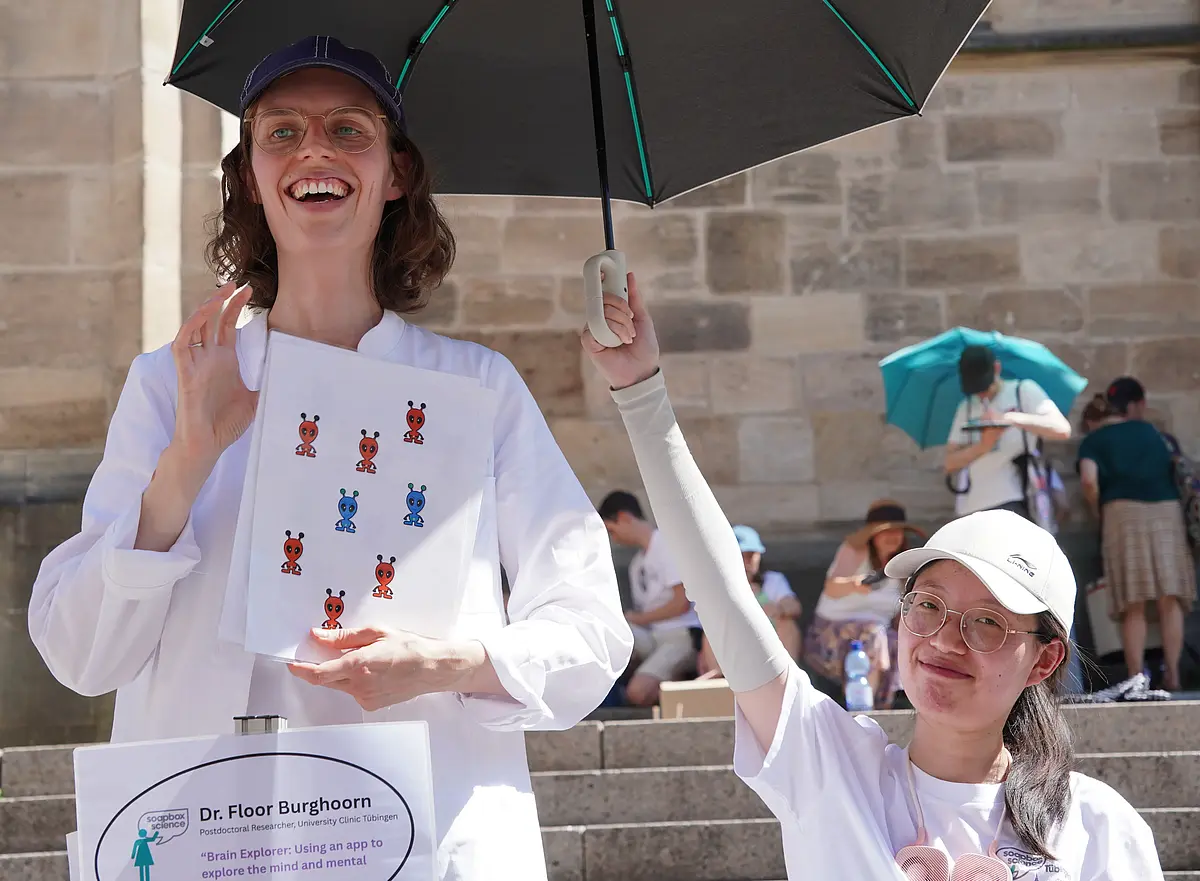
This year's program covered a wide array of topics, from stress research, skin health and plant immunology to neuroscience, robotics, and artificial intelligence. To make complex concepts accessible, speakers used posters, everyday objects like a football, and even a robot. Open dialogue with a diverse audience was central to the event. Rather than relying on technical terminology, speakers focused on clear explanations, inviting questions and spontaneous conversation. All had completed a dedicated workshop beforehand, preparing them to communicate their research in an engaging, accessible way for non-specialist audiences.
The speakers themselves also gave very positive feedback. Gesa Freimann, a PhD candidate at the Max Planck Institute for Biology who took part in the event as both an organiser and a speaker, summed up the day: “Soapbox Science was a great success. It was wonderful to see so many interested people of all ages engaging in conversations with our speakers, and to witness how much enthusiasm could be sparked even for a relatively unfamiliar research topic like archaea.” Lydia Kogler, a postdoctoral researcher at Tübingen University Hospital, was equally enthusiastic: “I thought the event was really well organised. The audience was very engaged, and the event attracted a lot of people. I really enjoyed it.”
Promoting visibility of nonbinary and women researchers
Soapbox Science Tübingen was once again organized by the Max Planck Institute for Biological Cybernetics together with the University of Tübingen's Team Equity. The event aims to showcase the diversity of today's scientific community and to challenge stereotypical perceptions of what a scientist looks like. At the same time, it provides speakers with an opportunity to expand their professional networks and gain valuable experience in public engagement and science communication. Anyone interested in taking part in next year's event as a speaker, organiser, or volunteer is welcome to contact Susan Fischer and Monika Lam at soapboxscience.tuebingenspam prevention@gmail.com