College of Fellows

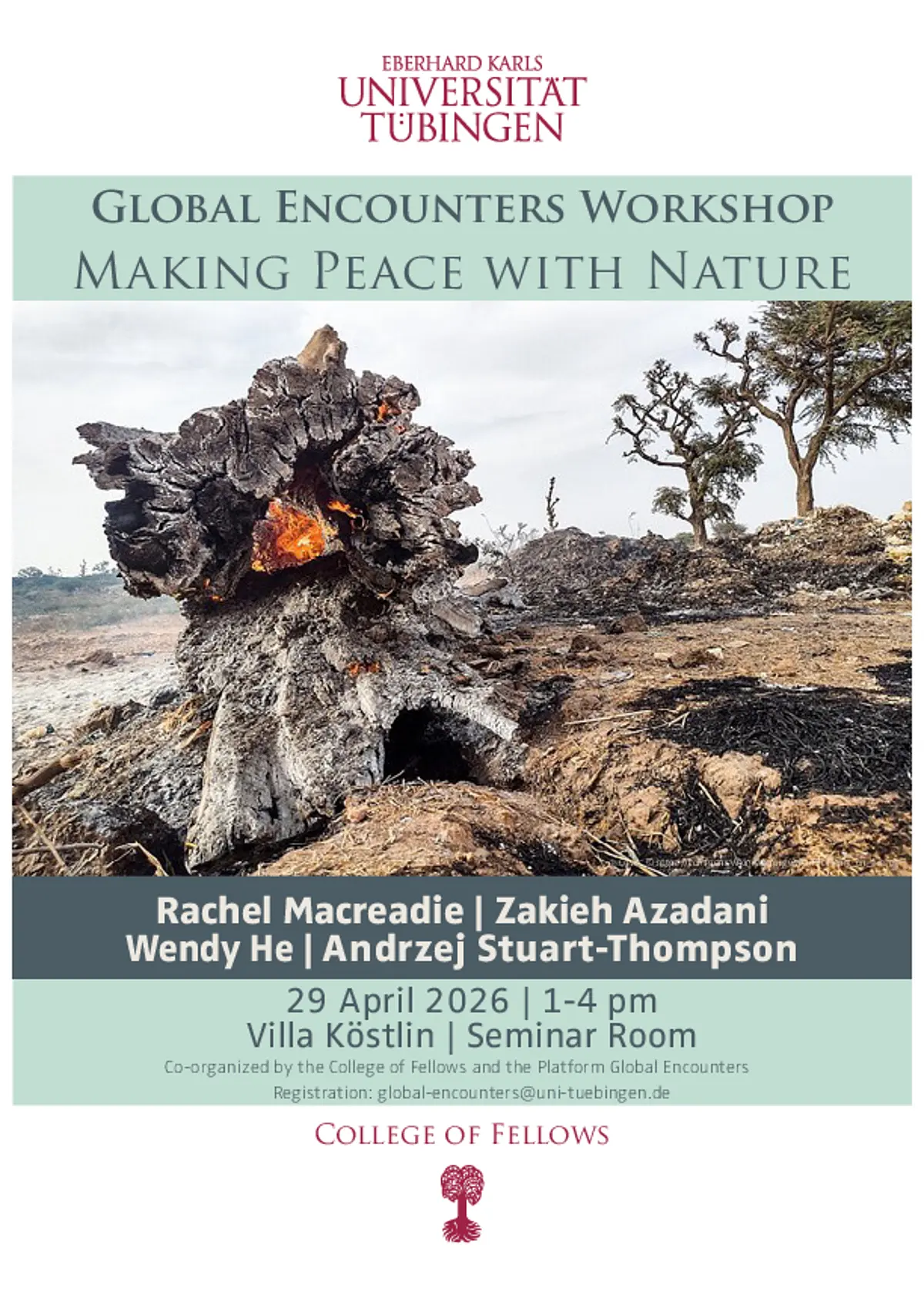
Global Encounters: Making Peace with Nature

“Making peace with Nature is the defining task of the 21st century”, said UN General Secretary António Guterres in his State of the Planet speech in 2020. This mission statement has informed UN agenda Setting and has become the motto for the 2024 UN Biodiversity Conference of the Parties (COP16) in Cali, Colombia. The need to find a more balanced approach between humans and Nature and/or critically rethink that divide altogether has been articulated in urges by politicians, activists, and scientists for a transformation. Their claim is to reevaluate international climate and environmental politics in morally decentring the human and reformulate ways of coexistence. This call invites applications from researchers working on human-nature relationships and their transformation historically as well with regard to current conditions of crises in the Global North and South.
We ask applicants to address one or more of the following research questions: How can we understand ‘peace’ between humans and Nature? What are the implications of not being ‘at peace’ with Nature? What role do ontological, epistemological, religious and political understandings of humans and Nature play in making peace with Nature? How can we differentiate between different human groups and their relationships with land without essentializing these connections? In what ways did the approach to nature change historically? How do modes of representation and conceptualization affect our relationship to nature? How do we have to rethink the very notion of nature/Nature?
The focus group “Global Encounters: Making Peace with Nature” addresses research questions such as how we can understand ‘peace’ between humans and nature, what the implications of not living “at peace” with nature are, and what role ontological, epistemological, religious, and political conceptions of humans and Nature play in making peace with Nature. How can we differentiate between different human groups and their relationships with land without essentializing these connections? In what ways did the approach to nature change historically? How do modes of representation and conceptualization affect our relationship to nature? How do we have to rethink the very notion of nature/Nature? The Focus Group brings together an interdisciplinary group of fellows and scholars who conduct research in both the Global South and North and apply innovative methodological approaches to address these questions from social science and humanities perspectives. 

Events

29 April 2026 – Kickoff Workshop: Making Peace with Nature

 29 April 2026, 1 pm.-4 pm.

 College of Fellows (Villa Köstlin), Seminar Room

In the summer semester 2026, the College of Fellows, together with the Global Encounters platform, welcomes four new Global Encounters Fellows to Tübingen, who will work together and with other Fellows and Tübingen scholars in a Focus Group ‘Making Peace with Nature’.

Please finde the  program here.

People

Zakieh Azadani
Global Encounters
Philosophy

Fellowship: Global Encounters Fellowship
Affiliation (host institution, host scholar): Department of Oriental and Islamic Studies, hosted by Prof. Dr. Heidrun Eichner
Stay in Tübingen (from – until): September 2026 – February 2027

Research Project: “Natural Purposiveness in Islamic Thought: Mullā adrā on Nature’s Agency”

This project explores how an Islamic vision of a conscious, purpose-driven natural world is articulated in the Islamic philosophical tradition. It focuses in particular on an interpretation of Mullā adrā (d. 1640), whose philosophical system elaborates on rethinking nature as a purposive, intelligent order in which all beings participate actively in their own movement toward perfection. The guiding question is: How does adrā explain a philosophical system which allows us to imagine nature not as a passive arena for human action, but as a living, dynamic whole, animated by inner awareness and directed toward its own ends? And what ethical implications for our understanding of the human–nature relationship might this reconfiguration carry, especially when contrasted with more anthropocentric models rooted in Islamic theology?

Research Areas: Philosophy in the Islamic World (particularly 13th-17th centuries), Mystical Philosophy in Safavid Iran, Ethics and the Question of Freedom, European philosophy (especially German idealism and contemporary continental philosophy)

Publications

Monograph 

  1. Azadani, Z. (2023) Āzādī va rodād dar andīše-ye Heidegger [Martin Heidegger on Freedom and Event]. Tehran: Nashr-e Ney.

Articles 

  1. Azadani, Z. (2025) “Seeking a Middle Path: A Journey Through Islamic Philosophical and Theological Perspectives on Human Agency”. In Reittier oder Schiedsrichter? Die »Willensfreiheit« im interdisziplinären Gespräch. Edited by Athina Lexutt and Volkmar Ortmann. Leipzig: Evangelische Verlagsanstalt GmbH.

  2. Azadani, Z. (2025) “An early attempt at a theological justification of the modern concepts of freedom and justice: Tanbīh al-umma wa tanzīh al-milla”. In Mobilität des Denkens. Eine Festschrift für Ulrich Rudolph. Edited by Urs Gösken, Patric Schaerer, Roman Seidel, James Weaver, Thomas Würtz. Brill. 

  3. Azadani, Z. (2024) “Delegation of Authority to Human Being: A Late Safavid Theologian’s Account on the Legislative Meaning of Tafwīḍ”. In Der Islam, vol. 101, no. 2, pp. 469-487. 

  4. Azadani, Z. (2023) “Divine Causality and Human Free Will: Ṭūsī’s Solution and Its Historical Background”. In Asiatische Studien - Études Asiatiques, vol. 77, no. 3-4, pp. 509-527. 

  5. Azadani, Z. (2022) “Mullā adrā on Free Will and Freedom”. In Asiatische Studien - Études Asiatiques, vol. 76, no. 2, pp. 355-370.

Translation 

  1. Azadani, Z. (2020) Dar ǧahān būdan. Persian translation of Being in the World by Hubert Dreyfus. Tehran: Nashr-e Ney. 

  2. Co-translator of the Persian translation of A History of Contemporary Women Philosophers (Originally edited by Mary Ellen Waithe), together with Maryam Nasr, Zahra Moballegh, etc. Tehran: Kargadan, 2022.

Contact: zakieh.azadanispam prevention@philosophie.uni-freiburg.de 
About: Zakieh Azadani is a postdoctoral researcher in philosophy at the University of Freiburg, currently funded by the Baden-Württemberg Stiftung and previously by the Alexander von Humboldt Foundation. She received her PhD in philosophy from the University of Tehran in 2017. Her research focuses on Philosophy in the Islamic World (particularly 13th-17th centuries), with an emphasis on metaphysics, ethics, and theories of human agency. Prior to her fellowship in Freiburg, she was a guest researcher at the University of Zurich, funded by the Swiss National Science Foundation. Her research project in Tübingen aims to examine the concept of natural purposiveness and the possibility of non-human agency in Islamic philosophical traditions, with a view to rethinking the human-nature relationship.

Junior Professor Riccarda Flemmer

Please view Riccarda Flemmer's profile here.

Professor Heidrun Eichner

Please view Heidrun Eichner's profile here.

Professor Andreas Hasenclever

Please view Andreas Hasenclever's profile here.

Wendy He
Global Encounters
Political Science

Fellowship: Global Encounters Fellowship
Affiliation (host institution, host scholar): Institute for Political Science, University of Tübingen, hosted by Prof. Dr. Andreas Hasenclever 
Stay in Tübingen (from – until): April 2026 – March 2027

Research Project: Making Peace with Nature: Confidence, Trust, and the Political Psychology of Climate Diplomacy. 

Climate science has made the stakes unmistakably clear. The remaining challenge is political. How can states build trust and sustain cooperation under deep uncertainty? Why do some climate negotiations collapse while others produce breakthrough agreements?

This project examines how leader confidence and trust dynamics shape cooperation in climate diplomacy. Drawing on political psychology and research on advice utilisation, I argue that miscalibrated confidence, what I call the “Confidence Trap,” distorts how leaders interpret evidence, incorporate expert advice, and signal commitment. Overconfident leaders may dismiss credible counsel and overpromise. Underconfident leaders may hesitate and signal unreliability. Both patterns weaken trust.

Through comparative case studies of major negotiations such as Copenhagen, Paris, and Glasgow, as well as analysis of China’s role in climate diplomacy, the project investigates how calibrated confidence, trusted chairs, and epistemic communities enable durable cooperation and shared norms.

By integrating in-depth case analysis with experimental design, the research offers theoretical and practical insights into how diplomacy can move beyond tactical bargaining toward sustained trust-building. Achieving peace with nature requires scientific knowledge, political will, and carefully calibrated judgment. It requires rethinking the psychological foundations of cooperation itself.

Research Areas: Political Psychology, Threat Credibility, U.S.-China Relations, Grand Strategy, Foreign Policy, Judgement and Decision-Making in War, Alliance Politics, Civil-Military Relations 

Publications

  1. “Getting Inside the Mind of Leaders and Advisers: A Data Collection Strategy for Historical Case Studies in International Relations” (with Pascal Vennesson) International Studies Perspectives 26 (3) (2025), pp. 356-376: https://doi.org/10.1093/isp/ekae017

  2. “Naming and Shaming China: America’s Strategy of Rhetorical Coercion in the South China Sea” (with Haridas Ramasamy) in Contemporary Southeast Asia 42, No. 3 (2020), pp.317-345; DOI: 10.1355/cs42-3a

  3. No Peace without Pause: Why Ceasefires Must Precede Negotiation in Ukraine,” Institute of Defence and Strategic Studies (IDSS) papers, RSIS, NTU, December 9, 2025.

  4. The Psychology of Waiting in U.S.-China Economic Statecraft: Why Washington’s Demand for Speed and Beijing’s Patience Create New Risks in the Tariff War,” China Dialogues (LSE IDEAS, London School of Economics and Political Science), December 5, 2025.

Contact: qingli-wendy.hespam prevention@cof.uni-tuebingen.de; iswendyhe@ntu.edu.sg; wendyheqinglispam prevention@gmail.com 
Activities at the College of Fellows: “Making Peace with Nature” Focus Group

About: Wendy He is an interdisciplinary scholar of international relations whose research bridges political psychology, international security, and diplomatic history. Her work examines how leaders and advisers assess credibility, escalation risk, and restraint under conditions of uncertainty, developing a psychological framework that explains how confidence calibration and trust dynamics shape foreign policy decision-making. She is currently developing a book project, The Confidence Trap, which advances this framework to explain how miscalibrated confidence distorts advice utilisation, trust, and cooperation in high-stakes negotiations.

She is a Global Encounters Fellow at the University of Tübingen, where she applies this framework to climate diplomacy, examining how confidence distortions and advice utilisation shape trust, cooperation, and norm formation in climate negotiations. She was a Hans J. Morgenthau Fellow in Grand Strategy at the Notre Dame International Security Center from 2024 to 2025 and was awarded the prestigious Singapore Social Science Research Council Graduate Research Fellowship in support of her postdoctoral research at Tübingen. 

In 2026, she received the Carl Beck Award at the International Studies Association, an annual award presented for an outstanding graduate student paper in International Studies, with special recognition for originality and innovation in engaging traditional concerns or emerging international problems. She was also the recipient of the 2025 Inter-University Seminar on Armed Forces and Society Graduate Paper Award for her paper on leader-adviser dynamics, confidence, and the assessment of threat credibility in foreign policy decision-making.

Her broader research agenda explores how cognitive and relational dynamics shape cooperation across both traditional security crises and global challenges such as climate change. 

Junior Professor Jacky Kosgei

Please view Jacky Kosgei's profile here.

Rachel Macreadie
Global Encounters
Political Science

Fellowship: Global Encounters Fellowship
Affiliation (host institution, host scholar): College of Fellows (Center for Interdisciplinary and Intercultural Studies), hosted by Prof. Dr. Dr. Russ West-Pavlov
Stay in Tübingen (from – until): April 2026 – March 2027
Research Project: Listening to Country: Dialogue, Policy and Pathways to ‘Making Peace with Nature’ in Victoria, Australia
Research Areas: Cross-cultural communication, risk management, crisis communication, climate justice, planetary health, minority rights, public policy 

Publications

  1. Pym, A. & Macreadie, R. (2026). Risk in translation and interpreting. In H. Nesi & P. Milin (Eds.) International Encyclopaedia of Languages and Linguistics. 3rd edition. Elsevier. https://doi.org/10.1016/B978-0-323-95504-1.01368-5
  2. Pym, A. & Macreadie, R. (2026). Translator employment and the risk of market collapse. News from Australia. Translation & Interpreting. 18(1), 1-18. https://doi.org/10.12807/ti.118201.2026.a01
  3. Macreadie, R., Bouyzourn, K., Pym, A. & Meylaerts, R. (2025). Thick and thin trust in cross-cultural vaccination messaging. What code of ethics do we need? Translation Studies, 18(2), 265-282. https://doi.org/10.1080/14781700.2025.2516000.
  4. Meylaerts, R., Macreadie, R., Bouyzourn, K. & Pym, A. (2024). How should we study interactions between translation policies, practices, and beliefs? Comparing case studies from a time of crisis. Perspectives, 1–19. https://doi.org/10.1080/0907676X.2024.2408590
  5. Bouyzourn, K., Macreadie, R., Zhou, S., Meylaerts, R. & Pym, A. (2023). Translation policies in times of a pandemic. Language Problems and Language Planninghttps://doi.org/10.1075/lplp.22053.bou
  6. Fung, P. & Macreadie, R. (2018). Engaging culturally and linguistically diverse (CALD) communities in parliamentary inquiries. Parliamentary Library, Parliament of Victoria. https://apo.org.au/sites/default/files/resource-files/2018-12/apo-nid211056.pdf 
Contact: rachel.macreadiespam prevention@gmail.com 
Activities at the College of Fellows: Global Encounters “Making Peace with Nature” (focus group, other)
About: Rachel Macreadie is an interdisciplinary political scientist and health policy researcher. She has a joint PhD in Translation Studies from the University of Melbourne and KU Leuven, an MA in Gender Studies and a Graduate Diploma in Law. Her PhD thesis examined crisis communication practices and policies with migrant communities during COVID-19. Rachel has nearly two decades of experience working as a parliamentary researcher for the Parliament of Victoria (Australia) in which she worked on several inquiries that led to important policy changes in areas including disability forced adoption, perinatal health, First Nations health, and migrant inclusion. In 2011-12, she was an Australian Aid Youth Ambassador for Development and worked as a migrant health researcher for the International Organization for Migration (in Vietnam) and the Victorian Foundation for Survivors of Torture (Melbourne).

Andrzej Stuart-Thompson
Global Encounters
Philosophy

Fellowship: Global Encounters Fellowship
Affiliation (host institution, host scholar): Faculty of Humanities, Seminar Neuphilologie, hosted by Jun. Prof. Dr. Jacky Kosgei 
Stay in Tübingen (from – until): April 2026 – March 2027

Research Project: 

Investigating Ecological Hopefulness in Lusophone Cultures:

During my 1-year position as a postdoctoral researcher at the University of Tübingen, I am inspired by this year’s Global Encounters Fellowship theme of ‘making peace with nature’ to research how literature and the arts can inspire hope at a time of human-made environmental crisis. Building on my background in Lusophone studies and my ecocritical collaborations with Dr Dorothée Boulanger (University of Oxford), I am currently building a panorama of cultural expressions of eco-optimism that emerge specifically in Portuguese-speaking contexts, namely Portugal and Brazil – where Indigenous languages and cosmologies provide additional critical counterpoints. Every culture’s storehouse of ecological wisdom and accompanying toolkit for green politics evolve in response to (and even in co-authorship with) local climates, landscapes, ecosystems, and species. Disseminated more widely, Portuguese, Brazilian, and Indigenous artists’ own unique solutions to the problems of climate change, environmental degradation, and biodiversity loss can provide the global community with fresh ways of imagining an eco-utopian ‘counterapocalypse’ (Joanna Zylinska, 2018) worth striving for.

In this vein, as my new and evolving research project begins to take shape (under its more precise title of Eco-Utopias of the ‘We-Earth’—The Multi-Species Co-Authoring of Culture in Portugal & Brazil), I will be exploring how Portuguese- and Indigenous language-speaking writers, filmmakers, and visual artists engage hopefully and reciprocally with other species in order to imagine solidaristic futures beyond the purely human. Examining a range of cultural objects co-authored in partnership with the biodiverse species of the Lusophone world, I am looking to redress anthropocentric narratives that prioritise exclusively human understandings of cultural creation, the future, and ecological catastrophe. By focusing on multi-species collaborations between cultural practitioners and the ‘more-than-human’, I mobilise ecocriticism alongside critical animal studies, plant philosophy, and queer ecologies to celebrate the forms of conviviality, expressivity, and artistry that only a biodiverse world can sustain. (I borrow the term ‘more-than-human’ from David Abram’s book The Spell of the Sensuous, from 1996: for a succinct explanation of its meaning, origins, and evolution, please see this collection edited by César Rodríguez-Garavito in 2024).

My stay in Tübingen equally represents an opportunity for me to revisit my DPhil thesis (Unruly Daughters: Complications of Epic and Identity in 20th and 21st Century Portuguese Women’s Poetry), which examined the critique of Portuguese canonical literature and national identity offered by modern Portuguese women poets, in order to expand upon its eco-feminist conclusions.

In parallel, I am looking forward to disseminating my collaborative work with Professor Cláudia Pazos-Alonso on translating the poetry of Natália Correia (1923-1993) into English. Soon to be published by Shantarin, the bilingual collection Song of Emerging Homeland and Other Poems seeks to show how this Azorean surrealist poet and philosopher of eco-matriarchy, who dreamt of ‘rewilding the world with roses’, may help us to revitalise our ecological hopefulness today.

Research Areas: Ecocriticism; ecofeminism; critical animal studies; plant philosophy; queer ecologies; Portuguese-speaking cultures; literature; film; visual arts

Publications

  1. (Forthcoming) Stuart-Thompson, Andrzej. ‘Ana Luísa Amaral’s Animal Voice-Overs: Exploring the politics and possibilities of (more-than-)human speech in Mundo (2021)', in Abriu: estudos de textualidade do Brasil, Galicia e Portugal.
  2. Boulanger, Dorothée and Andrzej Stuart-Thompson (eds.). Luso-Ecologies: Environmental, Ecocritical and More-Than-Human Perspectives in Lusophone Studies, Portuguese Studies, no. 41.1 (Spring 2025).
  3. Stuart-Thompson, Andrzej. ‘“A Casa da Porca”: the porcine undoing of domesticity and anthropocentrism in Hilda Hilst’s sensual world’, in Luso-Ecologies: Environmental, Ecocritical and More-Than-Human Perspectives in Lusophone Studies, Portuguese Studies, no. 41.1 (Spring 2025).
  4. Boulanger, Dorothée, and Andrzej Stuart-Thompson. ‘Postcolonial childhoods, literary filiations? Angolan boyhood narratives in the works of Luandino Vieira and Ondjaki’. Global Portuguese: Legacies of Empire and Acculturation, edited by Shihan da Silva and Stefan Halikowski-Smith (Leiden; Boston: Brill, 2025).
  5. Joy, Vaughn, and Andrzej Stuart-Thompson. ‘O Ornitólogo, João Pedro Rodrigues (2016)’, in Natureza e Cinema Português Contemporâneo, edited by Filipa Rosário and José Duarte (Lisbon: Editora Documenta/Sistema Solar, 2024).
  6. Stuart-Thompson, Andrzej. ‘“Escrever um poema/ escavar uma toca”: inhabiting the world dis-anthropocentrically with the poetry of Adília Lopes’. Adília Lopes: do privado ao político, ed. Burghard Balstrusch et al. (Lisbon: Editora Documenta/ Sistema Solar, 2024).
  7. Stuart-Thompson, Andrzej. ‘Ethically Inclined Models of Authorship and Lyric Subjectivity in the Poetry of Adília Lopes’. ELyra: Revista Da Rede Internacional Lyracompoetics, n. 14 (Dec. 2019), pp. 19-47, https://elyra.org/index.php/elyra/article/view/304.
Contact: andrzej-pierce-snowden.stuart-thompsonspam prevention@philosophie.uni-tuebingen.de; andrzej.stuart-thompsonspam prevention@humanities.ox.ac.uk 
Activities at the College of Fellows: “Making Peace with Nature” Focus Group

About: Having completed my DPhil in Medieval and Modern Languages (Portuguese) in 2023 at the University of Oxford, with a thesis entitled ‘Unruly Daughters: complications of epic and identity in 20th and 21st century Portuguese women’s poetry’, I carried my love of eco-feminist women’s writing into my teaching practice with a stipendiary lectureship at Oxford’s sub-faculty of Portuguese. More recently, I have convened a module on masculinities (‘A Cultural Analysis of Swagger: Representing Performative Masculinities in Literature and the Arts') and supervised master's dissertations for Oxford's MSt in Women's, Gender, and Sexuality Studies. 

With Dr Dorothée Boulanger, I run an ongoing research project entitled ‘Luso-Ecologies’ which focuses on ecocritical approaches to Lusophone cultural production. In this vein, I am now using my Global Encounters Fellowship at the University of Tübingen to investigate how literature and the arts – with case studies from Portugal and Brazil – can help with combatting eco-anxiety, generating active hope for a greener and more biodiverse planet.

Professor Russell West-Pavlov

Please view Russell West-Pavlov's profile here.

Professor Amaya Querejazu

View Amaya Querejazu's profile here.

Matthias Bornemann

Plattform Global Encounters

Dr Sara Bangert

College of Fellows