College of Fellows

Events

Upcoming Events


7 and 8 October 2026 | Teach@Tübingen Welcome Workshop for the winter term 2026/27

8 October 2026 | New Horizons Workshop “Urban Critical Zones” | with Prof. Stephen Muecke and Prof. Kate Rigby

13 October 2026 | New Horizons Workshop “Making sense in Proximity” | with Prof. Stephen Muecke 

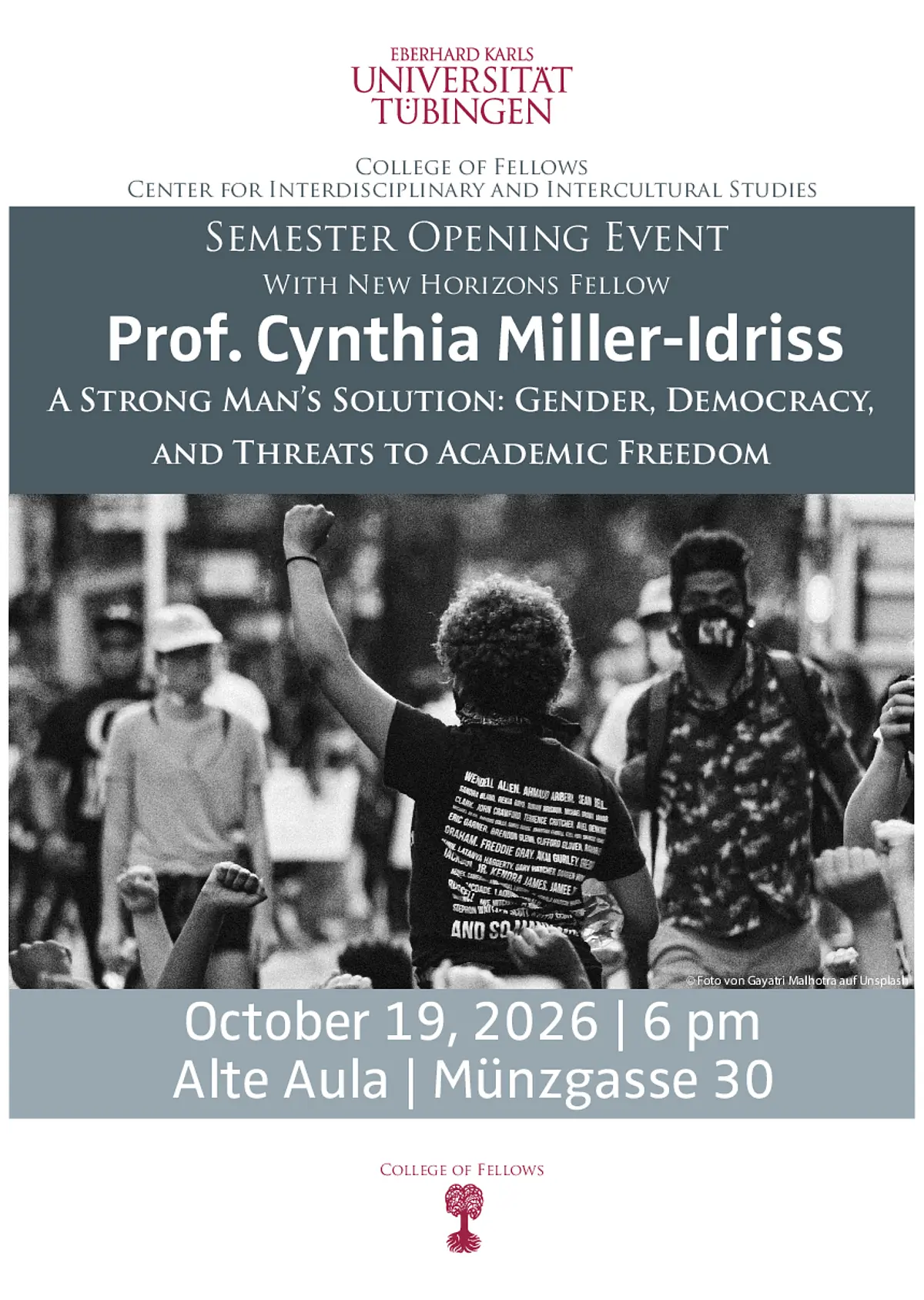
19 October 2026 | CoF Semester Opening | with Prof. Cynthia Miller-Idriss

21 October | CoF Lecture | “What is Confucianist Learning?From the Perspective of History”  | Prof. Guorong Yang

27 October 2026 | New Horizons Workshop “Transformation of Humanities” | with Prof. Stephen Muecke and Dr. Tim Lanzendörfer (Frankfurt a.M.) 

29 October 2026 | Public Lecture “Indigenous Australian Philosophy” | Prof. Stephen Muecke

30 October 2026 | CoF Lunch Talk “Aristotle and Confucius on Friendship and Moral Development” | Dr. Guy Schuh

Lectures and Lecture Series

CoF Semester Opening

Mon, 19 October 2026 | 6:00 pm
Alte Aula (Münzgasse 30)
 

We invite all international fellows, members and students of the University of Tübingen to join us for our College of Fellows semester opening with a guest lecture by New Horizons Fellow Professor Cynthia Miller-Idriss.

The reception following the lecture provides an opportunity for exchange and networking, also learn more about the College of Fellows and our activities.

Further information about Professor Cynthia Miller-Idriss's lecture will be announced shortly.

New Horizons Lecture

The New Horizons Lectures offers holders of the New Horizons Fellowship a platform to present their current research to a broader public audience.

Prof. Stephen Muecke:

"Indigenous Australian Philosophy"

Mon, 29 October 2026 | 6:00 pm
Alte Aula (Münzgasse 30)


Abstract:
Indigenous Australian Philosophy is emerging as a field that translates some concepts and practices from Indigenous Australia to form a branch of Australian Philosophy, a field that is itself ephemeral. The forms of knowledge that have accumulated over many thousands of years on the continent have mostly been translated into the disciplines of anthropology, history, archaeology, linguistics and some sciences. The door to the philosophy department has, for the most part, remained closed. Young Indigenous scholars are finding ways to open the field up to the knowledge their ancestors bequeathed to them, articulating the concepts and practices found there with critical analysis, with ecological management, with totemism and animism, and with pragmatics. Articulating Indigenous Australian Philosophy in English, in writing, in seminar rooms, has its challenges. But there is no doubt something new will emerge that is relevant to the Australian, and perhaps more global, context.

About:
Stephen Muecke is a Senior Research Fellow in the Nulungu Research Institute of the University of Notre Dame Australia, Fellow of the Australian Academy of the Humanities, and Emeritus Professor at the University of New South Wales. He is a cultural theorist and has worked at various Australian universities and been a visiting professor in Paris and Berlin. He has collaborated for many years with the Goolarabooloo people of the Kimberley region in Western Australia. An early result of that work was the prize-winning book Reading the Country: Introduction to Nomadology (1984), co-authored with Krim Benterrak and Paddy Roe, which explored the meaning and politics of place through Aboriginal narratives, songs and paintings. More recently, again with Paddy Roe, he published The Children's Country: Creation of a Goolarabooloo Future in North-West Australia (2021) and with Jennifer Eadie (eds., 2025) Living in Critical Zones: Environmental Humanities in South Asia. He is also a creative writer (No Road: Bitumen all the way was published in 1999) and has translated several books from French into English, notably Another Science is Possible (2018), by Belgian philosopher Isabelle Stengers, The Wandering Souls (2019), by French ethnopsychiatrist Tobie Nathan; Our Grateful Dead: Stories of Those Left behind, (2021) by Belgian ethologist Vinciane Despret, and forthcoming, Malcom Ferdinand, Loving the Earth: Undoing Colonial Inhabitation, Cambridge: Polity, 2026.

College of Fellows Lecture Series

The College of Fellows Lecture Series aims to foster interdisciplinary exchange and scholarly networking. Each month, fellows and international visiting scholars at the University of Tübingen present their research, followed by a reception that provides opportunities for discussion and exchange.

Prof. Guorong Yang:

"What is Confucianist Learning? From the Perspective of History"

Wed., 21 October 2026 | 6:30 pm
College of Fellows (Rümelinstr. 27/Villa Köstlin)


Abstract:
Confucianism takes ren (humaneness) and li (ritual propriety) as its inner core. As the fundamental conceptual nucleus of Confucian thought, ren and li constitute the defining basis of Confucianism as Confucianism, distinguishing it from other schools throughout history.

Within Confucianism, the unity of ren and li is manifested both in its overall intellectual system and across all domains of human existence. The latter includes the spiritual world, the social sphere, and the relationship between Heaven and humanity. The spiritual world concerns the aspirations of the human spirit, its grounding, and its elevation; its concrete articulation involves the religious dimension, the ethical dimension, and comprehensive forms of spiritual attainment. At the philosophical level, the social sphere as developed in Confucianism pertains to politics, ethics, and the everyday lifeworld. In terms of human existence, the spiritual world primarily concerns the relation between the self and itself, while the social sphere points to relations among persons. From a broader perspective, human existence also involves the relation between Heaven and humanity, and the Confucian understanding of this relation is likewise grounded in the concepts of ren and li.

In short, the unity of ren and li, as the core idea of Confucianism, permeates all aspects of Confucian thought. Confucianism thus unfolds as a comprehensive cultural system of ideas, and its concreteness and authenticity are manifested precisely in this integrative character. Contemporary categorizations such as moral metaphysical Confucianism, political Confucianism, institutional Confucianism, and everyday-life Confucianism tend to take one particular aspect of Confucianism as the whole, thereby inevitably leading to partial and one-sided interpretations.

Further CoF Lectures in the winter term 2026/27

11 November 2026
Prof. John Borneman: "The Lorelei's Call: Verwandtschaft, Loss, and Return in a Divided Germany"

11 November 2026 | 6:30 pm
College of Fellows (Rümelinstr. 27/Villa Köstlin)


Abstract:
In 1983 I began fieldwork in Germany, asking not how two states diverged after 1949 but how two generations narrated the losses set in motion by 1945. What I found reshaped the question: alongside Mitgliedschaft — membership, the passport one holds — ran Zugehörigkeit, a subjective belonging independent of official status.

I open with my father, dying in a Wisconsin nursing home, unexpectedly singing Heine's "Lorelei" to a German friend, confronting me with an inheritance I had spent my life disclaiming. I track my family's nineteenth-century emigration from Germany, a loss never quite transformational, before turning to Arnim, an East Berlin research subject across four decades, whose friendship taught me that ethnographic knowledge is inseparable from the relationships, and losses, through which it is made.

The talk closes with my decision to make Berlin home — not through membership finally acquired, but through Verwandtschaft: kinship built not from blood or soil, but from a shared working-through of loss.


John Borneman, Emeritus Professor of Anthropology at Princeton University, received his Ph.D. from Harvard (1989) and taught at Cornell (1991 – 2001), and Princeton (2001 – 2022). His longterm fieldwork has been in Germany and Syria, and he has written extensively on relation of the state and law to intimacy and practices of care. In 2013 he was awarded the Boyer Prize for contributions to psychoanalytic anthropology. His most recent book is I Was Married to a Horse, and other Tales of an Accidental Anthropology, published in 2026.

9 December 2026
Dr. Hans Lind: "Is the Law Faking? On the Culture of Legal Lies and Other Legal Truths"

Wed. 9 December 2026 | 6:30 pm
College of Fellows (Rümelinstr. 27/Villa Köstlin)


Abstract:
From the Talmudic tradition over Roman law to Islamic law, counterfactuals have populated legal history – and still prevail. While Bentham has denounced such legal fictions as a “a syphilis which runs in every vein and carries into every part of the system” of common law, others have readily welcomed law’s ‘white lies’, later culminating in a praise of both the utility and the aesthetics of legal feigning. Since fictions are indispensable means even in today’s system of legal autopoiesis, the talk will inquire in the different forms and reasons for law’s faking, from the early history of human rights to contemporary public international law.


Hans Lind is a Schrödinger Fellow of the Austrian Science fund and is currently in a sabbatical at the University of Vienna. Before, he taught at the Universities of Vienna, Yale and Konstanz. He was a visiting researcher at the Max-Planck-Institute for comparative public law and international law in Heidelberg before he came to Tübingen. Lind holds a degree in Law / Legal Studies from the University of Tübingen and earned his doctorate degree at Yale University. His Book Legal Fictions was published by Routledge, his collected volume Fictional Discourse and the Law was published by Routledge in 2020.

Focus Group Events

An overview of all Focus Groups can be found here

New Horizons: Proximity in the Future Humanities

8 October 2026
Workshop on Urban Critical Zones

Workshop on Urban Critical Zones, with Guest Prof. Kate Rigby (Cologne)

Thurs 8 Oct, 10:00 am – 5:00 pm
College of Fellows (Rümelinstr. 27/Villa Köstlin) | Common Room 

The notion of urban critical zones promises to fill a gap both in critical zones studies (indexed by the absence till now of CZ observatories in cities) and in urban studies, which customarily place humans agents centre stage while relegating other actors to the status of ‘infrastructure’ and neglecting many other possible actants, thereby demanding an ‘ecologization’ of the discipline. More radically, however, the notion of urban critical zones demands that we revamp the very idea of the city as a bounded given (allowing it to be reconceptualized via the fluid, even ‘uncanny’ notion of the zone), thinking its manifold constitutive processes and flows in a non-linear fashion; and taking on board the types of agency and the repertoire of actants we understand as contributing to the dynamic process of ‘cityness’. 

(3 sessions, interspersed with lunch (catered) and afternoon coffee break). 

13 October 2026
Workshop on Isbabelle Stengers: “Making Sense in Proximity”

Workshop on Isabelle Stengers: “Making Sense in Proximity” 

Tues 13 Oct, 10:00 am – 4:00 pm
College of Fellows (Rümelinstr. 27/Villa Köstlin) | Common Room 

Building upon Alfred North Whitehead’s concept of ‘coherence’ (no idea makes sense without being placed in relation with the other ideas that make up the whole) and Bruno Latour’s notion of ‘matters of concern’ (issues that provide an affirmative platform for thinking rather than mere ‘critique’), Isabelle Stengers proposes a model of ‘making sense in common’ – in which our shared proximity to contemporary crises, even where our opinions may diverge radically, provides a framework for constructive – and vitally necessary – dialogue. The workshop explores what this may mean for our respective projects, whether conceptual, empirical, or activist. 

(3 sessions, interspersed with lunch (catered) and afternoon coffee break). 

27 October 2026
Workshop on Transformations of the Humanities

Workshop on Transformations of the Humanities, with interventions by Stephen Muecke, Russ West-Pavlov, Tim Lanzendörfer, Mamadou Dramé/René Ramírez Gallegos (virtual), Anya Heise-von der Lippe

Tue 27 Oct, 10:00 am – 4:00 pm
Alte Aula (Münzgasse 30)  


Abstract: 
This workshop interrogates the public remit and the constitutive contours of the humanities from a number of points of view: as an assemblage in a universe of distributed agency; as a group of disciplines under pressure in an age of polycrises (from climate change to shifts in the graduate labour market); and as an institutional actant susceptible of transformation by developments originating in the Global South.

(3 sessions: 1: Muecke: Composition; Respondent Lanzendörfer (10-12); 2: Heise-von der Lippe, Applied Humanities; Respondent RWP (12:15-13:45); 3: humanities from the South: RWP) (14:15-16:00); interspersed by catering and coffee break)

29 October 2026
New Horizons Lecture: “Indigenous Australian Philosophy”

29 October 2026, 6:00 pm 
Alte Aula (Münzgasse 30)


Abstract: 
Indigenous Australian Philosophy is emerging as a field that translates some concepts and practices from Indigenous Australia to form a branch of Australian Philosophy, a field that is itself ephemeral. The forms of knowledge that have accumulated over many thousands of years on the continent have mostly been translated into the disciplines of anthropology, history, archaeology, linguistics and some sciences. The door to the philosophy department has, for the most part, remained closed. Young Indigenous scholars are finding ways to open the field up to the knowledge their ancestors bequeathed to them, articulating the concepts and practices found there with critical analysis, with ecological management, with totemism and animism, and with pragmatics. Articulating Indigenous Australian Philosophy in English, in writing, in seminar rooms, has its challenges. But there is no doubt something new will emerge that is relevant to the Australian, and perhaps more global, context.

Fellow Life Events

CoF Lunch Talks

The CoF Lunch Talk Series provides a regular forum for exchange among the fellows affiliated with the College of Fellows. The talks take place in a relaxed atmosphere over a light lunch. Interested members of the university are cordially invited to attend.

Dr. Guy Schuh: "Aristotle and Confucius on Friendship and Moral Development"

Fri. 30 October 2026 | 12:00 am
College of Fellows (Rümelinstr. 27/Villa Köstlin)


Abstract:
Every parent knows that friendship is not a mere pastime. Though being together with friends is a great pleasure, it also has the power to shape who we are. Two of the great philosophers of friendship—Aristotle and Confucius—both recognize this fact. In this talk, I will use their shared attention to friendship’s character-forming power as a lens through which to compare their treatments of friendship. I will argue for two theses in particular. First, while Aristotle and Confucius both recognize friendship’s character-forming effects, Confucius is better able to harmonize these effects with his account of friendship than Aristotle. Second, the kinds of character-forming effects that each recognizes implies an interesting difference in how they understand friendship. Confucius understands it as a form of commitment; Aristotle as a form of natural love.


Guy Schuh is an Intercultural Studies Fellow at Tubingen University. Before that, he held positions at the University of Alabama and Suffolk University. He has taught, and published research on, Ancient Greek and Classical Chinese Philosophy.

Further CoF Lunch Talks in the winter term 2026/27

20 November 2026
Dr. Rachel Macreadie: "Can Treaty Survive Politics? The Fragile Pact Between First Nations and the Victorian State"

Fri. 20 November 2026 | 12:00 am
College of Fellows (Rümelinstr. 27/Villa Köstlin)


Abstract: 
In 2025, Victoria became the first Australian jurisdiction to formalise a Treaty with First Peoples, acknowledging that Aboriginal sovereignty was never ceded. The Statewide Treaty Act 2025 followed a decade of negotiations. It aims to create a ‘renewed relationship’ between the State and First Peoples and advance their inherent rights and self-determination. Nonetheless, Treaty has been established at a time when Indigenous rights have been heavily politicised (nationally and globally). 

In 2023, the Australian Indigenous Voice to Parliament, which would have provided constitutional recognition of First Peoples in Australia, was defeated. The Victorian Opposition, currently leading the polls, has since vowed to abolish Treaty if they win the next election in November. Parliamentary debates have become increasingly polarised. In this presentation, I examine the friction between First Nations sovereignty and western democratic institutions, how Treaty is functioning in practice, and the consequences for this ‘renewed relationship’ when structural reform becomes temporary and threatened.


Rachel Macreadie is a Global Encounters Fellow at the University of Tübingen, Germany. She previously worked as a Parliamentary Committee Researcher for the Parliament of Victoria (2007 – 2025), and in migration policy for the International Organization for Migration in Vietnam and the Victorian Foundation for Survivors of Torture (as an Australian Aid Youth Ambassador for Development). She has a PhD in Translation Studies (University of Melbourne/KU Leuven) and a forthcoming book on crisis communication policies and practices (Routledge, 2027).


4 December 2026
Dr. Zakieh Azadani: "From Divine Wisdom to Nature's Agency: Thinking about Nature in Islamic Philosophy"

Fri. 4 December 2026 | 12:00 pm
College of Fellows (Rümelinstr. 27/Villa Köstlin)


Further information will follow.


22 January 2026
Dr. Sophia Johnson: "The Bible in/as European Political Vocabulary"

Fri. 22 January 2027 | 12:00 pm
College of Fellows (Rümelinstr. 27/Villa Köstlin)


Abstract:
The Bible plays an increasingly visible role in European political discourse, particularly in the narratives and vocabulary of both religious and nonreligious Far Right movements. This may come as a surprise given the prevailing secularist approach of European policymakers to create a supposedly neutral public space (although the reality is far more complex). However, the rejection of sacred traditions has alienated conservative religious communities, who are thus drawn to these movements despite moral misgivings over extreme ideology. For populists, the Bible acts as a source of both authority with which prevailing elites may be challenged and accessible repertoire of imagery for mass communication and narrative alliances between disparate groups. Yet insofar as this resembles religious fundamentalism, we can learn from religious responses in order to overcome its entanglement with political fundamentalism — foremostly by critically reframing the historical role of the Bible as a mirror rather than a source of modern European politics. Instead of rejecting the Bible from political discourse altogether, it can be used as a source of inclusive, pluralist political imaginaries, as a venue for community reflection, and as a touchstone of dialogue, especially in interfaith contexts.
 

Sophia R.C. Johnson is a scholar of the Bible, religion, and politics. Originally from the US, Dr Johnson received her MPhil and PhD in Hebrew Bible studies from the University of Cambridge. She first came to Germany in 2022 for a research stay at George-August-Universität Göttingen funded by the DAAD before joining the DFG project “Josua postcolonial” at Ruhr-Universität Bochum in 2023. Dr. Johnson also teaches for the interdisciplinary Master’s Programme in Religion, Ethics, and Politics (MaREPol) at Technische Universität Dortmund and serves on the board of the Feminist Studies in Religion CoLaboratory.