College of Fellows

Events

Aktuelle Veranstaltungen

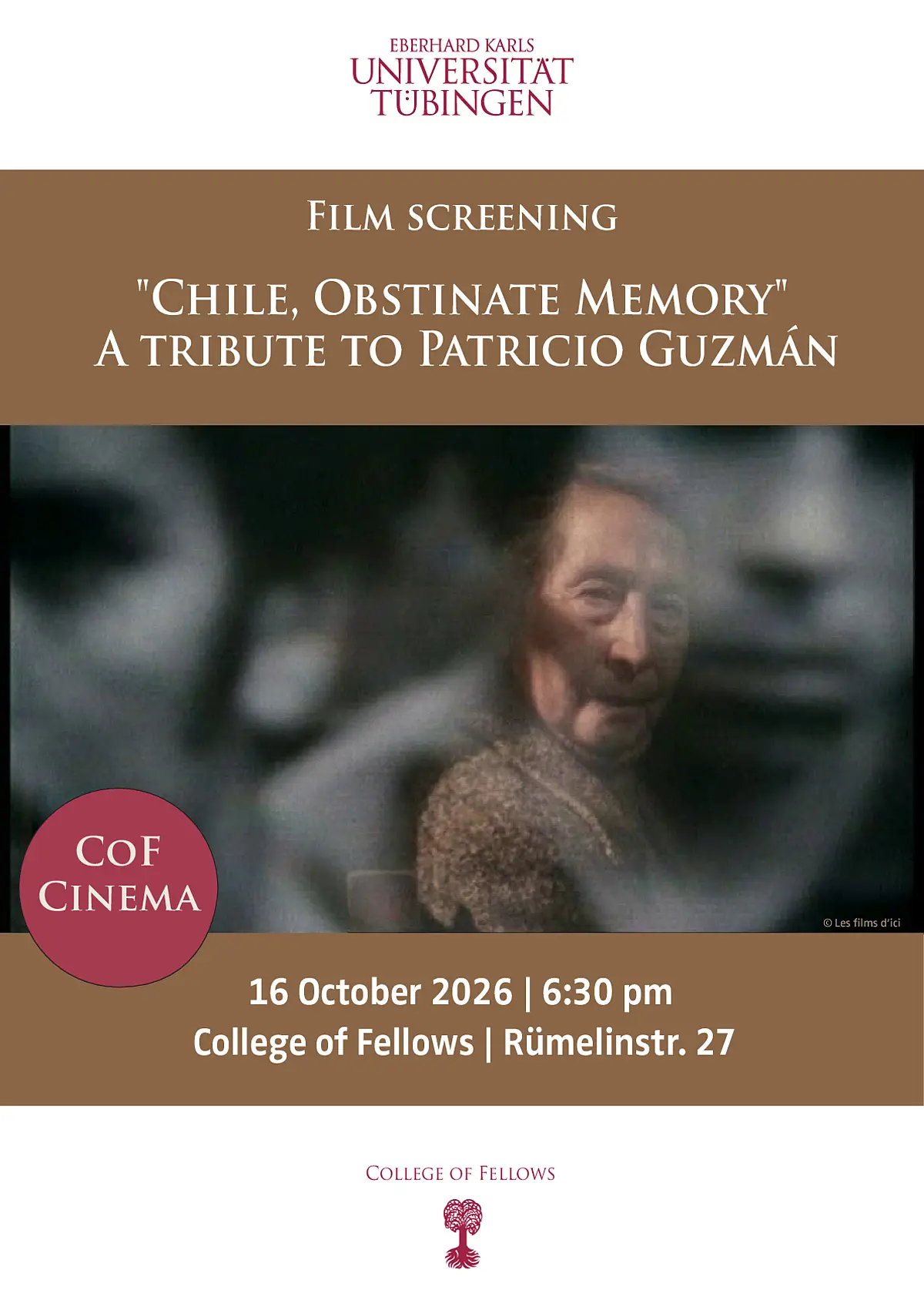
16. Oktober 2026 | CoF Cinema | Obstinate memory – Eine Hommage an Patricio Guzmán

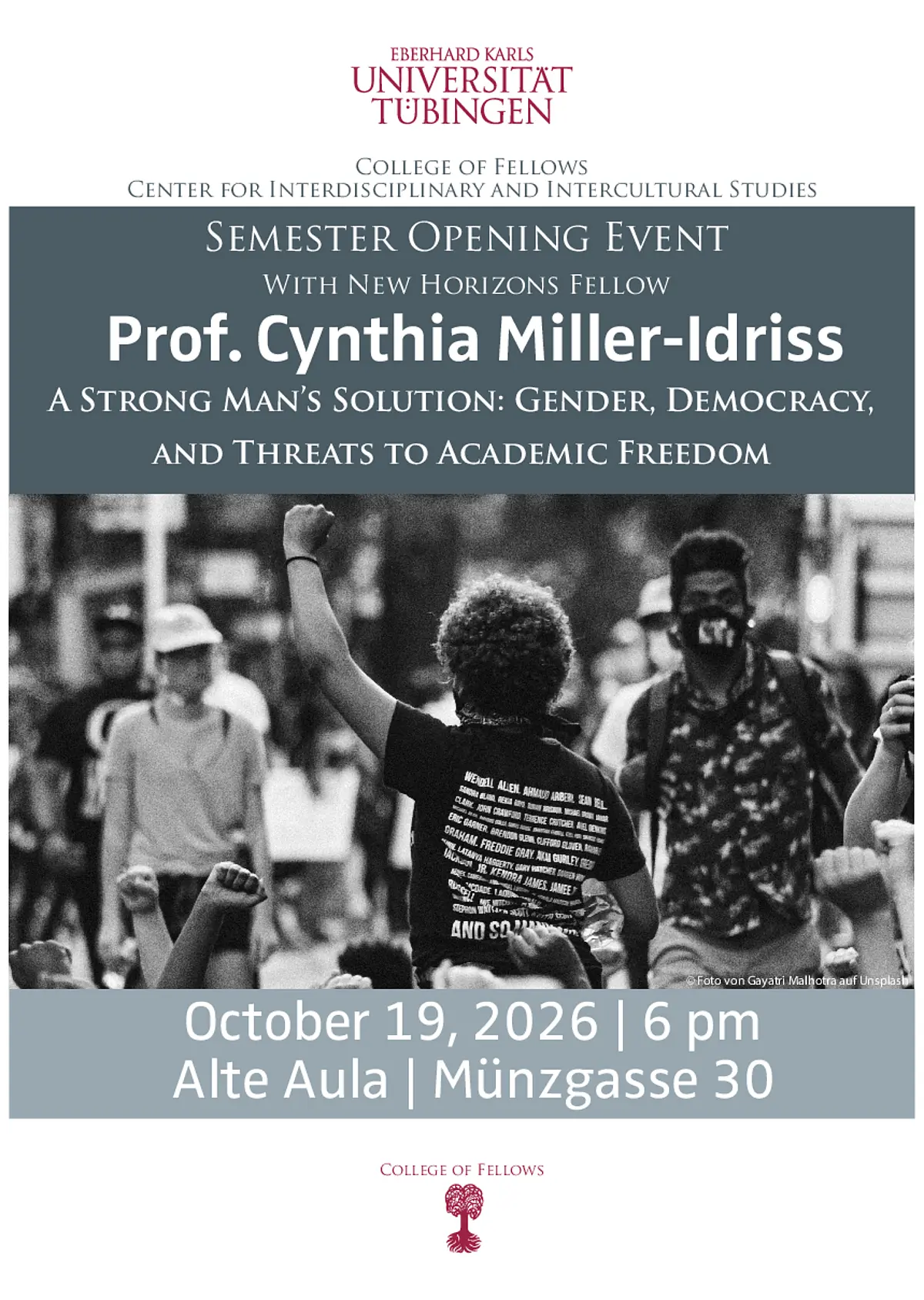
19. Oktober 2026 | CoF Semestereröffnung | “A Strong Man’s Solution: Gender, Democracy, and Threats to Academic Freedom” | Prof. Dr. Cynthia Miller-Idriss 

27. Oktober 2026 | New Horizons Workshop “Transformation of Humanities” | mit Prof. Dr. Stephen Muecke 

29. Oktober 2026 | New Horizons Lecture | “Country is Alive: Indigenous Australian Philosophy” | Prof. Dr. Stephen Muecke

30. Oktober 2026 | Lunch Talk | “Aristotle and Confucius on Friendship and Moral Development” | Dr. Guy Schuh

Vorträge und Vortragsreihen

CoF Semestereröffnung

Prof. Cynthia Miller-Idriss:

"A Strong Man’s Solution: Gender, Democracy, and Threats to Academic Freedom"

19. Oktober 2026 | 18:00 Uhr
Alte Aula (Münzgasse 30)


Zu unserer Semestereröffnung mit einem Vortrag von New Horizons Fellow Prof. Cynthia Miller-Idriss laden wir alle internationalen Fellows, Mitglieder und Studierenden der Universität Tübingen ein. 
Der anschließende Empfang dient dem Austausch und der Vernetzung, und bietet die Möglichkeit, das College of Fellows mit seinen Angeboten kennenzulernen.


Abstract zum Vortrag: 
Gender, misogyny, and machismo are central to the authoritarian playbook—particularly for far-right populists who have gained power through democratic processes. From the pages of traditional newspapers to grinning podcasters, gender-based grievances now function as a powerful lever for mobilizing audiences, subscribers, voters, and donors by convincing them that any shift in gender norms jeopardizes family stability, moral order, and even civilization itself. Around the world, authoritarian leaders are weaponizing gender-based grievances to rally supporters and roll back women’s and LGBTQ+ rights. By casting feminism as a threat to “family stability” and the “moral order,” they seek to shift public sentiment toward a patriarchal, illiberal future. Higher education institutions are right in the thick of this—from attacks on gender and women’s studies to restrictions on transgender student rights and the very definition of sex and gender—universities and colleges are being forced to adhere to retrenched gender policies in order to retain funding. In this talk, I outline the threat to academic freedom posed by the weaponization of gender and put it in the context of larger battles around science, expertise, facts, and the pursuit of knowledge.
 

Cynthia Miller-Idriss gehört zu den führenden Wissenschaftler*innen in der Forschung zu Extremismus, Radikalisierung und Polarisierung, wobei ihre Arbeit eine Brücke zwischen akademischer Forschung und praktischen Maßnahmen schlägt. Als Leiterin des „Polarization and Extremism Research & Innovation Lab“ (PERIL) an der American University fließen ihre Forschungsergebnisse in politische, mediale und gemeindebasierte Strategien zur Bewältigung drängender globaler Herausforderungen ein. Ihre Veröffentlichungen und Beiträge liefern wichtige Erkenntnisse zum Verständnis und zur Prävention der Dynamiken von Hass und Gewalt.
Cynthia Miller-Idriss ist aktuell New Horizons Fellow am College of Fellows, und als solche am Institut für Rechtsextremismusforschung (IRex) affiliiert. 

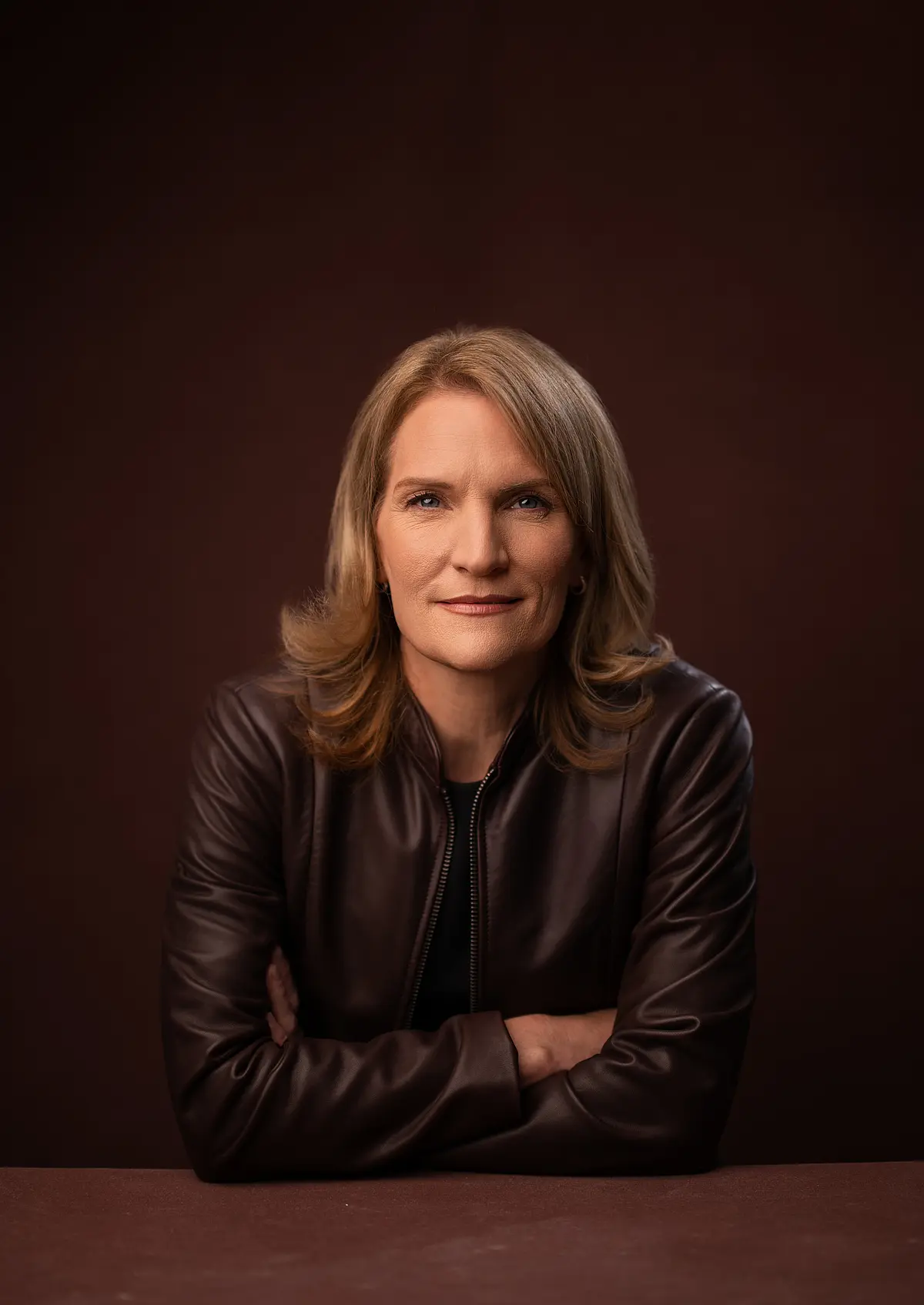
Cynthia Miller-Idriss
New Horizons Fellow
Soziologie

Fellowship: New Horizons Fellowship 
Affiliation: Institut für Rechtsextremismusforschung (IRex) 
Stay in Tübingen (from - until): November 6 – 14, 2025; June 14 – July 14, 2026; October 15 – November 25, 2026 
Research Project: Everyday Extremism, Social Cohesion and Democratic Resilience
Research Areas: Youth culture, iconography, youth extremism, prevention of violent extremism, media and digital literacy vis-à-vis propaganda and conspiracy theories, education

Publications: 

Recent books: 

  1. Forthcoming in 2026: Dashtgard, Pasha and Cynthia Miller-Idriss. A School Without Hate: Evidence from Education Interventions. Under contract at Harvard Education Press, fall 2026 pub date.
  2. Miller-Idriss, Cynthia. 2025. Man Up: The New Misogyny and the Rise of Violent Extremism. Princeton University Press. 
  3. Miller-Idriss, Cynthia. 2020. Hate in the Homeland: The New Global Far Right. Revised paperback edition with new preface and reader's guide, 2022. Princeton, NJ: Princeton University Press. 

  4. Miller-Idriss, Cynthia. 2018. The Extreme Gone Mainstream: Commercialization and Far Right Youth Culture in Germany. Princeton, NJ: Princeton University Press.

Recent peer-reviewed articles:  

  1. Miller-Idriss, Cynthia. 2025. “Misogyny Incubators: How Gaming Helps Channel Everyday Sexism into Violent Extremism.” Frontiers in Psychology. Volume 16. doi: 10.3389/fpsyg.2025.1537477

  2. Miller-Idriss, Cynthia. 2024. “What We Miss When We Overlook the Gendered Aspects of Nationalist Mobilization.” Nations and Nationalism 30(3): 404-409. doi: 10.1111/nana.13031

  3. Miller-Idriss, Cynthia. 2023. “Extremist Recruitment and Extremist Sentiment Normalization.” Conference briefing note from keynote, Canadian Association for Security and Intelligence Studies (CASIS) 2022 conference. Journal of Intelligence, Conflict, and Warfare 5(3): 164-168.

Recent popular and public-facing media: 

  1. Miller-Idriss, Cynthia. “How Misogyny and Gendered Grievances Fuel Authoritarianism.” Fascism: Journal of Comparative Fascist Studies (in production, Oct 2025).  

  2. Miller-Idriss, Cynthia. “How Tradwives Use Sexism, Racism, and Transphobia to Police Other Women.” Teen Vogue, September 17, 2025.

Contact: cynthiaspam prevention@american.edu 

Activities at the College of Fellows: During my time in Tübingen, I will be a part of the focus groups in IRex called “Far Right Threats” and “Everyday Extremism”. I will be part of regular discussions and work across these units and will also be working on the analysis and writing for my book-in-progress on gendered social divides among Gen Z and Gen Alpha, to be published in both English and German. I will also participate in and/or lead several workshops and shorter events, including public talks, interactive sessions and research insights with local practitioners, policy roundtables, and two workshops (in summer 2026 and in fall 2026):

  • Workshop on Everyday Extremism and Normalization (June or July 2026): Uniting scholars from diverse disciplinary backgrounds to examine the cultural dimensions of the rise and normalization of far-right ideologies beyond formal (electoral) politics. During this workshop, participants present and discuss their own research on everyday life extremism. They develop a joint perspective for further collaborative research. As one outcome, a joint publication, e.g. a research note, is envisioned. As a second step, joint efforts to apply for research grants can be based on the results of the workshop.
  • Workshop on Cross-Disciplinary Dialogues on Democratic Resilience (October 2026): Bringing together scholars, activists, and public officials to discuss strategies for strengthening social cohesion. Strengthening democracy requires transforming knowledge into action. Building on the results of the first workshop, which focused on bringing together academic researchers, this second workshop will explore innovative formats and social interventions by fostering collaboration between scholars, activists, and public officials to discuss ways to enhance social cohesion. 

There will be substantial other outcomes during my stay, including short essays that I will publish in mainstream media publications and additional meetings with faculty and students from across the university and the region.

About: Dr. Cynthia Miller-Idriss is a Professor in the School of Public Affairs and in the School of Education at the American University in Washington, DC, where she is the founding director and chief vision officer of the pioneering Polarization and Extremism Research & Innovation Lab (PERIL), which creates, tests, and scales up real-world solutions with a scholarly evidence base. A prolific writer and speaker, Miller-Idriss has a commitment to public engagement that places her at the forefront of a movement to catalyze change in how violence is understood and prevented in the US and globally. She is a columnist for MSNBC with recent bylines in The New York Times, The Washington Post, The Atlantic, Foreign Affairs, Politico, and more. Her most recent books include Man Up (Princeton University Press, 2025) and Hate in the Homeland (Princeton University Press, 2022). Miller-Idriss is a 2025 Andrew Carnegie Fellow, a member of the College of Fellows at the University of Tübingen, and a Draper Richards Kaplan Foundation Entrepreneur. In 2022, she served as the inaugural creative lead for the Alexander von Humboldt Foundation’s residency program on social cohesion in Berlin. She holds a Ph.D. in Sociology from the University of Michigan, dual masters degrees in public policy and sociology from the University of Michigan, and earned a bachelors degree magna cum laude in German Area Studies and Sociology from Cornell University. 
 

New Horizons Lecture

Die New Horizons Lectures bieten Fellows des New Horizons Programms die Bühne, einer breiten Öffentlichkeit Aspekte ihrer aktuellen Arbeiten vorzustellen. 

Prof. Stephen Muecke:

"Country is Alive: Indigenous Australian Philosophy"

29. Oktober 2026 | 18:00 Uhr 
Alte Aula (Münzgasse 30)
(Die Veranstaltung findet auf Englisch statt.)


Abstract:
Indigenous Australian Philosophy is emerging as a field that translates some concepts and practices from Indigenous Australia to form a branch of Australian Philosophy, a field that is itself ephemeral. The forms of knowledge that have accumulated over many thousands of years on the continent have mostly been translated into the disciplines of anthropology, history, archaeology, linguistics and some sciences. The door to the philosophy department has, for the most part, remained closed. Young Indigenous scholars are finding ways to open the field up to the knowledge their ancestors bequeathed to them, articulating the concepts and practices found there with critical analysis, with ecological management, with totemism and animism, and with pragmatics. Articulating Indigenous Australian Philosophy in English, in writing, in seminar rooms, has its challenges. But there is no doubt something new will emerge that is relevant to the Australian, and perhaps more global, context.

About:
Stephen Muecke is a Senior Research Fellow in the Nulungu Research Institute of the University of Notre Dame Australia, Fellow of the Australian Academy of the Humanities, and Emeritus Professor at the University of New South Wales. He is a cultural theorist and has worked at various Australian universities and been a visiting professor in Paris and Berlin. He has collaborated for many years with the Goolarabooloo people of the Kimberley region in Western Australia. An early result of that work was the prize-winning book Reading the Country: Introduction to Nomadology (1984), co-authored with Krim Benterrak and Paddy Roe, which explored the meaning and politics of place through Aboriginal narratives, songs and paintings. More recently, again with Paddy Roe, he published The Children's Country: Creation of a Goolarabooloo Future in North-West Australia (2021) and with Jennifer Eadie (eds., 2025) Living in Critical Zones: Environmental Humanities in South Asia. He is also a creative writer (No Road: Bitumen all the way was published in 1999) and has translated several books from French into English, notably Another Science is Possible (2018), by Belgian philosopher Isabelle Stengers, The Wandering Souls (2019), by French ethnopsychiatrist Tobie Nathan; Our Grateful Dead: Stories of Those Left behind, (2021) by Belgian ethologist Vinciane Despret, and forthcoming, Malcom Ferdinand, Loving the Earth: Undoing Colonial Inhabitation, Cambridge: Polity, 2026.

College of Fellows Lecture Series

Die College of Fellows Lecture Series hat interdisziplinären Austausch und wissenschaftliche Vernetzung zum Ziel. Jeden Monat stellen Fellows und internationale Gastwissenschaftler*innen der Universität Tübingen ihre Forschungen mit anschließendem Empfang vor.

Weitere CoF Lectures im WiSe 2026/27

11. Nov. 2026
Prof. John Borneman: "The Lorelei's Call: Verwandtschaft, Loss, and Return in a Divided Germany"

11. November 2026 | 18:30 Uhr
College of Fellows (Rümelinstr. 27/Villa Köstlin)


Abstract:
In 1983 I began fieldwork in Germany, asking not how two states diverged after 1949 but how two generations narrated the losses set in motion by 1945. What I found reshaped the question: alongside Mitgliedschaft — membership, the passport one holds — ran Zugehörigkeit, a subjective belonging independent of official status.

I open with my father, dying in a Wisconsin nursing home, unexpectedly singing Heine's "Lorelei" to a German friend, confronting me with an inheritance I had spent my life disclaiming. I track my family's nineteenth-century emigration from Germany, a loss never quite transformational, before turning to Arnim, an East Berlin research subject across four decades, whose friendship taught me that ethnographic knowledge is inseparable from the relationships, and losses, through which it is made.

The talk closes with my decision to make Berlin home — not through membership finally acquired, but through Verwandtschaft: kinship built not from blood or soil, but from a shared working-through of loss.


John Borneman, Emeritus Professor of Anthropology at Princeton University, received his Ph.D. from Harvard (1989) and taught at Cornell (1991 – 2001), and Princeton (2001 – 2022). His longterm fieldwork has been in Germany and Syria, and he has written extensively on relation of the state and law to intimacy and practices of care. In 2013 he was awarded the Boyer Prize for contributions to psychoanalytic anthropology. His most recent book is I Was Married to a Horse, and other Tales of an Accidental Anthropology, published in 2026.

9. Dez. 2026
Dr. Hans Lind: "Is the Law Faking? On the Culture of Legal Lies and Other Legal Truths"

Mi, 9. Dezember 2026 | 18:30 Uhr
College of Fellows (Rümelinstr. 27/Villa Köstlin)


Abstract:
From the Talmudic tradition over Roman law to Islamic law, counterfactuals have populated legal history – and still prevail. While Bentham has denounced such legal fictions as a “a syphilis which runs in every vein and carries into every part of the system” of common law, others have readily welcomed law’s ‘white lies’, later culminating in a praise of both the utility and the aesthetics of legal feigning. Since fictions are indispensable means even in today’s system of legal autopoiesis, the talk will inquire in the different forms and reasons for law’s faking, from the early history of human rights to contemporary public international law.


Hans Lind ist Schrödinger-Stipendiat des Österreichischen Wissenschaftsfonds und befindet sich derzeit im Sabbatical an der Universität Wien. Zuvor lehrte er an der Universität Wien, der Yale University und der Universität Konstanz. Bevor er nach Tübingen kam, war er Gastwissenschaftler am Max-Planck-Institut für ausländisches öffentliches Recht und Völkerrecht in Heidelberg. Lind hat einen Abschluss in Rechtswissenschaften von der Universität Tübingen und promovierte an der Yale University. Sein Buch Legal Fictions ist bei Routledge unter Vertrag, sein Sammelband Fictional Discourse and the Law wurde 2020 bei Routledge veröffentlicht.

20. Januar 2027
Dr. Farzane Vakilchap: "From PFAS Contamination to Safe Water Reuse: A New Path for 'Forever Chemicals' biodegradation"

Mi, 20. Januar 2027 | 18:30 Uhr
College of Fellows (Rümelinstr. 27/Villa Köstlin)
 

Weitere Informationen folgen in Kürze. 

Focus Group Events

Ausführliche Informationen zu den einzelnen Focus Groups finden Sie hier. 

New Horizons: Proximity in the Future Humanities

27. Oktober
Workshop on Transformations of the Humanities

Workshop on Transformations of the Humanities

Di, 27. Okt, 10:00 Uhr – 16:00 Uhr 
College of Fellows (Common Room)


Abstract:
This workshop interrogates the public remit and the constitutive contours of the humanities from a number of points of view: as an assemblage in a universe of distributed agency; as a group of disciplines under pressure in an age of polycrises (from climate change to shifts in the graduate labour market); and as an institutional actant susceptible of transformation by developments originating in the Global South.

Programme: 

Session 1: 10:00-12:00: Introduction, Presentations Russ West-Pavlov: The Proximate/Public Humanities

  • READING: West-Pavlov, ‘Deterritorializing the Humanities’ (Manuscript).

Lunch break: 12:00-12:30

Lunch break: 12:00-12:30

Session 2: 12:30-14:00 – Stephen Muecke, Experimental Humanities 

  • READING: Muecke, ‘An Ecology of Institutions: Recomposing the Humanities’; Muecke, ‘Illusion of Proximity’, Pt. 2 (Manuscript)

Coffee break: 14:30-15:00

Session 3: 15:30-16:00 – Stephen Muecke, group work: (1) Composing Our Humanities; (2) Re-Imagining the Humanities

Please follow this link to access the reading material.

29. Oktober 2026
New Horizons Lecture
Prof. Stephen Muecke: “Indigenous Australian Philosophy”

29. Oktober 2026 | 18.00 Uhr | Alte Aula, Münzgasse 30 (Die Veranstaltung findet auf Englisch statt.)


Indigenous Australian Philosophy is emerging as a field that translates some concepts and practices from Indigenous Australia to form a branch of Australian Philosophy, a field that is itself ephemeral. The forms of knowledge that have accumulated over many thousands of years on the continent have mostly been translated into the disciplines of anthropology, history, archaeology, linguistics and some sciences. The door to the philosophy department has, for the most part, remained closed. Young Indigenous scholars are finding ways to open the field up to the knowledge their ancestors bequeathed to them, articulating the concepts and practices found there with critical analysis, with ecological management, with totemism and animism, and with pragmatics. Articulating Indigenous Australian Philosophy in English, in writing, in seminar rooms, has its challenges. But there is no doubt something new will emerge that is relevant to the Australian, and perhaps more global, context.

Fellow Life Events

CoF Cinema

Obstinate memory –

Eine Hommage an Patricio Guzmán

Fr, 16. October 2026 | 18:30 Uhr
College of Fellows (Rümelinstr. 27/Villa Köstlin)


In diesem CoF Cinema zeigen wir den Film Chile, obstinate memory (1997) und würdigen hiermit das Schaffen des kürzlich verstorbenen Filmemachers Patricio Guzmán, eine der prägenden Persönlichkeiten des zeitgenössischen Dokumentarfilms.
Getränke und Snacks werden bereitgestellt, und im Anschluss an die Filmvorführung laden wir zur Diskussion und zum geselligen Austausch ein.

Der Abend wird von Fellow Ignacio Albornoz Farina (Intercultural Studies) organisert und moderiert.

CoF Lunch Talks

Die CoF Lunch Talk Series dient dem regelmäßigen Austausch der am College of Fellws angesiedelten Fellows. Die Vorträge finden in entspannter Atmosphäre bei einem Mittags-Snack statt, Interessierte sind herzlich eingeladen, an den Vorträgen teilzunehmen. 

Dr. Guy Schuh: "Aristotle and Confucius on Friendship and Moral Development"

Fr., 30. Oktober 2026 | 12:00 Uhr
College of Fellows (Rümelinstr. 27/Villa Köstlin)


Abstract:
Every parent knows that friendship is not a mere pastime. Though being together with friends is a great pleasure, it also has the power to shape who we are. Two of the great philosophers of friendship—Aristotle and Confucius—both recognize this fact. In this talk, I will use their shared attention to friendship’s character-forming power as a lens through which to compare their treatments of friendship. I will argue for two theses in particular. First, while Aristotle and Confucius both recognize friendship’s character-forming effects, Confucius is better able to harmonize these effects with his account of friendship than Aristotle. Second, the kinds of character-forming effects that each recognizes implies an interesting difference in how they understand friendship. Confucius understands it as a form of commitment; Aristotle as a form of natural love.


Guy Schuh is an Intercultural Studies Fellow at Tubingen University. Before that, he held positions at the University of Alabama and Suffolk University. He has taught, and published research on, Ancient Greek and Classical Chinese Philosophy.

Weitere CoF Lunch Talks im WiSe 2026/27

20. Nov. 2026
Dr. Rachel Macreadie: "Can Treaty Survive Politics? The Fragile Pact Between First Nations and the Victorian State"

Fr., 20. November 2026 | 12:00 Uhr
College of Fellows (Rümelinstr. 27/Villa Köstlin)


Abstract: 
In 2025, Victoria became the first Australian jurisdiction to formalise a Treaty with First Peoples, acknowledging that Aboriginal sovereignty was never ceded. The Statewide Treaty Act 2025 followed a decade of negotiations. It aims to create a ‘renewed relationship’ between the State and First Peoples and advance their inherent rights and self-determination. Nonetheless, Treaty has been established at a time when Indigenous rights have been heavily politicised (nationally and globally). 

In 2023, the Australian Indigenous Voice to Parliament, which would have provided constitutional recognition of First Peoples in Australia, was defeated. The Victorian Opposition, currently leading the polls, has since vowed to abolish Treaty if they win the next election in November. Parliamentary debates have become increasingly polarised. In this presentation, I examine the friction between First Nations sovereignty and western democratic institutions, how Treaty is functioning in practice, and the consequences for this ‘renewed relationship’ when structural reform becomes temporary and threatened.


Rachel Macreadie is a Global Encounters Fellow at the University of Tübingen, Germany. She previously worked as a Parliamentary Committee Researcher for the Parliament of Victoria (2007 – 2025), and in migration policy for the International Organization for Migration in Vietnam and the Victorian Foundation for Survivors of Torture (as an Australian Aid Youth Ambassador for Development). She has a PhD in Translation Studies (University of Melbourne/KU Leuven) and a forthcoming book on crisis communication policies and practices (Routledge, 2027).

4. Dez. 2026
Dr. Zakieh Azadani: "From Divine Wisdom to Nature's Agency: Thinking about Nature in Islamic Philosophy"

Fr., 4. Dezember 2026 | 12:00 Uhr
College of Fellows (Rümelinstr. 27/Villa Köstlin)


Nähere Informationen folgen. 

22. Jan. 2026
Dr. Sophia Johnson: "The Bible in/as European Political Vocabulary"

Fr., 22. Jan. 2027 | 12:00 Uhr
College of Fellows (Rümelinstr. 27/Villa Köstlin)


Abstract:
The Bible plays an increasingly visible role in European political discourse, particularly in the narratives and vocabulary of both religious and nonreligious Far Right movements. This may come as a surprise given the prevailing secularist approach of European policymakers to create a supposedly neutral public space (although the reality is far more complex). However, the rejection of sacred traditions has alienated conservative religious communities, who are thus drawn to these movements despite moral misgivings over extreme ideology. For populists, the Bible acts as a source of both authority with which prevailing elites may be challenged and accessible repertoire of imagery for mass communication and narrative alliances between disparate groups. Yet insofar as this resembles religious fundamentalism, we can learn from religious responses in order to overcome its entanglement with political fundamentalism — foremostly by critically reframing the historical role of the Bible as a mirror rather than a source of modern European politics. Instead of rejecting the Bible from political discourse altogether, it can be used as a source of inclusive, pluralist political imaginaries, as a venue for community reflection, and as a touchstone of dialogue, especially in interfaith contexts.
 

Sophia R.C. Johnson is a scholar of the Bible, religion, and politics. Originally from the US, Dr Johnson received her MPhil and PhD in Hebrew Bible studies from the University of Cambridge. She first came to Germany in 2022 for a research stay at George-August-Universität Göttingen funded by the DAAD before joining the DFG project “Josua postcolonial” at Ruhr-Universität Bochum in 2023. Dr. Johnson also teaches for the interdisciplinary Master’s Programme in Religion, Ethics, and Politics (MaREPol) at Technische Universität Dortmund and serves on the board of the Feminist Studies in Religion CoLaboratory. 

Projekte mit Kooperationspartnern

Einen Überblick über unsere Kooperationspartner finden Sie hier.

GRK 3105 'Figurationen des Prekären im Globalen Süden'

Capstone Seminar "Critical Perspectives on Precarity Studies"

mit Prof. Ritu Vij

10. – 12. November 2026 | Universität Tübingen
Veranstaltungsort: College of Fellows

Bewerbungsschluss: 25. Oktober 2026


In Kooperation mit dem Graduiertenkolleg (GRK) 3105 ‘Figurationen des Prekären im Globalen Süden’ veranstaltet das College of Fellows das Capstone Seminar "Critical Perspectives on Precarity Studies" mit DFG-Mercator-Fellow Ritu Vij.

Den ausführlichen Call for Applications mit allen Informationen zur Bewerbung finden Sie zum Download hier.
Das Antragsformular für die Bewerbung finden Sie hier.


Outline:
Discussions of precarity traverse the humanities and social sciences. From concerns with the lived experience of precarity in anthropological discourse and its representations in literary and cinematic archives, to the political production of precarization as a governmental technology of rule, the sociological transformation of the nature of work, and theoretical, philosophical accounts of precarity as an ontological condition of life, the vocabulary of precarity/precariousness/ precaritization addresses multiple dimensions of vulnerability in the 21st century. 

This seminar maps some of the dominant lines of inquiry in precarity studies, with the aim of introducing doctoral researchers to the promise, ellipses, and limits of contemporary thinking on precarity. Key to our discussions will be the notion of the human that anchors contestations about liberal imaginaries of ‘repair,’ and their refusal in practices of survivance by precaritized populations in the Global South.


About Ritu Vij: 
Ritu Vij is Senior Lecturer in International Relations at the University of Aberdeen. Her research lies at the intersection of social and political theory, with a focus on political economy and international political theory. In recent years, she has principally engaged the problem of precarity in International Relations and Social Theory, and is known for her work on how precarious lives and subjectivities are shaped by global political and economic processes, as well as for her contributions to debates on subalternity, modernity, and social justice. 

Her publications include the volume Precarity and International Relations (co-edited, 2021), the Special Issue Precarity: Aesthetic and Poetic Explorations’ (co-edited, 2025) and influential articles on precarity, globalization, and political subjectivity, such as “Broken Passages: From the Subaltern to the Precariat” (2025) and “The Global Subject of Precarity” in (2019). Her ongoing work includes a co-edited collection on Political Imaginaries of the ‘Slum’, an article on “Reimagining Precarious Futures”, and a book manuscript on Rethinking Subalternity/Precarity in the Post-Colony.