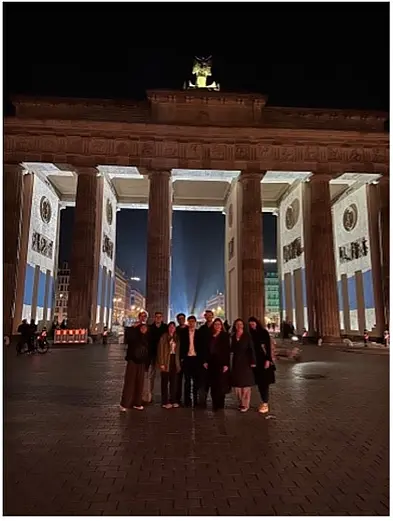
Who shapes the future of AI: those who power it, those who develop it, or those who regulate it? From October 7 to 9 2026, a group of law and computer science students and PhD candidates from the University of Tübingen followed the AI value chain through Berlin: from the energy supply for data centers, through platforms and software, to the applications that customers actually use, as well as the legal framework surrounding all of this. The excursion was part of “AI MEETS LAW”, organized and guided by Prof. Dr. Stefan Thomas, and all costs were generously covered by the Walter Sigle Foundation.
At Parloa, a Berlin-based company that develops agent-based AI for customer service, the participants not only got interesting insights into the company but also built their own AI voice agent. Along the way, they learned what matters most when developing such a system, from conversation design to security and safety. One insight stood out in particular: successful automation is not only about solving tickets, but about creating a positive customer experience.
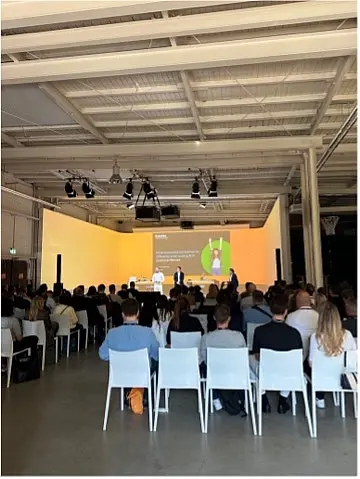
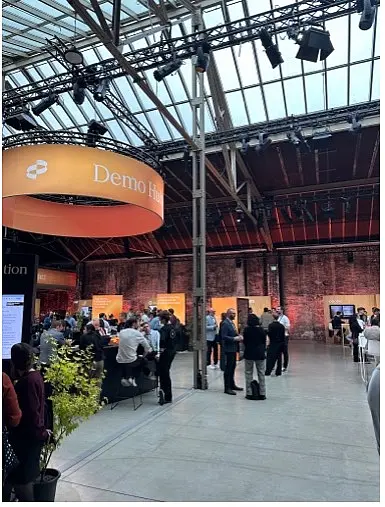
The group also attended THE WAVE conference, a gen AI venue hosted by Parloa. Keynote presentations included a talk on recent AI law developments by law professor Philipp Hacker and a presentation by Deloitte on what successful companies do differently when scaling AI in customer service. But there was much more to see: At several stations, Parloa explained how its AI agents work, and exhibitors and social events offered a first-hand impression of the vibrant AI deployment landscape.
At 50Hertz, the transmission system operator for northern and eastern Germany, the focus was on the energy supply behind the AI revolution. The group learned how AI is already supporting grid operations: The open-source tool ToOp is not an AI model itself, but rather a calculation engine that works with other models to optimize the grid topology and keep redispatch costs low. The central topic, however, was a legal one: the grid connection of data centers. Applications for grid connection are reaching record levels. A single application can account for about a quarter of Berlin’s demand and approval granted today means a connection in about ten years. Since the “first come, first served” principle has proven unsuitable, 50Hertz relies on a “first ready, first served” approach instead of an auction. The speakers emphasized that allocating scarce grid capacity is a normative decision and encouraged policymakers to have the courage to shape the rules. Much-discussed question, such as whether batteries are considered power plants under the KraftNAV, highlighted how closely energy law and AI are intertwined.
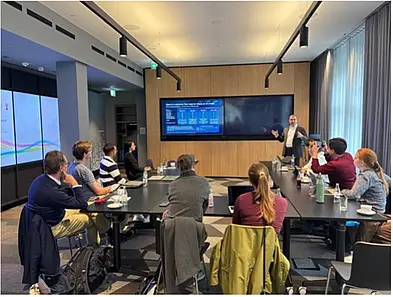
At Microsoft’s Policy Center, presentations and a live demo in Word illustrated how AI agents can review contracts based on clearly defined conditions, always with a human in the loop. A session on the AI economy discussed the impact on jobs and why using AI is not enough: organizations need to deploy it themselves, within the boundaries of their own tenant, rather than operating outside the guardrails. Rebekka Weiss, Head of Regulatory Policy, argued that regulation is still struggling to keep pace with rapid development of software, and that responsible AI remains the best approach in the long term.
The trip concluded at Bitkom with a short talk on the digitalization of civil court decisions: only about 1.3 percent of decisions of the regional courts are currently published, which limits both transparency and the development of legal AI. A fruitful exchange on further legal AI topics ensued.
Following the AI value chain from grid connection to customer interactions has shown the group how AI markets are shaped by questions of allocation and responsibility at every stage. Who gets access to scarce grid capacities that operators manage on behalf of society? Who is accountable for the answers provided by an AI agent? And who sets the rules for platforms that are evolving faster than any legislation? These are rarely technical questions alone, and they cannot be answered by technology itself. For aspiring lawyers, understanding the entire chain is essential for the ability to shape it.
Report: Louisa Gärtner