The human brain operates through countless electrical impulses: tiny sparks of energy that allow perception, interpretation, and decision-making. These impulses form the foundation of human consciousness and set Homo sapiens apart from other living beings. Yet, as technology advances, one might ask: does this distinction still hold?
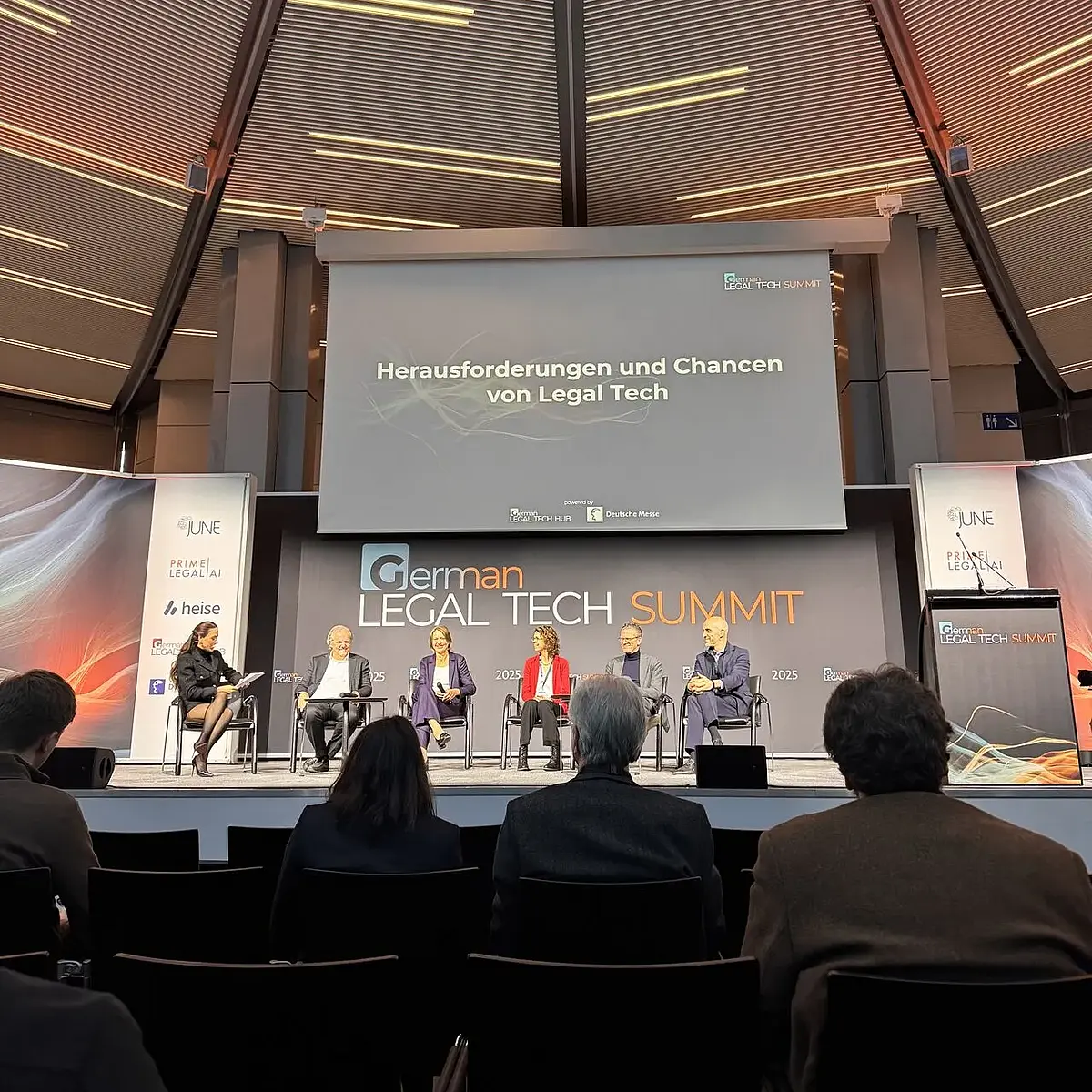
This question stood at the heart of Professor Harald Welzer’s opening keynote this December at the German Legal Tech Summit (GLTS) 2025 in Hannover. His remarks invited reflection on whether artificial intelligence, driven by algorithms and data rather than neurons and synapses, can ever approach the complexity of human thought.
Thanks to the support of the Walter Sigle Foundation, a team of law students from Tübingen participated in the summit, gaining valuable insights into the evolving dialogue between technology and law. They attended thought-provoking panel discussions on topics ranging from cryogenics and inheritance law to data protection and the risks of unauthorized AI use, particularly in the corporate sphere. Other sessions explored the integration of AI in judicial processes and the potential consequences for the rule of law.
Engaging with exhibitors, from dynamic startups to established companies, the participants discovered how innovation continues to redefine legal practice and professional responsibility.
The experience underscored one central insight: in a world increasingly dependent on algorithms and digital infrastructure, the ability to think critically about technology remains our most vital source of human power and it is our responsibility to use the electric impulses of our brain rather than the electricity coming from an outlet.
Text: Katharina Schell, Tanem Aydin & Kim Salmen