Biogeologie

Late Quaternary Hominin's ecology

In a nutshell

What does our research in this field focus on?
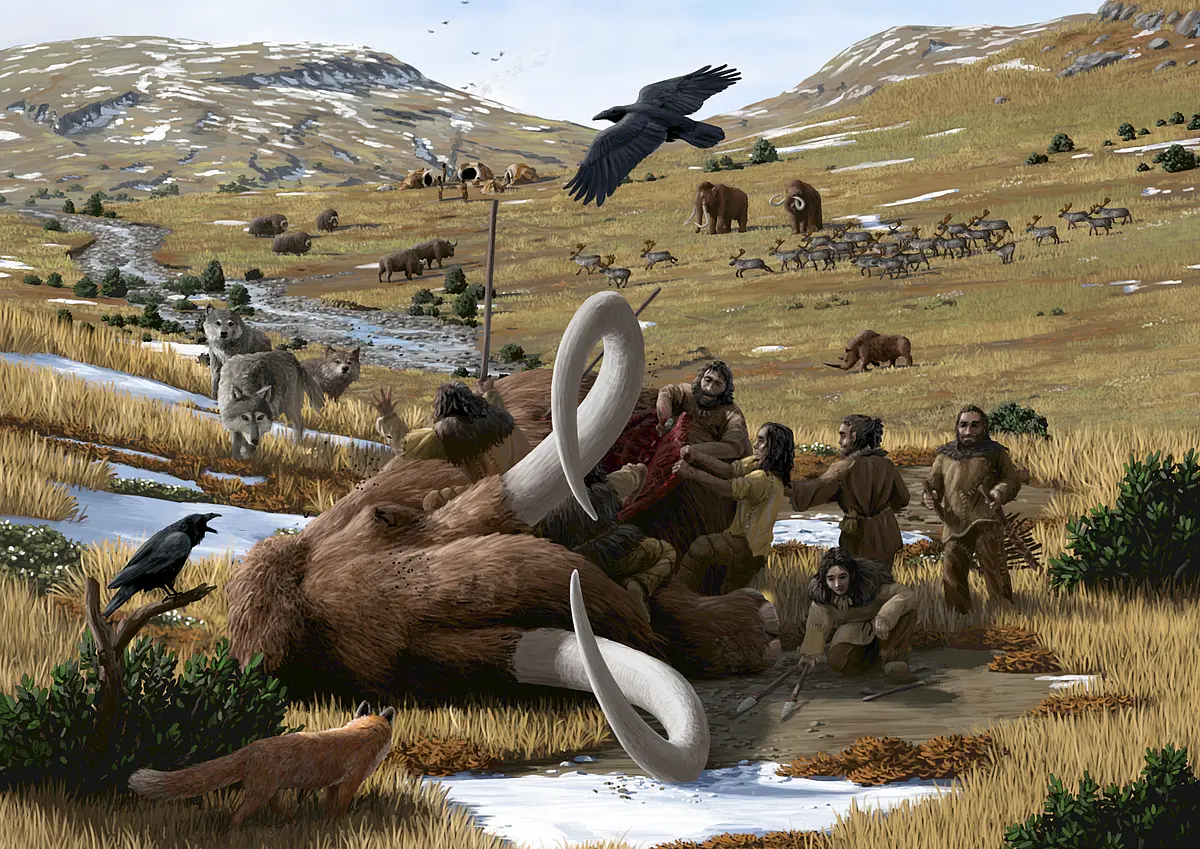
Our research focuses on the period from ca. 130,000 BP (Eemian Last Interglacial) to ca. 10,000 BP (Early Holocene period). We explore the interactions between Neanderthal and/or modern humans, fauna, environment, and climate. 

Which key methods or approaches do we commonly use?
Our research relies mainly on the analysis of bones and teeth (dentin and enamel) to investigate ecosystems and species interactions in the past. We apply stable isotope analysis of carbon and oxygen in tooth enamel (bioapatite), as well as carbon, nitrogen, and sulfur in bone and dentin (collagen). Additionally, we use compound-specific stable isotope analysis of carbon and nitrogen in amino acids to gain deeper insights into dietary and environmental dynamics.

What is our main contribution to this research field?
Our research contributes to understanding the drivers of megafauna extinction and the roles of different species in evolving ecosystem dynamics. We trace ecological niches and adaptation strategies of humans and animals during the Late Pleistocene and early Holocene, shedding light on their interactions with changing environments. Additionally, we explore anthropogenic impacts on ecosystems, such as the emergence of (paleo-)synanthropic behavior in small scavengers, and the early domestication of wolves.

Associated Projects

Finished projects

Core research team & scientific network

Biogeology research group

Scientific network

PhD, M.Sc. and B.Sc. students

Ongoing

Valentina García-Huidobro (PhD student)

Manhon Mouhat Bourquard (PhD student)

Jett M. Liska (M.sc. student)

Vladislav Lezzhov (M.Sc. Geowissenschaften):
Isotopic tracking of Late Pleistocene carnivore diet in Geographical Society Cave (Far East Russia). (H. Bocherens, D. Drucker)

2025

Nathanael Drüeke (M.Sc. ASHE): 
Isotopic spacing in bone and dentin of mammoth. (D. Drucker, S. Greif)

2024

Mahym Amanova (International M.Sc. in Quaternary and Prehistory (IMQP)– ERASMUS +, Instituto Politécnico de Tomar, Portugal , Università degli Studi di Ferrara, Italy): 
Isotopic insight into the ecology of the red deer from Riparo Tagliente (Italian pre-Alps) during the Late Epigravettian. (D. Drucker, F. Fontana)

Freya Riedel (M.Sc. Naturwissenschaftliches Archäologie): 
Morphological and isotopic analysis of five Roman-time equids from Heddesheim. (D. Drucker, B. Starkovitch & N. Conard)

2023

Theoni Panagiotopoulou (M.Sc. Naturwissenschaftliches Archäologie): 
Magdalenian environments and ecosystems: The case of Gnirshöhle. (S. Greiff, C. Baumann) < see joint published article >

2021

Ruth Rey (M.Sc. Naturwissenschaftliches Archäologie): 
Deciphering biogenic and diagenetic isotopic signals of Pleistocene proboscideans. (H. Bocherens, C. Miller)

2020

Dr. Chris Baumann (PhD, Archaeological Science):
Crazy like a fox? How the study of archaeological fox remains can help to understand human behavior in the Late Pleistocene of the Swabian Jura (Germany). (N. Conard, H. Bocherens)

Mauricio Marciales Daza (M.Sc. Naturwissenschaftliches Archäologie): 
Diet Reconstruction through Carbon and Nitrogen Stable Isotope Analysis: the Bronze Age Population at the Biniadris Cave (Menorca, Spain). (M. Diaz-Zorita Bonilla, C Spiteri)

Jorge Meza Paggi (M.Sc. Naturwissenschaftliches Archäologie): 
Oxygen Isotope Variability among Modern Fauna from the Lower Guadalquivir Valley, Spain: Implications for Achaeological Applications in Mediterranean. (M. Diaz-Zorita Bonilla, C Spiteri)


See all current and past PhD students and B.sc./M.sc. students.

Recent publications

  • Abrams, G., Auguste, P., Di Modica, K., Pirson, S., Pironneau, C., Dedrie, T., Meloro, C., De Groote, I., Fischer, V., Bocherens, H., Banbrabant, Y., Bray, F., 2025. Earliest Evidence of Neanderthal Multi-functional Bone Tool Production from Cave Lion (Panthera spelaea) Remains. Scientific Reports 15: 24010. https://doi.org/10.1038/s41598-025-08588
  • Baumann, C., Kandel, A.W., Hussain, S.T., 2025. Evidence for the catalytic role of humans in the assembly and evolution of European Late Pleistocene scavenger guild. Quaternary Science Reviews 349: 109148. https://doi.org/10.1016/j.quascirev.2024.109148
  • Bocherens, H., Kirillova, I.V., 2025. Cave lion: Isotopes and dietary paleoecology. Earth History and Biodiversity 3: 100015. https://doi.org/10.1016/j.hisbio.2024.100015  
  • Merkens, L., Anders, T., Traylor, W., Bocherens, H., Hickler, T., 2025. A simple climate-driven semi-mechanistic vegetation model can explain the pan-Asian extent of the glacial mammoth steppe. Palaeogeography Palaeoclimatology Palaeoecology 670: 112962. https://doi.org/10.1016/j.palaeo.2025.112962  
  • Panagiotopoulou, T., McCartin, M.J., Münzel, S.C., Drucker, D.G., Starkovich, B.M., Brown, S., Tafelmaier, Y., Baumann. C., 2025. Magdalenian environments and ecosystems of the norther Alpine foreland: the case of Gnirshöhle and Petersfels. Archaeological and Anthropological Sciences, 17: 125. https://doi.org/10.1007/s12520-025-02230-6
  • Shaikh, S., Bocherens, H., Suraprasit. K. 2025. Stable isotope ecology of Quaternary cervid and bovid species in Southeast Asia with implications for wildlife conservation. Scientific Reports 15 : 3939.  https://doi.org/10.1038/s41598-025-88065-6
  • Suraprasit, K., Yamee, C., Chaimanee, Y., Jaeger, J.-J., Bocherens, H.,2025. The Pleistocene grassland-dominated mammal fauna from Tham Kra Duk (Nakhon Si Thammarat, Peninsular Thailand). Historical Biology 37(1): 7-19. https://doi.org/10.1080/08912963.2023.2283936 read fulltext at: https://www.tandfonline.com/eprint/GMGDMQSSUHRVYVG9BTUV/full?target=10.1080/08912963.2023.2283936 

Public Outreach
