

News
06.11.2025
MAPIR Keynote at Tübingen: Peacetiming for Future Deterrence
The MAPIR – Master of Arts in Peace Research and International Relations keynote took place on 5 November 2025, featuring Prof. Maria Mälksoo from the University of Copenhagen
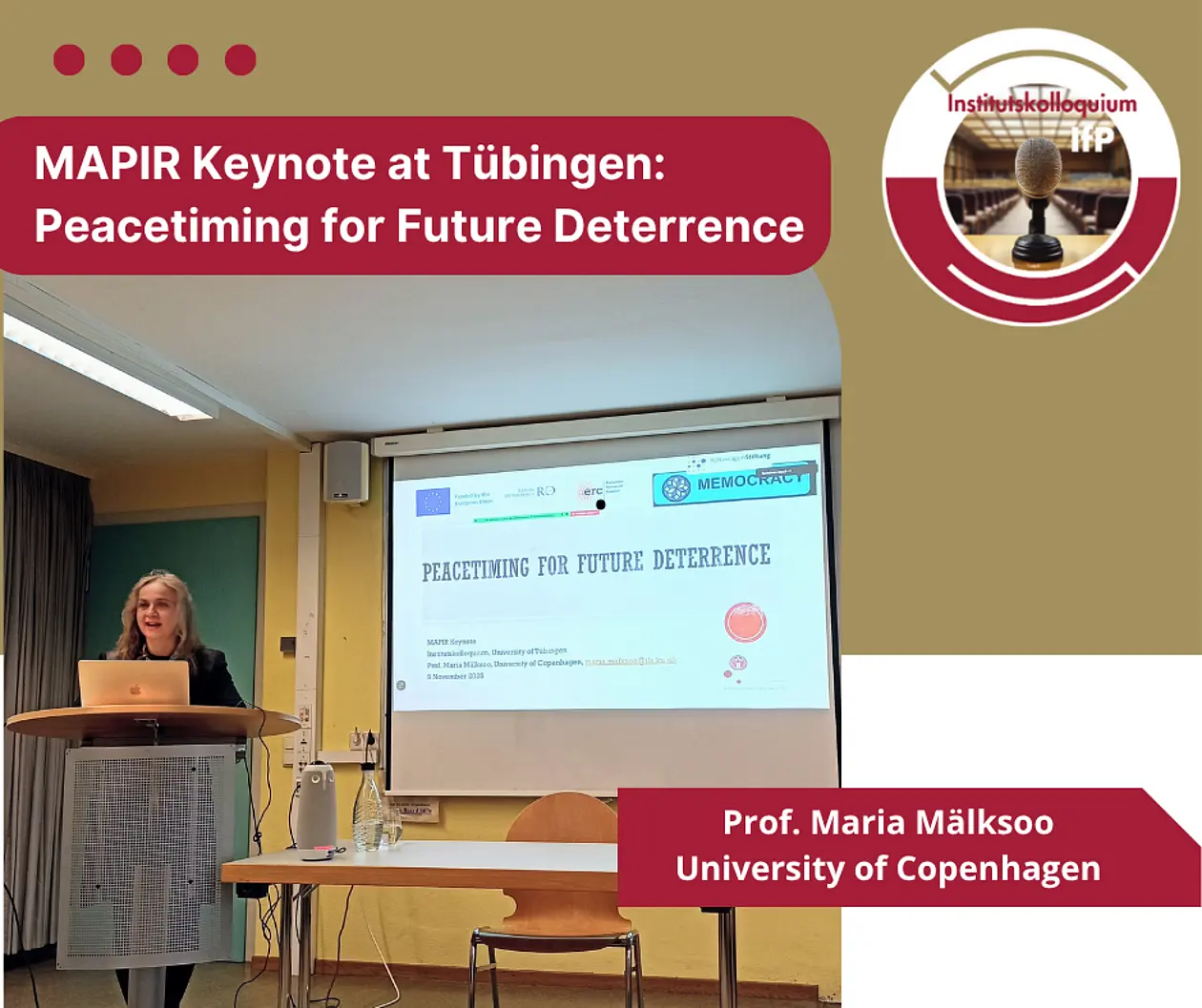
On Wednesday, 5 November 2025, Professor Dr. Maria Mälksoo from the University of Copenhagen delivered the annual MAPIR keynote at the Institute of Political Science of the University of Tübingen, as part of the Departmental Seminar series (Institutskolloquium IfP). The event brought together around 40 participants in person, with many more joining online via Zoom, reflecting strong interest in contemporary peace research and international relations. The session began with a welcome from Prof. Dr. Gabriele Abels, director of the Institute, who introduced the keynote speaker.
In her talk, titled “Peacetiming for Future Deterrence”, Mälksoo explored how the War in Ukraine signals the end of the current world order and generates competing visions for the post-war order, turning peace itself into a battlefield over defining the future world order. Perspectives on the timing and terms of peace—from the United States to Europe and the so-called Global South—reflect divergent political designs, each presenting different versions of deterrence and coexistence with Russia.
Mälksoo outlined three visions of peace:
- Minimalist peace—emphasizing an immediate cessation of hostilities without insisting on Ukraine’s victory, advocating for “peace as soon as possible,” exemplified by initiatives such as former US President Trump’s plan or the Chinese-Brazilian “Friends of Peace” proposal.
- Strategic defeat and accountability—aiming for Russia’s long-term defeat and accountability, represented by NATO and most Western European governments (“as long as it takes”).
- Maximalist vision—advocating for Ukrainian victory and justice, championed by Central and Eastern European states, without a defined timeline.
Each vision, Mälksoo argued, corresponds to a distinct post-war deterrence strategy, ranging from renewed coexistence with Russia to its long-term containment.
The keynote further distinguished two storylines shaping the current “peacetiming”:
- Peace through future deterrence—Western responses often delay effective deterrence by issuing strong statements while taking limited action in the present, creating a symbolic assurance of future peace (“deterrence by denial”).
- Accountability as deterrence—aiming to break the cycle of imitative violence through prosecuting Russian aggression, thereby generating general deterrence (“deterrence by punishment”).
Mälksoo concluded that achieving peace in Ukraine is as much about ending the war as about determining how future deterrence and the post-war world order will be envisioned and institutionalized.
Share


