

News
29.07.2025
New Publication by Prof. Dr. Gabriele Abels on gender representation in the European Parliament
IfP Professor Abels analyzes the impact of the 2024 elections on gender balance among MEPs
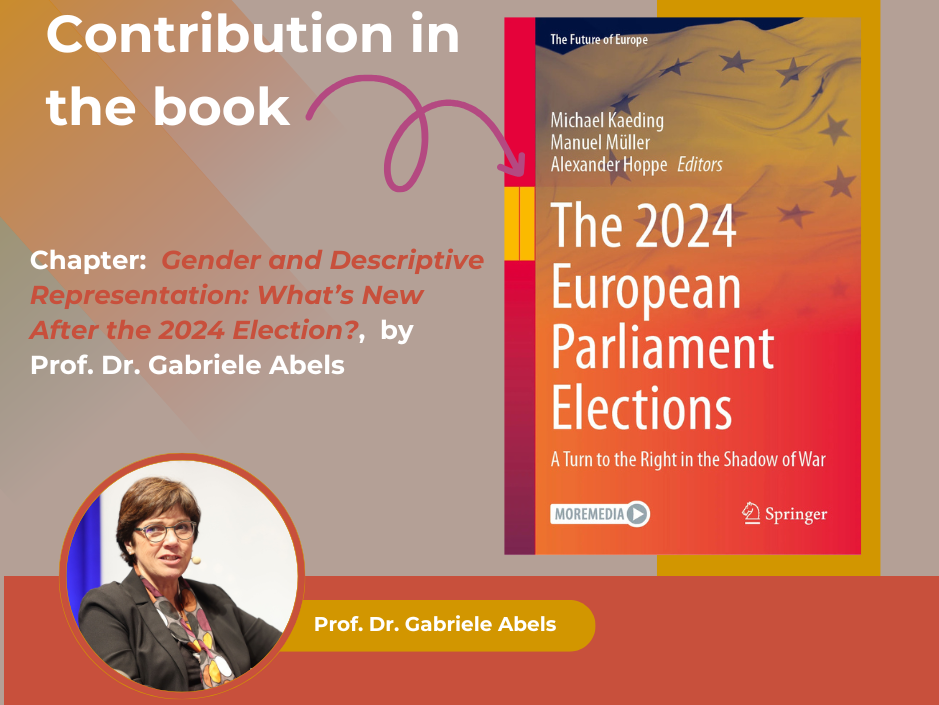
Prof. Dr. Gabriele Abels, Chair of Comparative Politics and European Integration at the Institute of Political Science (IfP), University of Tübingen, has contributed a chapter to the recently published volume The 2024 European Parliament Elections: A Turn to the Right in the Shadow of War (Springer, 2025). The book, edited by Michael Kaeding, Alex Hoppe, and Manuel Müller, explores the results of the 2024 European elections from various political and social perspectives.
In her chapter titled Gender and Descriptive Representation: What’s New After the 2024 Election?, Prof. Abels examines both progress and setbacks in gender representation in the European Parliament following the 2024 elections. Drawing on up-to-date data and a critical analysis of institutional and party mechanisms, she identifies important dynamics among Member States, evaluates the impact of gender quotas, and discusses the implications of these developments for the democratic legitimacy of the European Union.
The publication is available on the Springer website via the following link:
https://link.springer.com/chapter/10.1007/978-3-031-89455-8_23
Abstract of the chapter
Gender and Descriptive Representation: What’s New After the 2024 Election?
The European Parliament is widely assumed to be a frontrunner for gender equality, due to it traditionally having more female members than those in the national parliaments of its member states. This chapter investigates descriptive representation in the new European Parliament (EP) which for the first-time ever has seen a shrinking number of female MEPs (Members of the European Parliament). The decline is linked to the losses of centre-left parties in the elections and the rise of populist, right-wing parties (Green-Alternative-Liberal-Traditional-Authoritarian-Nationalist (GAL-TAN) cleavage), and because of an increasing fragmentation in national party systems and the high number of small and mini-parties. The chapter also illustrates that the number of women in intra-EP leadership has declined, for instance in committees, even if the number of “women pockets” has decreased. This development will most likely also have policy implications.
More information here!
About the book
The 2024 European Parliament Elections
Released shortly after the 2024 European Parliament elections, this book gathers contributions that analyze the elections from various perspectives. The main objective is to offer a timely assessment of different facets such as electoral systems, electoral campaigns, the public perception of the elections, the role of European parties, determinants of voting behavior, and the consequences of the electoral results for European governance. In addition to analyses from European studies, perspectives from other (sub)disciplines and research areas, such as election, party, communication and governance research, are featured in the volume. The authors, which consist of accomplished academics and civil society actors, present a highly diverse range of analyses, individually very rich and based on solid original research. Taken together, their contributions offer the reader a comprehensive understanding of the issues, parties, and mechanisms behind the European elections of 2024.