

Research Summary
Project (1): Role of cardio-vascular cGMP signaling for the cellular adaption to patho-/physiological stress
PI: Robert Lukowski, Co-PI: Julia Straubinger
Co- worker: Natalie Zinn, Michael Glaser, Sandra Frey, Nadine Rieth, Melanie Cruz-Santos
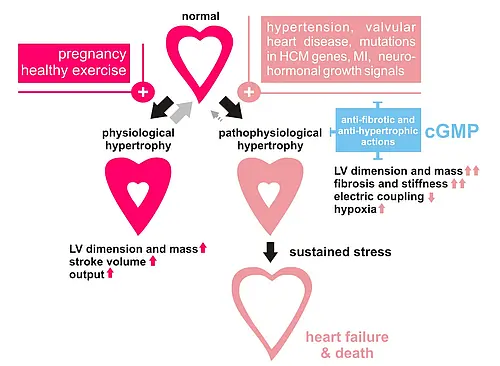
Cardiac hypertrophy is an adaptive response of the heart to physical exercise in e.g. trained athletes, or can result from stress factors such as chronically elevated blood pressure, myocardial infarction, and/or aortic valve disease. Stress-induced hypertrophy refers to an increase in the size of the heart muscle (myocardium), which, over time, contributes to the progression of pathophysiological myocyte hypoxia, chamber fibrosis, diastolic stiffness, reduced electric coupling eventually leading to heart failure. The second messenger cyclic GMP (cGMP) has emerged as an important signaling molecule in the heart since it affects the maladaptive stress-response mechanisms. cGMP is generated by nitric oxide (NO) stimulated soluble guanylyl cyclase (sGC) and by particulate guanylyl cyclases (pGCs) that couple to the natriuretic peptides (NPs). Clinical studies and functional analysis of genetic modified mice have established that NPs and cardiac pGCs diminish the development of pressure or volume induced heart hypertrophy and fibrosis. The available evidences including the inhibition of cGMP hydrolysis by phosphodiesterase 5 (PDE-5) using sildenafil suggest that cardiac cGMP signals through its downstream effector cGMP-dependent portein kinase type I (cGKI). The focus of our current research will be the use of new and better mouse models to study the molecular role of endogenous cGKI, PDE5/cGMP and potential effectors downstream for cardiac hypertrophy, fibrosis and dysfunction.
Project (2): BK channels as targets of cGMP signalling in myocardial pre- and postconditioning and survival
PI: Robert Lukowski, Co-PI: Peter Ruth
Co- worker: Anna Kuret, Sandra Frey, Nadine Rieth, N. N.
The role of the NO/cGMP/cGMP-dependent kinase I pathway in myocardial protection and pre-/postconditioning has been intensively investigated. Drugs that block the activity of cGMP-degrading enzymes such as the phosphodiesterase-5 inhibitor sildenafil have a pre-conditioning-like effect on survival of cardiomyocytes after ischemia/reperfusion (I/R) injury and are reducing infarction area. In cardiac myocytes, accumulation of cGMP leads to several protective events including stimulation of mitochondrial ATP-dependent potassium channels at the inner mitochondrial membrane (IMM). To investigate the role of mitoBK and cGMP signalling in cardiac cells in vivo, we aim to study BK-/- mice with a global deletion in addition to mice with cardiomyocyte-specific inactivation of BK. The protection against I/R injury will be tested by ischemic pre- and postconditioning, ligands of particulate guanylyl cyclase receptors, NO-stimulated guanylyl cyclases, and compounds that directly modulate BK activity. In order to assess the final extent of infarct size and survival, outcome in BK mutant mice will be followed on the long-term upon occlusion and reperfusion of the left coronary artery. Analyses of cGMP pools at I/R and effects of cGMP on functional characteristics of mitochondria isolated from cardiomyocytes of gene-targeted BK mouse mutants together with approaches to reveal electro-pharmacological properties of mitoBK will corroborate these in vivo approaches, and will finally improve our understanding of cardiac cGMP signalling and K+ channels at the IMM.
Project (3): Signaling dynamics of Ca2+-activated K+ channel complexes in health and disease
PI: Robert Lukowski
Co-worker: Lucas Matt, Sabrina Kempf, Clement Kabagema-Bilan, Sandra Frey
It has been widely recognized that the Ca2+-activated K+ channel (KCa) of big (BK, Slo1, MaxiK+) and intermediate (IK, KCa3.1) are involved in neuronal-, cardio-vascular, metabolic and immune functions and dysfunctions. In human diseases, changes in expression levels, altered configurations of the KCa ion channel complexes and their activity have been identified, indicating that they represent promising targets for future drug therapies of hypertension, obesity, autoimmune diseases and cancer. Our available gene-targeted KCa mouse models are insufficient to fully explore the cellular mechanisms by which IK, BK and their respective partner proteins affect the pathophysiology of these disorders. Since the role of ion channels critically depend on their integration into protein complexes, a comprehensive approach towards the identification of cell specific KCa signalling complexes in native tissues at the patho-/physiological level would be desired. Hence, novel strategies and tools are needed for future studies. Herein, we aim to establish a highly versatile system, which is based on a combination of state-of-the-art BAC transgenesis, small protein anchors and our previously introduced KCa-deficient mouse lines. The BAC-driven expression of un-/modified channels will permit a highly cell type specific reconstitution of the KCa proteins on a BK- or IK-negative mouse background. Using this strategy it is one aim of this project to rescue given disorders of the mutant mouse lines, which closely resemble specific aspects of the related human diseases. At the same time, the attached Strep/FLAG tandem affinity purification (SF-TAP) epitope will allow an efficient enrichment and the rapid isolation of high-purity channel complexes for the proteomic analyses by LC-MS/MS. Together, these studies should uncover the cell-context specific signalling networks defined by the BK and IK, the dynamic changes of their interactomes, and post-translation modifications of the channels providing important clues about their role in biology and pathophysiology.
Project (4): Ca2+-activated K+ channels as predictive factors for breast cancer risk and treatment outcome: From pre-clinical models to human disease
PIs: Peter Ruth, Hiltrud Brauch, Werner Schroth, Robert Lukowski
Co-worker: Corinna Mohr, Dominic Gross, Alice Dragoi
(in preparation)
Project (5): Role of Slack channels for neuronal- and cardial cell protection
PIs: Robert Lukowski and Peter Ruth
Co-worker: Rebekka Dieter, Nadine Rieth, Clement Kabagema-Bilan, N.N.
(in preparation)
Project (6): Slack and BK channels in hippocampal learning tasks
PIs: Lucas Matt, Peter Ruth and Robert Lukowski
Co-worker: Thomas Pham, Sabrina Kempf, N.N.
(in preparation)