Philologisches Seminar

Catalogus versionum latinarum (CVlat)

Catalogue of Early Modern Translations into Latin


In the context of our research project, we continuously collect early modern translations of fictional, historiographic texts and those pertaining to the field of humanities in the broadest sense, into Latin from 1450 to 1850. We aim to provide them in the future as a database: Catalogus versionum latinarum (CVlat).

Our research journey has far from ended. Nonetheless, we already want to give you access to a very preliminary version of the CVlat as excel spreadsheet (05/16/2025). Currently, the catalog comprises more than 1100 translations into Latin.

Shortly we will provide an updated and extended version of the catalogue, which contains not only fictional, but also non-fictional texts. In the future, all new entries will be sorted into broad categories of themes and genres to ensure searches for fictional and non-fictional texts. Those categories will be attributed in a separate column (Siglenspalte). Moreover, the new version will provide, alongside the Catalogus itself, integrated additional sheets with “Instructions for use” (Benutzungshinweise), “Research literature” (Forschungsliteratur), and “Contributors” (Beitragende Personen). Herein, users will find information on the abbreviations and citations used. Since we also used research literature to produce entries, we give a short-form reference (Author Year) in the commentary column (Kommentar). The detailed information on all publications cited will be provided in the sheet “Research literature”. And last but not least, we are indebted and grateful to all our excellent colleagues who have supported us with their pointers to or sometimes lists of translations into Latin. They can also be found within the CVlat, first named as contributors in the catalogue itself, and secondly, with more information on the sheet “Contributors”.

If you have any questions regarding the collected data or can provide information on any translation into Latin that is not yet included in our catalog, please contact Julia Heideklang via email.


Catalogues and Databases for Translations into Latin

Our CVlat builds upon many previous works of pioneers and the cataloging initiatives of preceding decades. Subsequently, we present an overview of catalogs and databases, which also provide entries of translations into Latin or even allow the targeted search for those translations. 

This section of our website is still under development. Therefore, not all catalogs or databases have been included yet. 

Gallica and the Catalogue général of France's National Library

As one of the largest and most comprehensive digital libraries, the French National Library offers a broad repertoire of early modern prints, for which two essential tools are available: Gallica, la bibliothèque numérique de la BnF et de ses partenaires, and the Catalogue général. Both catalogues allow for extended search options. Particular mention should be made of the search function in the Catalogue général, which allows users to specify both the source language and the target language, enabling them to search specifically for translations.

Gallica: https://gallica.bnf.fr/accueil/fr/html/accueil-fr

Catalogue général: https://catalogue.bnf.fr/index.do

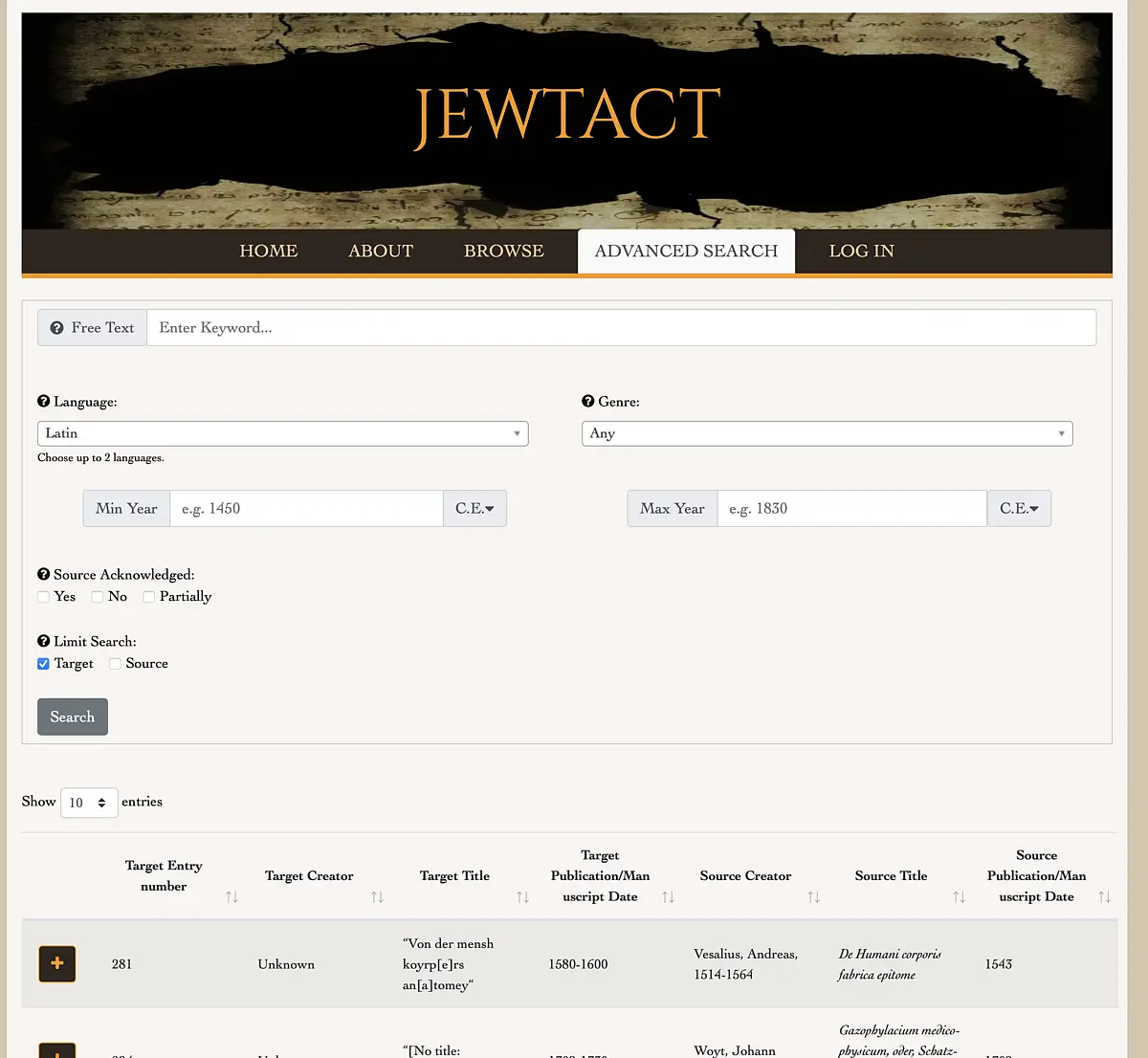
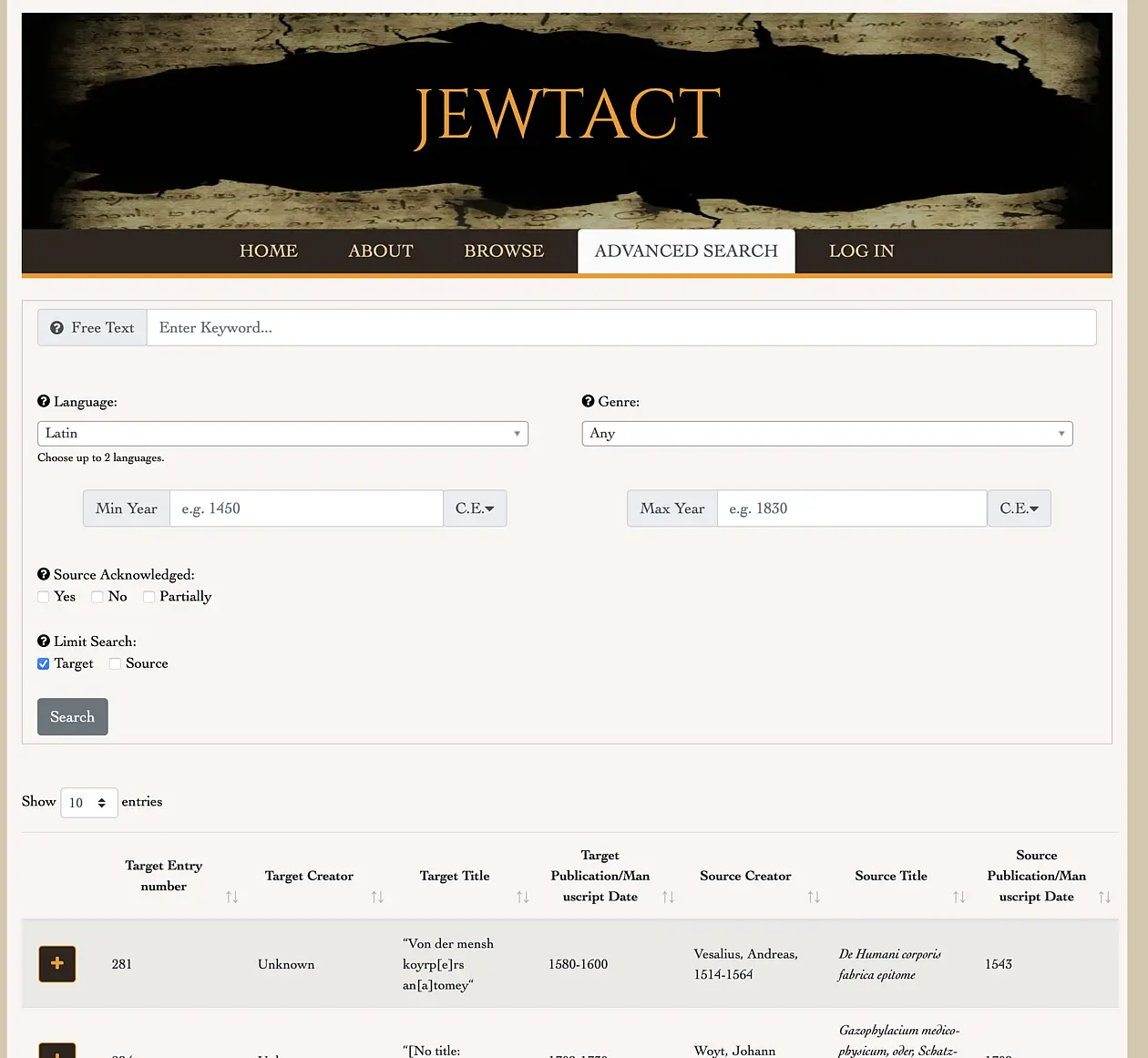
JEWTACT Database

This database has been brought forth from the ERC project “Jewish Translation and Cultural Transfer in Early Modern Europe” and collects all translations from European vernaculars into Jewish languages (Hebrew, Yiddish, Ladino, and Judaeo-Italian), printed between 1450 and 1830.

JEWTACT Database: https://aranne5.bgu.ac.il/jtact/index.php

Recommended citation: Online Database of Jewish Translations and Cultural Transfer in Early Modern Europe (JEWTACT). https://aranne5.bgu.ac.il/jtact/index.php . (access date).

noscemus

The noscemus database collects early modern Latin scientific texts and allows its users insights into Latin as scientific language in the early modern era. This database resulted from the collective work within ERC Project “Nova Scientia: Early Modern Scientific Literature and Latin” (ended in 2023, now at Universität Innsbruck, previously at the Ludwig Boltzmann Institute for Neo-Latin Studies). Via ‘semantic drilldown’, translations can be explicitly searched. Currently, it contains 88 translations.

noscemus: https://wiki.uibk.ac.at/noscemus/Main_Page

Renaissance Cultural Crossroads Catalogue (RCCC)

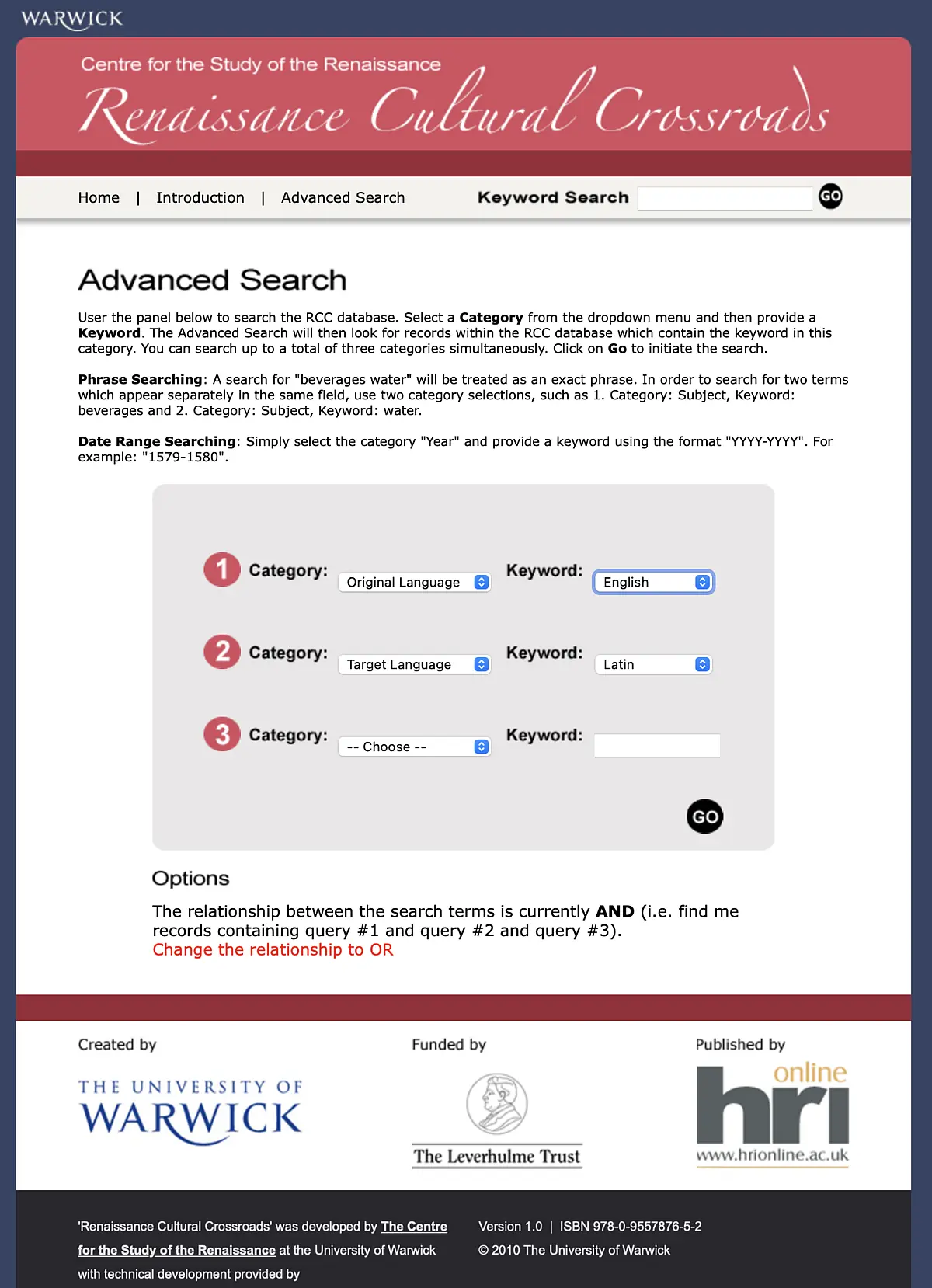
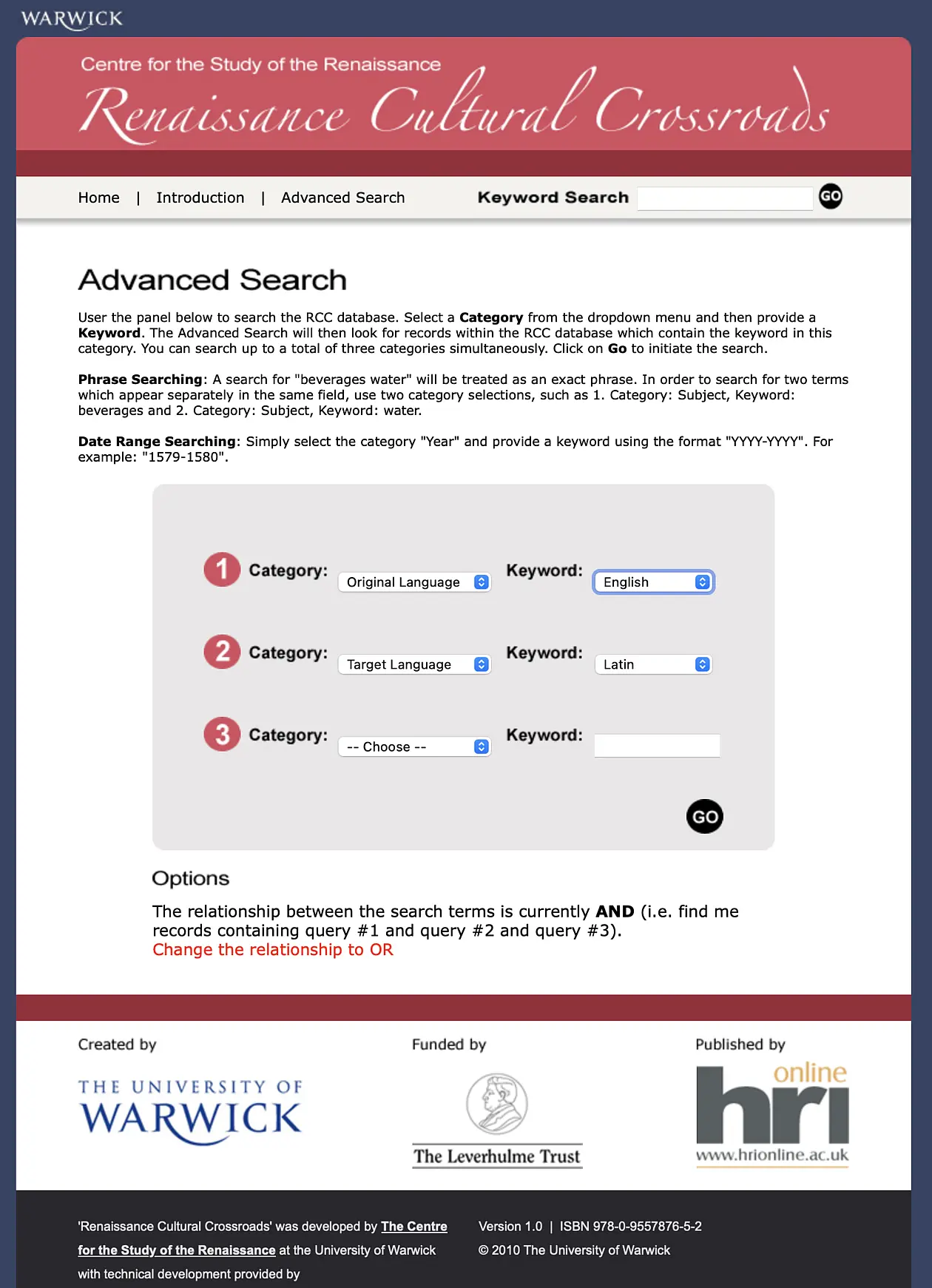
An essential pioneering project in cataloging early modern printed translations is the Renaissance Cultural Crossroads Catalog, which collects all those translations printed in the British Isles between 1473 and 1640. The approach and criteria for the collected translations are explained in the “Introduction” for users of this database. Through the extended search function, the source and target languages can be selected separately.

RCCC: https://www.dhi.ac.uk/rcc/

Recommended citation: Hosington, Brenda et al., Renaissance Cultural Crossroads <https://dhi.ac.uk>, ISBN 978-0-9557876-5-2 (access date).

Cultural Crosscurrents Catalogue of Translations in Stuart and Commonwealth Britain (1641-1660)

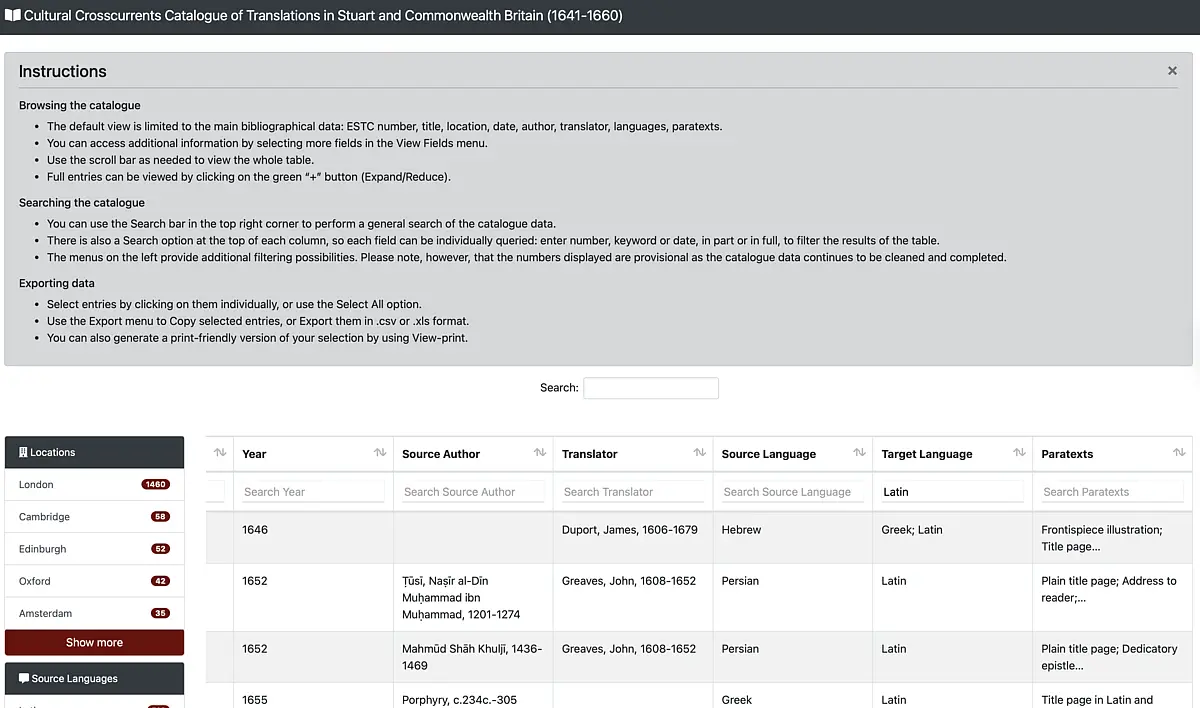
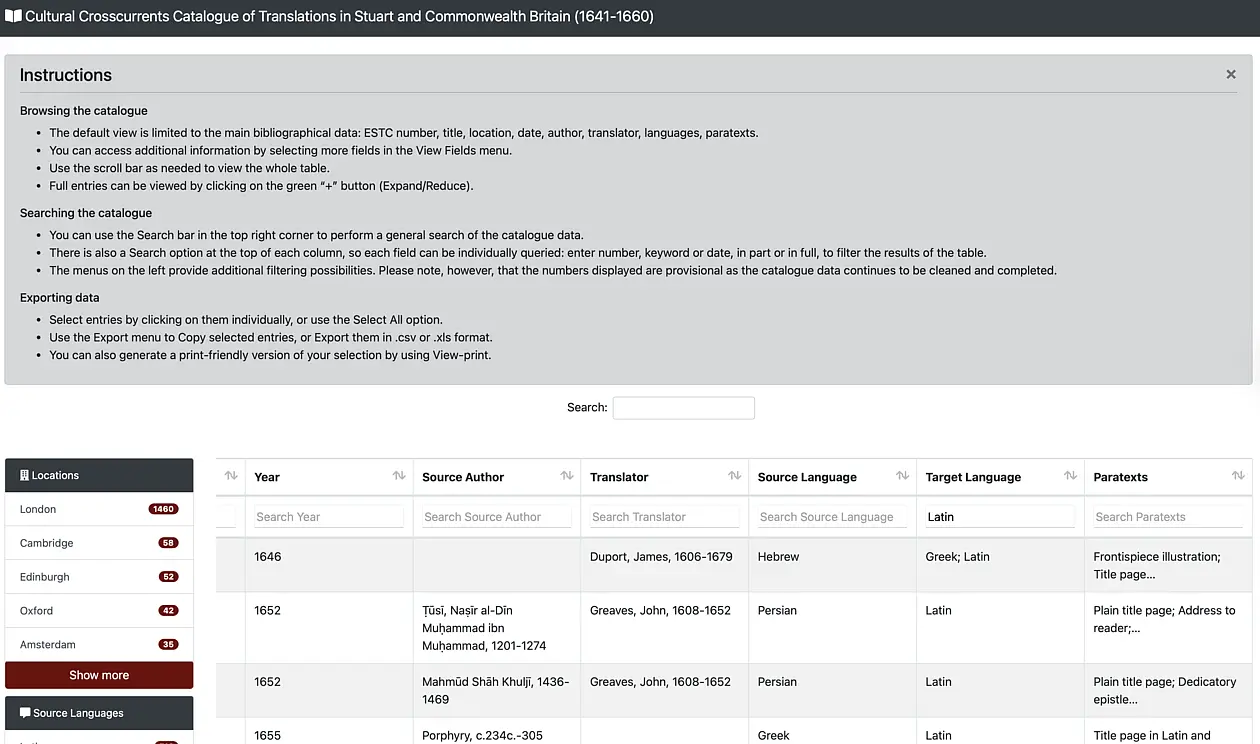
Against the alphabetical order, this database follows directly as the continuation of the above-mentioned RCCC. It collects all the translations printed between 1641 and 1660. Once more, an adaptable search of all collected data is enabled, and again, as demonstrated in the screenshot, source and target languages can be selected. For Latin, 143 entries are listed. All data can be downloaded in different formats as well, such as Excel or CSV.

CCC: Cultural Crosscurrents Catalogue of Translations in Stuart and Commonwealth Britain (1641-1660)

The CCC has been developed at the Université de Montréal under Marie-Alice Belle and Brenda M. Hosington. Its data basis is presented here:

Marie Alice Belle, Brenda Hosington, Olga Stepanova, Faustine Richalet, Daniel Lévy, Marie-France Guénette, Laurence Marion-Pariseau, Josephine Bywaters, (2025), "CCC catalogue dataset - Printed Translations in Britain 1641-1660", HSSCommons: (DOI: 10.25547/2H8F-P835).