Zellbiologie

The MSc CIB is a two year program with a total 120 CP (= Credit Points according to the ECTS), i.e. 30 CP per semester. 90 CP are awarded for courses, 30 CP for the thesis. Most modules are graded and will contributed to the overall grade of your master degree; the exception are Elective Modules and courses for the Interdisciplinary Module: these module/courses are either not graded or their grades will not be included.

The graph above shows a typical course of study. Whereas the courses of the 1st and partially the 2nd semester are fixed, students choose - according to their interests - the topics of the Advanced Elective Modules, the Transdisciplinary Study Area, the Research Modules 1+2, and of the master thesis. Thus, depending on the selected courses, the specific course organisation might look differently for each student.

In consultation with the coordinators of the MSc CIB program, students can organise external internships, national and international, as well as internships in a company.

All modules are summarised below. The module handbook specifies content, teaching methods, prerequisites, and examination procedures for each module. The examination rules contain detailed information about the calculation of the final grade of the master degree.

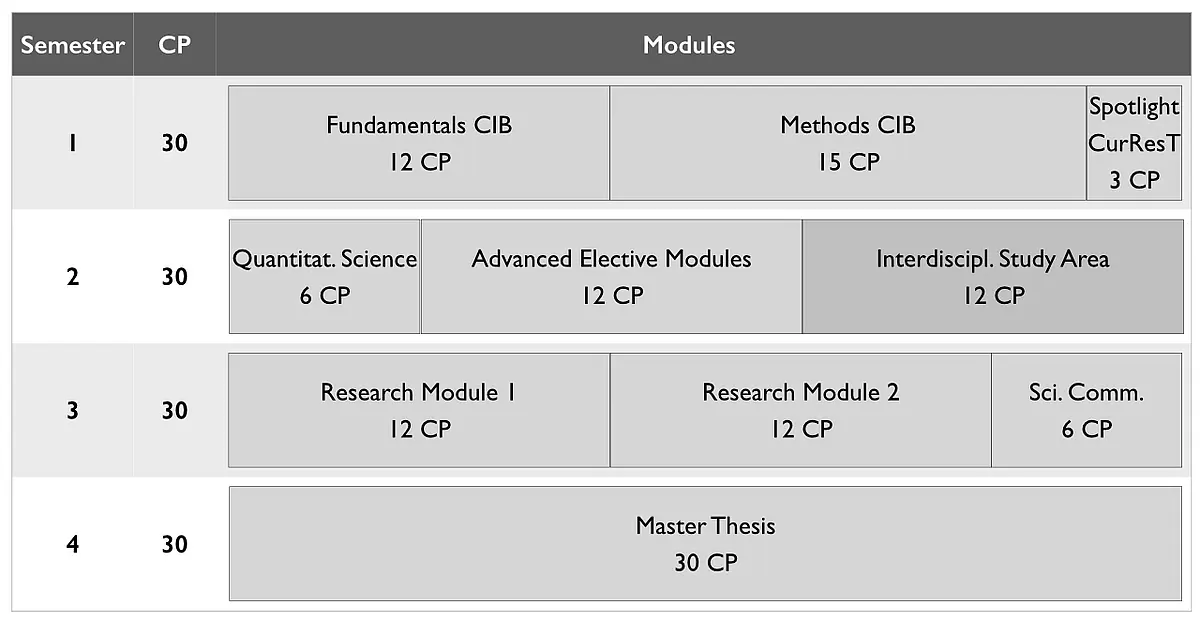
Overview of the four semesters of MSc CIB

Semester 1 of MSc CIB

During the first semester of the MSc CIB, you delve into the theoretical background of the molecular processes that regulate the behaviour of cells during normal development and homeostasis as well as how these processes are modified during disease and infection (module Fundamentals of Cellular and Immunological Biosciences). You will learn the theoretical knowledge of techniques that enable you to investigate these processes and have hands-on experiences on a broad selection of theses techniques (module Methods in Cellular and Immunological Biosciences: this module teaches many different molecular biology techniques using mostly plants as model systems; similar techniques are applicable to other model systems). In the module Spotlights on Current Research Topics, you gain insights into ongoing research projects conducted in different labs associated with the MSc CIB. These labs are part of the University Tübingen and of associated research institutes, e.g. the Max-Planck-Insitute for Biology Tübingen and the Friederich-Miescher-Laboratorium.

Semester 2 of MSc CIB

During the second semester, you learn quantitative techniques used in molecular biology (module Quantitative and Computational Biology) and begin to explore various areas of research that interest you (Advanced Elective Module). From courses offered in the Advanced Elective Module, you will choose courses of your choice totalling 12 CPs, which will be assigned to the Advanced Elective Module. You can take additional courses from the Advanced Elective Module and assign the respective CPs to the Interdisciplinary Study Area. Alternatively, you can assign CPs to the Interdisciplinary Study Area that you have earned from courses at the University of Tübingen outside the MSc CIB program, e.g. courses from the Faculty of Medicine, courses from the Transdisciplinary Course Program or languages courses.

Semester 3 of MSc CIB

During the third semester of MSc CIB, you are getting ready for the master thesis. You delve deeper into specific research topics during two longer individual lab internships (Research Module 1 and Research Module 2). In addition, you learn different techniques of science communication, from preparing scientific posters to scientific writing (Scientific Communication).

Semester 4 of MSc CIB

In the last semester of the MSc CIB, you perform your master thesis. The master thesis enables you to demonstrate your abilities in addressing a scientific question experimentally and present the data and conclusions adequately.