

09.12.2025
ERC Consolidator Grants for Andreas Geiger and Tobias Hauser
Funding for projects on AI as an assistant for scientific innovation and personalized treatment approaches for obsessive-compulsive disorders
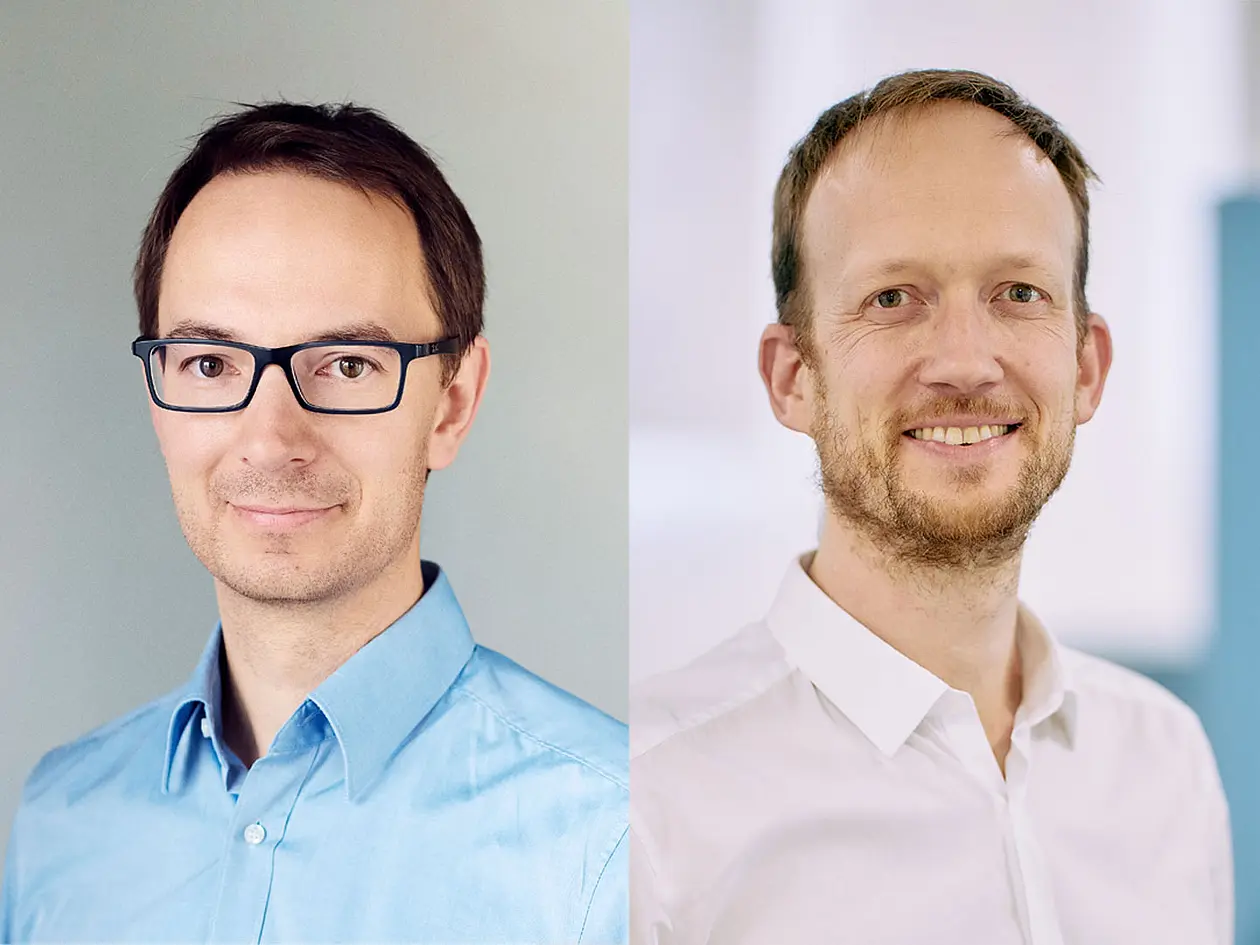
With Andreas Geiger and Tobias Hauser, two members of our cluster have been awarded Consolidator Grants from the European Research Council (ERC) in the current funding round. The awards come with generous project funding, usually of two million euros over a five-year period. In this funding round, the ERC approved 349 of the 3,121 applications submitted for Consolidator Grants across the EU - around 11 percent. A total of five Consolidator Grants have been awarded to the University of Tübingen. “Five applications from Tübingen have prevailed in the tough Europe-wide competition for Consolidator Grants - a remarkable success. These researchers have shown great inventiveness, with the potential for real innovation in medicine and machine learning,” said University President, Professor Dr. Dr. h.c. (Dōshisha) Karla Pollmann.
Andreas Geiger – Artificial intelligence as an assistant for scientific innovation
In his project, Computational Assistants for Scientific Discovery (CASIDO), Andreas Geiger aims to develop new methods in artificial intelligence (AI) that will support researchers in making new dis-coveries and accelerate the progress of their work. His project will receive two million euros over five years.
“In certain fields, such as biology, chemistry, and materials science, AI has already proven its great potential for developing solutions,” says Andreas Geiger. “I want to use AI as a kind of general re-search assistant.” Geiger points out that the output of scientific publications is growing rapidly; re-searchers have to sift through thousands of new publications every day to identify relevant develop-ments and understand complex relationships between subjects. “This flood of information over-whelms people. As a result, interesting connections in texts or patterns in databases are overlooked, opportunities are missed, and scientific innovation slows down,” Geiger says.
This is where his CASIDO project comes in: an AI assistant designed to support researchers in their daily work, for example, in reviewing and comparing research papers, identifying crucial gaps in re-search, and developing new and creative approaches. “We don't want AI that replaces researchers, but rather AI that expands their capabilities,” says Geiger. “Our vision is a new generation of intelli-gent tools that help researchers better organize the existing knowledge.” He adds that it is about co-operation between humans and AI - in which humans contribute their strengths of creativity, intuition, and critical thinking to the scientific discovery process.
Andreas Geiger's Consolidator Grant follows directly on from an ERC Starting Grant. Over the past five years, he has been working on the LEGO-3D project, developing models that enable machines such as autonomous vehicles to learn to perceive their surroundings in three dimensions.
Contact:
Professor Dr. Andreas Geiger
University of Tübingen – Department of Informatics
Excellence cluster: Machine Learning: New Perspectives for Science
Tübingen AI Center
a.geiger[at]uni-tuebingen.de
Tobias Hauser – Tackling obsessive-compulsive disorders with personalized treatment
Mental illness affects millions of people worldwide and is one of the greatest challenges facing our society today. Yet many approaches to treatment have remained largely unchanged for many years and rarely take into account how different the brains and symptoms of individual patients can be. A typical example is obsessive-compulsive disorder (OCD): it is widespread and can severely impair everyday life, but existing treatments do not work equally well for everyone.
Tobias Hauser, of Computational Psychiatry at the Faculty of Medicine and fellow of the German Center for Mental Health (DZPG) in Tübingen is seeking to change this with his new project, CoNbI-OCD (Computational Neuroscience-based Interventions for OCD). Under the Consolidator Grant, he will receive two million euros for his research over five years. Hauser says we need to fundamentally rethink the treatment of obsessive-compulsive disorders, and enlist the help of the latest findings from neuroscience and artificial intelligence (AI). The goal is to develop state-of-the-art, personalized treatments that combine classic psychotherapy with innovative technologies such as brain scans, computer models of thinking, and generative AI. This should make it possible to better understand what happens in the brain during obsessive thoughts and to offer individually tailored support.
“We are at a turning point in the treatment of mental illness,” says Hauser. “In the CoNbI-OCD pro-ject, we aim to use the findings from modern brain research and AI to finally offer those affected more effective therapies that are better tailored to their personal needs.” Through close collaboration with people who have personal experience of OCD, as well as with mental health professionals, CoNbI-OCD ensures that the new methods are practical, safe, and suitable for everyday use. The goal is to develop modern, more effective treatments tailored to individuals affected by for obses-sive-compulsive disorders.
Contact:
Professor Dr. Tobias Hauser
Tübingen University Hospitals
General Psychiatry and Psychotherapy Clinic
Developmental Computational Psychiatry Lab
tobias.hauser[at]uni-tuebingen.de
After a press release from the University of Tübingen.
Share


