The PRETINA joint project pursues two overarching goals. On the one hand, citizens are to be supported in exercising their fundamental right to informational self-determination when using eye-tracking technologies in computer games. On the other hand, developers should be enabled to assume their ethical, legal and social responsibility, to protect the privacy of users and to technically implement data protection.
Until a few years ago, eye tracking technologies were primarily tested in special application niches. However, technological advances, especially the miniaturization and improvement of camera sensor technology and algorithms for estimating the direction of gaze, have led to a rapid expansion of possible areas of application. Eye tracking is now used in a number of application areas, e.g. in the healthcare sector for the early detection of diseases (Sipatchin 2021), in the marketing sector to measure the efficiency of advertising measures (Wagner-Havlicek & Wimmer 2022) or in computer games for more intuitive human-computer interaction (Sareika 2005). In the field of consumer electronics in particular, development is progressing rapidly: eye tracking is already being used in everyday life and is therefore becoming more commonplace as a technology, e.g. integrated into HMDs such as the Apple Vision Pro.
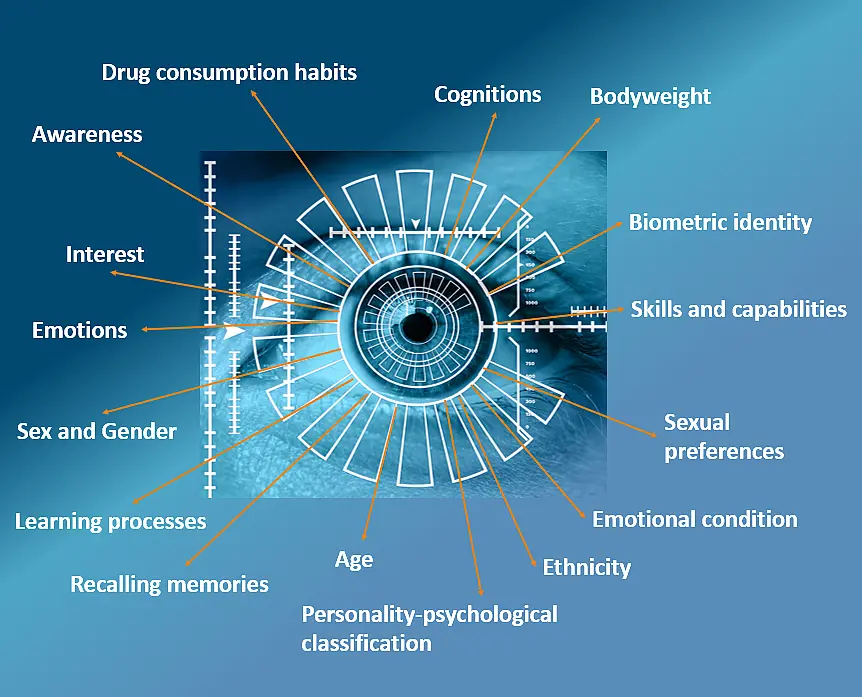
Not only the increasing availability and self-evidence of eye tracking, but above all the analytical possibilities of this technology harbor potential for far-reaching privacy violations (Kröger et al. 2020). Eye tracking can be used to draw conclusions about mental, physical and emotional states, ethnic affiliations and many other insights into the 'inner self' of the user. In critical areas of application, for example, this can give those responsible for processing the data an advantage in terms of power, or even increase it. Passing on such insights and combining them into comprehensive profiles can even be used to control the behavior of citizens.
Against this background, PRETINA:
1. support citizens in the use of eye-tracking technologies in the exercise of their fundamental right to informational self-determination.
2. help developers in their work to fulfill their ethical, legal and social responsibility, to protect the privacy of users and to implement data protection technically.
The application context of gaming is placed at the center of the research. Eye tracking is increasingly finding its way into the private entertainment sector by means of HMDs, among other things. Nevertheless, this is a field of application that has hardly been researched to date. At the same time, its use is characterized by its low threshold: apart from HMDs, which are purchased for entertainment purposes anyway, users do not need any other peripherals. Manufacturers and game developers can access the eye tracking technology built in as standard. Special data protection and privacy challenges result in particular from the merging and analysis of personal data from different sensors used in entertainment contexts (acceleration sensors, room detection, in-game activity detection, etc.). In addition, the investigation of the relationship between the self-determined purchase decision of such an HMD and the consent to eye tracking for entertainment purposes opens up important insights with regard to, for example, the self-determined use of technology, the perception of data protection risks as well as privacy calculus and privacy paradox.
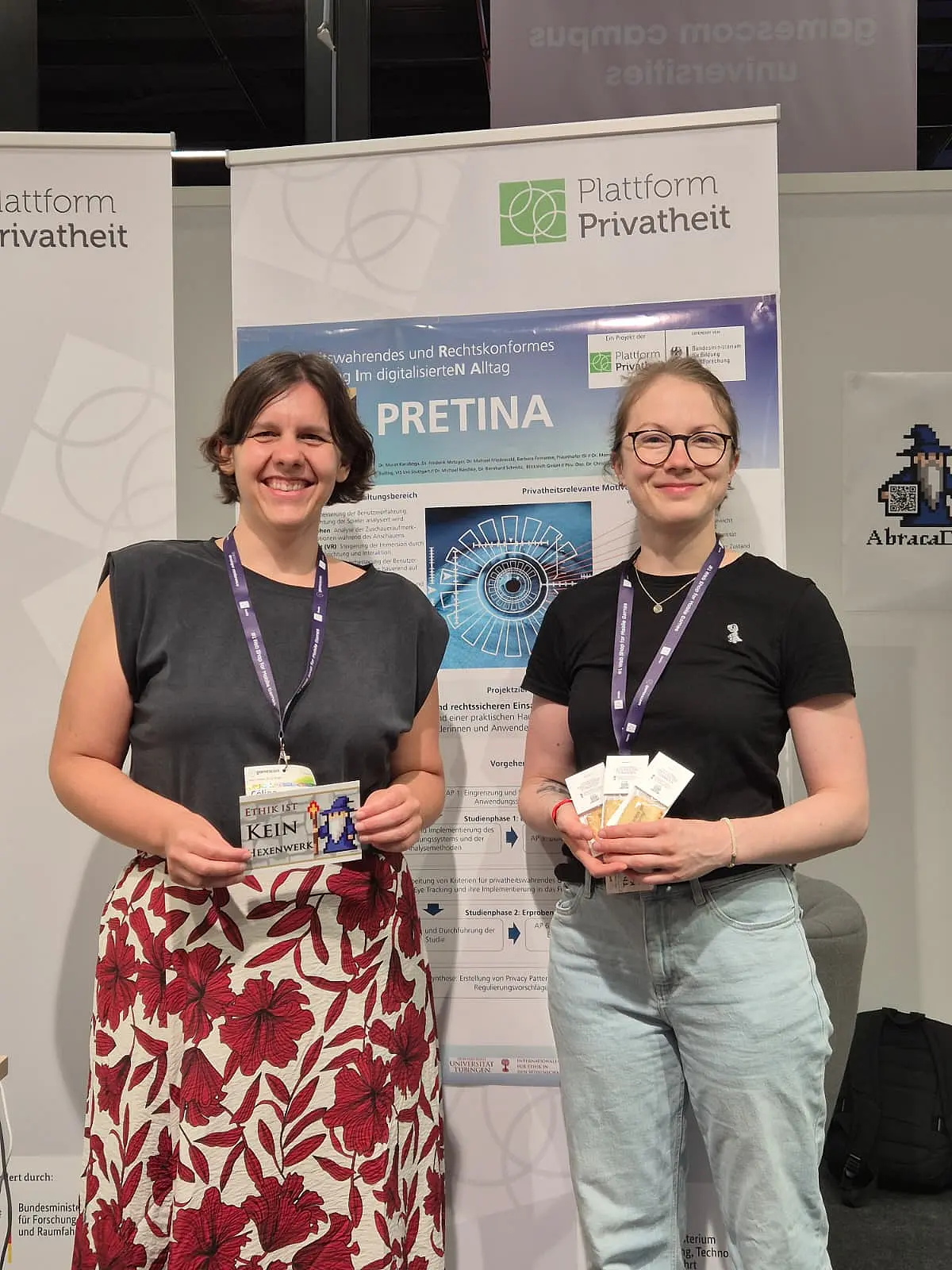
In order to facilitate a direct exchange with users, PRETINA will investigate eye tracking via the use of corresponding HMDs in a gaming context. To this end, the consortium will take part in a computer games trade fair, where it will both conduct studies and actively engage with users.
In PRETINA, the technological consequences and their perception by users will be systematically brought together and characterized in detail.
The ethical (IZEW), socio-economic (Fraunhofer ISI) and legal implications (University of Kassel) will be dealt with by project partners who specialize in these topics. The technical implementation of functional models for investigating these aspects is ensured by the project partners Blickshift and the University of Stuttgart. This means that issues relating to data protection and socially relevant factors can be implemented in the technology in such a way that they can be demonstrated to citizens 'in vivo' and discussed collaboratively.