Research Center for Science Communication (RCS)

Rhetoric, AI, and Learning Futures

Guest Lecture and Course with Dr. Christopher Basgier (Auburn University, USA) in July

At the Institute of Rhetoric, we are actively engaging with the future of our discipline and the university in light of technological developments in artificial intelligence – through projects such as the RHET AI Center and Jugend präsentiert, but increasingly also within the department and our seminars themselves. A new series entitled “Rhetoric, AI, and Learning Futures” reflects this and will bring excellent researchers to Tübingen over the coming months to offer lectures and workshops for educators and students.

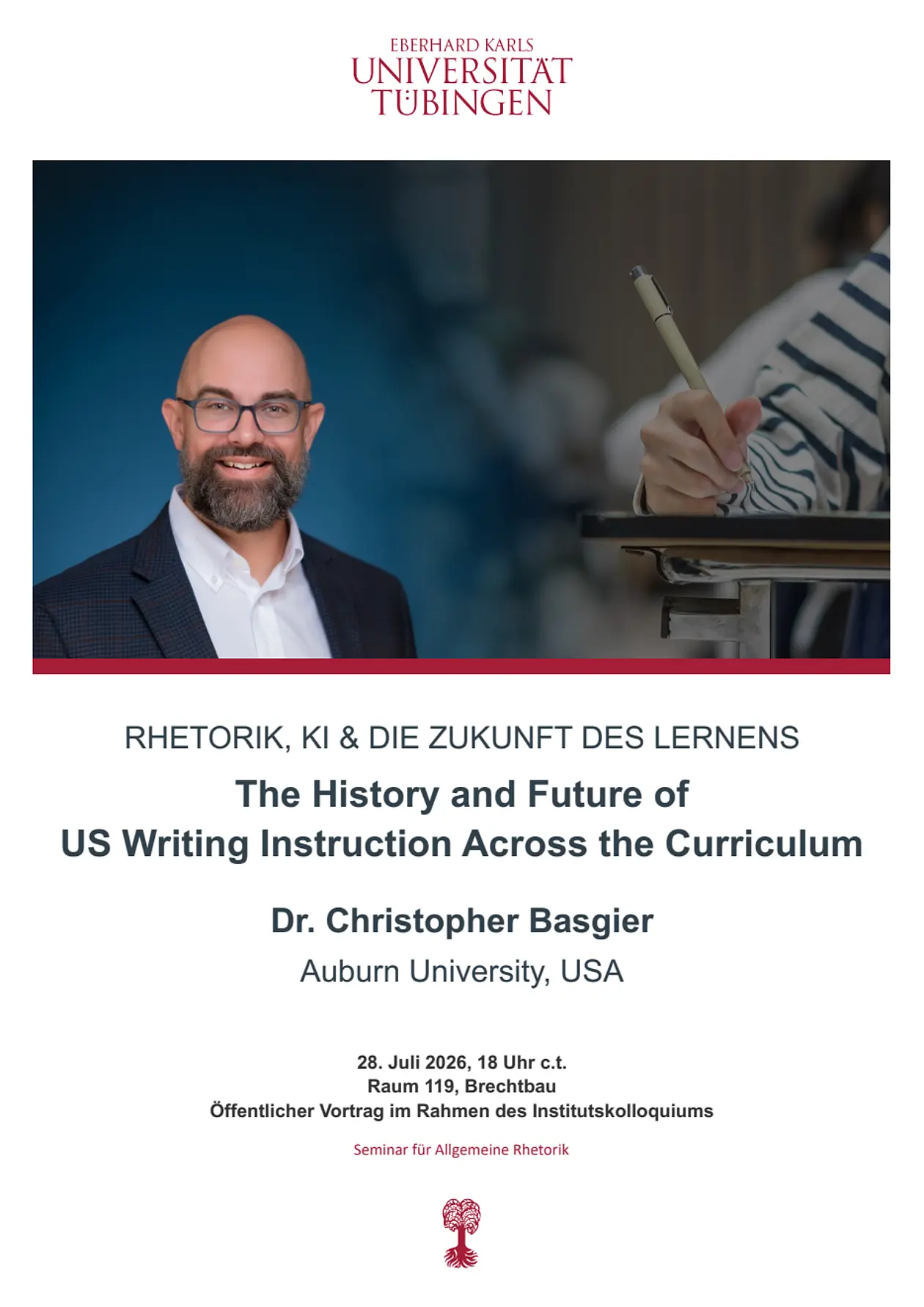
We are delighted to welcome Dr. Christopher Basgier from Auburn University (USA) to Tübingen in July as the first guest in this series. As Director of University Writing, he leads programs that promote academic writing skills, cross-disciplinary writing pedagogy, and writing consultation. His research and teaching combine perspectives from rhetoric, writing studies, and higher education.

During his visit, Chris Basgier will speak about the history and future of academic writing instruction in the US in a public lecture on July 28, 2026. Additionally, he will hold a seminar for students and doctoral candidates on academic writing and generative artificial intelligence on July 29–30. Both events offer the opportunity to explore current international perspectives on writing, rhetoric, higher education pedagogy, and AI, and to engage in conversation with an expert in rhetoric, writing instruction, and AI from the US higher education context.
 

Lecture in the Institute Colloquium

The History and Future of US Writing Instruction Across the Curriculum

28.07.2026 | 18:15 | Room 119, Brechtbau (Wilhelmstr. 50)

The lecture traces the development of academic writing instruction in the US—from classical rhetorical education and the expansion of access to higher education in the 20th century to the current challenges posed by generative AI. Using examples from Auburn University, Dr. Basgier will discuss how rhetorical perspectives on writing can open up new approaches to critical thinking, ethics, and scientific knowledge.

Abstract

In the United States, higher education institutions have developed complex infrastructures for teaching and supporting academic writing. Most first-year undergraduate students take a required writing course that introduces rhetorical conventions and processes of academic writing. Some institutions extend writing instruction beyond the first year via discipline-specific writing courses and professional development in writing pedagogy for faculty in all fields. A majority of US universities also have a writing center, where students can get one-on-one extracurricular tutoring from trained peers who help them respond to writing assignments and rhetorical situations. Furthermore, an entire academic discipline—rhetoric, composition, and writing studies—conducts scholarly inquiry into the teaching, learning, and study of writing. In this talk, Dr. Christopher Basgier will discuss how this complex ecosystem of writing instruction, support, and research came to be, as well as its near future, through the lens of three moments when changing literacy demands reshaped writing instruction: the shift from the classical (heavily rhetorical) curriculum to the modern research university in the late 1800s; expanded access and the revival of rhetoric in the 1960s and 70s; and the rapid development of generative artificial intelligence (genAI), which challenges existing assumptions about writing instruction. Using professional development programs at Auburn University as illustrations, he will argue that rhetorical ways of thinking about writing can help faculty across the disciplines reimagine the relationships among writing, critical thinking, ethics, and inquiry. 

Seminar (2 ECTS)

Writing and GenAI: Myths and Realities

29. and 30.07.2026 | 9:00-17:00 each day | Room 119, Brechtbau (Wilhelmstr. 50)

This seminar examines common assumptions and misconceptions about writing and generative AI. Drawing on approaches from rhetoric and writing studies, participants will reflect on writing as a social and knowledge-building practice, as well as on how to engage with AI technologies in their studies, professional lives, and everyday life. In addition to discussing scholarly texts, participants will also develop their own practical stance on the use of AI in academic writing.

Successful completion of the seminar earns 2 ECTS credits.
Registration: Please email seminar-orgaspam prevention@rhetorik.uni-tuebingen.de with your name and degree program.
 

Abstract

Many common myths about writing are intensifying and changing in the wake of generative artificial intelligence (genAI). For example, writing is often treated as a transparent carrier of meaning, an assumption that may seem plausible when a large language model (LLM) appears to “understand” a prompt. However, the fields of rhetoric and writing studies see it differently: writing is a social, rhetorical, and knowledge-making activity (and not just an automatable process). At the same time, the technology has introduced new myths, including the idea that LLMs “think” like humans. In this short course, we will examine such myths, discuss more productive ways of understanding writing in the age of genAI, and consider how rhetorical concepts can help us respond critically to the technology as writers. Students will analyze academic essays about writing and genAI, reflect on their own practices as writers, and write a provisional, personal ethics statement about genAI use in academic writing, the professional world, and life.