Institute of Political Science

Call for contributions: Summer school "Holding the Ruins, Shaping the Future Loss & Damage, Climate Assemblies and Plural Ways of Knowing" (Kopie 1)

8-12 June 2026 at University of Tübingen, Germany

Loss and Damage (L&D) and Climate Assemblies have emerged as two closely connected developments in contemporary climate politics. While Loss and Damage addresses the irreversible impacts of climate change and the question of how environmental harm becomes politically recognized, Climate Assemblies and related participatory formats open spaces in which citizens collectively deliberate about climate futures and possible pathways for action. 

The summer school “Holding the Ruins, Shaping the Future” brings together scholars, artists and practitioners working at the intersections of climate politics, arts-based research and participatory governance to explore plural ways of knowing environmental harm and their implications for decision-making and action.

We welcome contributions from PhD candidates and early-career researchers engaging with questions from disciplinary, transdisciplinary or practice-based perspectives. Contributions may include theoretical reflections, empirical research, methodological explorations, arts-based approaches, or work-in-progress presentations. We particularly encourage submissions that critically engage with the relationships between knowledge production, participation and climate governance. 

For the application, please submit a 150-word abstract by 1st May 2026 to verena.gresz[at]uni-tuebingen.de. You can find more information here.

British Academy's "Knowledge Frontiers: International Interdisciplinary Research" Programme 2025

Project "Re-Staging Climate Assemblies" (KF25\100465)

Re-Staging Climate Assemblies is an interdisciplinary project at the intersection of research on arts and humanities perspectives on climate change and innovations in deliberative democracy, Through ‘re-stagings’ of citizen climate assemblies co-designed with youth diaspora communities in Sheffield, UK and Tübingen, Germany, it will collectively assemble a body of stories, tools and resources for more inclusive and just climate adaptation and mitigation conversations. The project will address engagement with underrepresented citizens within climate assemblies and acknowledge diverse knowledges, insights and modes of deliberation. It will explore the potential of participatory arts-based approaches, notably scenario-making, for innovating within democratic processes and catalysing transformative climate action. The project directly addresses increasingly urgent demands at local, national and international levels for more inclusive, deliberative and active modes of citizenship in relation to climate change and just transitions. In doing so it puts social and environmental justice centre stage.

British Academy’s Knowledge Frontiers: International Interdisciplinary Research Programme 2025.

In collaboration with the University of Sheffield.

Team: Verena Gresz, M.A.

Funding: £292,355.00

Time: April 2025 – March 2027

Abstract

Rights of Nature (RoN) are discussed as a legal innovation that denotes nature’s inherent right to exist and flourish. Inspired by indigenous relational ontologies, RoN have seen the recognition of rivers, mountains and forests as living beings from Latin America to former British colonies inspiring a fast-growing global movement. RoN’s transformative promise is a new mind set respecting human as well as non-human living beings as agents. The project examines how RoN can transform asymmetric relations between humans and nature yielding legal and institutional models for more sustainable and just development. Sub-studies will focus on translation processes and strategies in cases of internationally celebrated precedents. In the spirit of the decolonialisation of science and with a deep commitment to collaborative research involving indigenous and non-indigenous scholars and activists, the project adopts an interpretive methodology focussing on the reconstruction of meaning in search for alternatives to destructive anthropocentric development.
RoN has sparked heated discussions about moral relativism and resistance to pluralizing ontologies for the sake of the idea of a universal scientific knowledge. South-North dialogues will bring together abstract academic discussion and lived experiences of RoN engaging indigenous and non-indigenous scholars and activists. The intention is to create synergies (Synergy Labs) between different types of knowledges in order to better understand differences and sameness in the ontological underpinnings of RoN. As a blue sky research, the project does not shy away from the possibility of tensions – on the contrary: it understands the likeliness of disagreements as chances for postcolonial moments that can open new ways to think about human-nature relations beyond one's own (academic) world of experience and as places from which changes may emerge.

Outcomes

We are very happy to present the final report on the workshop "Transformative Potential of Rights of Nature?" which took place in Tübingen, Germany From the 20th to 21st January 2023. It was an amazing experience to hear from and bring together diverse perspectives from the Pacific, Europe and Latin America. We also feel extremely privileged to have had the visual artist Alessandra Zaffiro from Housatonic with us who created graphic protocols as “visual harvests” of our sessions. Please check out the results of this fruitful event in our workshop report which is now available for download here.

Knowledge Dialogues between Latin America and Europe Diálogo de Saberes entre América Latina y Europa

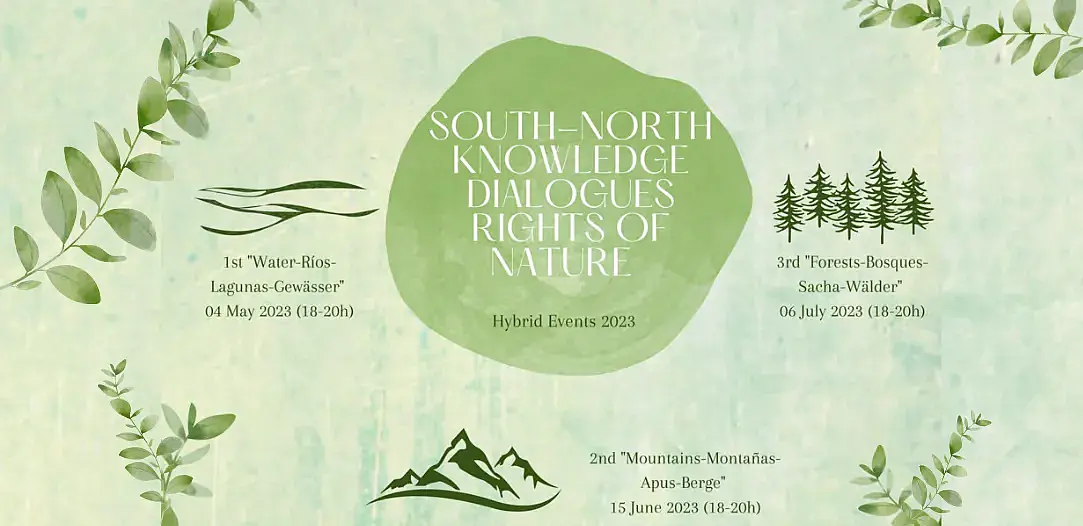
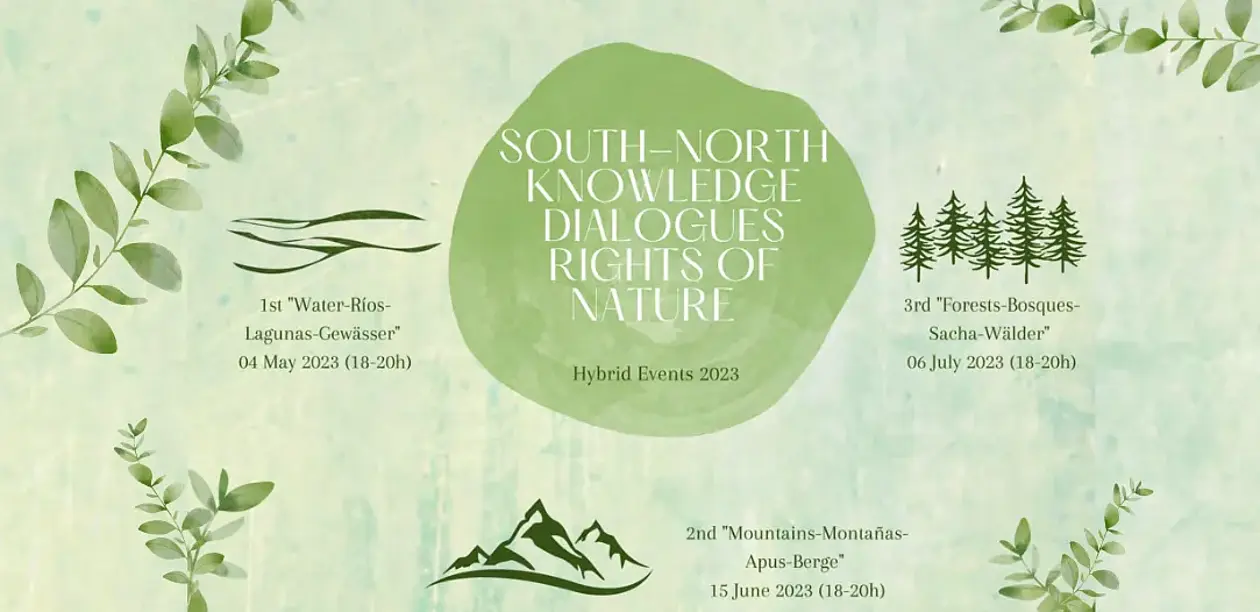
Series of South-North dialogues about Rights of Nature in summer term 2023 and 2024.
Rights of Nature (RoN) are discussed as a legal innovation that denotes nature’s inherent right to exist and flourish. Inspired by indigenous relational ontologies, RoN have seen the recognition of rivers, mountains and forests as living beings from Latin America to former British colonies inspiring a fast-growing global movement. RoN’s transformative promise is a new mind set respecting human as well as non-human living beings as agents. 
The Knowledge Dialogues between Latin America and Europe aim to bring together activists, indigenous peoples, practitioners and scientists in a critical dialogue between the advocates and adversaries of RoN. The events will shed light on different topic areas, such as constitutional reforms, forest protection, global political transformation, and moral implications reflecting on the potential and limitations of RoN for sustainable transformations. Further, the workshop should serve as a networking space for scholars, activists, and policy makers working on the challenges posed by the Anthropocene with conceptions of “nature” as a central category beyond disciplinary and geographical boundaries.

The trailer for our first South-North Knowledge Dialogue is now available! Click here for the full video.