
Objectives of the Cluster of Excellence
Understanding our evolutionary past has been an ongoing pursuit for over 150 years, yet as the field has been propelled into the modern day, longstanding beliefs are now being re-examined. Since the advent of a 3rd scientific revolution within archaeology, methods such as sedimentary ancient DNA, high resolution CT scanning, and
isotopic landscape modelling to name a few have opened new corridors into the research of our species' origins. It is becoming ever apparent that human evolution was not as linear as gaps in previous research imply and as such the need for a new approach to research within the subject is imminent, something that the HUMAN ORIGINS Cluster of Excellence (CoE) aims to fulfil.
Through the research of human evolution over the past 5 million years, HUMAN ORIGINS looks to move away from traditional modes of archaeological and fossil analysis towards an interdisciplinary framework. This framework incorporates biological, cultural, and environmental perspectives, establishing a modernized foundation from which human origins can be explored. As its founding institution, HUMAN ORIGINS puts the University of Tübingen in the spotlight as a leading institution for research in human evolutionary studies. Using a holistic, multi-scale, and diachronic approach, the cluster centers its studies around three main themes: Systematics and Evolutionary Relationships, The Evolution of Human Cognition, and The Evolution Of The Human Ecological Niche, endeavoring to find the answers to questions such as:
Where did we come from and how did we get here?
How did cultural and technological developments affect our biology? and, most intriguingly,
Why are we the only surviving Hominin species?
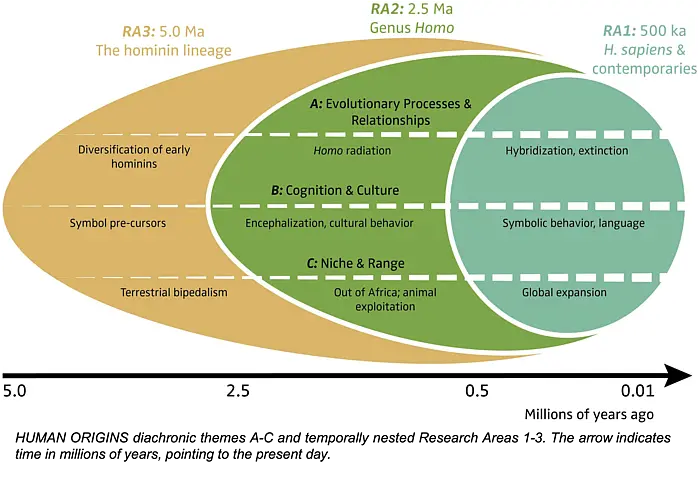
In order to answer these questions, the cluster has divided its research into three distinct sub-divisions:
Research Area 1: 500.000 to 10.000 years before present - Homo Sapiens
Research Area 2: up to 2.5 million years before present - Genus Homo, and
Research Area 3: up to 5 million years before present - The Hominin Lineage.
Within these Research Areas, world-renowned experts from numerous sub-fields are investigating a manifold of topics relating to the main themes of the cluster through the interconnected temporal lenses of these timeframes. Building upon existing datasets, HUMAN ORIGINS will delve into a multi-faceted analysis of our shared past, from single finds to the archaeology of cross continental regions, ensuring that comparative perspective is at the heart of its research. This research intends on broadening databases, narrowing research gaps through methodological innovation, and promoting archaeological investigations in under-represented locales.
HUMAN ORIGINS also sets out not only to expand upon its research but also to evolve its approach towards methods development, ethics, public outreach, and education.
To accomplish this, the cluster is supported by a collection of overarching projects including: The central laboratories for Bio-cultural Imaging, Archaeomaterials, Ancient Biomolecules and Ethics and its Incubator and Field Exploration funds.
Equality and diversity are foundational values on which the cluster is built, and in cooperation with the Ethics lab, staff and researchers work collaboratively to maintain this ethos within every area of HUMAN ORIGINS. In keeping with these values, individual researchers and university staff are working in combined effort to bring about a paradigm shift within the field of human origins and create a network of research which will bring our knowledge of the past far into the future.