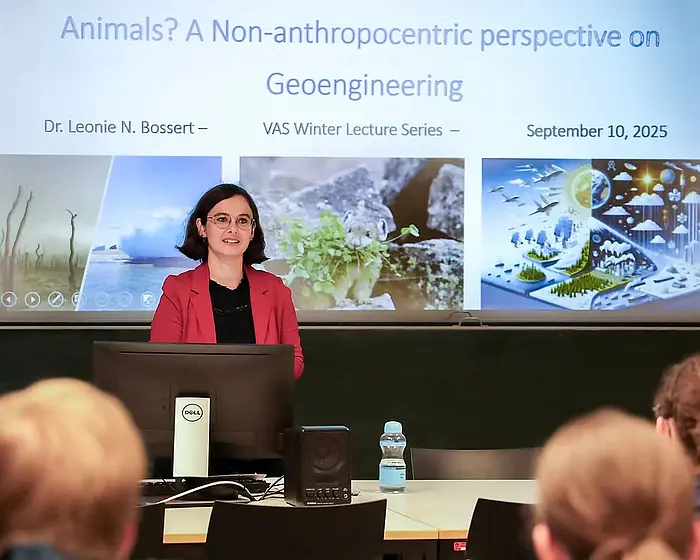
Selection (for all, see https://leonie-bossert.com/ ):
Monographs:
Bossert, Leonie N. (2022): Gemeinsame Zukunft für Mensch und Tier – Tiere in der Nachhaltigen Entwicklung. (Common future for humans and animals – Animals in Sustainable Development) Baden-Baden: Karl Alber
Bossert, Leonie (2015): Wildtierethik (Wild Animals Ethics), Baden-Baden: Nomos.
Journal Articles:
2026:
Bossert, Leonie N.; Palmer, Clare (2026): Geoengineering and Animal Ethics: The Case of Stratospheric Aerosol Injection. In: Ethics, Policy & Environment.
Rizk, A., Jones, E., Saab, A., Strobeyko, A., Soininen, N., Burci, G., Höll, D., Bossert, L., et al. (2026): Microbial rights for a planetary age. In: Earth System Governance 28, 100331 (Open Access).
Ryan, Mark; Bossert, Leonie N. (2026): Facing the pain: ethical considerations of AI-based pain detection of farmed animals. In: AI and Ethics 6 (110).
Eline De Jong; Bossert, Leonie N. (2026): Animal and Technology Ethics: The Need to Bring Them into Conversation. In: Ethics, Policy & Environment, 1–6.
2025:
Bossert, Leonie N. (2025): Opium for the Earth at the expense of nonhuman animals? Geoengineering and interspecies justice. In: Climatic Change 178 (186) (Open Access).
Bossert, Leonie N.; Loh, Wulf (2025): Why the carbon footprint of generative large language models alone will not help us assess their sustainability. In: Nature Machine Intelligence 7, 164-165.
Bossert, Leonie N.; Höll, Davina (2025): On the values of microbes: An ethical investigation of relational values associated with the microbial world. In: People and Nature 7 (4), 804-814 (Open Access).
Bossert, Leonie N.; Potthast, Thomas (2025): Genetic engineering, nature conservation, and animal ethics: Why genetically modifying wild sentient animals is not a good option. In: Environmental Ethics, 47 (2), 117-139 (online first 2024).
Bossert, Leonie N. (2025): Künstliche Intelligenz in der Veterinärmedizin – Ethische Risiken und Nebenwirkungen. In: TIERethik 2025/1 (30), 216-231.
2024:
Bossert, Leonie N.; Crompton, Tom; Dutta, Anwesha; Seager, Joni (2024): Mapping the patriarchy in conservation. In: Nature Portfolio Biodiversity 3, 38 (Open Access).
Bossert, Leonie N. (2024): Interspecies Justice within a normative Sustainable Development framework – Animal-friendly energy systems as a test case. In: Journal of Agricultural and Environmental Ethics 37, 14 (Open Access).
Bossert, Leonie N.; Coeckelbergh, Mark (2024): From MilkingBots to RoboDolphins: How AI
changes human-animal relations and enables alienation towards animals. In: Nature – Humanities and Social Science Communications 11, 920 (Open Access).
Ryan, Mark; Bossert, Leonie N. (2024): Dr. Doolittle uses AI: Ethical challenges of trying to speak whale. In: Biological Conservation 295: 110648 (Open Access).
2023:
Bossert, Leonie N. (2023): Benefitting Nonhuman Animals with AI: Why Going Beyond “Do No Harm” Is Important. In: Philosophy and Technology 36, 57
Bossert, Leonie N.; Hagendorff, Thilo (2023): The ethics of sustainable AI: Why animals (should) matter for a sustainable use of AI. In: Sustainable Development 31, 3459-3467
2022:
Hagendorff, Thilo; Bossert, Leonie N.; Tse, Yip Fai; Singer, Peter (2022): Speciesist bias in AI. How AI applications perpetuate discrimination and unfair outcomes against animals. In: AI and Ethics 3, 717-734 (Open Access).
Höll, Davina; Bossert, Leonie N. (2022): Introducing the Microbiome: Interdisciplinary Perspectives. In: Endeavour 46, 100817.
Blattner, Charlotte E.; Bossert, Leonie N. (2022): Tierarbeit – Animal Labour – Der Versuch einer Einordnung. In: TIERethik 2022/1 (24), 8-38 (Open Access).
Bossert, Leonie N.; Schlegel, Lena (2022): Anthropozentrismus (in) der Krise. Warum Probleme nicht mit der Denkweise gelöst werden können, die sie auch hervorgerufen hat. In: GAIA Ecological Perspectives for Science and Society 31/1, 14-18.
Höll, Davina; Bossert, Leonie (2022): “What would a microbe say?”: Paving the Way to Multispecies Communication. In: TRANSPOSITIONES Journal for Transdisciplinary and Intermedial Culture Studies, Vol. 1 (1), Multiple Knowledges. Learning from/with Other Beings, 103-118 (Open Access).
2021:
Bossert, Leonie; Hagendorff, Thilo (2021): Animals and AI. The role of animals in AI research and application – an overview and ethical evaluation. In: Technology in Society 67, 101678.
2018
Bossert, Leonie (2018): Von Hirschkühen, „Milchkühen“ und Waschbären: Begründung unterschiedlich bestehender Hilfspflichten und ihre Anwendung auf „invasive“ Arten. In: TIERethik 2018/2 (17), 58-84.
Edited volumes:
Bossert, Leonie N.; Höll, Davina (Eds.) (2022): The Microbiome and its Challenges for the Environmental Humanities. Special Issue of Endeavour 46, Issues 1-2.
Meisch, Simon; Lundershausen, Johannes; Bossert, Leonie; Rockoff, Marcus (Eds.) (2015): Ethics of Science in the Research for Sustainable Development, Baden-Baden: Nomos.
Voget-Kleschin, Lieske; Bossert, Leonie; Ott, Konrad (Eds.) (2014): Nachhaltige Lebensstile – Welchen Beitrag kann ein bewusster Fleischkonsum zu mehr Naturschutz, Klimaschutz und Gesundheit leisten? (Sustainable lifestyles – How can less meat consumption contribute to nature conservation, climate protection and health?) Marburg: Metropolis.
Book chapters:
Bossert, Leonie N.; Höll, Davina (2024): Narrating the Uncanny Triad: Imagining Microbe, Animal, and Human Entanglements within the Planetary Health Humanities. In: Heike Härting; Heather Meek (Eds.): Planetary Health Humanities and Pandemics. New York/London: Routledge, 233-253.
Bossert, Leonie N. (2024): Andere Tiere im Anthropozän. Eine nicht-anthropozentrische Perspektive auf Gerechtigkeit. In: Florian Wobser (Ed.): Anthropozän. Interdisziplinäre Perspektiven und philosophische Bildung. Frankfurt: Campus, 73-87.
Bossert, Leonie N. (2022): „Unsere gemeinsame Zukunft“ – Nachhaltige Entwicklung tierethisch gedacht. (In: Julia Enxing; Simone Horstmann, Gregor Taxacher (Eds.): Animate Theologies. Darmstadt: WBG, 96-114.
Handbook contributions:
Bossert, Leonie (2018): Mitleidsethische Ansätze. (Compassion Ethics) In: Ach, Johann; Borchers, Dagmar (Eds.): Handbuch Tierethik. Stuttgart: Metzler, 101-106.
Bossert, Leonie (2018): Fürsorgeethische und feministische Ansätze. (Care ethical and feminist approaches) In: Ach, Johann; Borchers, Dagmar (Eds.): Handbuch Tierethik. Stuttgart: Metzler, 117-122.
Bossert, Leonie (2016): Tierschutz. (Animal Protection) In: Ott, Konrad; Voget-Kleschin, Lieske; Dierks, Jan (Eds.): Handbuch Umweltethik. Stuttgart: Metzler, 292-297.