Model of Conjugative DNA-transfer in Streptomyces
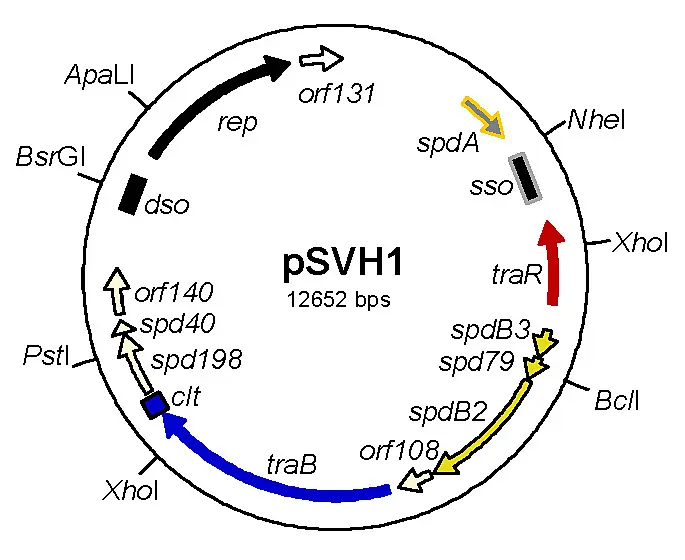
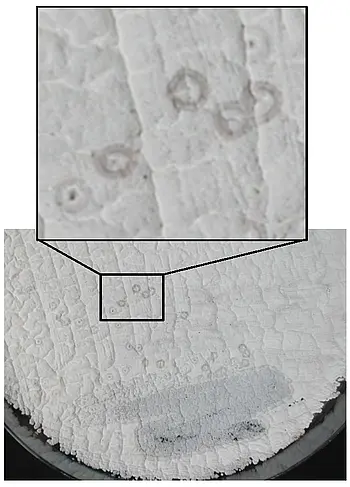
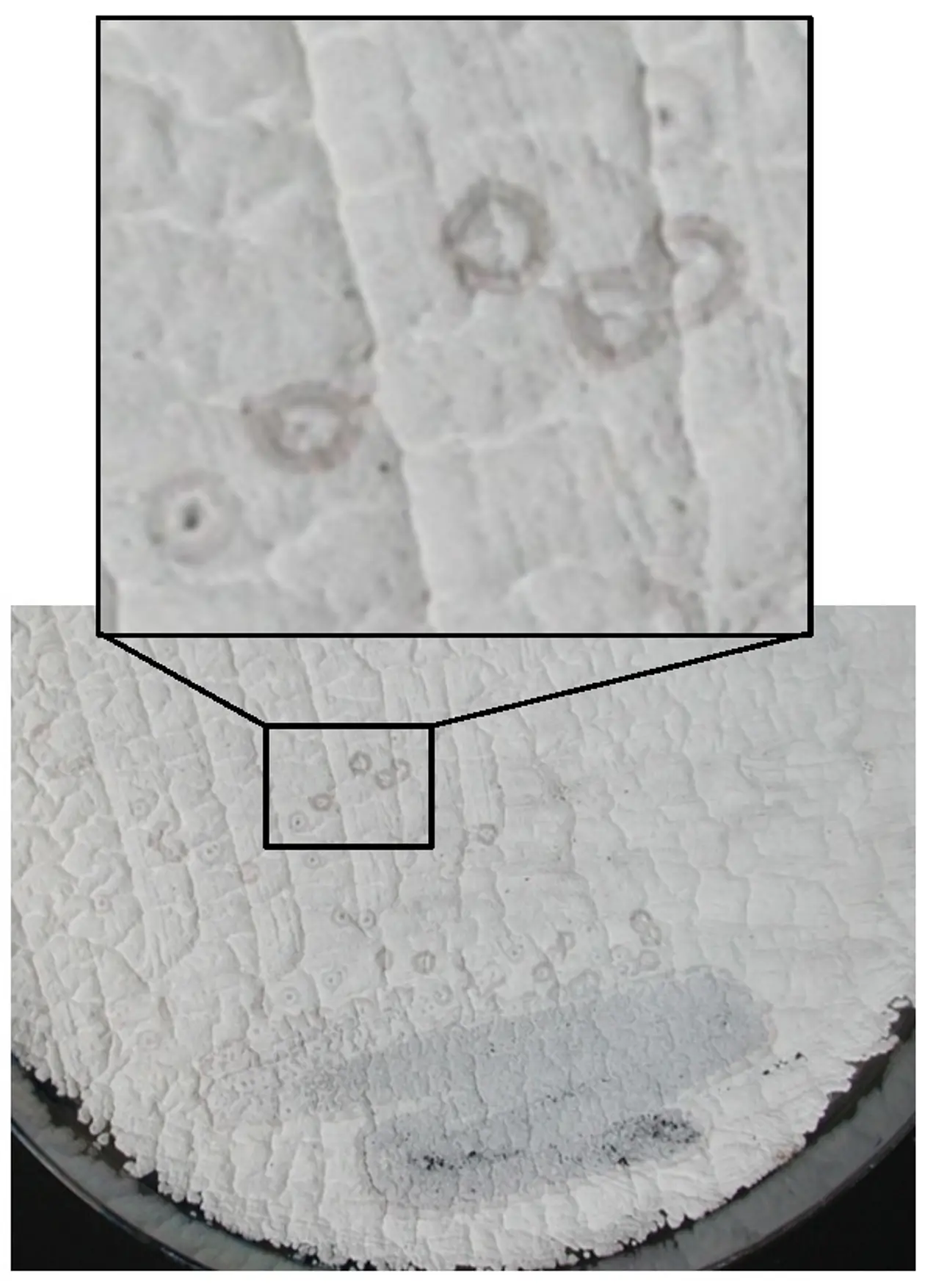
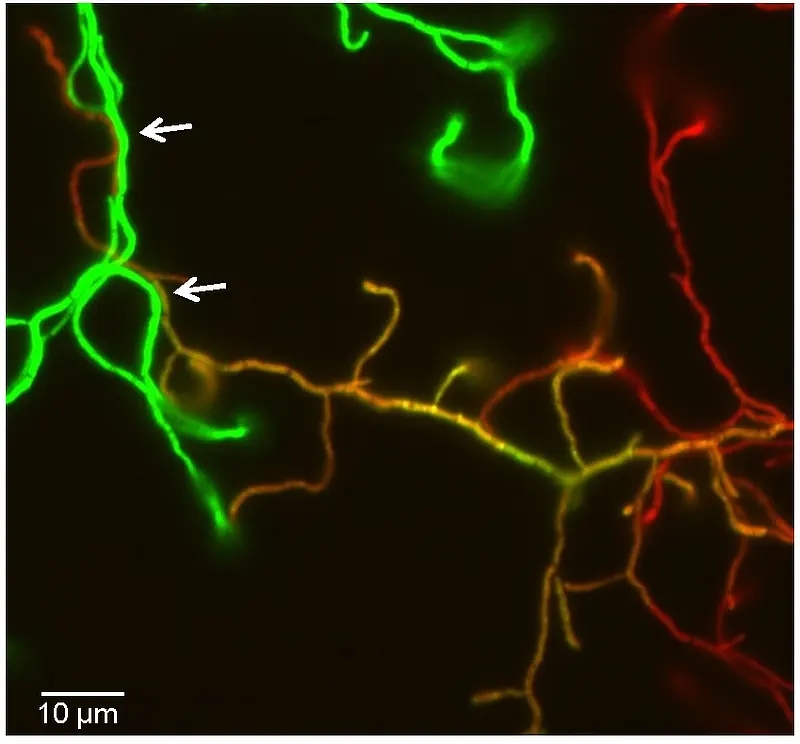
The characterization of the pSVH1-encoded Tra and Spd proteins suggested the following model of the Streptomyces conjugative DNA-translocation system (http://www.ncbi.nlm.nih.gov/pubmed/25592263). Streptomyces plasmids do not seem to encode a system for establishing mating pairs. Therefore, conjugative DNA-transfer occurs only on solid agar during growth as substrate mycelium. Formation of multiple branching hyphae by apical tip extension provides good probability that mating partners will meet. Since Streptomyces hyphae grow by apical tip extension, the machinery for peptidoglycan remodeling is present at the hyphal tip and at new branching points. Presence of TraB probably directs fusion of the walls of the mating partners, maybe by interaction with a chromosomally encoded lytic transglycosylase.
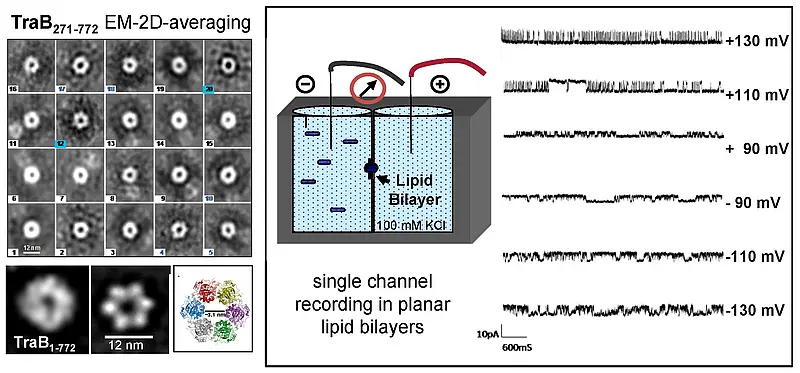
After fusion of the PG-layer, Membrane insertion of TraB hexamers that assembled at clt sequences provides a pore structure for the DNA translocation.
TraB was shown to bind to the clt locus non-covalently without processing the plasmid (http://www.ncbi.nlm.nih.gov/pubmed/16776656). This raises the question, how TraB is able to translocate a circular DNA molecule. While during cell division the chromosome is already present at the closing septum, allowing FtsK to assemble at KOPS sequences at each chromosomal arm, TraB has to translocate the DNA across an intact membrane. Since it is highly unlikely that a circular molecule can be transported across the membrane, involvement of further DNA processing enzymes, e.g. a topoisomerase has to be postulated. Another possibility would be the fusion of the two TraB hexamers to a single channel structure releasing the circular plasmid end into the recipient.
In the recipient a vegetative cross wall traversing multi-protein complex consisting of Spd proteins is formed. By interaction with SpdB2 and other Spd proteins (http://www.ncbi.nlm.nih.gov/pubmed/17768240, www.ncbi.nlm.nih.gov/pubmed/27687731) the DNA translocase TraB is redirected to the septal crosswall and promotes plasmid transfer to the neighboring mycelial compartments. Thus, through the combined action of initial plasmid transfer and subsequent plasmid spreading large parts of the recipient mycelium are colonized by the plasmid. Since TraB not only interacts with the clt locus but also recognizes chromosomal clc sites, plasmid transfer also involves the transfer of chromosomal DNA. In mating experiments with specifically marked donor and recipient strains, we observed the high-efficient transfer of megabase-sized chromosomal DNA-fragments (or a complete donor chromosome), containing multiple Biosynthetic Gene Clusters (BGC). Apparently, the Streptomyces chromosome can exploit the plasmid-encoded transfer apparatus, thereby acting itself as a mobile genetic element.
Vector plasmids
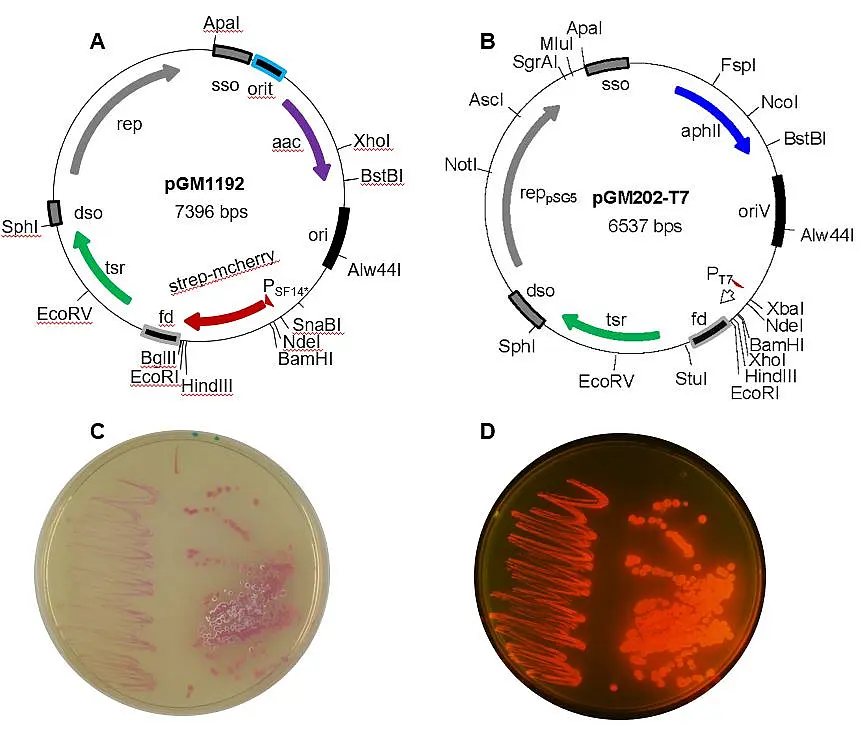
Actinomycetes genes are often difficult to express in heterologous hosts and purification of the respective proteins in active form can be challenging. Thus, a series of stable replicating bifunctional expression vectors has been constructed to facilitate gene expression in Streptomyces strains (https://www.ncbi.nlm.nih.gov/pubmed/30191290).
Most vectors are derived from the multi-copy, temperature-sensitive Streptomyces ghanaensis plasmid pSG5, which replicates via a rolling-circle replication mechanism (RCR). To support replication in E. coli the pMB1 replicon was included. Resistance genes against thiostrepton (tsr) and kanamycin (aphII) or apramycin (aac(3)IV) allow selection in Streptomyces and E. coli. Stable replication in Streptomyces was achieved by placing all genes in the same orientation as rep and by inserting the single-stranded origin sso for lagging strand replication. Inducible gene expression is mediated by either the PtipA promoter or the PT7 promoter (for use with S. lividans T7, constructed by J. Altenbuchner). The PSF14 promoter is constitutively active in E. coli and Streptomyces. Thus, Streptomyces and E. coli colonies carrying pGM1192 show a pink colour, even without irradiation with blue light (https://www.ncbi.nlm.nih.gov/pubmed/30191290). Some vectors, like pGM1202 are equipped with the oriT fragment of plasmid RP4 and can be mobilized to streptomycetes by intergeneric conjugation. His-tag and Strep-tag II encoding sequences allow purification of the proteins via affinity chromatography. Using these plasmids several Streptomyces proteins that could not be produced in E. coli were purified from S. lividans. Some of the plasmids are available from Addgene (https://www.addgene.org/).