International Center for Ethics in the Sciences and Humanities (IZEW)
Risk Matrix VIKING
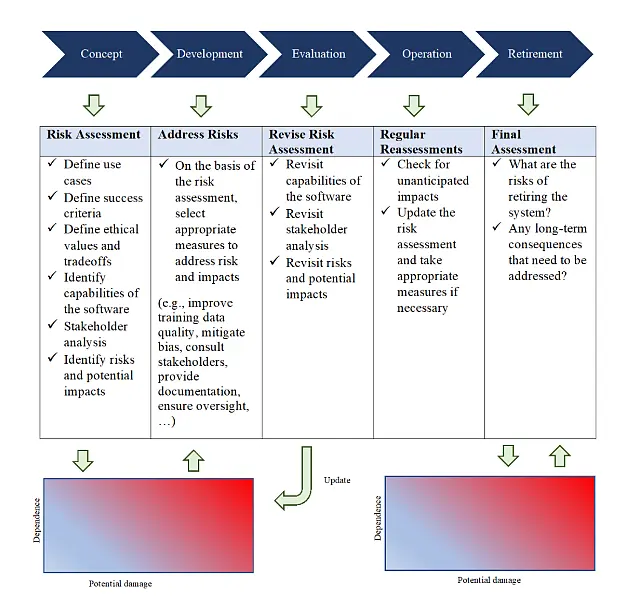
In a working paper, we take a detailed look at the challenges involved in selecting and operationalising ethical principles in the context of AI risk assessment and propose a concrete solution in the form of a risk matrix developed as part of the VIKING project ('Trustworthy Artificial Intelligence for Police Applications'). Based on our initial analyses and the project requirements, we have opted for a dynamic and iterative approach to ethical assessment, inspired by the capAI approach (Floridi et al. 2022), which assesses compliance with the European Artificial Intelligence Act (AI Act). Based on a comprehensive analysis of existing ethical frameworks, we first propose a framework for applying ethical principles to the process of developing and implementing AI systems in the context of police investigations (risk matrix), which classifies applications according to the risks they pose. The risk matrix is then refined through its application to specific use cases and in close collaboration with various stakeholders within the VIKING project.
Elements representing the capabilities of the system in question are placed in the matrix according to the intensity of the potential damage and the level of dependency of the affected individuals. The dimension of potential damage, indicated by the placement of the elements along the x-axis, represents the risk as a combination of the probability and extent of potential damage. The placement of the element on the y-axis takes into account the dependence of stakeholders on the decisions or outcomes of the system.
If necessary, the tables and visualisations should be supplemented with more detailed descriptions of the assessed risks, potential difficulties in identifying relevant aspects, and other details that may affect the overall assessment or be useful for future revisions of the matrix.
The risk assessment should be repeated during the evaluation phase and possibly also in later phases to take into account changes to the system or (unexpected) changes in the circumstances under which it is used.