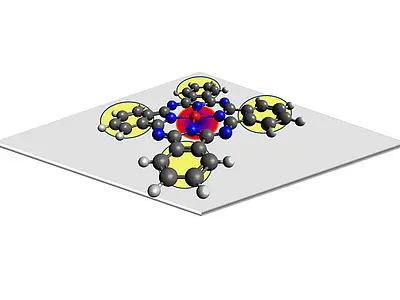
Also for transition metal phthalocyanine (TMPc) interfaces different interaction channels are known, illustrated by a yellow or red background in Fig. 1. The charge transfer via the transition metal however is an important channel and may affect also the HOMO/LUMO related electronic structure and thus states important for charge carrier transport. Moreover, a charge transfer involving the transion metal can result in a drastic change of electronic and magnetic interface properties. This might be in particular important for possible future applications in spintronic nanodevices such as spin valves or spin memory devices.
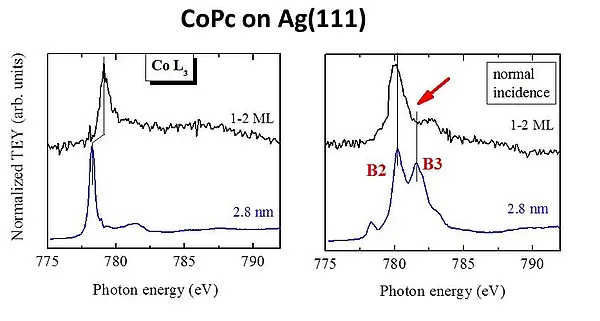
Both X-ray absorption (XAS) and XPS) spectra contain valuable information about the electronic configuration of d-levels of the central metal atom of TMPcs. Their shape is determined to a large extent by multiplet effects; the reason is the strong overlap of the core wave function with the valence wave functions. As an example, XAS spectra for a monolayer (ML) coverage CoPc on Ag(111) and compare them to spectra representative for the bulk (2.8 nm) are shown below.